
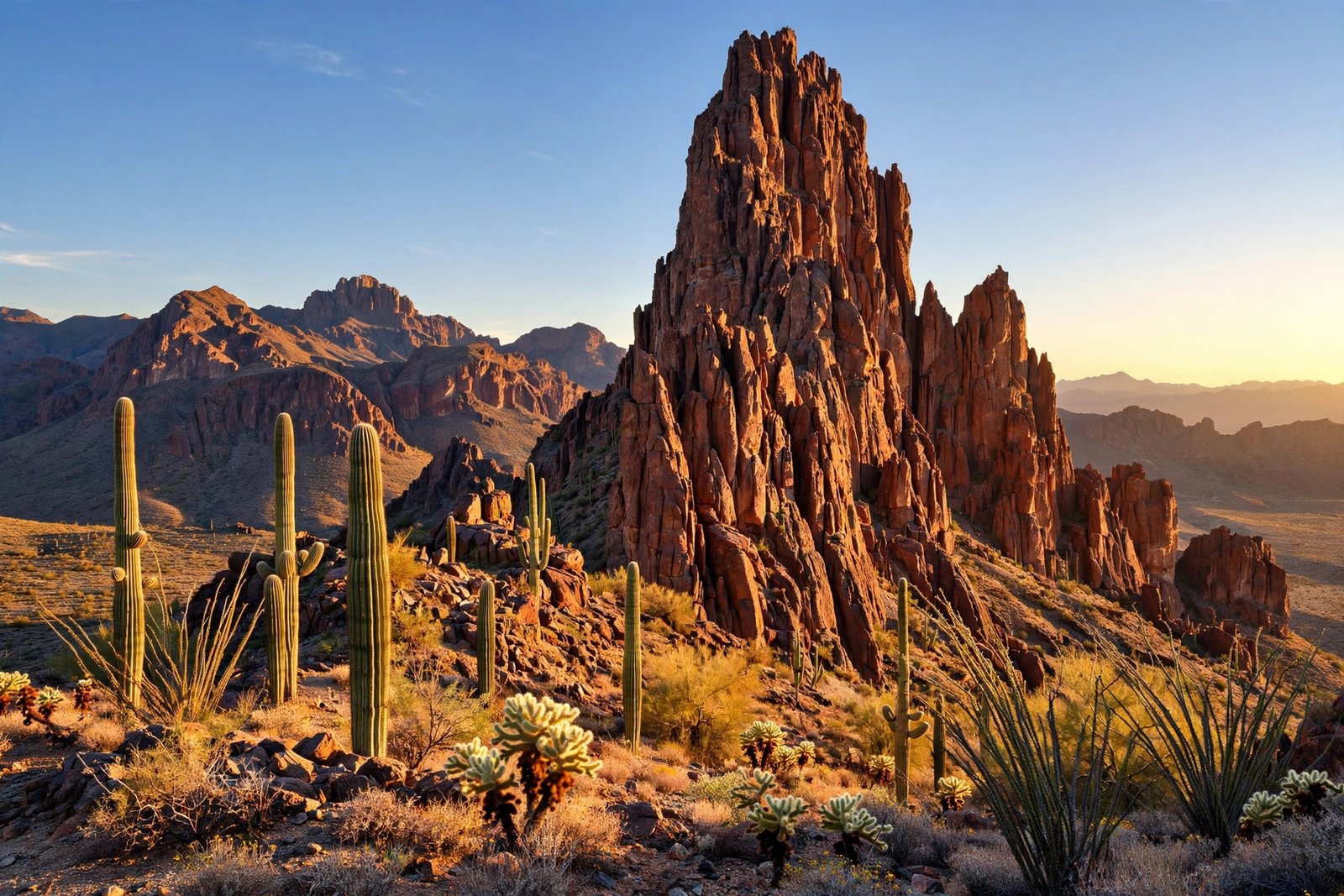
Somewhere in the Superstition Mountains east of Phoenix, Arizona, legend says, lies a gold mine so rich that a single man could carry out enough ore to live comfortably for the rest of his life. The mine has never been found, at least not by anyone who lived to prove it. Its supposed discoverer, a German immigrant named Jacob Waltz, died in Phoenix in 1891 without revealing its location. More than a century later, treasure hunters still hike into the Superstitions searching for it, and some have never come back. The Lost Dutchman’s Gold Mine is America’s most famous lost treasure, a story that blends real history, frontier folklore, and a desert that does not forgive mistakes.
The name itself is a clue to the legend’s tangled origins. Waltz was German, not Dutch, but in the 19th-century American West, German immigrants were often called Dutchmen, a corruption of Deutsch, the German word for German. Waltz arrived in Arizona Territory in the 1860s, worked as a prospector and farmer, and lived a quiet, unremarkable life in Phoenix. What set him apart was the gold. From time to time, Waltz appeared in Phoenix with pouches of remarkably rich gold ore, ore so pure that assayers remarked on it. He never explained where it came from, and when neighbors pressed him, he smiled, changed the subject, or told a different story each time. That silence, and that gold, made him a legend.
The legend takes shape
In most versions of the tale, Waltz learned the mine’s location from a member of the Peralta family, a Mexican mining family said to have worked rich mines in the Superstitions in the 1840s. According to the story, Waltz and a partner, sometimes named as Jacob Weiser, helped or rescued a Peralta and were rewarded with the secret. Other versions say Waltz discovered the mine himself while prospecting in the mountains. Historians who have studied the legend, including Robert Blair, author of Tales of the Superstitions, argue that the story likely blends several separate legends: tales of lost Apache gold, tales of a lost mine worked by Mexican miners, and tales of soldiers who stumbled on a rich vein and never returned.
What is not in dispute is that Waltz was a real person, that he died in Phoenix in October 1891, and that people have been searching for his mine since at least 1892. On his deathbed, Waltz is said to have given clues to Julia Thomas, a neighbor who cared for him in his final days. Thomas later sold maps and claimed to know the mine’s general location, and her version of the story, including a crude map Waltz supposedly drew, launched the first wave of searches. Other deathbed accounts mention a man called Dr. Walker, to whom Waltz is said to have described the mine. The clues, in every version, are tantalizing and maddeningly vague: a canyon, a distinctive rock formation called Weaver’s Needle, a mine shaft hidden by brush, a vein of gold so rich it gleams in the rock.
Weaver’s Needle is the legend’s most famous landmark. The towering volcanic spire rises above the desert east of Phoenix, visible for miles, and in many versions of the story, the mine lies in its shadow, though whether the morning shadow, the afternoon shadow, or the evening shadow matters has never been agreed upon. That ambiguity has not stopped anyone. According to one estimate cited by Arizona place-name expert Byrd Granger, thousands of people each year make some effort to locate the mine, and the Superstition Wilderness, some 160,000 acres of rugged desert mountains, has absorbed them all without giving up its secret.
The seekers, and the price they paid
The search for the Lost Dutchman has a long and sometimes tragic history. Adolph Ruth, a Washington veterinarian who came to Arizona in 1931 with a map he believed led to the mine, vanished in the Superstitions, and his skull was later found with what appeared to be a bullet hole. His death became a sensation and drew a new generation of seekers. Others have died of heat, dehydration, falls, or getting lost in the trackless wilderness. The Superstition Mountains are not a theme park. Summer temperatures soar, water is scarce, trails are faint, and cell phone service is unreliable. The wilderness demands respect, and every year, rescue teams pull lost or injured hikers out of the mountains, some of whom were looking for gold.
Among the seekers was former Arizona Attorney General Bob Corbin, who spent years searching and wrote about the experience. Others have been geologists, historians, and weekend adventurers, each convinced that a fresh reading of the clues, a new map, or a better understanding of the geology would crack the case. Some argue that the mine, if it exists, is not in the Superstitions at all but in Mexico, or that it was a different mine entirely, such as the Bulldog Gold Mine near Goldfield, Arizona, which fits some of Waltz’s descriptions. Geologists have added a skeptical note: the Superstition Mountains are volcanic in origin, and volcanic rock is not typically the host for rich gold veins of the kind Waltz supposedly found, which suggests that if Waltz had gold, it may have come from elsewhere.
That skepticism has not dented the legend’s popularity. If anything, it has deepened it. The Lost Dutchman’s story has been printed or cited, as of 1977, at least six times more often than the stories of Captain Kidd’s lost treasure or California’s Lost Pegleg mine, according to Granger. Books, documentaries, television shows, and podcasts revisit the mystery every few years. Lost Dutchman State Park, at the western foot of the Superstitions near Apache Junction, welcomes visitors with campgrounds, hiking trails, and a front-row view of the mountains, and its rangers patiently explain both the legend and the dangers of chasing it.
Why the legend endures
Part of the legend’s power is the desert itself. The Superstition Mountains are genuinely strange and beautiful: jagged volcanic peaks, deep canyons, saguaro cacti, and silence so complete it feels ancient. The Apache people, who lived in and around the mountains long before Waltz, regarded parts of the range as sacred, and some versions of the legend say the mine is protected by spirits or by a curse that punishes those who seek it. Whether or not one believes in curses, the mountains have a way of humbling visitors, and that humbling quality feeds the story.
Part of the power is Waltz himself. He was not a colorful outlaw or a famous general. He was an ordinary immigrant prospector who kept a secret, and ordinary people keeping extraordinary secrets is a story that never gets old. Every version of the legend ends the same way: the secret died with him, or nearly did, and the gold, if it exists, is still out there, waiting for someone clever enough, lucky enough, or brave enough to find it. That open ending invites every listener to imagine themselves as the one who finally solves it.
And part of the power is the gold itself. Gold has driven American dreams since 1849, and the idea of a lost mine, a fortune hidden in the hills, taps into a fantasy as old as the frontier: that wealth is not earned slowly but discovered suddenly, by the right person in the right place at the right time. The Lost Dutchman legend promises that fantasy without the hard work of mining, and it delivers it in a landscape that is, itself, a kind of treasure.
Visiting the legend safely
For visitors who want to experience the legend without risking their lives, Lost Dutchman State Park is the perfect starting point. The park covers 320 acres of saguaro-studded desert at 6109 N. Apache Trail in Apache Junction, with trails that offer stunning views of the Superstitions and Weaver’s Needle without entering the deep wilderness. The park’s campground is a popular base for exploring the area, and the nearby town of Apache Junction embraces the legend with museums, shops, and the famous Superstition Mountain Museum.
Those who venture into the Superstition Wilderness should treat it with the respect it deserves. Bring far more water than you think you need, tell someone your plans and your expected return, wear sun protection and sturdy boots, and do not rely on a cell phone for navigation or rescue. Hike in the cooler months, avoid the brutal summer heat, and remember that the wilderness is protected land: collecting artifacts, digging, or disturbing cultural sites is illegal and disrespectful to the peoples whose history is written in these mountains.
The Lost Dutchman’s Gold Mine may never be found, and that may be the point. The legend has given Arizona a story, a state park, a museum, and a mystery that has lasted for more than 130 years. The gold, if it ever existed, is less valuable than the story itself, which continues to draw dreamers into the desert, searching for something just beyond the next ridge.
Frequently asked questions
Who was the Lost Dutchman? Jacob Waltz, a German immigrant prospector who lived in Phoenix and died in 1891. He was called Dutchman because Deutsch, meaning German, was corrupted into Dutch in 19th-century American slang.
Where is the Lost Dutchman’s Mine supposed to be? In the Superstition Mountains east of Phoenix, Arizona, near Apache Junction, often said to lie in the shadow of Weaver’s Needle. No mine has ever been verified.
Has anyone ever found the mine? No. Despite searches since at least 1892, no one has produced verified evidence of the mine’s location, and geologists note that the volcanic Superstitions are unlikely hosts for rich gold veins.
Is it safe to search for the mine? The Superstition Wilderness is rugged and dangerous. Searchers have died from heat, dehydration, and falls. Visitors should stick to marked trails, carry ample water, and tell someone their plans.
Where can I learn more about the legend? Lost Dutchman State Park and the Superstition Mountain Museum in Apache Junction offer exhibits, trails, and views of the mountains at the heart of the story.
Related reading
- The Salem Witch Trials of 1692: What Really Happened
- The Bell Witch: Tennessee’s Most Famous Poltergeist
- Mothman of Point Pleasant and the Silver Bridge Legend
Sources: Lost Dutchman’s Gold Mine, Lost Dutchman State Park.