
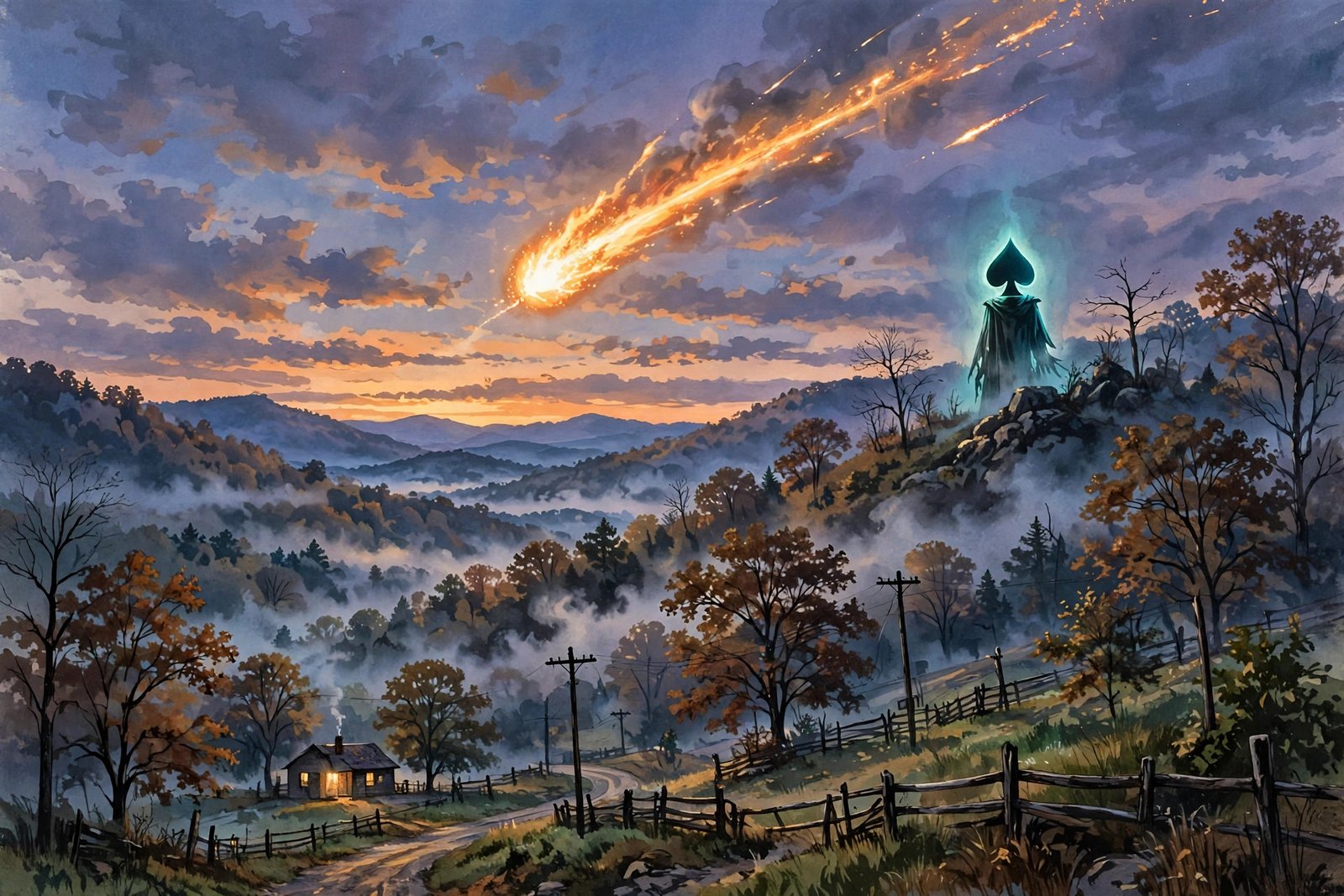
On a warm September evening in 1952, a small town in the hills of West Virginia became the center of one of America’s strangest stories. A bright light crossed the sky, a group of boys and their mother climbed a dark hill to see where it had landed, and they came back with a tale of a towering figure with glowing eyes and a spade-shaped hood. Within days, the Flatwoods Monster was front-page news across the country. More than seventy years later, the legend is still alive in the town of Flatwoods, celebrated in a museum, in giant roadside chairs, and in the memories of a community that has never quite let the story go. Was it a visitor from another world, a trick of the dark, or something in between? The answer depends on who you ask, and that is exactly why the story has endured.
The Night of September 12, 1952
It was just after 7:15 p.m. on Friday, September 12, 1952, when brothers Edward and Fred May were playing outside with their friend Tommy Hyer in the small community of Flatwoods, in Braxton County, West Virginia. The boys looked up and saw a bright object streak across the sky. It seemed to slow, glow, and come down on a hilltop on the farm of G. Bailey Fisher, just outside town. To three boys on a September evening, it looked like something had landed, and they ran home to tell their mother.
Kathleen May, the boys’ mother, was not about to let them wander up a dark hill alone. She gathered the boys and went to find help, and the group that set off up the hill included 17-year-old Gene Lemon, a member of the West Virginia National Guard who happened to be visiting. Armed with little more than a flashlight and curiosity, the small party climbed toward the top of Fisher’s hill, where the object had seemed to come down. The air, they would later say, carried a strange, sharp smell, and a mist seemed to hang over the ground. Then, in the beam of the flashlight, they saw it.
What the Witnesses Said They Saw
The figure the group described was unlike anything in a West Virginia field. They said it stood somewhere between seven and ten feet tall, with a body that seemed to float or glide rather than walk. Its head was covered by a spade-shaped hood, like the ace of spades on a playing card, and beneath it two glowing eyes stared out at them. The lower half of the figure was dark and pleated, like a long skirt or robe, and witnesses said its small arms ended in claw-like hands. Gene Lemon later described a hissing sound, and several in the party said the strange smell made their eyes water and their throats burn.
The group did not stay to study the creature. Lemon reportedly screamed, and the party fled down the hill in a panic. By the time they reached town, several of them were shaking, nauseated, and frightened. A local doctor who examined some of the witnesses that night found them genuinely distressed, with irritated eyes and throats, though he could not say what had caused it. Whatever they had seen on that hilltop, the people who went up there believed it was real, and their fear was impossible to fake. The story they told would soon travel far beyond Braxton County.
A Town on Edge
News of the encounter spread fast. The local paper picked it up, then regional papers, and within days the Flatwoods Monster was being written about in newspapers across the United States. Reporters and curiosity seekers descended on the little town. Some came looking for evidence on Fisher’s hill, where searchers found broken branches, a patch of flattened grass, and a lingering, odd smell, but nothing that could be called proof of a landing. Others came simply to gawk. For a community of a few hundred people, the sudden attention was bewildering and, for some local businesses, not entirely unwelcome.
The timing mattered. The early 1950s were the golden age of the flying saucer. Just a few years earlier, the Roswell incident and the first reports of unidentified flying objects had put the whole country on edge, and Americans were primed to believe that something strange might be visiting from the sky. Flatwoods arrived at exactly the right moment to become a national sensation. The monster’s odd appearance, the glowing eyes, the metallic smell, all of it fit the picture of the age. Whether the witnesses had seen a creature from another world or something far more ordinary, the country was ready to listen.
The Air Force Investigates
The story was big enough that the United States Air Force took notice. At the time, the Air Force was running Project Blue Book, its official investigation into reports of unidentified flying objects, and the Flatwoods sighting became one of the cases in its files. Investigators looked into the reports from the hilltop, considered the descriptions from the witnesses, and weighed the possibility that something had landed near Flatwoods that night. Like most Project Blue Book cases, the Flatwoods file ended without a definitive answer that satisfied everyone.
The Air Force’s interest gave the story a stamp of seriousness it might otherwise never have had. This was not just a local ghost story whispered around a general store; it was a case that military investigators had examined. That official attention is part of why the Flatwoods Monster is still remembered today while countless other small-town scares have been forgotten. The case file kept the story alive in books about UFOs and the unexplained for decades, and it gave believers a reason to say that something real had happened on that hill, even if no one could prove exactly what it was.
The Skeptical Explanation: A Meteor and a Barn Owl
Not everyone who has studied the case believes a monster stood on Fisher’s hill that night. The most widely cited skeptical explanation comes from investigator Joe Nickell, who examined the case in detail and published his conclusions in 2000. Nickell argued that the bright object the boys saw crossing the sky was most likely a meteor, a common sight that can look, to an excited observer, like something landing just over the next hill. Meteors can appear to fall close by even when they burn up miles away, and a September night sky offered plenty of room for the mistake.
As for the figure itself, Nickell proposed that the group encountered a barn owl, perched on a branch in the dark. A barn owl’s pale, heart-shaped face can look startlingly like a hooded head in a flashlight beam, its dark body and folded wings can suggest a pleated robe, and its glowing eyes, caught in the light, can seem to shine. The hissing sound the witnesses reported is a sound barn owls are known to make when threatened, and the strange smell may have come from the vegetation or the excitement of the moment. Nickell’s explanation does not require anyone to have lied. It only requires a dark hill, a frightened group, and a bird in the wrong place at the wrong time. For many researchers, it is the most convincing account of what happened, though it has never convinced everyone in Flatwoods.
The Legend Lives On in Flatwoods
Whatever stood on that hilltop, the town of Flatwoods has embraced the monster as its own. The Flatwoods Monster Museum in nearby Sutton, West Virginia, tells the story of that September night with newspaper clippings, witness accounts, and memorabilia collected over the decades. Visitors can walk through the exhibits, read the original reports, and decide for themselves what the witnesses saw. The museum has become a stop for travelers crossing the state on Interstate 79 and for fans of American folklore making a pilgrimage to one of the country’s most famous monster sightings.
Outside the museum, the legend is written across the landscape. Five giant monster-shaped chairs stand around Braxton County, each one a photo opportunity for visitors and a cheerful landmark for locals. The monster shows up on murals, on souvenirs, and on the welcome signs that greet drivers coming into town. Every year, the story draws a fresh round of visitors, podcasters, and documentary crews, all of them retracing the steps of Kathleen May, Gene Lemon, and the three boys who ran home on a September evening in 1952. For a small town in the West Virginia hills, the monster has become a point of pride, a piece of local identity, and a modest but real part of the local economy.
Why the Flatwoods Monster Still Matters
The Flatwoods Monster endures because it sits at the crossroads of so many American obsessions: the mystery of the sky, the fear of the unknown, the small town suddenly famous, and the question of whom to believe. The witnesses were ordinary people, a mother, her sons, a teenage guardsman, and a neighbor boy, and their story has been picked apart by skeptics and defended by believers for more than seventy years without either side landing a knockout blow. That unresolved tension is the engine of the legend.
There is also something deeply human about the story. The witnesses were frightened, and their fear was real whether or not the monster was. The town that took the story to heart was not trying to fool anyone; it was trying to make sense of a night that did not make sense. And the investigators, from the Air Force to Joe Nickell, were doing the same thing from the other side, trying to fit a strange night into an orderly explanation. The Flatwoods Monster is, in the end, a story about how Americans deal with the unexplained: some of us build a museum, some of us write a debunking, and the rest of us keep wondering. That is why, more than seventy years on, the monster still stands on its hilltop in the West Virginia dark, glowing eyes and all.
FAQs
Q: When did the Flatwoods Monster sighting happen?
A: The sighting took place on the evening of September 12, 1952, just after 7:15 p.m., when three boys saw a bright object appear to land on a hilltop near Flatwoods, West Virginia.
Q: Who saw the Flatwoods Monster?
A: Brothers Edward and Fred May and their friend Tommy Hyer first saw the light in the sky. They returned to the hill with their mother, Kathleen May, and 17-year-old National Guardsman Gene Lemon, and the group reported seeing the tall figure together.
Q: What did the Flatwoods Monster look like?
A: Witnesses described a figure about seven to ten feet tall with a spade-shaped hood, glowing eyes, a dark pleated lower half, and claw-like hands. They also reported a hissing sound and a strange, sharp smell.
Q: Did the US Air Force investigate the Flatwoods Monster?
A: Yes. The Air Force looked into the case as part of Project Blue Book, its official investigation into reports of unidentified flying objects. The case was recorded in its files without a definitive conclusion.
Q: What is the skeptical explanation for the Flatwoods Monster?
A: Investigator Joe Nickell concluded in 2000 that the light in the sky was most likely a meteor and that the figure was probably a barn owl seen in the dark, its pale face and glowing eyes mistaken for a hooded creature in a flashlight beam.
Q: Can you visit Flatwoods Monster sites today?
A: Yes. The Flatwoods Monster Museum in Sutton, West Virginia, tells the story of the 1952 sighting, and five giant monster-shaped chairs stand around Braxton County as landmarks for visitors.
Related reading: Mothman: The Point Pleasant Legend and the Silver Bridge, Bigfoot: America’s Enduring Cryptid Mystery, and The Jersey Devil: New Jersey’s Legend Explained.
Sources: Appalachian Historian: The Flatwoods Monster, Wikipedia: Flatwoods Monster, Beyond Haunted: Flatwoods Monster.