
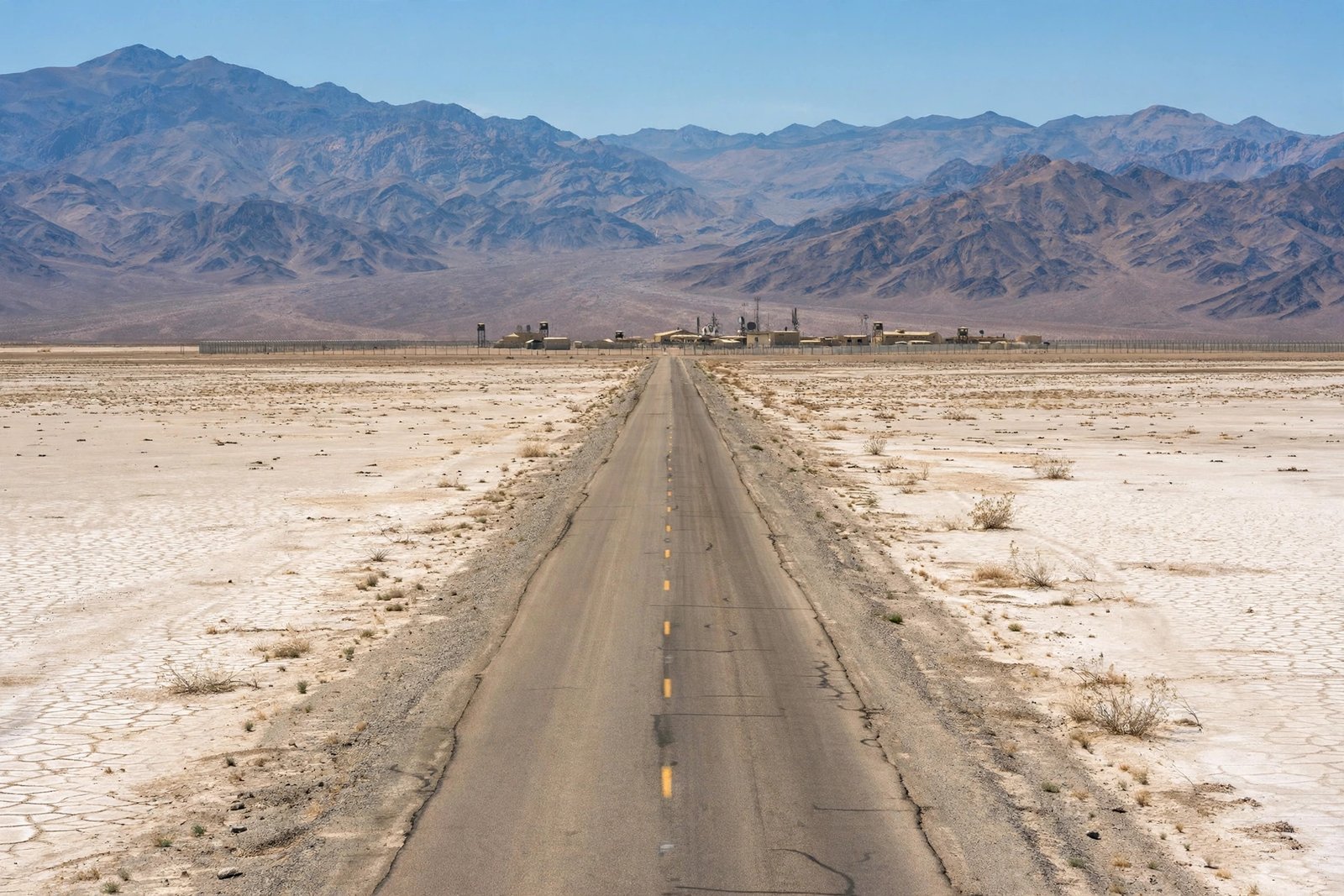
It is the most famous secret base in the world. For seventy years, Area 51 has sat in the Nevada desert, ringed by warning signs, guarded by patrols, and wrapped in rumors about captured flying saucers and hidden alien bodies. Movies, television shows, and video games have turned it into a symbol of everything the government might be hiding. But behind the folklore sits a real place with a real, documented history, and much of that history is now public.
The truth about Area 51 is stranger than the myths in some ways and far more ordinary in others. It was built to test spy planes, not to store spacecraft. Its secrecy had a practical purpose: keeping America’s most advanced aircraft hidden from Soviet eyes during the Cold War. This is what the declassified record actually says about the base, where the UFO stories came from, and what remains genuinely unknown.
A Base Born in the Cold War
Area 51 is a highly classified United States Air Force facility inside the Nevada Test and Training Range in southern Nevada, about 83 miles north-northwest of Las Vegas. Its official names are Homey Airport and Groom Lake, after the dry lakebed beside its runway. It is a remote detachment of Edwards Air Force Base, and the airspace above it is restricted. What goes on there today is classified at the highest levels.
The site was chosen in April 1955 by a small team led by Lockheed engineer Clarence “Kelly” Johnson and CIA officer Richard Bissell. They needed a remote place to test a brand-new kind of airplane, and Groom Lake offered a flat, dry lakebed in the middle of empty desert. Construction began that spring, and a 5,000-foot runway was laid out on the southwest corner of the lakebed. The base was built for a single purpose: flight-testing the Lockheed U-2 reconnaissance aircraft under a CIA program called Project AQUATONE. President Dwight D. Eisenhower had approved the U-2 program in late 1954, worried about how little the United States knew about Soviet military strength.
The U-2: The Plane That Started It All
The U-2 was unlike anything that had flown before. Designed by Kelly Johnson’s team at Lockheed’s Skunk Works, it had long, glider-like wings and could fly above 70,000 feet, far higher than Soviet interceptors of the time could reach. The idea was simple: fly so high that no one could shoot you down, and photograph what the satellites of the era could not yet see.
The first U-2 arrived at Groom Lake disassembled aboard a cargo plane on July 24, 1955. It made its first flight there on August 1, 1955, an accidental hop during a taxi test with Lockheed test pilot Tony LeVier at the controls. Within a year, U-2s were flying over the Soviet Union, and the aircraft became, in the words of a later declassified CIA assessment, the most important source of intelligence on the Soviet Union. The program’s most famous moment came in 1960, when a Soviet missile shot down a U-2 flown by Francis Gary Powers, turning a secret program into a global diplomatic crisis.
Faster, Higher, Stranger: The A-12 and the SR-71
Altitude alone turned out not to be enough protection, as the Powers shootdown proved. The CIA and Lockheed answered with something faster: Project OXCART, which produced the A-12, a single-seat spy plane designed to fly at Mach 3 and above 90,000 feet. The first A-12 arrived at Area 51 in February 1962, and it made its first flight at Groom Lake on April 26, 1962. Its shape was radical, its speed was unmatched, and to anyone who glimpsed it in the sky, it looked like nothing built on Earth.
The A-12 flew operational reconnaissance missions over North Vietnam and North Korea in 1967 and 1968, then was retired in 1968 in favor of its Air Force successor, the two-seat SR-71 Blackbird. The SR-71 became one of the most famous aircraft ever built. On July 28, 1976, an SR-71 flew at a recorded speed of Mach 3.3, about 2,193 miles per hour. Much of the testing that made those aircraft possible happened at Groom Lake, in total secrecy, with pilots and engineers who could not tell their own families what they did for a living.
The Stealth Revolution: Have Blue and the F-117
In the 1970s, Area 51 hosted the next leap in military aviation: stealth. Under the code name Have Blue, Lockheed’s Skunk Works built small, faceted, angular test aircraft designed to be nearly invisible to radar. The strange, diamond-like shape that made them hard to detect also made them look deeply unnatural in the sky, and test flights were usually flown at night over the desert.
Have Blue led to the F-117 Nighthawk, America’s first operational stealth aircraft. The F-117 remained classified for years before the Air Force publicly acknowledged it, and its odd, boomerang-like silhouette fed the same rumors that the earlier spy planes had started. The base also hosted testing of captured Soviet aircraft, including MiG fighters, so American pilots could learn how to fight them. For decades, the pattern repeated: a strange new aircraft appeared over the Nevada desert, witnesses reported something they could not explain, and the government said nothing, because saying anything would have revealed a secret program.
Why the UFO Stories Started
Here is where the documented history and the folklore meet. The U-2 flew at altitudes that civilian pilots and air traffic controllers believed were impossible, and its silver skin caught the sunlight in ways that made it shine like a bright, moving object in the sky. Commercial airline pilots in the 1950s began reporting strange objects at extreme heights. Many of those reports, investigated by government agencies, later lined up with classified U-2 flights.
The pattern continued with the A-12. Reports of UFO sightings around Area 51 reached new heights in the mid-1960s, just after the A-12’s first flights, as historian Annie Jacobsen documented in her history of the base. A dark, triangular aircraft moving at extraordinary speed, with no visible markings and no explanation, is exactly what a witness would describe after seeing a Blackbird or a stealth prototype. The government could not explain the sightings without revealing the aircraft, so the sightings stayed unexplained, and the UFO legend grew to fill the silence.
Bob Lazar and the Alien Claims
The modern alien mythology of Area 51 owes a great deal to one man. In 1989, a man named Bob Lazar appeared in interviews on Las Vegas television station KLAS-TV and claimed he had worked at a site near Area 51 that he called S-4, where he said the government was reverse-engineering alien spacecraft powered by a mysterious substance he called element 115. His claims spread quickly and became the foundation of much of today’s Area 51 lore.
It is important to be clear about the status of those claims: they are uncorroborated. No documents, no physical evidence, and no independent witness has confirmed Lazar’s account, and the government has never acknowledged any such program. His story is a claim, not a confirmed fact, and it should be treated that way. The same applies to the broader belief that alien craft or bodies are stored at the base. The Pentagon’s UAP office, the All-Domain Anomaly Resolution Office, has investigated such claims, and no public evidence has ever been produced to support them.
There is also a common mix-up worth correcting. The famous Roswell incident, often linked to Area 51 in popular culture, happened in 1947 in New Mexico, years before the Groom Lake base was built in 1955. Whatever happened at Roswell, it did not happen at Area 51, because Area 51 did not exist yet. The two stories have been folded together by decades of retelling, but the timeline does not support the connection.
2013: The Government Finally Says the Name
For decades, the government refused to confirm that Area 51 existed at all. Maps left it blank. Officials would not say the name. That changed on June 25, 2013, when the CIA released a less-redacted version of an official history of the U-2 and OXCART programs, written by Gregory Pedlow and Donald Welzenbach. The release came in response to a Freedom of Information Act request filed in 2005 by Jeffrey Richelson of the National Security Archive at George Washington University.
The 2013 release was the first official CIA acknowledgment of the Groom Lake facility’s existence by name and the first official account of the U-2 testing that happened there. It is worth noting a nuance that many news reports missed at the time: the Air Force had already acknowledged the site’s existence in 1998. What the 2013 documents did was confirm, for the first time, what the base was actually used for. Even so, the release covered history, not the present. The base’s current activities remain classified, and the documents say nothing about aliens, because the programs they describe were about aircraft.
Storm Area 51: The Joke That Became a Festival
In June 2019, Area 51 collided with internet culture in a way no one expected. On June 27, 2019, a college student named Matty Roberts created a Facebook event as a joke. Titled “Storm Area 51, They Can’t Stop All of Us,” it invited people to gather in rural Nevada on September 20, 2019, and rush the base together to see the aliens that conspiracy lore claims are hidden inside. The event’s description joked that if everyone ran in the crouched, arms-back style of the anime character Naruto, they could move faster than bullets.
The joke exploded. More than 2 million people responded to the event online, and the response was serious enough that the FBI visited Roberts, the Air Force warned that the base was an open training range and discouraged anyone from trying to enter, and officials in rural Lincoln County signed a preemptive emergency declaration. Two music festivals were organized for the weekend: Alienstock in Rachel, Nevada, and the Storm Area 51 Basecamp in Hiko, Nevada. When the day arrived, the reality was far smaller than the meme. About 150 people showed up at the two entrances to the base, and about 1,500 people attended the festivals, according to state and local law enforcement. No one entered the site. A handful of people were detained, mostly for minor offenses, and the weekend ended as a desert party rather than a raid.
What Is Still Secret, and What Is Not
So what do we actually know, and what do we not know? The confirmed facts are substantial. Area 51 is real, it is an Air Force facility at Groom Lake, it was built in 1955 for the U-2 program, and it hosted the A-12, the SR-71, and the stealth aircraft that became the F-117. The government has acknowledged its existence and has declassified the early history of its aircraft programs. That much is on the public record.
What is not known is what the base does today. All research and activity at Area 51 is classified at the highest level, the airspace above it is restricted, and the government does not discuss current programs there. Based on its history, the base most likely supports the development and testing of experimental aircraft and weapons systems, but that is an inference, not a confirmed fact. There is also a more recent wrinkle: a 2025 investigation by the Wall Street Journal reported that the military deliberately fed UFO myths around Area 51 at times to protect classified aircraft programs, letting witnesses believe they had seen something alien rather than revealing a secret plane. If that reporting is accurate, the folklore was not just an accident of secrecy. It was, at least in part, a cover story.
Visiting the Edge of Area 51
Area 51 itself is closed to the public, and trespassing on the base or the surrounding test range can lead to arrest, fines, and serious danger. The warning signs around the perimeter are real, and the patrols, known as the “cammo dudes” for their camouflage uniforms, do not treat the boundary as a suggestion. But the area around it has become a destination in its own right. The tiny town of Rachel, Nevada, calls itself the UFO capital of the world, and the stretch of State Route 375 that runs past it is nicknamed the Extraterrestrial Highway. The Little A’Le’Inn, the motel and restaurant that hosted the Alienstock festival, has become a pilgrimage stop for UFO enthusiasts.
Visitors come for the folklore, the desert scenery, and the strange feeling of standing near a place the government spent decades pretending did not exist. The base stays hidden behind distant ridges, and the closest most people ever get is a gate in the middle of nowhere. That distance is fitting. Area 51 has always been a place defined by what you cannot see, and the mystery has outlasted every secret it was built to protect.
Frequently Asked Questions
Is Area 51 real?
Yes. Area 51 is a real, highly classified United States Air Force facility at Groom Lake in southern Nevada, about 83 miles north-northwest of Las Vegas. The CIA officially acknowledged its existence in 2013 by releasing declassified documents about the U-2 program, though the Air Force had acknowledged the site’s existence in 1998.
What was Area 51 built for?
It was built in 1955 to test the Lockheed U-2 spy plane under the CIA’s Project AQUATONE. It later hosted the A-12 OXCART, the SR-71 Blackbird, and the stealth aircraft that became the F-117 Nighthawk. Its purpose was developing and testing advanced military aircraft in total secrecy during the Cold War.
Are there aliens or UFOs at Area 51?
There is no public evidence of aliens, alien spacecraft, or extraterrestrial bodies at Area 51. The famous UFO sightings around the base are largely explained by secret test flights of unusual aircraft like the U-2, the A-12, and stealth prototypes. Claims like Bob Lazar’s 1989 account of reverse-engineered alien craft are uncorroborated, and the Pentagon’s UAP office has found no evidence to support them.
What happened at Storm Area 51 in 2019?
A joke Facebook event created by Matty Roberts on June 27, 2019, drew more than 2 million responses online. On September 20, 2019, only about 150 people showed up at the base’s entrances, and about 1,500 attended two nearby music festivals in Rachel and Hiko, Nevada. No one entered the base, and the event ended peacefully with a handful of minor detentions.