
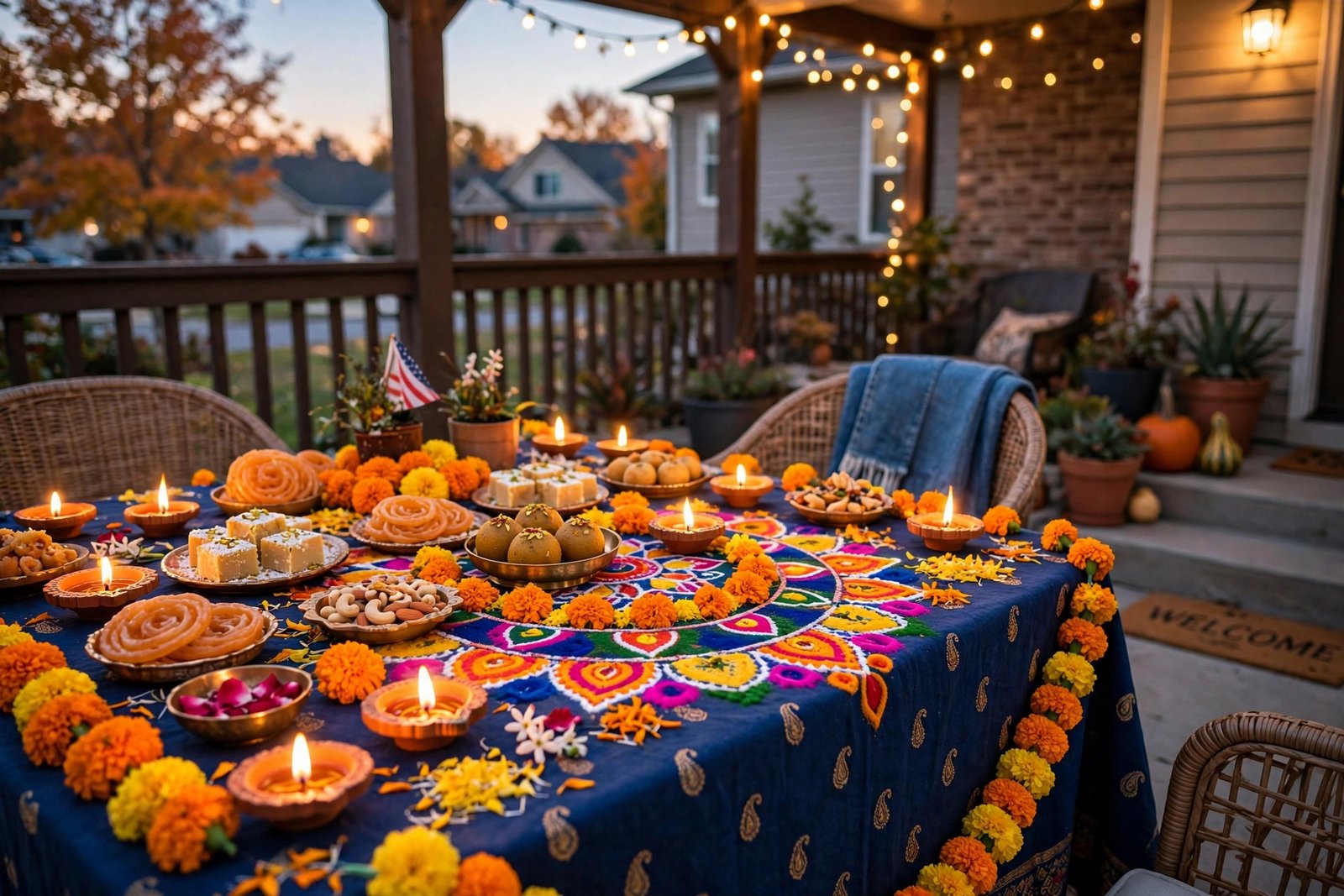
Diwali 2026 falls on Sunday, November 8, in the United States, and across the country millions of Americans are preparing for the festival of lights. The five-day celebration runs from Dhanteras on Friday, November 6, to Bhai Dooj on Tuesday, November 10, with the main night, Lakshmi Puja, on Sunday evening. For Hindu, Jain, and Sikh families, Diwali is one of the most important festivals of the year. For their neighbors, coworkers, and classmates, it has become one of America’s most visible and welcoming celebrations, filling city squares, temples, museums, and school halls with lamps, sweets, music, and color. This year carries an extra milestone: California is observing Diwali as an official state holiday for the first time in 2026, a recognition of how deeply the festival has woven itself into American life.
Diwali falls on the new moon night of the Hindu month of Kartik, which is why the date moves each year between mid-October and mid-November. In 2026 it arrives 19 days later than in 2025, when it fell on October 20, and in 2027 it will move back to late October. The festival is not a federal holiday in the United States, so most public celebrations are squeezed into the weekends around it, while the home observance stays fixed on the lunar calendar. That split between public weekends and the home night is part of what makes Diwali in America distinctive: the same family might attend a big outdoor mela on a Saturday, then light diyas at home on Sunday evening, then visit a temple on Monday.
The five days of Diwali, explained
The festival unfolds over five days, each with its own meaning. Dhanteras, on Friday, November 6, opens the celebration. Traditionally it is a day for cleaning the home and buying something new, often gold, silver, or a new utensil, as a symbol of prosperity and good fortune. Many families also light a lamp at the doorstep in the evening. Naraka Chaturdashi, sometimes called Choti Diwali, falls on Saturday, November 7. It recalls the victory of Lord Krishna over the demon Narakasura, and it is often marked with a pre-dawn oil bath, new clothes, and the first round of sweets and fireworks.
Sunday, November 8, is the heart of the festival: Lakshmi Puja, the evening prayer to Lakshmi, the goddess of wealth and prosperity. Families clean and decorate their homes, set out rows of small clay lamps called diyas, draw colorful rangoli patterns at doorways, and gather for prayers, sweets, and a festive dinner. Because Diwali follows the lunar calendar, the exact puja window depends on local sunset times. In New York, the Lakshmi Puja window is in the early evening, roughly 5:03 p.m. to 6:52 p.m., while Chicago, Houston, and the Bay Area each have their own local windows. Temples publish their own schedules, and families often check their local temple’s calendar rather than relying on a single national time.
Monday, November 9, brings Govardhan Puja and Annakut, when many temples display a mountain of food offered to Lord Krishna. Tuesday, November 10, is Bhai Dooj, a day celebrating the bond between brothers and sisters, when sisters pray for their brothers’ well-being and brothers give gifts in return. Together, the five days move from preparation and cleaning to prayer, feasting, gratitude, and family, which is why Diwali feels less like a single party and more like a season within a week.
What Diwali means to different traditions
Although Diwali is most widely associated with Hindu tradition, it carries meaning across several faiths, and American celebrations often reflect that breadth. In Hindu tradition, the festival is commonly linked to the return of Lord Rama to Ayodhya after fourteen years in exile, when residents are said to have lit rows of lamps to welcome him home. It is also the night of Lakshmi Puja, when families invite prosperity and good fortune into their homes. For Jains, Diwali marks the nirvana, or final liberation, of Lord Mahavira. For Sikhs, the festival coincides with Bandi Chhor Divas, commemorating the release of Guru Hargobind from imprisonment. These different stories share a common theme that resonates far beyond any one community: light overcoming darkness, knowledge overcoming ignorance, and good overcoming evil.
That universal theme helps explain why Diwali has found such a warm welcome in American public life. Schools teach the story of the lamps, museums host Diwali family days, libraries run rangoli and diya workshops, and city councils issue Diwali proclamations. In many American towns, the local Diwali mela is now a fixture of the autumn calendar, alongside pumpkin patches and harvest festivals. Neighbors who do not celebrate the festival religiously still show up for the food, the dancing, and the fireworks, and they leave with a better sense of the families who live next door.
Where America celebrates Diwali in 2026
Public celebrations in America usually fall on weekends before or after the festival itself, because organizers know families need parking, babysitters, and daylight. The biggest public weekends in 2026 run from mid-October through Saturday, November 7, the last big public Saturday before the home night. Cities with large South Asian communities host the largest events: New York’s Times Square Diwali festival, the melas of Edison and Jersey City in New Jersey, Houston’s celebrations in Texas, the Bay Area’s gatherings in California, and Chicago’s events in Illinois are among the best known. Smaller cities have their own versions too, often organized by temples, cultural associations, or university student groups.
Temples anchor the religious side of the week. The Hindu Temple Society of North America in Flushing, New York, lists Dhanteras observances on Friday, November 6, and Deepavali day prayers on Sunday, November 8, including morning homam and abhishekam and an evening deepa pooja. BAPS Akshardham in Robbinsville, New Jersey, runs a nine-day Diwali festival from November 7 to 15. The Hindu Temple of Atlanta lists Karthika Masam observances beginning November 9. These schedules are published on the temples’ own websites, and because dates for some observances can shift by a day between traditions and time zones, checking the local temple’s calendar is always the safest approach.
California’s new state-holiday status adds a new chapter to the story. With Diwali recognized as a state holiday in California for the first time in 2026, many public schools and state employees can observe the day, which allows for bigger community events and makes it easier for families to celebrate without choosing between work and worship. Other states and cities have taken similar steps in recent years, and the trend reflects a broader American pattern: as communities grow and diversify, public calendars gradually make room for the festivals those communities hold dear.
Food, light, and the feeling of Diwali
If there is one sense that defines Diwali, it is a combination of light and sweetness. Homes glow with diyas, candles, and strings of lights. Doorways are decorated with rangoli, intricate patterns made from colored powder, rice, or flower petals. Fireworks light up the night sky where local rules allow them, and sparklers are a favorite with children. Inside, the kitchen is the center of the celebration. Families prepare and share sweets like ladoo, barfi, gulab jamun, and jalebi, along with savory snacks, and boxes of sweets travel between homes, offices, and classrooms as gifts.
New clothes are part of the tradition too, and many families wear their finest outfits for Lakshmi Puja and for visits to temples and relatives. The emphasis on cleaning and decorating the home before the festival is not just housekeeping; it is a ritual of renewal, a way of making space, literally and spiritually, for the year ahead. Gifts flow in every direction: between parents and children, between siblings on Bhai Dooj, between friends and neighbors. For many American families, Diwali has also become a moment to teach children about their heritage, with grandparents telling the stories of Rama, Lakshmi, or Mahavira while grandchildren help place the diyas.
Fireworks deserve a practical note. Rules vary widely by state, county, and city in the United States, and some places ban consumer fireworks entirely while others allow them only on certain days. Families planning fireworks should check local rules and celebrate safely, keeping water nearby, supervising children, and respecting neighbors, pets, and local noise rules. Many public melas offer professional fireworks displays, which give everyone the spectacle without the risk.
How to celebrate Diwali respectfully as a guest
Americans who are invited to a Diwali celebration, or who want to attend a public event, will find a warm welcome. A few simple courtesies go a long way. Dress festively if you can; bright colors are always appropriate. Bring a small gift, such as a box of sweets, flowers, or a candle, and accept the sweets and food offered to you with gratitude. Remove your shoes when entering a home or temple if others are doing so, and follow the lead of your hosts during prayers. If you are unsure about a custom, asking politely is almost always appreciated; Diwali is a festival of inclusion, and hosts generally love explaining its traditions.
For families celebrating at home for the first time, the simplest observance is also the most meaningful: clean and decorate a space, light a few lamps or candles in the evening, share sweets with loved ones, and take a moment to reflect on what light means in your own life. That is the core of the festival, and it translates across cultures and faiths. Whether you mark Diwali in a temple in Flushing, at a mela in Houston, in a California classroom newly closed for the holiday, or at a kitchen table anywhere in America, the message is the same: darkness does not last, and light, shared generously, always returns.
Frequently asked questions
When is Diwali 2026 in the USA? Diwali, or Lakshmi Puja, falls on Sunday, November 8, 2026. The five-day festival runs from Dhanteras on Friday, November 6, to Bhai Dooj on Tuesday, November 10.
What time is Lakshmi Puja? The puja window depends on local sunset times. In New York it is roughly 5:03 p.m. to 6:52 p.m.; other cities have their own windows, so check your local temple’s schedule.
Is Diwali a federal holiday in the US? No. Diwali is not a federal holiday, but California is observing it as an official state holiday for the first time in 2026, and many schools and cities recognize it locally.
What do people do on Diwali? Families clean and decorate their homes, light diyas, draw rangoli, pray to Lakshmi, share sweets, wear new clothes, visit temples and relatives, and enjoy fireworks where permitted.
Can non-Hindus celebrate Diwali? Yes. Public melas, museum events, and school programs welcome everyone, and the festival’s theme of light overcoming darkness resonates across faiths and cultures.
Related reading
- Macy’s Thanksgiving Day Parade 2026: Your Complete Guide
- Tailgating in America: The Game-Day Tradition, Explained
- Halloween 2026 in America: Costumes, Spending, and Traditions
Sources: Diwali 2026 USA celebrations guide, US Hindu temple events November 2026.