
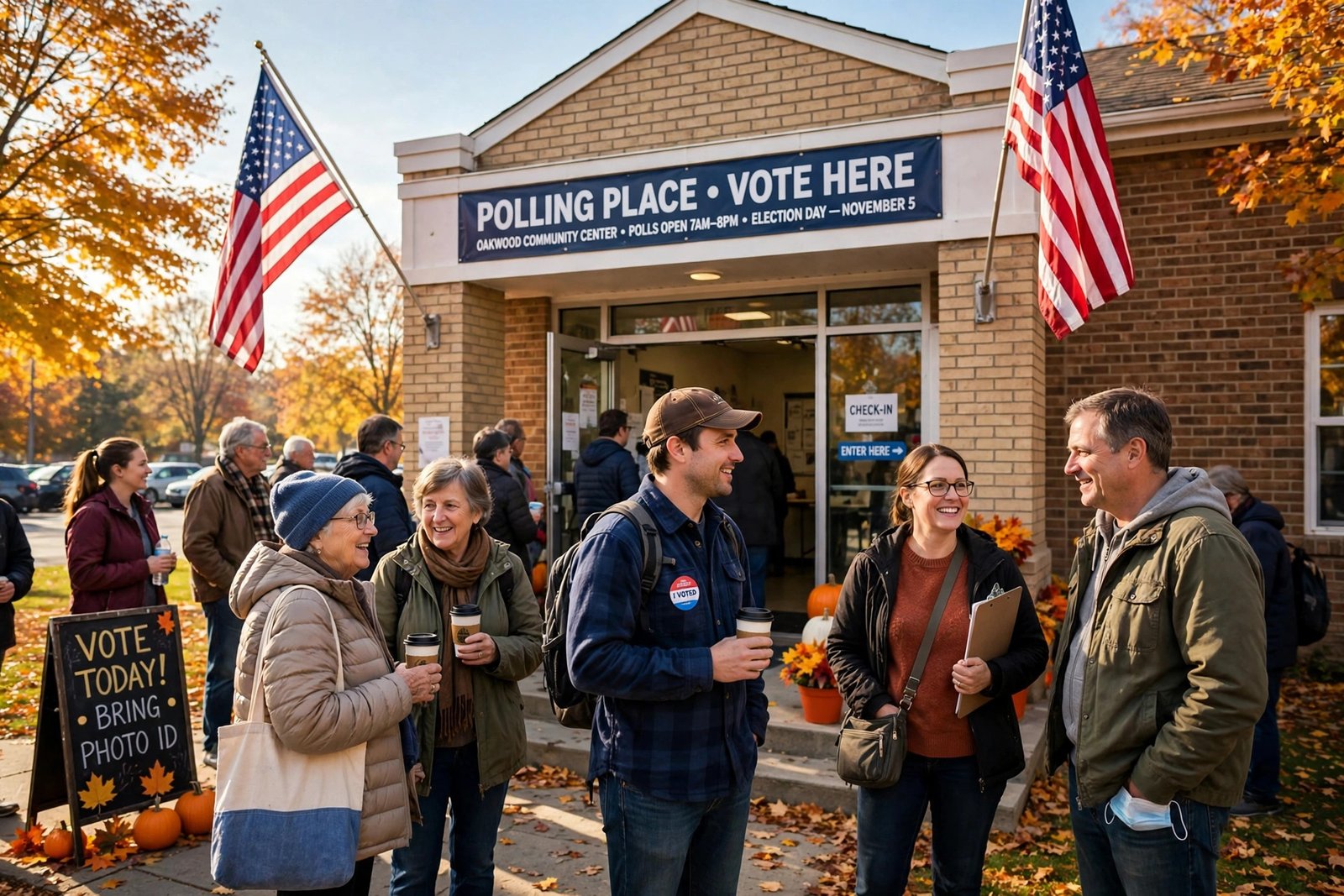
Tomorrow, Tuesday, November 3, 2026, Americans head to the polls in midterm elections that will shape the next two years of American politics. Every seat in the United States House of Representatives is on the ballot, more than thirty seats in the United States Senate are up for grabs, and voters in state after state will choose governors, state lawmakers, judges, and local officials. On top of that, voters in 39 states will decide more than 140 ballot measures, according to the National Conference of State Legislatures, covering everything from voter identification rules to abortion rights, marijuana, sports betting, and campaign finance. If you have ever wondered why midterms matter even when no president is on the ballot, this is the year to pay attention: the people elected tomorrow will write the laws, set the budgets, and decide the rules that touch daily life far more directly than most Washington headlines suggest.
Midterm elections get their name because they fall in the middle of a presidential term, two years after Americans elect a president and two years before they do it again. Historically, turnout is lower than in presidential years, yet the stakes are enormous. The party that controls the House and the Senate decides which bills reach a vote, which nominees are confirmed, and how aggressively Congress investigates the executive branch. In 2026, Republicans are defending a 53-47 majority in the Senate, according to midterm previews, and a narrow margin in the House, where Democrats need only a net gain of three seats to take control. That means a handful of competitive races could flip the balance of power in Washington, and with it, the direction of federal policy on spending, health care, immigration, energy, and the courts.
What is on the ballot in the House and Senate
All 435 seats in the House of Representatives are contested every two years, so every American voter has a House race on the ballot. House members serve two-year terms, which keeps them closely tied to the mood of their districts. In 2026, redistricting battles and newly drawn maps in several states add extra uncertainty, because some voters may find themselves in a different district than the one they voted in two years ago. Checking a sample ballot before heading out is the simplest way to avoid surprises at the polling place, and most state election websites and local election offices publish one free of charge.
In the Senate, 35 seats are on the ballot: the 33 regular Class 2 seats plus special elections in Ohio and Florida. Senators serve six-year terms, so only about a third of the chamber faces voters in any given election. That staggered design is deliberate. The founders wanted the Senate to be a more stable body, less swept by a single election’s mood. But in a closely divided chamber, even a small number of flips can change everything. A shift of a few seats determines which party sets the Senate calendar, chairs the committees, and moves judicial and executive nominations forward. For voters, that means Senate races in competitive states carry national weight, even if the candidates are running to represent just one state.
Beyond Congress, governors’ races are among the most consequential contests on the ballot. Governors sign or veto state legislation, propose state budgets, appoint judges and agency heads, and set the tone for how their states handle education funding, policing, housing, and health care. In Pennsylvania, for example, voters are choosing a governor and lieutenant governor ticket alongside every U.S. House seat, the entire state House, and half of the state Senate. Texas voters are deciding a governor’s race, a U.S. Senate race, and a long list of statewide offices, from attorney general to comptroller. In Massachusetts, voters are weighing a governor’s race, a Senate race, and nine statewide ballot questions. The pattern repeats across the country: the offices closest to home often have the most visible effect on daily life.
The ballot measures that could change everyday life
Ballot measures are where voters act as lawmakers directly. Rather than choosing a person, voters decide a policy question outright. In 2026, the biggest themes are voter identification, abortion and reproductive rights, marijuana, and campaign finance. Arizona’s Proposition 144 would amend the state constitution to require identification for mail voting and to let the legislature set the details for how voters show it. Nevada’s Question 7 would add a constitutional requirement for photo identification when voting in person and an identification number when voting by mail. California and Nevada are also voting on new voter identification proposals, while Arizona, North Carolina, and Ohio are deciding whether to add existing identification rules to their constitutions.
On abortion, Nevada’s Question 6 would establish a state constitutional right to abortion without interference from state or local governments, and Virginia voters are considering a constitutional amendment protecting reproductive rights. Missouri voters are deciding whether to repeal a constitutional right to reproductive freedom that voters approved in 2024. Idaho is among the states with an abortion-related measure on the ballot. These measures matter because, since the Supreme Court returned abortion regulation largely to the states, state constitutions and state laws have become the decisive battleground, and ballot measures let voters settle the question directly rather than leaving it to legislatures alone.
Other measures show how varied direct democracy can be. Nebraska voters are deciding a pair of measures that would start the process of legalizing online sports betting, with one authorizing the legislature to make the laws and another letting the gaming commission regulate it. Massachusetts voters could effectively eliminate recreational marijuana sales, keeping only small personal possession legal for adults 21 and older. Alabama’s Amendment 3 would require local school boards to have schools start the day with the Pledge of Allegiance and authorize student-led prayer. Campaign finance measures, including a California proposal about public financing, round out a ballot that touches schools, courts, wallets, and voting booths alike.
How and when to vote on November 3
Polls begin closing at 6 p.m. Eastern Time on Tuesday, November 3, and the last regularly scheduled polls close at 1 a.m. Eastern on Wednesday, November 4, in Alaska’s western Aleutian Islands. Poll hours vary by state and sometimes by locality, so the safest move is to check your state election website or your county election office for the exact hours where you live. Many states also offer early voting and mail voting, and in states with mail ballots, the deadline for returning them is typically Election Day itself. In Texas, for example, mail ballots must be postmarked by 7 p.m. local time on Election Day and received by 5 p.m. the next day to count, while Pennsylvania requires mail ballots to arrive by 8 p.m. on Election Day.
Before you go, a little preparation goes a long way. Look up your polling place, because it can change from year to year, especially after redistricting. Bring the identification your state requires, if any, and check whether your state accepts a range of documents or insists on a photo ID. Review your sample ballot in advance so you can research the down-ballot races and ballot measures, which are often the longest and least familiar part of the ballot. Judges, school boards, water districts, and city councils rarely make national news, but they make decisions about classrooms, streets, water, and local taxes that residents feel every day.
If you run into a problem at the polls, you have options. Most states offer a provisional ballot if your registration cannot be confirmed on the spot, and election officials are required to explain the process. Nonpartisan voter protection hotlines operate on Election Day in many states. The key point is not to leave without casting a ballot or asking for help. A single vote in a local race or on a ballot measure can decide an outcome, and local races are regularly decided by dozens of votes, not thousands.
Why midterms shape the next two years
The results tomorrow will set the terms of debate for the rest of the decade’s first half. If one party controls both chambers of Congress, it can move its legislative agenda more easily, though the Senate’s filibuster still requires broad support for most bills. If control is split, compromise becomes necessary, and the president’s veto power grows in importance. Either way, the composition of Congress affects negotiations over the federal budget, the debt limit, tax policy, and funding for defense, infrastructure, and social programs. It also affects oversight: committee chairs decide which hearings are held and which officials are called to testify.
State results matter just as much, and sometimes more. Governors and state legislatures will draw or defend voting rules, abortion laws, education policy, and tax policy for years. State supreme courts and local judges, many of them elected, will interpret those laws. Ballot measures approved tomorrow will become law or constitutional amendments in their states, sometimes with effects that last far beyond the next election cycle. That is why political scientists often say that all politics is local, even in a midterm year dominated by national headlines.
There is also a longer story worth remembering. Midterm elections have often been a check on the party holding the White House, with voters using the off-year to register approval or frustration. But every cycle is different, and turnout, candidate quality, local issues, and ballot measures can all break the pattern. The only reliable prediction is that the results will be read, rightly or wrongly, as a verdict on the country’s direction. The voters who show up will write that verdict.
What to watch on election night
As results come in on Tuesday evening, watch three things. First, the House: with Democrats needing a net gain of only three seats, early results from competitive districts will signal whether control is likely to flip. Second, the Senate: the handful of truly competitive races will determine whether Republicans hold their majority or Democrats narrow or erase it. Third, the ballot measures: voter identification and abortion measures in swing states and large states will tell a story about where public opinion is heading, regardless of which party wins the most seats.
Be patient with the count. In states with large numbers of mail ballots, full results can take days, and that is normal. Election officials count ballots under rules set by state law, and close races trigger automatic recounts in many states. A race that looks undecided on election night is not necessarily in dispute; it is often simply uncounted. Trust the process, follow your local election office for official updates, and be wary of claims about results that arrive before the votes are counted.
For more on the measures voters are deciding, see national coverage of the 2026 ballot measures and midterm previews from the National Conference of State Legislatures, which tracks ballot measures across the states. Your state election website remains the best source for your own ballot, polling place, and hours.
Frequently asked questions
When is Election Day 2026? Election Day is Tuesday, November 3, 2026. Polls begin closing at 6 p.m. Eastern Time, with the last polls closing at 1 a.m. Eastern on November 4 in Alaska’s Aleutian Islands.
What offices are on the ballot? All 435 U.S. House seats, 35 U.S. Senate seats, many governors’ offices, state legislatures, judges, and local offices, plus more than 140 ballot measures in 39 states.
Do I need to check my polling place? Yes. Polling places can change after redistricting, so confirm your location and hours with your state election website or county election office before you go.
What if my registration cannot be confirmed? Ask for a provisional ballot and follow the instructions election officials give you. Most states have a process for verifying provisional ballots after Election Day.
Why do midterms matter? Because Congress, governors, state legislatures, and ballot measures decided in midterms shape laws, budgets, and rights for years, often more directly than presidential elections do.
Related reading
- Social Security COLA 2026: What Retirees Need to Know
- The U.S. Dollar as the World’s Reserve Currency, Explained
- Why America Has Six Time Zones, Explained
Sources: USA Today ballot measures voter guide, Midterms Tuesday: what is at stake.