
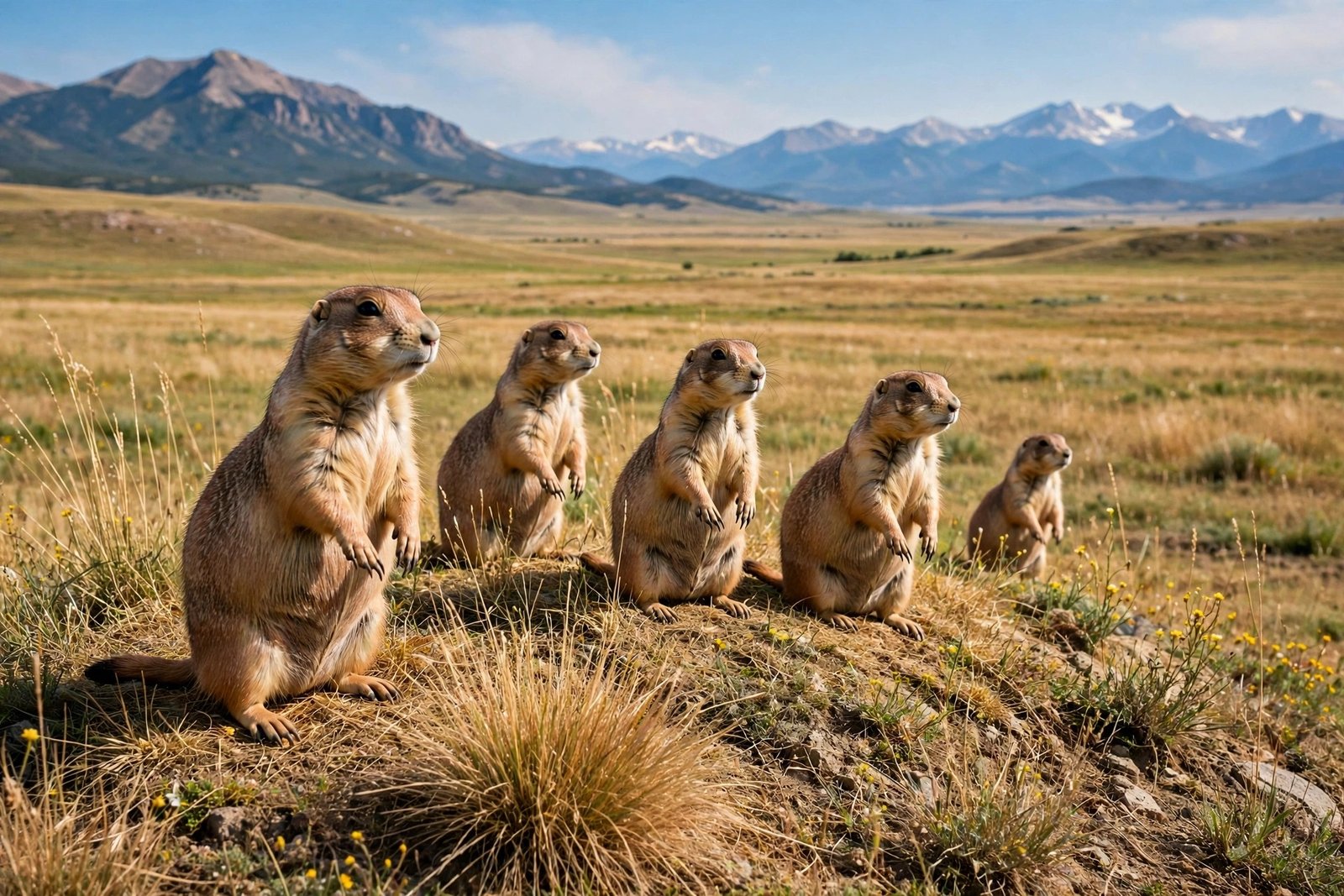
At first glance, a prairie dog looks like an unlikely hero. It is small, round, and chatty, standing upright on its hind legs on the open grasslands of the American West, scanning the horizon and chirping warnings to its neighbors. Yet beneath that charming surface is one of the most important animals in the entire prairie ecosystem. Prairie dogs are often called a keystone species, which means that many other plants and animals depend on the habitat they create. Their burrows, their grazing, and even their role as prey help shape the grasslands around them in ways that ripple far beyond a single colony.
To understand the American West, you have to understand its grasslands, and to understand its grasslands, you have to understand prairie dogs. For thousands of years, these social rodents have lived in large colonies known as towns, digging extensive underground burrow systems and clipping the grasses around their mounds. Those actions, repeated by countless prairie dogs over countless generations, have helped maintain open prairie, create shelter for other species, and support predators from eagles to ferrets. Today, prairie dogs face real challenges, but their story is also a story of conservation, recovery, and the surprising power of a small animal to shape a landscape.
What Is a Prairie Dog?
Despite the name, prairie dogs are not dogs at all. They are rodents, members of the squirrel family, and they are closely related to ground squirrels and marmots. Their name comes from their habitat, the prairies, and their call, a high-pitched bark or chirp that early explorers thought sounded dog-like. Five species live in North America, including the black-tailed, white-tailed, Gunnison’s, Utah, and Mexican prairie dogs, each adapted to different parts of the West, from the Great Plains to high mountain valleys and desert grasslands.
Prairie dogs are highly social animals, and that social life is one of their most fascinating traits. They live in family groups called coteries, usually made up of one adult male, several adult females, and their young, and those coteries join together to form larger towns that can cover many acres. Within a town, prairie dogs communicate constantly. They use a complex system of calls to warn of predators, and researchers have found that those calls can convey detailed information, distinguishing, for example, between a hawk overhead, a coyote approaching on the ground, and a human walking nearby. It is a sophisticated language for such a small animal, and it helps the whole colony survive.
Prairie Dog Towns: Cities Beneath the Grass
A prairie dog town is far more than a collection of holes in the ground. It is an engineered underground city, with burrows that can extend many feet below the surface and include multiple chambers for sleeping, raising young, storing food, and escaping predators. Entrances are often surrounded by mounds of excavated soil, which serve as lookout posts and help keep water out during rainstorms. The burrows stay cooler than the surface in summer and warmer in winter, providing a stable environment through the extremes of prairie weather.
Above ground, prairie dogs actively manage their surroundings. They clip tall grasses and plants around their burrows, which improves visibility and makes it harder for predators to approach unseen. That grazing and clipping also changes the plant community, encouraging shorter grasses and forbs that other animals, including pronghorn and bison, may use. In this way, prairie dogs are not just residents of the prairie. They are gardeners and architects, shaping the landscape through daily behavior. When prairie dogs disappear from an area, the grassland often changes too, becoming taller, denser, and less diverse in ways that affect many other species.
A Keystone Species: How Prairie Dogs Support Other Wildlife
The term keystone species comes from architecture: remove the keystone, and the arch collapses. Prairie dogs earn that title because so many other species rely on them or on the habitat they create. Their burrows provide shelter not only for prairie dogs themselves, but for a host of other animals. Burrowing owls, small, long-legged owls that live on the prairie, often nest in abandoned or shared prairie dog burrows. Snakes, toads, rabbits, and insects also use burrow systems for shelter from heat, cold, and predators. Without prairie dogs digging and maintaining those tunnels, many of those animals would have far fewer places to live.
Prairie dogs are also an important food source. Eagles, hawks, coyotes, badgers, foxes, and other predators hunt prairie dogs, and for some species, prairie dogs make up a large share of the diet. The ferruginous hawk, a large prairie raptor, is closely associated with prairie dog towns, and golden eagles also hunt over colonies. That predator-prey relationship is a normal and healthy part of the grassland food web. When prairie dog numbers fall sharply, predators that depend on them can struggle as well, which is one reason conservationists pay close attention to prairie dog populations.
Their grazing also benefits other grazers and ground-nesting birds. By keeping vegetation short around towns, prairie dogs create open areas where birds such as mountain plovers can nest and spot predators, and where bison and pronghorn can graze on fresh, nutritious regrowth. The bare soil around burrow mounds provides habitat for certain insects and plants, and the mixing of soil through digging helps cycle nutrients. In short, a prairie dog town is a hub of biodiversity, supporting a community that extends well beyond the prairie dogs themselves. Protecting prairie dogs, therefore, is not just about one species. It is about protecting an entire prairie community.
The Black-Footed Ferret Connection
No story about prairie dogs is complete without the black-footed ferret, one of North America’s most endangered mammals and one of its greatest conservation recovery stories. Black-footed ferrets depend almost entirely on prairie dogs for food and shelter. They live in prairie dog burrows, raise their kits underground, and hunt prairie dogs as their primary prey. When prairie dog populations collapsed in the twentieth century due to habitat loss, poisoning, and disease, black-footed ferrets collapsed with them, and by the late twentieth century, the species was believed to be extinct in the wild.
The rediscovery of a small wild population, followed by a captive breeding and reintroduction program, brought the black-footed ferret back from the brink, but its future still depends on healthy prairie dog towns. Reintroduction sites are chosen where prairie dog colonies are large and stable enough to support ferrets, and conservation teams work to protect those colonies from disease and habitat loss. The ferret’s recovery is therefore inseparable from prairie dog conservation. Save the prairie dog towns, and you give ferrets a home. Lose the towns, and ferrets have nowhere to go. That link makes prairie dogs a flagship for broader grassland conservation, connecting a small, common-looking rodent to one of the rarest mammals on the continent.
Visitors are unlikely to see a black-footed ferret in the wild, as the animals are nocturnal, secretive, and rare, but the story matters because it shows how interconnected prairie life is. Conservation is rarely about a single species in isolation. It is about the web of relationships between species, and prairie dogs sit at the center of that web on the Great Plains. Learning about ferrets helps visitors appreciate why a prairie dog town, which might look like just a field of holes, is actually a critical piece of American wildlife heritage.
Where to See Prairie Dogs
One of the best things about prairie dogs is how accessible they are to watch. Unlike many rare or secretive animals, prairie dogs are often visible in national parks, national grasslands, and wildlife refuges across the West, and they are active during the day. Places such as Badlands National Park, Theodore Roosevelt National Park, Wind Cave National Park, and various national grasslands are known for prairie dog towns that visitors can observe from roads, trails, and overlooks. The U.S. National Park Service at nps.gov and the U.S. Fish and Wildlife Service at fws.gov provide general information about public lands, wildlife viewing, and conservation programs that can help visitors plan a trip.
When watching prairie dogs, the best approach is quiet and patient. Bring binoculars, keep a respectful distance, and avoid approaching burrows closely, which can stress the animals and disturb their behavior. Early morning and late afternoon are often the most active times, when prairie dogs are feeding and socializing. Listen for their calls, watch for sentries standing upright, and look for burrowing owls perched near burrow entrances. A prairie dog town rewards slow observation. The longer you watch, the more you notice: family groups interacting, young pups emerging in spring and early summer, and predators circling overhead.
Visitors should also remember that prairie dogs are wild animals, not pets. Do not feed them, do not try to handle them, and keep pets leashed and away from colonies, both for the safety of the wildlife and for your own. Prairie dogs can carry diseases, and like all wild animals, they should be admired from a distance. Responsible viewing protects both the animals and the experience for future visitors, and it is the best way to enjoy one of the West’s most entertaining wildlife spectacles.
Conservation Challenges: Habitat Loss and Plague
Despite their importance, prairie dogs face serious challenges. The first is habitat loss and fragmentation. As grasslands have been converted to farms, ranches, housing, and other development, prairie dog habitat has shrunk and become broken into isolated patches. Small, isolated colonies are more vulnerable to disease, inbreeding, and local extinction, and they are less able to support predators like ferrets that need large, connected towns. Roads, fences, and other barriers can further divide colonies, making it harder for prairie dogs to disperse and recolonize areas.
The second major challenge is disease, particularly sylvatic plague, a bacterial disease carried by fleas that can sweep through a prairie dog town and kill a large share of its residents in a short time. Plague is not caused by prairie dogs themselves, and it affects other wildlife and, rarely, people as well, but prairie dogs are highly susceptible to it. A plague outbreak can devastate a colony that took years to build, and repeated outbreaks can prevent recovery. Conservation teams use tools such as flea control and, in some cases, vaccination research to help protect key colonies, especially those supporting black-footed ferrets, but plague remains a persistent threat that cannot be eliminated entirely.
Human attitudes have also shaped prairie dog history. In the past, prairie dogs were widely viewed as pests by ranchers and farmers, who worried about competition with livestock for forage and about livestock stepping into burrows. Large-scale poisoning campaigns reduced prairie dog numbers dramatically. Today, attitudes are more mixed, and many ranchers, land managers, and conservationists work together on coexistence strategies, including managing colony boundaries, protecting key towns, and recognizing the ecological benefits prairie dogs provide. That shift, from eradication to coexistence, is essential for the future of prairie grasslands, and it reflects a broader change in how Americans think about native wildlife.
Conservation efforts now focus on protecting large, connected grasslands, maintaining healthy prairie dog towns, and supporting ferret reintroduction where conditions are right. Those efforts involve federal agencies, state wildlife departments, tribal lands, private landowners, and conservation organizations, because prairie grasslands cross many boundaries. The work is ongoing and complex, but the goal is clear: keep enough prairie dog habitat intact, connected, and healthy to sustain the full prairie community, from burrowing owls to black-footed ferrets to the eagles overhead.
Why Prairie Dogs Matter for the Future of the West
Prairie dogs remind us that size is not a measure of importance. A small rodent, weighing only a couple of pounds, can shape an ecosystem, feed predators, shelter owls, and support one of the continent’s rarest mammals. That is a powerful lesson for conservation, and it is why prairie dogs continue to capture the attention of scientists, wildlife watchers, and anyone who loves the open West. Protecting them is not a niche concern. It is a way of protecting grasslands themselves, which are among the most threatened ecosystems in North America.
For visitors, prairie dogs also offer a joyful and accessible introduction to wildlife. You do not need to hike for days or travel to a remote wilderness to see them. You can watch them from a park road, learn their calls, and begin to see the prairie not as empty space, but as a living, working landscape full of relationships. That shift in perception, from empty to alive, is perhaps the most important gift prairie dogs give us. Once you see a town as a community, you start to care about what happens to it, and caring is the first step toward conservation.
Related reading: The American Bison Comeback: A Near-Extinction Success Story, Gray Wolf Recovery in the American West, and The American Alligator Comeback: A Conservation Success Story.
Frequently Asked Questions
Are prairie dogs really dogs? No. Prairie dogs are rodents in the squirrel family. Their name comes from their prairie habitat and their bark-like alarm calls, not from any relation to domestic dogs.
Why are prairie dogs called a keystone species? Prairie dogs are called a keystone species because many other animals depend on them. Their burrows shelter burrowing owls and other wildlife, their grazing shapes grassland plants, and they are prey for eagles, hawks, coyotes, and black-footed ferrets.
What is the connection between prairie dogs and black-footed ferrets? Black-footed ferrets depend almost entirely on prairie dogs for food and shelter, living in prairie dog burrows and hunting prairie dogs. Ferret recovery therefore depends on protecting large, healthy prairie dog towns.
Where can I see prairie dogs? Prairie dogs can often be seen in national parks, national grasslands, and wildlife refuges across the American West, including Badlands, Theodore Roosevelt, and Wind Cave National Parks. Watch quietly from a distance with binoculars, and do not feed or approach them.
What threatens prairie dogs? The main threats are habitat loss and fragmentation, sylvatic plague carried by fleas, and historical persecution as perceived pests. Conservation work focuses on protecting connected grasslands and key colonies, especially those supporting black-footed ferrets.