
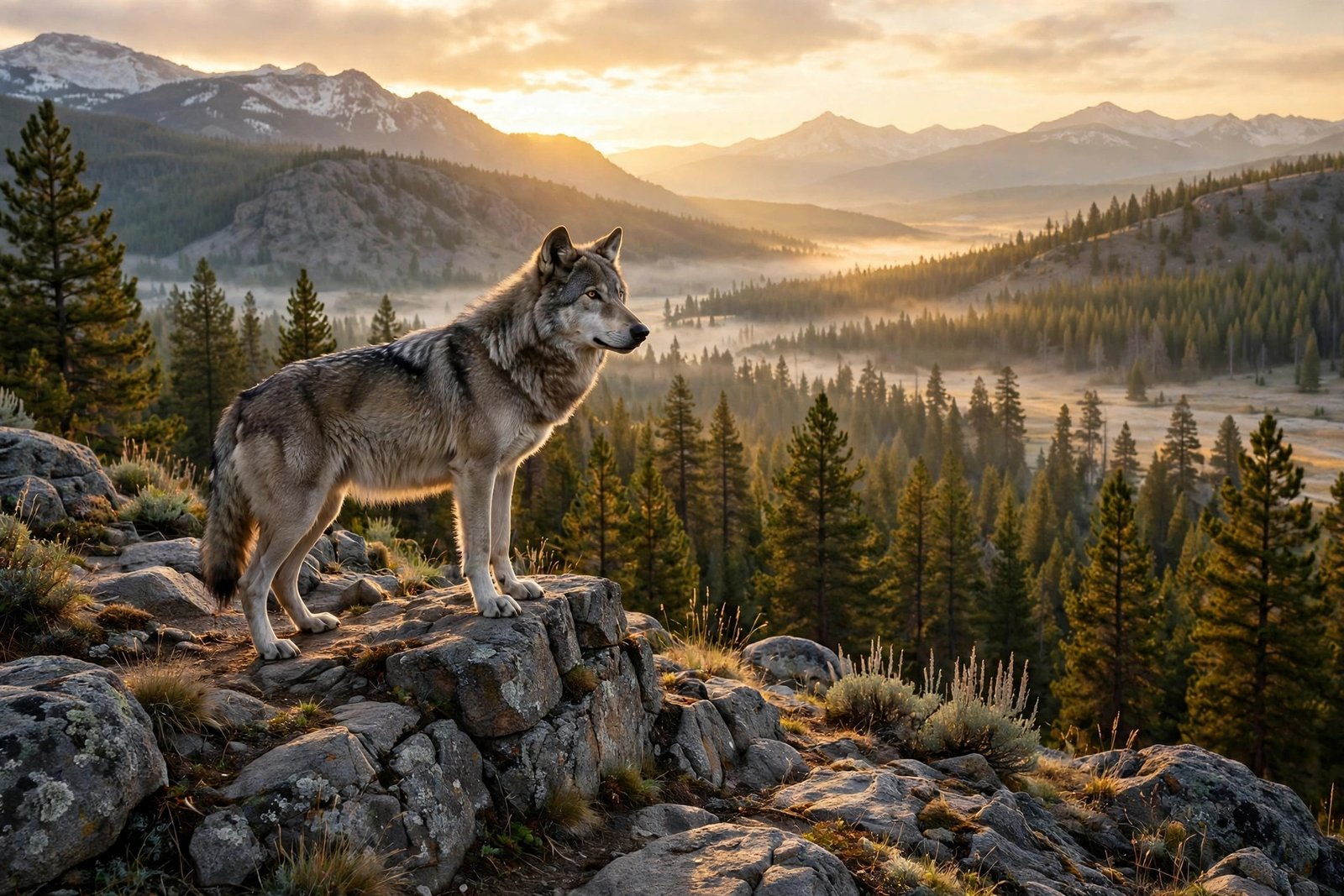
On a cold January morning in 1995, a small group of gray wolves stepped out of acclimation pens in Yellowstone National Park and into a landscape that had not heard their howl for generations. It was a quiet moment with enormous consequences. Within a few decades, that return would help reshape how Americans think about predators, wilderness, and what recovery really looks like in the American West.
Today, the gray wolf recovery story in the American West is one of the most closely watched conservation stories in the country. Wolves have spread from Yellowstone and central Idaho into Montana, Wyoming, Washington, Oregon, California, and, most recently, Colorado. Their numbers have grown, their range has expanded, and the debates around them have grown just as lively. Ranchers, hunters, biologists, tribal nations, and wildlife watchers all have a stake in what happens next, and none of them agree on everything.
This article traces how wolves disappeared, how they came back, what the science says now, and why the next chapter will be decided as much in state meeting rooms and on working ranches as in remote mountain valleys.
How Wolves Disappeared From the West
Gray wolves once roamed across much of North America, from the Arctic tundra to the deserts of Mexico. In the American West, they were a normal part of the landscape, hunting elk, deer, and other prey and shaping the behavior of animals around them. That changed dramatically as settlers moved west in the nineteenth and early twentieth centuries.
As ranching expanded, wolves were seen as a direct threat to livestock. Government predator-control programs, bounty hunting, trapping, and poisoning campaigns reduced wolf numbers sharply. By the 1920s, wolves had been eliminated from Yellowstone National Park, and by the middle of the twentieth century, they survived in the lower 48 states mainly in a small area of northeastern Minnesota. The loss was not just about one species. Without a top predator, elk populations in places like Yellowstone grew large and stayed in valley bottoms for longer periods, grazing young willows and aspens heavily and changing streamside habitats.
The passage of the Endangered Species Act in the 1970s changed the legal landscape. The gray wolf was listed as endangered, and recovery became a federal mandate. Planning began, slowly at first, for a return to places where wolves had once thrived. It would take more than two decades of debate, research, and legal wrangling before the first wolves were released back into Yellowstone.
The Yellowstone Return Changed Everything
In January 1995, fourteen gray wolves captured in Canada were relocated to Yellowstone’s Lamar Valley. In 1996, seventeen more Canadian wolves were brought into the park, followed by additional wolves from northwestern Montana in 1997. In total, dozens of wolves were released in Yellowstone and central Idaho in 1995 and 1996, forming the foundation of today’s Northern Rockies population.
Biologists expected wolves to hunt elk, and they did. What surprised many observers was how quickly other changes followed. Elk began to move more, avoiding risky areas near streams and thick cover. Willows, aspens, and cottonwoods in some valleys had a chance to grow taller. Beavers, which depend on willow for food and dam building, returned to some streams. Scavengers from ravens and eagles to bears benefited from wolf kills left behind in winter. Scientists still debate how large and how universal these ripple effects were, and they rightly caution that drought, fire, and other factors also shape these landscapes. But there is broad agreement that restoring a top predator restored a missing ecological process.
Yellowstone also became a living laboratory. The Yellowstone Wolf Project, one of the longest-running wolf studies in the world, has followed packs, pups, hunting success, disease, and interactions with other wildlife for three decades. Visitors now travel from around the world hoping to hear a wolf howl in Lamar Valley, and wolf watching has become a meaningful part of the local visitor economy in gateway communities.
From Yellowstone to the Pacific Coast
Wolves do not respect park boundaries, state lines, or management plans. Young wolves, especially, can travel hundreds of miles in search of new territory and mates. That natural dispersal is how recovery spread beyond the Northern Rockies.
Washington, Oregon, and California each developed their own wolf plans as wolves arrived naturally from Idaho and British Columbia. By the end of 2024, state counts reported in federal summaries showed a minimum of 50 wolves in California, 204 in Oregon, and 230 in Washington. Idaho, Montana, and Wyoming continued to hold much larger populations, with end-of-2024 minimum estimates of about 1,150 wolves in Idaho, 1,091 in Montana, and more than 300 in Wyoming, including about 100 in Yellowstone National Park itself. These are minimum counts, not total population estimates, and methods differ by state, but the direction of travel over the past decade has been clear: more wolves, in more places.
That expansion has brought wolves into landscapes very different from Yellowstone. In Washington’s northeast corner, in Oregon’s eastern forests, and in California’s northern counties, wolves now live near ranches, timberlands, highways, and small towns. State agencies track packs with GPS collars, confirm livestock losses, and work with ranchers on deterrents such as range riders, fladry, guard dogs, and carcass removal. The work is painstaking and often contentious, but it reflects a shift from the old question of whether wolves should return to the practical question of how people and wolves share the same ground.
Colorado Votes to Bring Wolves Home
Colorado wrote the newest chapter in this story at the ballot box. In November 2020, Colorado voters narrowly approved Proposition 114, directing the state to reintroduce wolves on the Western Slope by the end of 2023. It was the first time voters, rather than a federal agency alone, had ordered a wolf reintroduction.
Colorado Parks and Wildlife released five gray wolves onto public land in Grand County on December 18, 2023, with five more released that same week in Grand and Summit counties. The first ten wolves came from Oregon, and the agency later released additional wolves from British Columbia. The goal, set out in the Colorado Wolf Restoration and Management Plan approved in May 2023, was to build a permanent, self-sustaining population, with plans to release 30 to 50 wolves over several years.
Early signs have been encouraging for biologists. Colorado has now recorded multiple reproducing packs and pups born in the wild for three straight years, a key milestone for any reintroduction. At the same time, Colorado has also experienced the familiar tensions of wolf country: confirmed livestock losses, frustrated ranchers, and difficult decisions about lethal control in specific cases. State officials have described the program as reaching an inflection point, where the wolves already in Colorado must increasingly sustain the population on their own. That tension between hope and hardship is, in many ways, the whole story of wolf recovery in miniature.
What the Federal Government Says Now
The legal status of gray wolves remains complicated and varies by region. Wolves in the Northern Rockies, including Idaho, Montana, Wyoming, and parts of Oregon and Washington, were removed from the federal endangered list years ago and are managed by states and tribes. Wolves elsewhere in the West remain listed, though the U.S. Fish and Wildlife Service has recently concluded that a national recovery plan is no longer needed because wolf populations have become stable, well-distributed, and genetically connected.
In findings announced in November 2025, the Service said that listing gray wolves across 44 states and in Minnesota was no longer appropriate and that recovery plans would not promote conservation. The decision drew swift criticism from conservation groups, including the Center for Biological Diversity, which has challenged the agency’s approach and argued that a comprehensive national plan is still required. A federal appeals court has also been weighing related questions about wolf protections in the Northern Rockies. For readers, the practical takeaway is simple: the legal fight is not over, and future court decisions could change management again.
What is less disputed is the underlying biology. Federal species status assessments completed in 2023 for the western United States and in 2025 for the eastern United States found habitat and prey remain abundant, wolves continue to expand, and populations are projected to remain viable for decades. At the time of recent federal reviews, officials cited approximately 2,797 wolves across at least 286 packs in seven western states, a figure that illustrates how far recovery has come from the fewer than 1,000 wolves that remained in the lower 48 at the low point.
Living With Wolves: Ranchers, Hunters, and Neighbors
No honest account of wolf recovery can skip the people who live with wolves every day. For many ranchers, a wolf pack nearby means sleepless nights during calving season, extra labor, and real financial loss when livestock are killed. Compensation programs exist in several states, but ranchers often say they cover only direct losses, not the indirect costs of stressed animals, lower weights, or extra fencing and riders.
Hunters have mixed views as well. Some worry wolves reduce elk and deer herds in specific areas, while others point out that habitat, drought, and hunting pressure all affect game populations and that wolves are one factor among many. Tribal nations bring another essential perspective. Many tribes have deep cultural connections to wolves and have played leading roles in wolf management, research, and advocacy, while also balancing the interests of tribal ranchers and hunters.
What works, according to wildlife managers in multiple states, is not a single tool but a combination: early warning when collared wolves approach livestock, rapid response to confirmed depredations, nonlethal deterrents tailored to each ranch, fair and prompt compensation, and honest communication. When those pieces are missing, conflict escalates quickly. When they are present, coexistence is difficult but possible, and many ranchers have become skilled wolf managers in their own right.
For visitors and wildlife lovers, the guidance is straightforward and important. Keep a respectful distance, never approach or feed wolves, keep dogs leashed in wolf country, store food properly while camping, and report wolf sightings to the relevant state wildlife agency. Wolves are naturally wary of people, and keeping them wild is the best way to keep both people and wolves safe.
Why Wolf Recovery Still Matters
Wolf recovery matters for reasons that go beyond wolves themselves. Apex predators help keep ecosystems balanced by influencing prey behavior and numbers, which in turn affects plants, streams, and other wildlife. They are also an indicator species: a landscape healthy enough to support wolves is often healthy enough to support a wide range of other native plants and animals.
There is also a cultural and ethical dimension. For many Americans, the return of the wolf represents a willingness to correct a past mistake and to share the landscape with a native species that was here long before fences and highways. For others, it represents a federal or voter-driven decision imposed on rural communities that bear most of the costs. Both views deserve to be heard, and the most durable recovery plans are those that take both seriously.
Looking ahead, the key questions are practical. Can Colorado’s young population become self-sustaining? Will wolves continue to expand into new areas of the West, including the southern Rockies and the Pacific Coast? Will states maintain robust monitoring and conflict-prevention programs as federal roles shift? And will the courts, Congress, and wildlife agencies settle on a stable legal framework that gives both wolves and people predictability? The answers will unfold pack by pack, pup by pup, over the coming years.
The howl that returned to Yellowstone in 1995 has now echoed across much of the West. Whether it continues to echo for generations to come will depend on the choices made now by scientists, ranchers, policymakers, and ordinary Americans who care about wild places. That is why this comeback story, still unfinished, remains one of the most important wildlife stories in America.
Learn more from the agencies tracking this recovery: the Colorado Parks and Wildlife release on the first wolf releases, the Yellowstone Forever account of the wolf homecoming, and the Rocky Mountain Elk Foundation summary of recent federal findings and state counts.
Related reading
- Florida Manatees Comeback: Slow Speed Zones
- Bald Eagle Comeback: Conservation Success
- Monarch Butterfly Migration: Mexico and Milkweed
Frequently Asked Questions
When were wolves reintroduced to Yellowstone?
Wolves were reintroduced to Yellowstone National Park in January 1995, when fourteen gray wolves captured in Canada were released in Lamar Valley. More wolves followed in 1996 and 1997, and wolves were also released in central Idaho during the same period.
Why were wolves removed from Yellowstone in the first place?
Wolves were eliminated from Yellowstone by the 1920s through government predator-control programs, hunting, trapping, and poisoning, largely because they were seen as a threat to livestock and game animals. Changing attitudes and the Endangered Species Act later made their return possible.
How many wolves are in the American West today?
Counts vary by state and method, and most are minimum counts rather than total estimates. Recent federal summaries cited about 2,797 wolves across at least 286 packs in seven western states, plus larger delisted populations in the Northern Rockies. End-of-2024 minimum counts included about 1,150 in Idaho, 1,091 in Montana, and more than 300 in Wyoming.
Are gray wolves still endangered?
It depends on where you are. Wolves in the Northern Rockies are managed by states and tribes after delisting, while wolves in other parts of the West remain federally listed. Recent federal findings arguing that listing is no longer appropriate are being challenged in court, so the legal picture may still change.
What should I do if I see a wolf in the wild?
Keep your distance, do not approach or feed the animal, keep pets leashed, and enjoy the sighting quietly. Report the sighting to your state wildlife agency, which uses public reports to help track packs and prevent conflicts.