
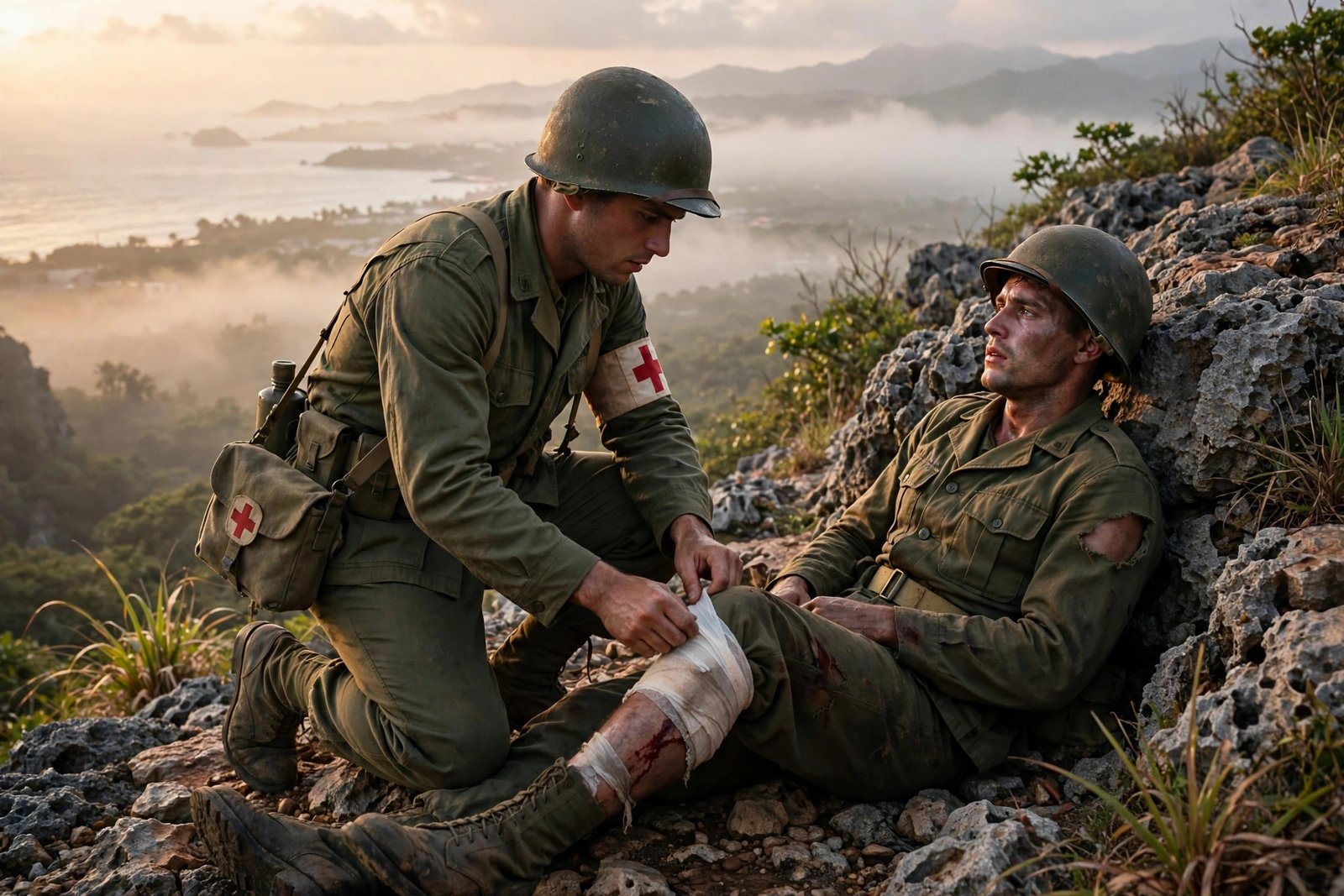
On a cliff in Okinawa in the spring of 1945, an American soldier did something no one thought possible. He walked into the heaviest fighting of the Pacific War without a rifle and without a pistol. Over one long night, he carried wounded men to the edge of a 400-foot escarpment and lowered them, one by one, down the cliff face to safety. By morning, dozens of men who would otherwise have died on that ridge were alive because of him. His name was Desmond Doss, and he remains the only conscientious objector to receive the Medal of Honor during World War II.
Doss did not set out to become famous. He set out to serve his country without breaking his faith. His story is about what conviction looks like when it costs you something, and about how a man who refused to carry a weapon became one of the most decorated soldiers of his generation.
A Childhood Shaped by Faith in Lynchburg
Desmond Thomas Doss was born on February 7, 1919, in Lynchburg, Virginia. He grew up in a working-class family during the Great Depression, and his mother raised him as a devout Seventh-day Adventist. That faith emphasized Sabbath-keeping, a vegetarian diet, and nonviolence, and young Desmond took those teachings seriously.
Two moments from his youth shaped him. The first was the commandment he learned as a boy: “Thou shalt not kill.” For Doss, those words were a direct instruction, not a suggestion. The second was a frightening scene at home, when his father, who struggled with drinking, pulled a gun during an argument. The sight of a weapon pointed at a family member left a deep mark, and it hardened a conviction already forming: he would never pick up a gun against another person.
Doss attended the Park Avenue Seventh-day Adventist Church school until the eighth grade, then went to work to help support his family. When war came, he was working in a shipyard in Newport News, Virginia, in defense work that could have kept him out of uniform. He chose a different path. He believed the war was a just one, and he wanted to serve, just not by killing.
The Conscientious Objector Who Volunteered
When Doss enlisted in the Army in April 1942, he did so as a conscientious objector, a classification that allowed men whose religious beliefs forbade combat to serve in noncombat roles. Doss himself disliked the label. He preferred “conscientious cooperator,” because he was not refusing to serve. He was volunteering for the most dangerous job he could imagine without a weapon: combat medic.
That distinction matters. A conscientious objector in the popular imagination is sometimes pictured as someone who stays home. Doss did the opposite. He asked to be sent where the fighting was worst, carrying only a medical bag, so he could save lives instead of taking them. It satisfied both his conscience and his patriotism, but it put him on a collision course with an Army built around rifles. He trained at Fort Jackson, South Carolina, then joined the 2nd Platoon, Company B, 1st Battalion, 307th Infantry, 77th Infantry Division.
Training, Ridicule, and Refusing to Quit
Basic training was brutal for Doss in ways that had little to do with physical demands. His fellow soldiers mocked him for refusing to handle a weapon. Some called him a coward. Others thought he was a liability who would get them killed. He was given extra duties, a hard time by drill instructors, and at one point faced efforts to have him discharged as unfit for duty. He also refused to train on Saturdays, his Sabbath, which only added to the friction.
Doss never argued back with anger. He held his ground quietly and kept doing the work in front of him. What slowly changed minds was not an argument but a demonstration. In training exercises, he proved to be a capable and tireless medic: strong, calm under pressure, and never hesitant to run toward an injured man. The same soldiers who had ridiculed him began to notice that the unarmed medic was often the first one at a casualty’s side. By the time his unit shipped out, mockery had begun to give way to grudging respect.
Guam and Leyte: First Tests Under Fire
Doss saw combat for the first time in 1944. He served with his unit on Guam and in the Philippines, where he was twice awarded the Bronze Star Medal for actions under fire. These were not ceremonial awards. They recognized a medic who repeatedly exposed himself to enemy fire to reach wounded men, treat them where they fell, and get them to safety.
The fighting in the Pacific was unforgiving. Japanese forces fought from caves, tunnels, and fortified positions, and a medic’s work was among the most dangerous jobs on the battlefield. On Guam and Leyte, Doss built the reputation that would carry him through Okinawa. He was steady, willing to keep working while others took cover. His fellow soldiers began to understand what his faith meant in practice. It did not mean he would hide. It meant he would run toward the wounded while everyone else ran for cover.
Okinawa and the Maeda Escarpment
The Battle of Okinawa began with American landings on April 1, 1945. Okinawa lay just a short distance from the home islands of Japan, and its defenders fought with a desperation that made every ridge a killing ground. The 307th Infantry Regiment moved into the line on April 29, taking up positions at the top of the Maeda Escarpment, a jagged coral and limestone ridge American soldiers nicknamed Hacksaw Ridge.
The escarpment was a cliff roughly 400 feet high, and its top 35 feet formed an overhang reachable only by climbing cargo nets. It was a natural fortress, with Japanese soldiers hidden in caves and tunnels throughout it. An earlier assault by A Company had nearly annihilated the unit. On May 2, 1945, the remainder of A Company, along with B Company, of which Doss was a part, climbed the cargo nets to the top. The fighting was close, chaotic, and relentless. Doss worked through it all as he always had, dressing wounds in the open and refusing shelter while the wounded still needed him. His Medal of Honor citation covers his actions from April 29 through May 21, 1945.
The Night of May 5, 1945
The most famous night of Doss’s life came on May 5, 1945. It was a Saturday, his Sabbath, and the fighting had intensified until American forces were ordered to retreat. Heavy artillery, mortar, and machine-gun fire had crashed into the troops as they gained the summit, inflicting heavy casualties and driving the others back down the cliff. Doss refused to go with them. An estimated 75 men remained behind on top of the escarpment, too wounded to retreat under their own power. He would not leave them behind.
Working alone, in the dark, under enemy fire, Doss found wounded men one at a time, dragged them to the edge of the escarpment, and lowered them down the cliff face on a rope-supported litter to friendly hands waiting below. He used a special knot he had learned as a boy in the Pathfinders, the Adventist youth group, to rig the lowering system. He prayed as he worked, repeating a simple prayer: “Lord, please help me get one more.” He did not stop until every wounded man he could find had been brought to safety, a rescue that stretched across many hours until nearly dawn. He had not been unwilling to face the enemy. He had been unwilling to kill, and that left him free to do something no armed soldier on that ridge could have done that night.
The 75-Men Question: What the Record Really Says
Almost every retelling says Doss saved 75 men on Hacksaw Ridge, and the Army’s own accounts use that number. But the honest version is a little more complicated, and it is worth telling straight, because it makes Doss look better, not worse. Doss did not keep count as he worked that night. When asked how many men he had pulled to safety, his own estimate was about 50. His commanding officer believed the number was closer to 100. The two men discussed it and settled on 75 as the official figure.
The Medal of Honor citation itself does not state a count of the men Doss saved. It describes his actions in detail and says he saved the lives of many soldiers, but the famous number comes from the agreement between Doss and his commander, not from a headcount on the cliff. The range the record gives is 50 by his own estimate, 100 by his commander’s, and 75 by agreement. Whatever the exact number, the scale of what he did is not in doubt. Dozens of wounded men lived because one unarmed medic refused to leave them.
Wounded, Evacuated, and Honored
Doss stayed in the fight after that night, and he was wounded four times on Okinawa. On May 21, 1945, during a night attack, he remained in exposed territory while the rest of his company took cover, giving aid until he was seriously wounded in the legs by a grenade blast. While waiting for litter bearers, he was shot and suffered a compound fracture of an arm. He bound a rifle stock to his shattered arm as a splint and crawled a long distance over rough terrain to reach the aid station. He also gave up his own place on a litter to a more critically wounded man. He was finally evacuated on May 21, 1945, aboard the hospital ship USS Mercy.
On October 12, 1945, President Harry S. Truman presented Doss with the Medal of Honor in a ceremony on the White House lawn. Truman shook his hand and told him, “I’m proud of you. You really deserve this. I consider this a greater honor than being president.” Doss became the first, and only, conscientious objector to receive the Medal of Honor during World War II. He had also earned two Bronze Stars and a Purple Heart, all without ever harming another human being.
Life After the War, and Hacksaw Ridge on Screen
The war left Doss with lasting wounds. He spent years recovering from his injuries and from tuberculosis contracted during his service. He settled in Alabama, worked with young people in church-sponsored programs, and lived a quiet life far from the spotlight. His first wife, Dorothy, died in a car accident in 1991. He later married Frances May Duman in 1993. After being hospitalized for difficulty breathing, Doss died on March 23, 2006, at his home in Piedmont, Alabama, at the age of 87. He was buried on April 3, 2006, in the Chattanooga National Cemetery in Chattanooga, Tennessee.
For decades, his story was known mostly to military historians and the men he had saved. That changed with the documentary “The Conscientious Objector” in 2004, and then with the 2016 feature film “Hacksaw Ridge,” directed by Mel Gibson and starring Andrew Garfield as Doss. The film was released nationwide in the United States on November 4, 2016, earned strong reviews and two Academy Awards, and brought Garfield an Academy Award nomination for Best Actor. Like any Hollywood dramatization, it compresses timelines and adds dialogue written for the screen. But the core of the story, the unarmed medic on the cliff, is drawn directly from the historical record.
Why Doss Still Matters
Desmond Doss matters because his story refuses to fit into easy categories. He was a patriot who would not kill and a soldier who would not carry a weapon. He was a man of deep religious conviction who served in the most violent place imaginable, and he did it by saving lives rather than taking them. His story also matters because of what it says about courage. Courage is often pictured as aggression, as charging forward with a weapon in hand. Doss showed a different kind: the courage to stand alone in your convictions when everyone around you thinks you are wrong, and the courage to walk unarmed into gunfire because someone else needs help.
He did not prove his critics wrong by arguing with them. He proved them wrong by saving their lives. For the soldiers of the 77th Infantry Division, the lesson was personal. The men who had called Doss a coward in training owed him their lives by the end of the war. For the rest of us, the lesson is broader. Doss reminds us that heroism does not always look the way we expect, and that the most unlikely person in the room is sometimes the one who changes everything. He went up that cliff with nothing but a medical bag, a rope, and a prayer, and he came down a hero. He never fired a shot, and he never needed to.
Frequently Asked Questions
Did Desmond Doss really save 75 men at Hacksaw Ridge?
The Army credits Doss with saving 75 men on the Maeda Escarpment on May 5, 1945. The number was a compromise: Doss estimated about 50, his commanding officer believed it was closer to 100, and they agreed on 75. The Medal of Honor citation does not give a count, but the rescue of dozens of wounded men under fire is documented in the citation and in Army accounts.
Why did Desmond Doss refuse to carry a gun?
Doss was a Seventh-day Adventist, and his faith taught him that “Thou shalt not kill” was absolute. A childhood experience of seeing his father pull a gun during an argument deepened his conviction. He believed the war was just and wanted to serve, so he volunteered as a combat medic, a role that let him serve without killing.
Was Desmond Doss the only conscientious objector to receive the Medal of Honor in World War II?
Yes. Doss was the first conscientious objector to receive the Medal of Honor, and he remains the only one to receive it for actions during World War II. President Harry S. Truman presented the medal to him on October 12, 1945, at the White House.
How accurate is the movie Hacksaw Ridge?
The 2016 film, directed by Mel Gibson and starring Andrew Garfield, is based on Doss’s real life and the documented events at Okinawa, including the rescue and his wounding on May 21, 1945. Like most historical films, it compresses timelines and adds dramatized dialogue. The central facts of his service, his refusal to carry a weapon, and the rescue come from the historical record.