
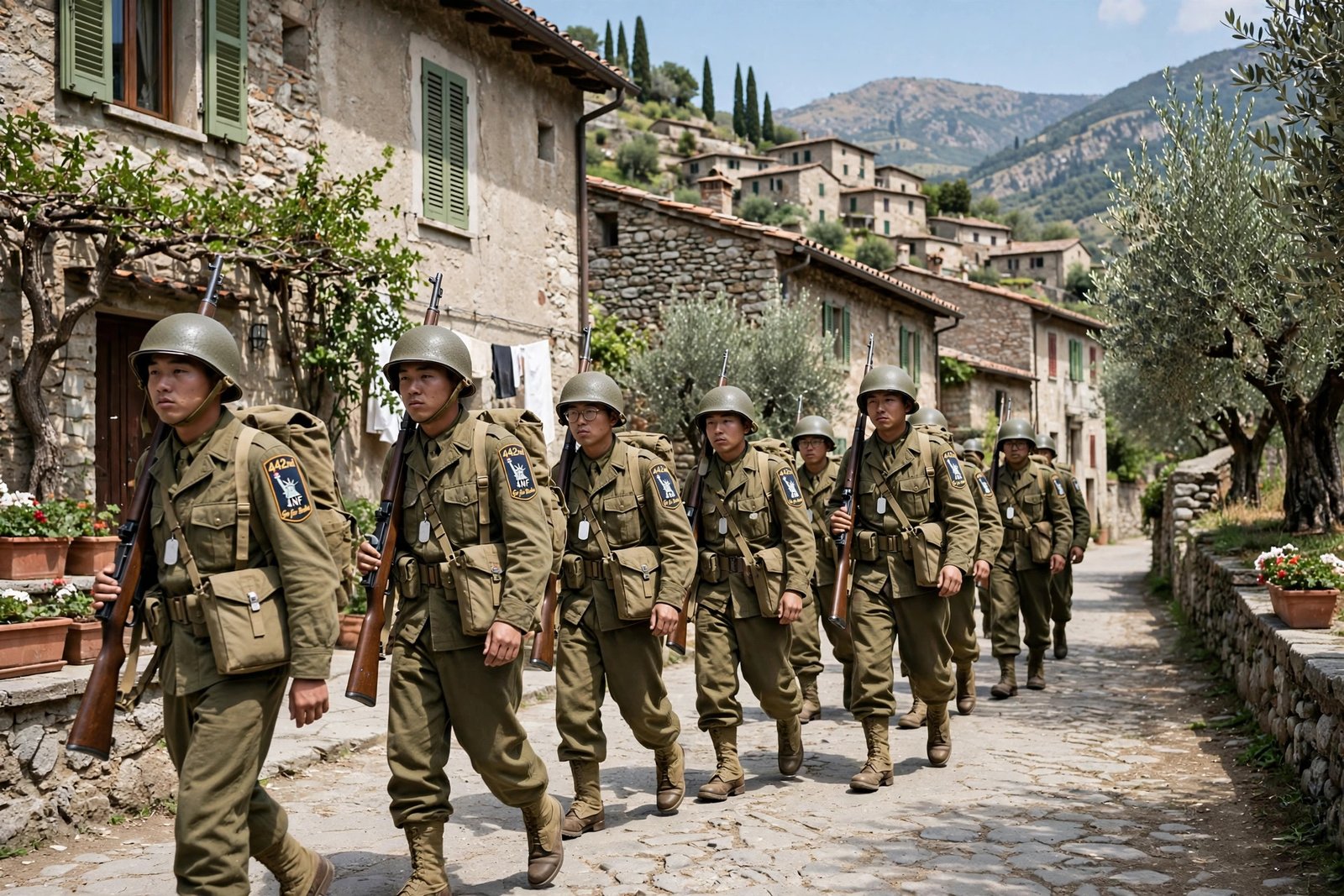
When the 442nd Regimental Combat Team marched through the streets of Washington in the summer of 1946, President Harry Truman stood to review them. The men before him had fought their way across Italy and France, rescued a trapped battalion in the Vosges Mountains, and helped break the last great German defensive line in northern Italy. They had done all of it while their own families were held behind barbed wire back home. That contradiction — fighting for a country that doubted their loyalty — is what makes the story of the 442nd Regimental Combat Team one of the most remarkable chapters in American military history.
Today, the 442nd is remembered as the most decorated unit in U.S. military history for its size and length of service. Its soldiers, almost entirely second-generation Japanese Americans known as Nisei, earned 21 Medals of Honor, along with thousands of other decorations, in less than two years of combat. Their motto, “Go For Broke,” was a gambler’s phrase that meant risking everything for the win. They lived up to it, again and again.
From Pearl Harbor to a Segregated Unit
The story of the 442nd begins not on a battlefield but in the shock and suspicion that followed the Japanese attack on Pearl Harbor on December 7, 1941. In the months that followed, more than 110,000 people of Japanese ancestry living on the West Coast were removed from their homes and placed in internment camps under Executive Order 9066. About two-thirds of them were American citizens. Japanese American soldiers already serving in the Army were discharged or reassigned, and young Nisei men were classified as enemy aliens, ineligible for the draft.
Yet many Japanese Americans wanted to serve. In Hawaii, where Japanese Americans made up a large share of the population, young men organized as the Varsity Victory Volunteers, doing labor for the Army while petitioning for a chance to fight. On the mainland, men inside the camps volunteered too, even though their families remained confined. Their argument was simple and powerful: the best way to prove their loyalty was to defend the country in uniform.
The War Department listened. On February 1, 1943, the 442nd Regimental Combat Team was activated, and volunteers began gathering at Camp Shelby, Mississippi, for training. About 2,686 men came from Hawaii and roughly 1,500 from the mainland, including volunteers from the internment camps. The unit included three infantry battalions, the 522nd Field Artillery Battalion, the 232nd Combat Engineer Company, and supporting companies. The soldiers trained for more than a year before shipping out, and in May 1944 the regiment deployed to the Mediterranean theater.
The 100th Battalion: The Purple Heart Battalion
The 442nd did not fight alone. Its story is inseparable from that of the 100th Infantry Battalion, a separate unit of Japanese American soldiers from Hawaii that had already been fighting in Italy since the fall of 1943. The 100th had earned a fearsome reputation — and a painful nickname, the “Purple Heart Battalion” — for the heavy casualties it suffered in brutal fighting around Monte Cassino and Anzio.
When the 442nd arrived in Italy in June 1944, it joined the 100th in combat attached to the 34th Infantry Division. On August 10, 1944, the 100th formally became the 442nd’s first battalion. From that point on, the two units’ histories were one, and the combined 100th/442nd would carry the record that still stands today. The men of the 100th brought combat experience; the men of the 442nd brought fresh strength. Together they became a force that commanders reached for when a mission looked hardest.
Fighting Through Italy
The 442nd entered combat on June 26, 1944, in Italy, and the fighting was immediate and grinding. German forces defended every hilltop and river crossing, and the regiment pushed north through a landscape of stone villages and terraced fields. The soldiers learned quickly that their reputation would be built the hard way, in close fighting where artillery and machine guns made every advance costly.
That summer, the 442nd helped drive German forces from the Italian countryside, fighting alongside other Allied units toward Rome and beyond. The experience hardened the regiment. Young men who had arrived at Camp Shelby as volunteers from Honolulu and from desert camps were now veterans, and their officers — many of them not Japanese American — came to trust them completely. In September 1944, the regiment was reassigned to the Seventh Army for the invasion of southern France, a move that would lead to its most famous battles.
Bruyeres, Biffontaine, and the Vosges Mountains
In the autumn of 1944, the 442nd was attached to the 36th Infantry Division for the drive into the Vosges Mountains of eastern France. The Vosges are steep, densely forested, and cold in October, and the German defenders knew the ground. In four weeks of heavy combat in October and November, the 442nd liberated the French towns of Bruyeres and Biffontaine, fighting house to house and hill to hill against determined resistance.
The people of Bruyeres never forgot it. Monuments to the 442nd stand in the town today, and the bond between the regiment and the French communities it freed has lasted for generations, with veterans returning for anniversaries and local families keeping the memory alive. For the soldiers, though, the Vosges campaign is remembered above all for what came next: the rescue of the Lost Battalion.
The Rescue of the Lost Battalion
In late October 1944, the 1st Battalion of the 141st Infantry Regiment — Texas soldiers — pushed too far forward and was cut off by German forces in the Vosges forest. Surrounded, short of food and ammunition, and under constant attack, the Texans held on while rescue attempts by other units failed with heavy losses. The 442nd was ordered in.
What followed was five days of some of the fiercest fighting of the war in western Europe. The men of the 442nd attacked uphill through dense forest, minefields, and machine-gun fire, taking ground yard by yard. When they finally broke through, they found 211 surviving Texans. The rescue cost the 442nd dearly — casualties ran into the hundreds — but it became the regiment’s defining act. The rescued Texans, and the state of Texas itself, honored the 442nd for generations afterward, and the men of both units called one another brothers for the rest of their lives. For this action, the 100th, 2nd, and 3rd Battalions and the 232nd Engineer Company each received the Distinguished Unit Citation, later redesignated the Presidential Unit Citation.
Breaking the Gothic Line and Liberating Dachau
After the Vosges, the 442nd spent the winter guarding the French-Italian border in the Maritime Alps. In March 1945 it returned to Italy, attached to the 92nd Infantry Division, for the final Allied offensive in the Po Valley. In April 1945, the regiment helped break through the Gothic Line, the last major German defensive line in northern Italy, in fighting around Seravezza, Carrara, and Fosdinovo. The breakthrough helped open the way to the final Allied victory in Italy.
Meanwhile, the 522nd Field Artillery Battalion had been detached for service in Germany, where it took part in the liberation of the Dachau concentration camp and its subcamps in late April 1945. The artillerymen were among the first American troops to witness the horrors of the camps, and the experience left a lasting mark on men who had themselves known confinement in America. The 522nd’s role in the liberation is now a central part of the regiment’s legacy, connecting its fight against fascism abroad with the injustice its families faced at home.
Heroes of the 442nd
Behind the unit citations were individual acts of extraordinary courage. Private First Class Sadao Munemori, fighting near Seravezza, Italy, on April 5, 1945, smothered a German grenade with his body to protect two comrades. He was killed instantly and was later awarded the Medal of Honor, the first Japanese American to receive the nation’s highest award for valor in World War II. April 5 is now observed as National Go For Broke Day in his memory.
Second Lieutenant Daniel Inouye, who would later become a United States senator from Hawaii, was grievously wounded in Italy in April 1945 while leading an assault on a German position. He continued to direct his men after losing his right arm, and his Distinguished Service Cross was later upgraded to the Medal of Honor in a congressionally mandated review of Asian American service in the 1990s. That review added 20 Medals of Honor to the regiment’s record, bringing its total to 21 — the fullest measure of what the unit had done.
The final tally is staggering: more than 18,000 individual decorations, including 21 Medals of Honor, 52 Distinguished Service Crosses, hundreds of Silver Stars, thousands of Bronze Stars, and close to 9,500 Purple Hearts. About 800 men of the 100th and 442nd were killed or missing in action. The regiment’s roughly 4,000 original members had to be replaced nearly two and a half times over the course of the war, and about 10,000 men served in total.
Coming Home — and Changing America
When the war ended, the 442nd was demobilized and inactivated in August 1946. Its homecoming was bittersweet. The men returned to a country that was only beginning to reckon with what it had done to their families. President Truman’s words at their July 1946 review — “You fought the enemy abroad and prejudice at home and you won” — captured both the triumph and the unfinished business.
But the veterans of the 442nd did not fade away. They became leaders in Hawaii and across the country: in politics, business, law, and education. Daniel Inouye served in the Senate for nearly fifty years. Others helped build the movement that eventually led to the Civil Liberties Act of 1988, in which the United States formally apologized for internment and paid reparations to survivors. The regiment’s legacy also lives on in the Army itself: the lineage and honors of the 442nd are preserved by the 100th Battalion, 442nd Infantry, an Army Reserve unit still serving today.
In 2011, Congress awarded the Congressional Gold Medal collectively to the 100th Infantry Battalion, the 442nd Regimental Combat Team, and the Military Intelligence Service — the Japanese American units of World War II. It was the highest civilian honor Congress can bestow, and it recognized what the soldiers themselves had always insisted: they were Americans, fighting for their country, and they had proved it beyond any doubt.
Why the 442nd Still Matters
The story of the 442nd endures because it asks a question America still wrestles with: who gets to be called an American, and what does loyalty look like when the country fails you? The men of the 442nd answered with their service. They did not fight because America had treated them fairly. They fought because they believed in what America was supposed to be — and because they intended to hold it to that promise.
Visiting their story today is easy. The U.S. Army’s Center of Military History preserves the regiment’s official history, Arlington National Cemetery honors the more than twenty members of the unit buried there, and the Go For Broke National Education Center in Los Angeles keeps the veterans’ oral histories alive. The towns of Bruyeres and Biffontaine still welcome American visitors as friends. And every year, new generations learn the motto that carried the regiment through Italy and France: Go For Broke.
It is worth remembering that the 442nd’s record was not achieved by supermen. It was achieved by farm boys from Hawaii, shop clerks from California, and young men straight out of internment camps — ordinary Americans who, when tested, refused to break. That is why their story still moves people eighty years later, and why it deserves a place in every telling of America’s World War II history.
Related reading
Keep exploring American military history on Trending 4: the Tuskegee Airmen, the Red Tails heroes of WWII, the Ghost Army and its inflatable tanks, and Sergeant Stubby, the WWI hero dog.
Frequently Asked Questions
What was the 442nd Regimental Combat Team?
The 442nd Regimental Combat Team was a segregated U.S. Army unit in World War II made up almost entirely of second-generation Japanese Americans, known as Nisei. Activated in February 1943 and trained at Camp Shelby, Mississippi, it fought in Italy and France and became the most decorated unit in American history for its size and length of service.
Why is the 442nd called the most decorated unit in U.S. history?
The regiment earned that distinction because of the sheer number of awards its soldiers received in less than two years of combat: 21 Medals of Honor, 52 Distinguished Service Crosses, hundreds of Silver Stars, thousands of Bronze Stars, and close to 9,500 Purple Hearts, along with eight Presidential Unit Citations. No other unit of comparable size and service time matches that record.
What does “Go For Broke” mean?
“Go For Broke” was the 442nd’s motto, borrowed from gamblers’ slang for risking everything on one bet in hopes of a big win. For the soldiers, it meant giving everything in battle and never holding back — a fitting creed for men who felt they had something to prove about their loyalty to the United States.
What was the rescue of the Lost Battalion?
In October 1944, the 442nd rescued 211 Texas soldiers of the 141st Infantry Regiment who had been surrounded by German forces in the Vosges Mountains of France. After five days of fierce uphill fighting, the 442nd broke through to the trapped battalion, suffering heavy casualties in the process. The rescue is the regiment’s most famous action.
Where can I learn more about the 442nd?
Good starting points include the U.S. Army Center of Military History’s account of the regiment, the Arlington National Cemetery blog on the unit, and the Go For Broke National Education Center, which preserves veterans’ stories. The Densho Encyclopedia also offers a detailed history of the regiment’s organization and combat record. Sources: Arlington National Cemetery, U.S. Army, Densho Encyclopedia.