
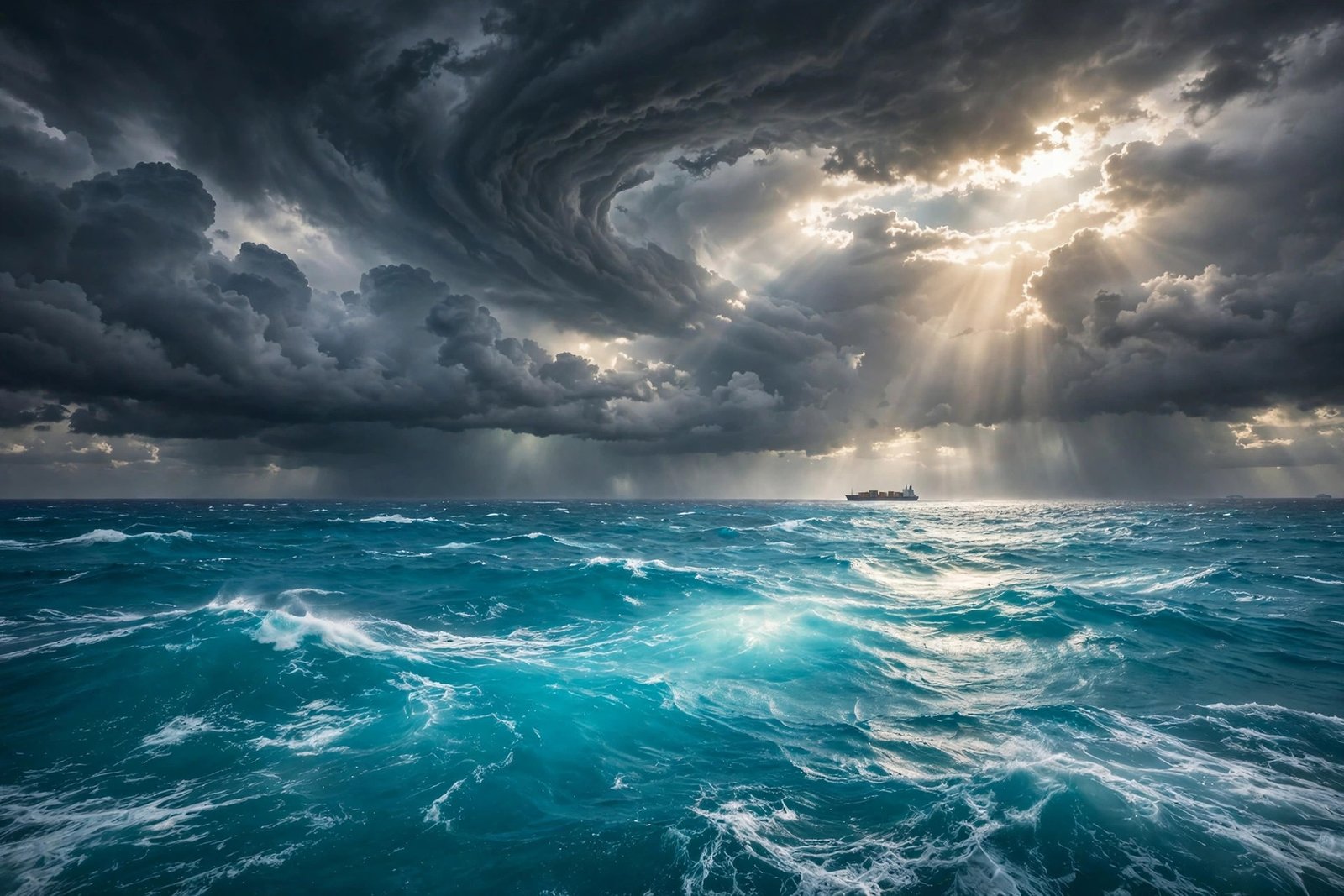
Somewhere in the western Atlantic, between Florida, Bermuda, and Puerto Rico, ships and planes are said to vanish without a trace. The Bermuda Triangle is one of the most famous legends in the world — a place where, according to the stories, compasses spin and whole crews disappear into thin air. But the United States government does not recognize the Bermuda Triangle as a real place at all, and the official record tells a much quieter story than the legend. The disappearances are real. The mystery was largely manufactured. Here are the facts behind the legend.
Where Is the Bermuda Triangle — and Does It Even Exist?
The Bermuda Triangle is usually drawn as a triangle with its corners at Miami, Florida; Bermuda; and San Juan, Puerto Rico. That shape is a convention, not a boundary. No official map draws its borders, and the U.S. Board on Geographic Names does not recognize “Bermuda Triangle” as an official geographic name — it keeps no file on the area at all. Estimates of its size vary enormously: Encyclopaedia Britannica notes that estimates of the area range from roughly 500,000 to 1,510,000 square miles.
That matters, because a mystery needs a location. If the borders are flexible, then almost any disappearance in a huge stretch of the Atlantic can be swept into the legend — and many were. Several of the famous “Triangle” cases happened outside even the most generous version of the triangle, and some happened nowhere near it at all. NOAA puts it plainly on its fact page, “What is the Bermuda Triangle?”: there is no evidence that mysterious disappearances occur with any greater frequency in the Bermuda Triangle than in any other large, well-traveled area of the ocean.
How a Magazine Article Created a Legend
The legend has a birthday, and it is surprisingly recent. The phrase “Bermuda Triangle” was coined by writer Vincent Gaddis in “The Deadly Bermuda Triangle,” published in Argosy magazine in February 1964. Gaddis gathered a handful of old disappearances, drew a triangle around them, and gave the whole thing a catchy name. The idea caught on, then all at once: Charles Berlitz’s bestselling book The Bermuda Triangle, published in 1974, sold millions of copies and turned the legend into a global phenomenon, offering supernatural explanations — Atlantis, alien abductions, and strange forces beneath the sea.
Then came the fact-check. In 1975, Larry Kusche, a research librarian at Arizona State University, published The Bermuda Triangle Mystery — Solved (reviewed in 1975). Kusche did something no previous writer on the subject had bothered to do: he went back to the original records. He read the Navy reports, the contemporary newspaper accounts, and the weather logs. What he found was that the legend was built on sloppy research. A sizable fraction of the wrecks and crashes attributed to the Triangle had actually happened elsewhere — in one case, in the Pacific Ocean. Descriptions of calm seas and fine weather often contradicted the actual records, which showed storms. And dramatic details that made the stories so chilling simply did not appear in the original sources; they had been added by later writers copying each other. Kusche’s conclusion was blunt: the mystery was manufactured, repeated so many times that it began to take on the aura of truth.
The USS Cyclops: The Navy’s Greatest Non-Combat Loss
Long before anyone had heard of the Bermuda Triangle, the USS Cyclops vanished. The Navy collier left Rio de Janeiro on February 16, 1918, loaded with manganese ore. She stopped at Salvador, Brazil, and then made an unscheduled call at Barbados, because she was riding dangerously low in the water. Her captain had also reported that the starboard engine had a cracked cylinder and was not working.
On March 4, 1918, the Cyclops left Barbados for Baltimore, where she was due on March 13. She was never seen again. All 306 people aboard were lost — the largest non-combat loss of life in U.S. Navy history. No distress call was ever received and no wreckage was ever found. The Navy’s own summary admitted that many theories had been advanced, but none satisfactorily accounted for her disappearance.
What the legend usually leaves out is that the Cyclops was a ship in trouble before she ever left port. She was overloaded, she had a broken engine, and she was a type of vessel — a collier with large open holds — known to be vulnerable to structural failure in heavy weather. Naval historians today take catastrophic structural failure as the most likely explanation. She disappeared in 1918, nearly half a century before the phrase “Bermuda Triangle” existed; her inclusion in the legend came later, when writers looking for cases reached back into history and claimed her.
Flight 19: Five Planes That Never Came Home
If one incident built the Bermuda Triangle legend, it is Flight 19. On December 5, 1945, five U.S. Navy TBM Avenger torpedo bombers carrying 14 airmen took off from Naval Air Station Fort Lauderdale on a routine training exercise over the Bahamas. The flight leader was Lt. Charles Taylor, an experienced pilot. Radio traffic picked up on shore showed that Taylor believed his compasses had failed and that he was over the Florida Keys. He was not. The flight wandered as darkness fell and a weather front moved in, and the planes are presumed to have run out of fuel and ditched in the Atlantic.
None of the five planes was ever found. Worse, a PBM Mariner flying boat sent out that same night to search for them also disappeared, with 13 people aboard — bringing the total loss to 27 airmen in a single night. The Navy later considered an in-flight fire the likely explanation for the Mariner’s loss. The Navy board of investigation first attributed the loss of Flight 19 to Taylor’s disorientation, then — after his mother protested — amended the finding to “causes or reasons unknown.”
The radio transcripts that survive are genuinely haunting, and the loss of 27 men in one night was a real tragedy. But the legend’s version of Flight 19 adds details the records do not support. Popular retellings describe strange radio messages and eerie final words that do not appear in the Navy’s own account. Kusche, who tracked down the Navy’s 400-page report on the loss, found that much of the famous dialogue had been invented or embellished by later writers. What the records actually show is a training flight that became lost — a navigational error, compounded by worsening weather, darkness, and fuel exhaustion — in an era before modern navigation aids. A plane that ditches at night in deep water leaves almost nothing to find.
The Other Cases in the Legend
Flight 19 and the Cyclops are the two cases everyone cites, but the legend’s catalog is longer. The SS Marine Sulphur Queen, a tanker carrying molten sulfur, disappeared in February 1963 with 39 crew aboard. A Coast Guard investigation could not fix a cause, but listed several candidates, including an explosion in the cargo tanks and a hull failure that broke the ship in two. Like the Cyclops, she was carrying a dangerous cargo in a vessel with known vulnerabilities. Many other cases in Berlitz’s book are weaker still: some involved ships that were later found, or that disappeared in storms whose severity the legend downplayed. Once you remove the cases that happened elsewhere, the cases with known causes, and the cases that were exaggerated, the list of genuinely unexplained disappearances shrinks to a handful — normal for any large, heavily traveled stretch of ocean over a century of shipping.
What NOAA, the Navy, and the Coast Guard Actually Say
The official position is remarkably consistent, and it has not changed in decades. The U.S. Coast Guard’s long-standing statement reads: “The Coast Guard does not recognize the existence of the so-called Bermuda Triangle as a geographic area of specific hazard to ships or planes. In a review of many aircraft and vessel losses in the area over the years, there has been nothing discovered that would indicate that casualties were the result of anything other than physical causes. No extraordinary factors have ever been identified.”
NOAA’s National Ocean Service says the same thing in its own words: the U.S. Navy and U.S. Coast Guard contend that there are no supernatural explanations for disasters at sea, and that the combined forces of nature and human fallibility outdo even the wildest fiction. That is the conclusion of the organizations that actually search for lost ships and planes.
The insurance market agrees. Lloyd’s of London, which prices the risk of shipping for a living, has said it charges no higher premiums for voyages through the area than for any other routine sea journey, and its records show losses there running at about the same rate as anywhere else in the world’s oceans. If the Bermuda Triangle were truly dangerous, insurers would be the first to notice — their money depends on it.
The Science: Why Ships and Planes Really Disappear There
None of this means the western Atlantic is a safe, gentle place. It is one of the busiest and most weather-prone stretches of ocean on Earth, and NOAA points to several factors that explain many of the historic losses. Most Atlantic tropical storms and hurricanes pass through the area, and before improved weather forecasting, those storms claimed many ships. The Gulf Stream can cause rapid and sometimes violent changes in weather, and the Caribbean’s many islands create shallow waters where reefs and sandbanks have wrecked ships for centuries.
There are also more specific hazards. NOAA notes there is some evidence that the Bermuda Triangle is a place where a magnetic compass sometimes points toward true north rather than magnetic north — along a line called the agonic line, the usual correction between the two disappears. A navigator who forgets to account for that difference can drift far off course, which is roughly what appears to have happened to Flight 19. Rogue waves — large, unexpected waves — are a real phenomenon, and NOAA has documented a 60-foot example in the Gulf Stream off Charleston. And human error, the most common cause of accidents at sea in any ocean, is always in play. Put all of that together — heavy traffic, violent weather, strong currents, shallow reefs, and human fallibility — and you do not need a supernatural explanation. You need a good weather forecast.
The Paranormal Claims — and Why They Stay Unproven
The legend’s more colorful explanations deserve a fair hearing, because they are a big part of why the story survives. Over the years, writers have blamed the disappearances on the lost continent of Atlantis, on alien abductions, on time warps and portals to other dimensions, and on methane gas erupting from the seafloor. NOAA itself mentions methane gas and geomagnetic disruption as explanations that are “more grounded in science, if not in evidence.” That careful phrasing is important: interesting ideas are not the same as demonstrated causes.
None of the paranormal explanations has ever been supported by evidence. No wreck has shown signs of anything other than a physical cause, and the methane hypothesis has never been demonstrated as a cause of any specific disappearance. After a century of losses and investigations, the burden of proof is on the extraordinary claim, and it has not been met. The disappearances are real, the people lost were real, and the extraordinary explanations remain unproven.
Why the Legend Refuses to Die
So why does the story persist, more than fifty years after Kusche debunked it? Part of the answer is that the real stories are genuinely dramatic: 27 airmen lost in one night, a 542-foot ship with 306 people aboard gone without a whisper. The ordinary explanations — bad weather, a broken engine, a wrong turn — feel too small for the loss. Part of it is the power of a good name: “Bermuda Triangle” sounds like a place with a secret, and once something has a label, it is easy to believe it is real. And part of it is simple repetition: the legend has been retold in books, television shows, and now social media for so long that many people encounter the story long before they encounter the evidence against it.
But the facts are available to anyone who wants them. The Navy’s reports, NOAA’s fact page, and the Coast Guard’s statement are all public, and they tell a story that is less thrilling than Atlantis and aliens but more respectful of the people who were lost: ordinary men, in ordinary machines, in a dangerous ocean, on bad days. That is the real mystery of the Bermuda Triangle — not that ships and planes disappeared, but that we needed a supernatural reason for it.
Frequently Asked Questions
Where is the Bermuda Triangle?
It is popularly drawn with corners at Miami, Florida; Bermuda; and San Juan, Puerto Rico. But it has no official boundaries: no map draws them, and the U.S. Board on Geographic Names does not recognize the name. Estimates of its area range from about 500,000 to 1.5 million square miles.
What happened to Flight 19?
On December 5, 1945, five U.S. Navy TBM Avenger bombers with 14 airmen aboard took off from Fort Lauderdale on a training flight and never returned. The flight leader became disoriented, the planes wandered as darkness and bad weather closed in, and they are presumed to have run out of fuel and ditched in the Atlantic. A search plane sent the same night also vanished with 13 aboard. No wreckage of either has been conclusively found.
What happened to the USS Cyclops?
The Navy collier USS Cyclops left Barbados on March 4, 1918, bound for Baltimore, and was never seen again. All 306 people aboard were lost. The ship was overloaded and had a broken engine. The Navy never determined a cause; naval historians consider catastrophic structural failure in heavy weather the most likely explanation.
Does NOAA say the Bermuda Triangle is dangerous?
No. NOAA states there is no evidence that mysterious disappearances occur with any greater frequency in the Bermuda Triangle than in any other large, well-traveled area of the ocean. The Coast Guard likewise does not recognize it as an area of specific hazard, and Lloyd’s of London charges no higher premiums for voyages through it.
Are there any scientific explanations for the disappearances?
Yes. NOAA points to the Gulf Stream’s rapid weather changes, the hurricanes and tropical storms that cross the area, shallow reefs and sandbanks, magnetic compass variation along the agonic line, and human error. Rogue waves are also a documented hazard. These ordinary factors, combined with very heavy shipping and air traffic, account for the losses without any supernatural cause.
Related reading
For more American mysteries, read the mystery of Skinwalker Ranch in Utah, the Flatwoods Monster legend of West Virginia, and the Lost Dutchman Mine legend of Arizona.