
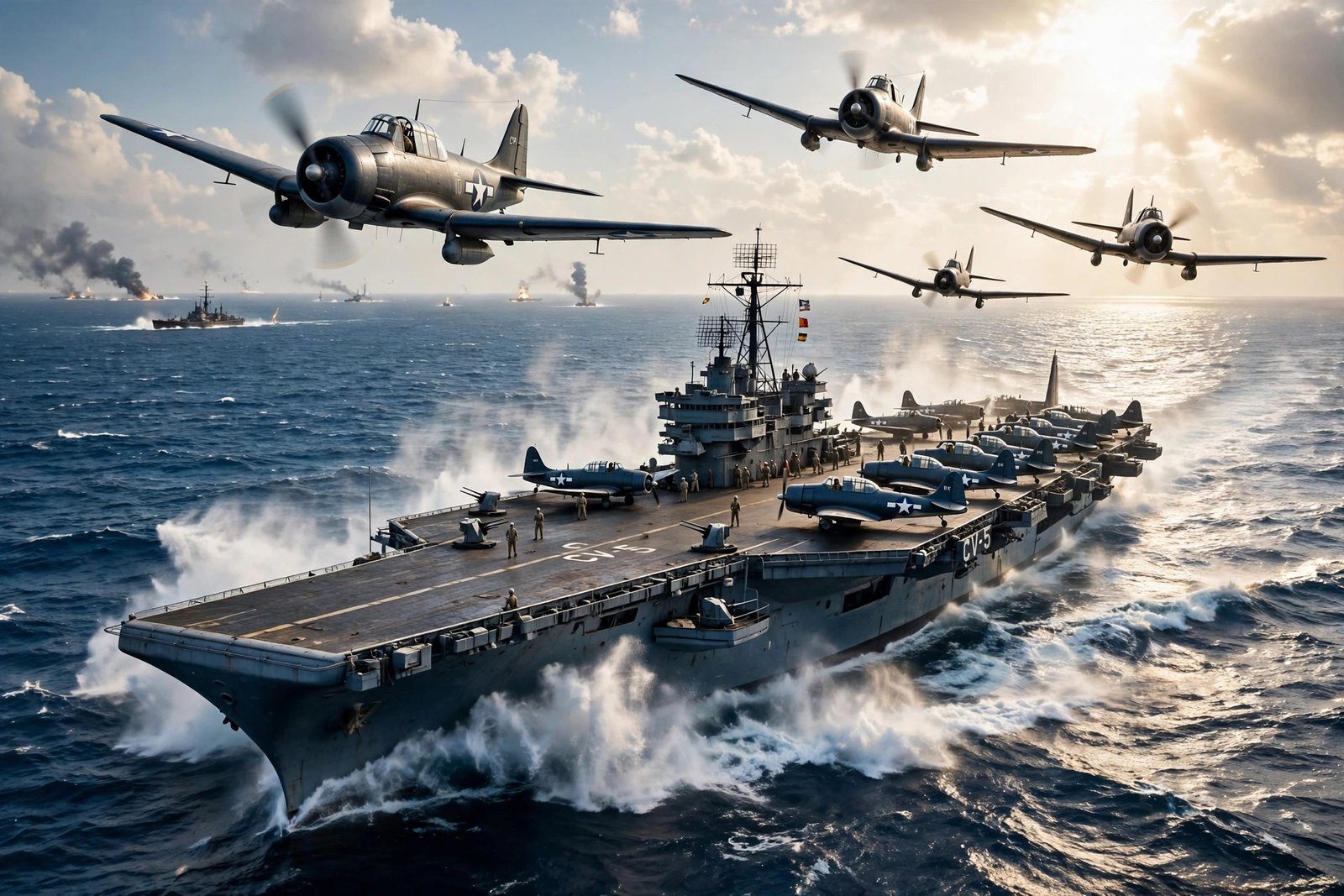
On the morning of June 4, 1942, the fate of the Pacific War hung on a gamble. Three American aircraft carriers — outnumbered and operating more than a thousand miles from their nearest base — lay in wait northeast of a tiny coral atoll called Midway. Coming toward them was the most powerful naval force Japan had ever assembled: four fleet carriers, two battleships, and the pride of the Imperial Japanese Navy, commanded by the same admiral who had planned the attack on Pearl Harbor. By the time the sun set on June 7, all four of those Japanese carriers would be at the bottom of the Pacific, and the war would never be the same.
Six months earlier, Japan had seemed unstoppable. The attack on Pearl Harbor on December 7, 1941, had crippled the American battleship fleet. In the months that followed, Japanese forces seized Malaysia, Singapore, the Dutch East Indies, and the Philippines. American forces were reeling, and the Pacific Fleet’s remaining strength rested on its aircraft carriers — the very ships the Japanese had failed to catch at Pearl Harbor.
By the spring of 1942, Japan’s supreme naval commander, Admiral Isoroku Yamamoto, believed the time had come to finish the job. His plan, Operation MI, was to attack Midway Atoll, a small American outpost about 1,300 miles northwest of Hawaii, and lure the surviving American carriers into a trap. If the Americans rushed to defend Midway, Yamamoto’s battleships and carriers would destroy them. With the U.S. Pacific Fleet eliminated, Japan could fortify its Pacific conquests and, Yamamoto hoped, force the United States to negotiate a peace. What Yamamoto did not know was that the Americans were reading his mail.
The Codebreakers of Station Hypo
The real battle of Midway was won before a single shot was fired, in a basement room at Pearl Harbor. There, a team of Navy cryptanalysts led by Commander Joseph Rochefort worked around the clock breaking the Japanese Navy’s main operational code, JN-25. By the spring of 1942, Rochefort’s unit — known as Station Hypo — had pieced together enough of the code to learn that Japan was planning a major operation against a target the Japanese called “AF.”
The problem was that nobody knew where AF was. Rochefort was convinced it was Midway, but his superiors in Washington were not so sure. So Captain Wilfred Holmes, a member of Rochefort’s team, devised a simple trick. Midway’s garrison was ordered to send an uncoded radio message reporting that the atoll’s water purification system had broken down and the base was running short of fresh water. Within a day, American codebreakers intercepted a Japanese message reporting that “AF was short on water.” The trap had worked — AF was Midway, and the date of the attack was June 4 or 5.
Armed with that knowledge, Admiral Chester Nimitz, commander of the U.S. Pacific Fleet, made a decision that still amazes historians. He would commit every carrier he had — just three — to an ambush northeast of Midway, betting everything on Rochefort’s intelligence. The U.S. Navy’s own account of the battle puts it plainly: intelligence provided by American cryptologists was the key that made the victory possible.
The Fleets That Met at Midway
The forces that faced each other near Midway Atoll could hardly have been more unequal on paper. Japan’s First Carrier Striking Force, under Vice Admiral Chuichi Nagumo, sailed with four fleet carriers — Akagi, Kaga, Soryu, and Hiryu — carrying 229 aircraft between them, escorted by two battleships, cruisers, and destroyers. Behind them, Yamamoto himself followed with the main body of the Combined Fleet, including the giant battleship Yamato. It was the largest naval force Japan had ever sent into battle.
Against them, Nimitz could muster just three carriers: USS Enterprise, USS Hornet, and USS Yorktown, with about 234 carrier-based aircraft plus 110 fighters, bombers, and patrol planes based on Midway itself. The Yorktown had been badly damaged a month earlier at the Battle of the Coral Sea, the first carrier battle in history, and many expected her to be out of action for months. Instead, Pearl Harbor’s shipyard workers repaired her in about 72 hours, and she sailed for Midway with work crews still aboard. Without her, the Americans would have fought with only two carriers.
The American commanders were Rear Admiral Frank Jack Fletcher, who held overall tactical command, and Rear Admiral Raymond Spruance, who commanded the task force built around Enterprise and Hornet. Nimitz stayed at Pearl Harbor, directing the battle from his headquarters. On the Japanese side, Nagumo commanded the carriers while Yamamoto directed the overall operation from Yamato, hundreds of miles behind the front line — a distance that would prove costly when events moved faster than messages could travel.
June 4: The Morning of the Battle
Before dawn on June 4, Nagumo launched 108 aircraft against Midway’s defenses. The first bombs fell on the atoll at 6:30 a.m. Marine Corps pilots from Midway rose to meet them, and Army, Navy, and Marine bombers from the island attacked the Japanese fleet — but the Japanese fighters, the fast and deadly Mitsubishi Zero, shot many of them down. By mid-morning, the Japanese strike commander reported back that a second strike on Midway would be needed, and Nagumo faced a fateful choice: keep his reserve aircraft armed for a possible attack on American ships, or rearm them with bombs for another strike on the island.
While Nagumo hesitated, the American carriers launched their own attack. It began badly. The slow, obsolete TBD Devastator torpedo bombers went in first, flying low and level toward the Japanese carriers — and the Japanese combat air patrol tore them apart. Torpedo Squadron 8, flying from Hornet, lost 15 of its 15 aircraft. Only one man survived: Ensign George Gay, who floated in the ocean for hours, watching the battle unfold around him. But their sacrifice was not in vain. The Japanese fighters had been drawn down to sea level to deal with the torpedo planes, and their carriers were caught with decks full of aircraft being refueled and rearmed.
Then, at about 10:20 in the morning, the dive bombers arrived. Lieutenant Commander Wade McClusky, leading Enterprise’s dive bombers, had nearly given up the search and was about to turn for home when he spotted the wake of a Japanese destroyer — the Arashi — racing to rejoin the fleet. McClusky followed the wake straight to the Japanese carriers. At almost the same moment, dive bombers from Yorktown, led by Lieutenant Commander Max Leslie, arrived from another direction. The Japanese carriers had no fighter cover above them and no time to react.
Five Minutes That Changed the War
What happened next is often called the most decisive five minutes in the history of naval warfare. Between about 10:20 and 10:25 a.m. on June 4, American SBD Dauntless dive bombers smashed three Japanese carriers. Kaga took multiple bomb hits and erupted in flames. A single bomb struck Akagi, the flagship, and exploded among the armed and fueled aircraft on her hangar deck, turning her into an inferno. Soryu was hit three times and soon became a burning wreck. In five minutes, the core of Japan’s carrier force was destroyed.
One carrier remained: Hiryu. That afternoon, her aircraft found the Yorktown and attacked twice, leaving the American carrier dead in the water and burning. Fletcher, believing Yorktown was lost, transferred his flag to a cruiser and left Spruance in tactical command. But the Americans were not finished. Late in the afternoon, dive bombers from Enterprise found Hiryu and crippled her. By nightfall, all four Japanese carriers were burning or sunk, and the Japanese invasion of Midway was abandoned.
The Yorktown’s Last Stand
The Yorktown’s story did not end with the Hiryu’s attack. Her crew fought the fires, and by the morning of June 5 she was still afloat, though badly damaged. Salvage crews went aboard to try to save her, and the destroyer Hammann came alongside to help. On June 6, the Japanese submarine I-168 slipped through the American screen and fired a spread of torpedoes. Two struck the Yorktown, and one hit Hammann, which broke in two and sank within minutes. The Yorktown lingered through the night and finally rolled over and sank at dawn on June 7.
Meanwhile, Spruance pursued the retreating Japanese fleet westward. On June 6, American dive bombers caught the heavy cruiser Mikuma and sank her, while her sister ship Mogami was heavily damaged. The rest of the Japanese fleet escaped, but Yamamoto had already accepted the truth: the operation had failed, and the carriers were gone.
The Cost of Victory
The butcher’s bill at Midway tells the story in numbers. Japan lost all four fleet carriers — Akagi, Kaga, Soryu, and Hiryu — plus the heavy cruiser Mikuma, 248 aircraft, and about 3,057 men, according to figures compiled by the Naval History and Heritage Command and the National WWII Museum. The United States lost one carrier, the Yorktown, one destroyer, the Hammann, about 150 aircraft, and 307 men.
The numbers only hint at the real damage. Japan lost the core of its trained carrier aircrews, the maintenance crews that kept the planes flying, and the institutional knowledge built up over years of combat. American industry, by contrast, was just getting started. The United States would build more than a dozen fleet carriers before the war ended; Japan, struggling with shortages of steel, fuel, and trained manpower, could not keep pace.
Why Midway Turned the Pacific War
Historians call Midway the turning point of the Pacific War, and the reasons go beyond the ships sunk. Before Midway, Japan had the initiative: it chose where and when to fight, and the Allies reacted. After Midway, the roles reversed. The United States seized the strategic initiative, and within two months American Marines were landing on Guadalcanal, beginning the long island-hopping campaign that would end at Okinawa and, eventually, in Tokyo Bay.
The battle also proved that intelligence could win wars. Station Hypo’s codebreakers gave Nimitz the date, the place, and the order of battle — information so precise that he could risk his entire carrier force on an ambush. The fresh-water ruse that confirmed Midway as the target remains one of the most famous intelligence tricks in military history. And the battle proved that the aircraft carrier, not the battleship, was now the decisive weapon at sea. Yamamoto’s great battleships, including the mighty Yamato, never fired a shot at Midway.
There was luck involved too, and honest histories admit it. McClusky’s decision to follow the Arashi’s wake was a gamble. The torpedo squadrons’ sacrifice, which cleared the skies for the dive bombers, was a tragedy that happened to create an opening. The Japanese carriers were caught at their most vulnerable moment — refueling and rearming — because of a chain of decisions and coincidences that no one could have planned. But luck favors the prepared, and the Americans were prepared because their codebreakers had told them exactly where to be.
Remembering Midway Today
Midway Atoll is now a remote wildlife refuge, far from the tourist trail, but the battle is remembered wherever American naval history is told. The Naval History and Heritage Command maintains an extensive collection of Midway records, photographs, and oral histories, and the National WWII Museum in New Orleans tells the battle’s story as one of the great turning points of the war. The only known surviving aircraft from the battle — a Douglas SBD Dauntless that also survived Pearl Harbor — is on display at the National Naval Aviation Museum in Pensacola, Florida.
In 2019, the wreckage of two of the lost carriers was found on the ocean floor. A research vessel operated by the late Paul Allen’s Vulcan Inc. located the Kaga and the Akagi more than 17,000 feet down, in the waters of the Papahanaumokuakea Marine National Monument. The wrecks are now war graves, protected by law, and a reminder of the men who died there.
The lesson of Midway endures because it is a story about more than ships. It is about the codebreakers in a basement who out-thought an empire, the shipyard workers who put a shattered carrier back to sea in three days, the torpedo pilots who flew into certain death so that others could strike, and a dive bomber commander who refused to turn back. On June 4, 1942, all of that came together in five minutes over a lonely atoll in the middle of the Pacific — and the course of the war changed forever. As the Smithsonian’s account of the battle notes, Midway gave American forces the breathing room and the time to go on the offensive, and Japan never got the initiative back. For a deeper look at the intelligence story behind the victory, the Smithsonian’s telling of the true story of Midway is well worth reading.
Related reading
- Iwo Jima Flag Raising Story Explained
- Navajo Code Talkers: WWII’s Unbreakable Code
- Audie Murphy: Most Decorated WWII Soldier
Frequently Asked Questions
When was the Battle of Midway fought?
The Battle of Midway was fought from June 4 to June 7, 1942, about six months after the attack on Pearl Harbor and one month after the Battle of the Coral Sea. The main carrier engagement took place on June 4, with the Yorktown sinking on June 7.
Which Japanese carriers were sunk at Midway?
All four Japanese fleet carriers at the battle were sunk: Akagi, Kaga, and Soryu were crippled by American dive bombers on the morning of June 4, and Hiryu was crippled that afternoon. The heavy cruiser Mikuma was also sunk on June 6. All four carriers had taken part in the attack on Pearl Harbor.
How did American codebreakers help win Midway?
Commander Joseph Rochefort’s team at Station Hypo in Pearl Harbor had partially broken the Japanese JN-25 naval code and learned Japan planned to attack a target called “AF.” A ruse — having Midway broadcast a fake message about a water shortage — confirmed AF was Midway. The codebreakers also gave Admiral Nimitz the date of the attack and the Japanese order of battle, letting him set an ambush.
What American ships were lost at Midway?
The United States lost the aircraft carrier USS Yorktown, which was damaged by Hiryu’s aircraft on June 4 and then torpedoed by the Japanese submarine I-168 on June 6, sinking at dawn on June 7. The destroyer USS Hammann, which was helping salvage the Yorktown, was also sunk by the same torpedo spread. The carriers Enterprise and Hornet survived undamaged.
Why is Midway considered the turning point of the Pacific War?
Midway destroyed the core of Japan’s carrier force and its irreplaceable trained aircrews, ending Japan’s ability to mount large offensive operations. It shifted the strategic initiative to the United States, which went on the offensive at Guadalcanal two months later. Japan’s shipbuilding and pilot training could never replace what was lost, while American industry rapidly outbuilt Japan.