
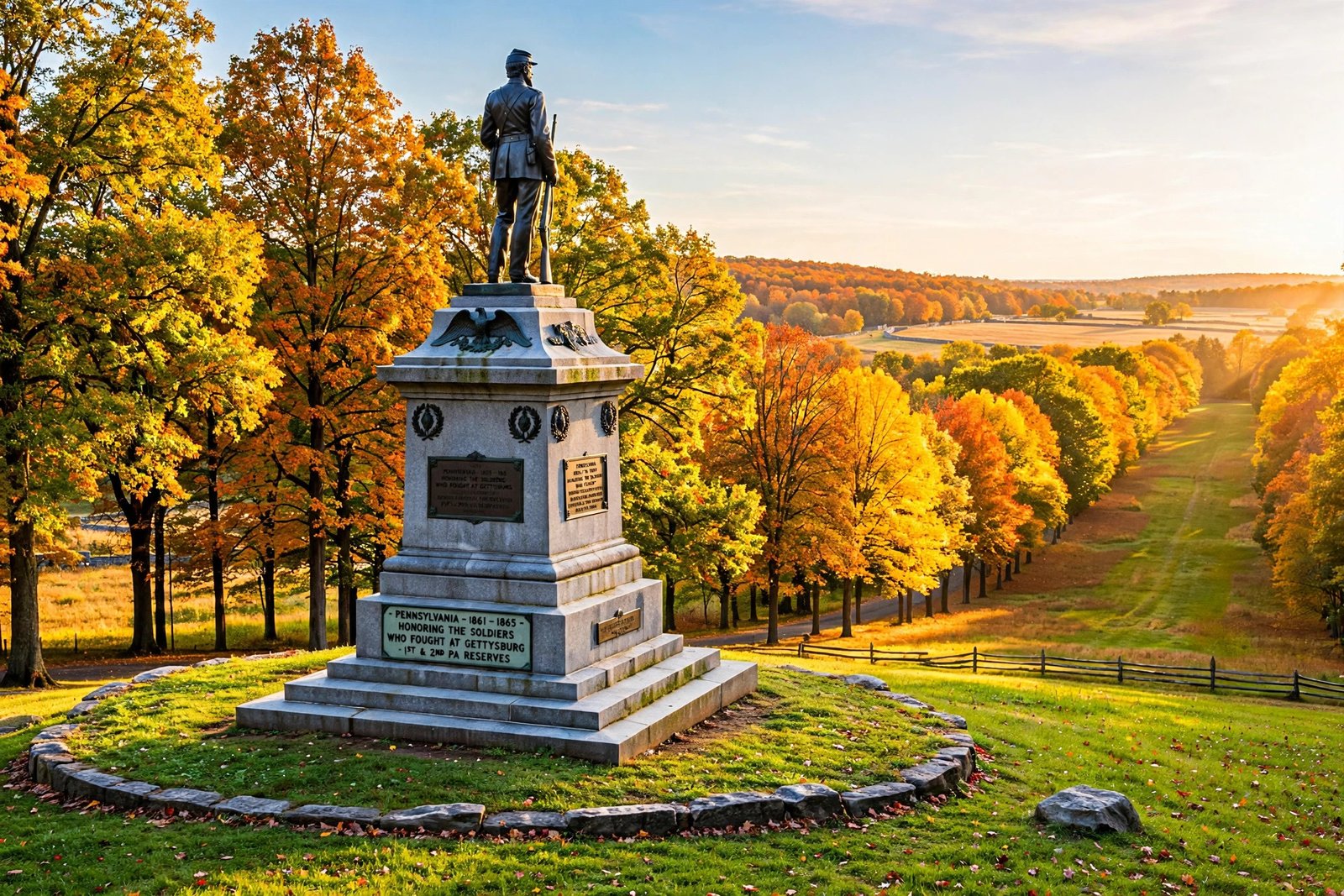
On November 19, 1863, in a small Pennsylvania town still burying its dead, President Abraham Lincoln stood up and spoke for about two minutes. He delivered 272 words — by the count most commonly cited — that are now among the most famous in the English language. The Gettysburg Address did not end the Civil War, free a single enslaved person by itself, or win a battle. What it did was something rarer: it told a divided nation what its war was for, and in doing so, it redefined America itself.
This article tells the story behind those 272 words: the battle that made the speech necessary, the cemetery dedication where Lincoln spoke, what he actually said and why each phrase mattered, and how a two-minute address that was barely noticed on the day became the text carved into the Lincoln Memorial and memorized by generations of schoolchildren. The facts here follow the National Park Service and the Library of Congress, the institutions that preserve the battlefield, the cemetery, and Lincoln’s own handwritten copies.
The Battle That Came Before the Speech
The Battle of Gettysburg, fought from July 1 to July 3, 1863, was the bloodiest battle of the Civil War and a turning point in the conflict. Confederate General Robert E. Lee had invaded the North for the second time, hoping a victory on Union soil would strengthen the Confederacy’s hand abroad and erode Northern support for the war. Instead, Union forces under General George Gordon Meade, who had taken command just days before the battle, held the high ground south of Gettysburg and repulsed Lee’s assaults, including the famous Pickett’s Charge on July 3.
When Lee retreated to Virginia on July 4, the scale of the slaughter was staggering. The battlefield held thousands of dead and wounded, and the small town of Gettysburg — its farms, churches, and homes pressed into service as hospitals — faced the grim work of caring for the injured and burying the dead. Pennsylvania Governor Andrew Gregg Curtin appointed Gettysburg lawyer David Wills to oversee honorable burials for the state’s dead, and the plan for a Soldiers’ National Cemetery on Cemetery Hill began to take shape. It was that cemetery’s dedication, four and a half months after the battle, that brought Lincoln to Gettysburg.
A Cemetery Dedication, Not a Major Event
It is worth remembering how modest Lincoln’s role was meant to be. The featured speaker on November 19, 1863, was Edward Everett, one of the most celebrated orators of his age, a former senator, governor, and Harvard president. Everett spoke for about two hours, delivering a learned oration on the causes of the war and the history of the battle. Lincoln was invited, in David Wills’s words, to offer only a few appropriate remarks after the oration, formally setting apart the ground for its sacred use.
The audience, gathered on a chilly November afternoon, had already sat through a long program of music, prayer, and Everett’s oration before Lincoln rose. Contemporary accounts suggest the applause for his brief remarks was polite but not thunderous, and some newspapers the next day gave the address only passing notice. There is no evidence that Lincoln or anyone else in attendance understood that they were witnessing the birth of a classic. The speech’s fame grew slowly, through reprinting, school recitation, and Lincoln’s own later reputation — a reminder that history’s judgment often arrives long after the moment itself.
Four Score and Seven Years Ago
Lincoln opened with a phrase that is now instantly recognizable: Four score and seven years ago our fathers brought forth on this continent, a new nation, conceived in Liberty, and dedicated to the proposition that all men are created equal. A score is twenty years, so four score and seven is eighty-seven years — counting back from 1863 to 1776, the year of the Declaration of Independence. With that single calculation, Lincoln reached past the Constitution of 1787 and anchored the nation’s founding in the Declaration’s promise of equality.
That choice was deliberate and consequential. By grounding the nation in 1776 rather than in the Constitution, Lincoln framed the Civil War not merely as a fight to preserve a political union, but as a test of whether a nation dedicated to equality could survive. The Constitution, after all, had tolerated slavery; the Declaration, with its claim that all men are created equal, supplied the moral standard against which the war could be judged. In ten sentences, Lincoln would return to that standard again and again.
What the Address Actually Says
The address is short enough to read in about two minutes, and it repays a slow reading. After the opening, Lincoln turns to the present: Now we are engaged in a great civil war, testing whether that nation, or any nation so conceived and so dedicated, can long endure. We are met on a great battle-field of that war. We have come to dedicate a portion of that field, as a final resting place for those who here gave their lives that that nation might live.
Then comes the speech’s pivot, and its most humbling claim: But, in a larger sense, we can not dedicate — we can not consecrate — we can not hallow — this ground. The brave men, living and dead, who struggled here, have consecrated it, far above our poor power to add or detract. The world will little note, nor long remember what we say here, but it can never forget what they did here. Lincoln was wrong about the world forgetting his words — the irony is now famous — but the rhetorical move was powerful: the living cannot honor the dead with speeches, only with deeds.
The Unfinished Work and a New Birth of Freedom
The closing passage is where the address turns from remembrance to resolve. It is for us the living, rather, to be dedicated here to the unfinished work which they who fought here have thus far so nobly advanced. It is rather for us to be here dedicated to the great task remaining before us — that from these honored dead we take increased devotion to that cause for which they gave the last full measure of devotion.
Then the famous conclusion: that we here highly resolve that these dead shall not have died in vain — that this nation, under God, shall have a new birth of freedom — and that government of the people, by the people, for the people, shall not perish from the earth. The phrase government of the people, by the people, for the people has become the most quoted definition of democracy in American history. The new birth of freedom pointed beyond the war’s immediate outcome toward emancipation and a more equal republic — a promise the nation would spend the next century and more trying to fulfill. The National Park Service preserves the cemetery where these words were spoken; see its Gettysburg overview and the Gettysburg Address plaque at the cemetery.
Five Copies, One Speech
One of the most interesting facts about the Gettysburg Address is that there is no single authoritative original. Lincoln wrote out the speech five times, and the five manuscript copies differ in wording, punctuation, and details. The two earliest drafts, known as the Nicolay and Hay copies, are held by the Library of Congress. The later copies — the Everett, Bancroft, and Bliss copies — were written in 1864 for charitable purposes, and the Bliss copy, the only one Lincoln signed, has become the standard text, the version carved into the wall of the Lincoln Memorial in Washington.
The differences are small but telling. Some copies include the phrase under God in the final sentence and some do not, and historians still debate whether Lincoln spoke those words at Gettysburg itself, since contemporary newspaper transcriptions differ. The 272-word count most commonly cited follows the Bliss text, though counts vary slightly by version. Rather than undermining the speech, these variations reveal something human about it: Lincoln kept revising, polishing a short text until it said exactly what he meant, and the version we memorize today is the product of that care.
The Myths Worth Clearing Up
Popular lore has wrapped the address in myths that do not survive scrutiny. The most persistent is that Lincoln scribbled the speech on the back of an envelope during the train ride to Gettysburg. In fact, the evidence shows he composed most of it in Washington before leaving, and finished it in Gettysburg the night before the dedication. Another myth holds that the crowd greeted the speech with stunned silence or disappointment; contemporary accounts are mixed, and applause was reported, though it was not the ovation Everett received.
A third misconception is that Lincoln’s address was immediately recognized as a masterpiece. It was not. Its reputation grew over decades, through the efforts of teachers, orators, and Lincoln’s biographers, and through its placement at the Lincoln Memorial, dedicated in 1922, where the full text is carved in stone beside the statue. By the twentieth century, the address had become what it remains today: the shortest, most durable statement of American purpose ever delivered by a president. You can read the full text and background through the Ben’s Guide to the Gettysburg Address from the Government Publishing Office.
Why the Address Still Matters
The Gettysburg Address endures because it does something rare in political speech: it states an ideal, admits a debt, and assigns a task, all in under three hundred words. It does not mention the enemy by name, settle a policy dispute, or claim victory. Instead, it asks the living to prove worthy of the dead by finishing their work — a demand that applies just as well to later generations as to the audience in 1863.
That is why the speech is invoked in moments of national crisis and renewal, from civil rights marches to presidential inaugurations, and why it is still memorized in classrooms across the country. Its language is plain, its sentences are short, and its argument is complete: a nation conceived in liberty and dedicated to equality must be preserved by citizens willing to renew that dedication themselves. Lincoln’s 272 words did not save the Union on their own, but they gave the Union a reason to be saved — and a standard by which to judge whether it lived up to its founding promise.
Frequently Asked Questions
When was the Gettysburg Address delivered? November 19, 1863, at the dedication of the Soldiers’ National Cemetery in Gettysburg, Pennsylvania.
How long is the Gettysburg Address? The commonly cited count is 272 words, delivered in about two to three minutes. Counts vary slightly among Lincoln’s five manuscript copies.
Who was the main speaker that day? Edward Everett, the celebrated orator, who spoke for about two hours. Lincoln was invited to deliver only a few appropriate remarks afterward.
What does four score and seven years ago mean? A score is twenty years, so four score and seven is eighty-seven years — counting back from 1863 to 1776, the year of the Declaration of Independence.
Where can I see the Gettysburg Address today? The full text is carved into the wall of the Lincoln Memorial in Washington, D.C., and Lincoln’s Nicolay and Hay manuscript copies are held by the Library of Congress.
Why is the Gettysburg Address famous? Because it reframed the Civil War as a struggle for equality and democracy, not merely for the Union, in language that has defined American purpose ever since.