
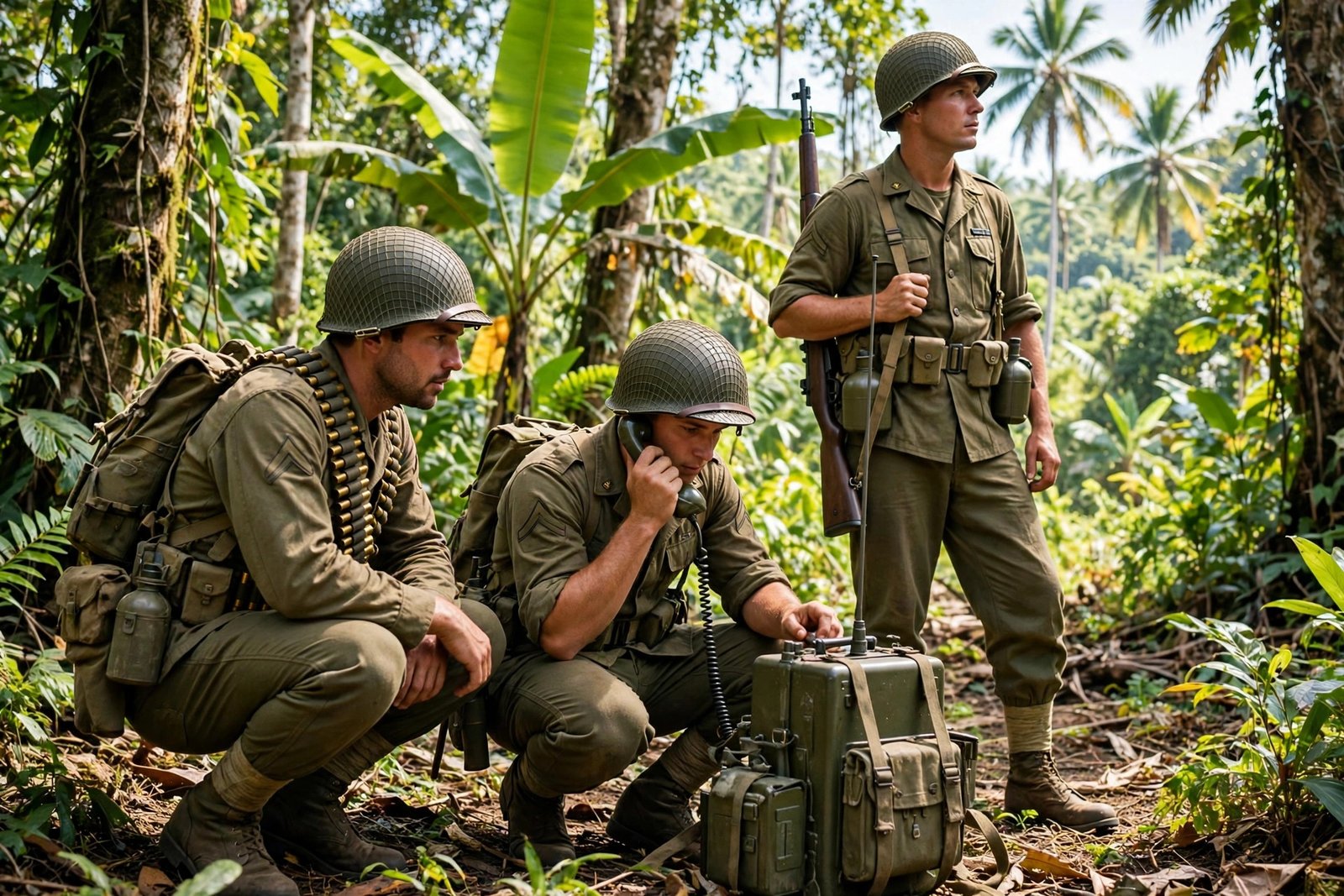
During World War II, the United States Marine Corps faced a problem that had plagued armies for centuries: how to send messages quickly on a battlefield without the enemy listening in. Mechanical codes took hours to encrypt and decrypt, and Japanese code breakers, among the best in the world, intercepted many American messages. The solution came from an unlikely place: the language of the Navajo people, spoken by fewer than thirty non-Navajo people in the entire world, according to Marine Corps estimates at the time. Recruited as Code Talkers, Navajo Marines created a code based on their own language that the enemy never broke, not once, in three years of war. Their story is one of the most remarkable in American military history, and it remained classified until 1968, more than two decades after the war ended.
The idea came from Philip Johnston, a missionary’s son who had grown up among the Navajo people in northern Arizona and spoke their language fluently. As a boy, Johnston had served as an interpreter for a Navajo delegation to Washington, and he understood both the complexity of the Navajo language and its value as a code. In 1942, after reading about an Army unit experimenting with Native American languages for code, Johnston proposed to the Marine Corps that Navajo be developed into a voice code for battlefield communications. The Marines were skeptical at first. Earlier experiments with Native languages had raised fears that a code based on a spoken language could be cracked if the enemy captured a speaker. But Johnston argued that Navajo was different: it was unwritten, tonal, and extraordinarily complex, with a grammar and vocabulary unlike any European or Asian language.
Building an unbreakable code
The Marine Corps approved a pilot project, and on May 5, 1942, the first 29 Navajo recruits arrived at the Marine recruit depot in San Diego for basic training. After the same seven weeks of basic training as any other recruit, they moved to Camp Elliott for specialized instruction in radio operation and message transmission. There, working with Johnston and Marine officers, they built the code itself. It was not simply Navajo spoken plainly. The Code Talkers developed a dictionary of more than 200 Navajo words assigned to military terms: planes became birds, with different birds for different aircraft types, tanks became tortoises, submarines became iron fish, and so on. For words with no Navajo equivalent, they created a phonetic alphabet in which each English letter was represented by a Navajo word, chosen so that the first letter of the Navajo word matched the English letter.
The result was a two-layer code: a Navajo speaker who had not been trained in the code could not understand it, because the word substitutions made no literal sense, and a trained code breaker who did not speak Navajo could not even begin. The Code Talkers memorized the entire dictionary. Nothing was written down, so there was nothing for the enemy to capture. Messages that took hours to encrypt and decrypt by machine could be translated, transmitted, and retranslated in minutes. In a famous demonstration, the Code Talkers translated a test message in two and a half minutes, a feat that stunned Marine officers and secured the program’s future.
By the end of the war, between 375 and 420 Navajos had served as Code Talkers, according to National Archives estimates, with the Marine Corps training more than 400. They served in every major Marine operation in the Pacific, from Guadalcanal in 1942 to Iwo Jima and Okinawa in 1945, transmitting tactical information over telephone and radio under fire. Their work was so secret that even other Marines often did not know what they were doing. On Guadalcanal, an Army patrol once captured a Navajo communicator and, hearing him speak an unfamiliar language over the radio, reported to headquarters that they had captured a Japanese soldier in Marine clothing. The confusion was understandable, and it underscored just how secret, and how strange, the program seemed even to Americans.
Iwo Jima: the code’s finest hour
The Battle of Iwo Jima, in February and March 1945, was the Code Talkers’ finest hour. Six Navajo Code Talkers worked around the clock during the invasion, transmitting more than 800 messages without a single error. Major Howard Connor, the signal officer for the 5th Marine Division at Iwo Jima, later said that were it not for the Navajos, the Marines would never have taken Iwo Jima. That is a striking claim from a senior officer, and it reflects how completely the Marines had come to depend on the code. In the chaos of an amphibious assault, where orders, artillery coordinates, and casualty reports must move in minutes, the Code Talkers gave commanders a channel they could trust absolutely.
The same pattern held across the Pacific. At Guam and Peleliu, Marine reports described the use of Code Talkers as indispensable for the rapid transmission of classified documents. At Okinawa, Code Talkers worked through the long, grinding campaign, often under artillery fire, relaying messages that decided where troops moved and where shells fell. The Japanese, skilled code breakers who had broken many Allied codes, never broke the Navajo code. After the war, Japan’s own chief of intelligence admitted that the Navajo code was the one code they were never able to decipher.
The Code Talkers were not the only Native Americans to serve as code talkers. During World War I, Choctaw soldiers had transmitted messages in their own language, and during World War II, the Army recruited code talkers from the Kiowa, Hopi, Creek, Seminole, and other tribes for service in Europe and North Africa. But the Navajo program was the largest and the most famous, and its scale, more than 400 men, and its record, zero messages broken, set it apart.
Silence, then recognition
When the war ended, the Code Talkers were ordered to keep silent. The code remained classified, because the military believed it might be needed again, and the men returned to civilian life without telling their families, their communities, or even each other what they had done. For more than two decades, their service was a secret they carried alone. Many went on to work as teachers, ranchers, miners, and public servants on the Navajo Nation, and their children grew up knowing only that their fathers had served, not how.
The silence finally broke in 1968, when the program was declassified. Recognition followed slowly but steadily. In 2000, Congress passed the Honoring the Code Talkers Act, authorizing the President to award the Congressional Gold Medal to each of the original 29 Code Talkers and the Congressional Silver Medal to those who served later. On July 26, 2001, in a ceremony in the Rotunda of the U.S. Capitol, the original Code Talkers received their gold medals, and their families accepted medals for those who had died. It was a moment of national gratitude, six decades in the making.
Today, the story of the Navajo Code Talkers is taught in schools, preserved in museums, and honored by the Navajo Nation and the Marine Corps. The Navajo Code Talker Dictionary, once a closely guarded secret, is now public, and visitors can see it at the National Archives and the National Museum of the American Indian. The last of the original Code Talkers have passed away, but their legacy endures in a simple truth: a language that boarding schools once tried to suppress became the weapon that helped win a war, and the men who spoke it became heroes precisely because of who they were.
Visitors who want to learn more can explore the Navajo Nation Museum in Window Rock, Arizona, and the Navajo Code Talkers exhibits at museums across the country, where the dictionary, photographs, and oral histories bring the story to life. The Marine Corps also honors the Code Talkers in its own museums and memorials. Perhaps the most fitting tribute, though, is simpler: learning a few words of the Navajo language, and remembering that a language once punished in boarding schools became, in the hands of brave young Marines, an instrument of freedom.
Frequently asked questions
What was the Navajo code? A voice code built from the Navajo language, with more than 200 Navajo words assigned to military terms plus a phonetic alphabet for spelling. Code Talkers memorized it; nothing was written down.
How many Navajo Code Talkers were there? The original group numbered 29, recruited in May 1942. By the end of the war, between 375 and 420 Navajos had served as Code Talkers.
Was the code ever broken? No. Japanese code breakers never deciphered the Navajo code, and Japan’s chief of intelligence admitted as much after the war.
Why was the program kept secret until 1968? The military classified the code in case it was needed again, and Code Talkers were ordered not to discuss their service even with their families.
When were the Code Talkers honored? Congress authorized the Congressional Gold Medal in 2000, and the original 29 received their medals in a Capitol ceremony on July 26, 2001.
Related reading
- Buffalo Soldiers: America’s First Black Regiments
- The 442nd Regimental Combat Team: WWII’s Most Decorated Unit
- The Ghost Army: WWII’s Inflatable Tanks and Gold Medal
Sources: National Archives: Semper Fidelis, Code Talkers, CIA: Navajo Code Talkers and the Unbreakable Code.