
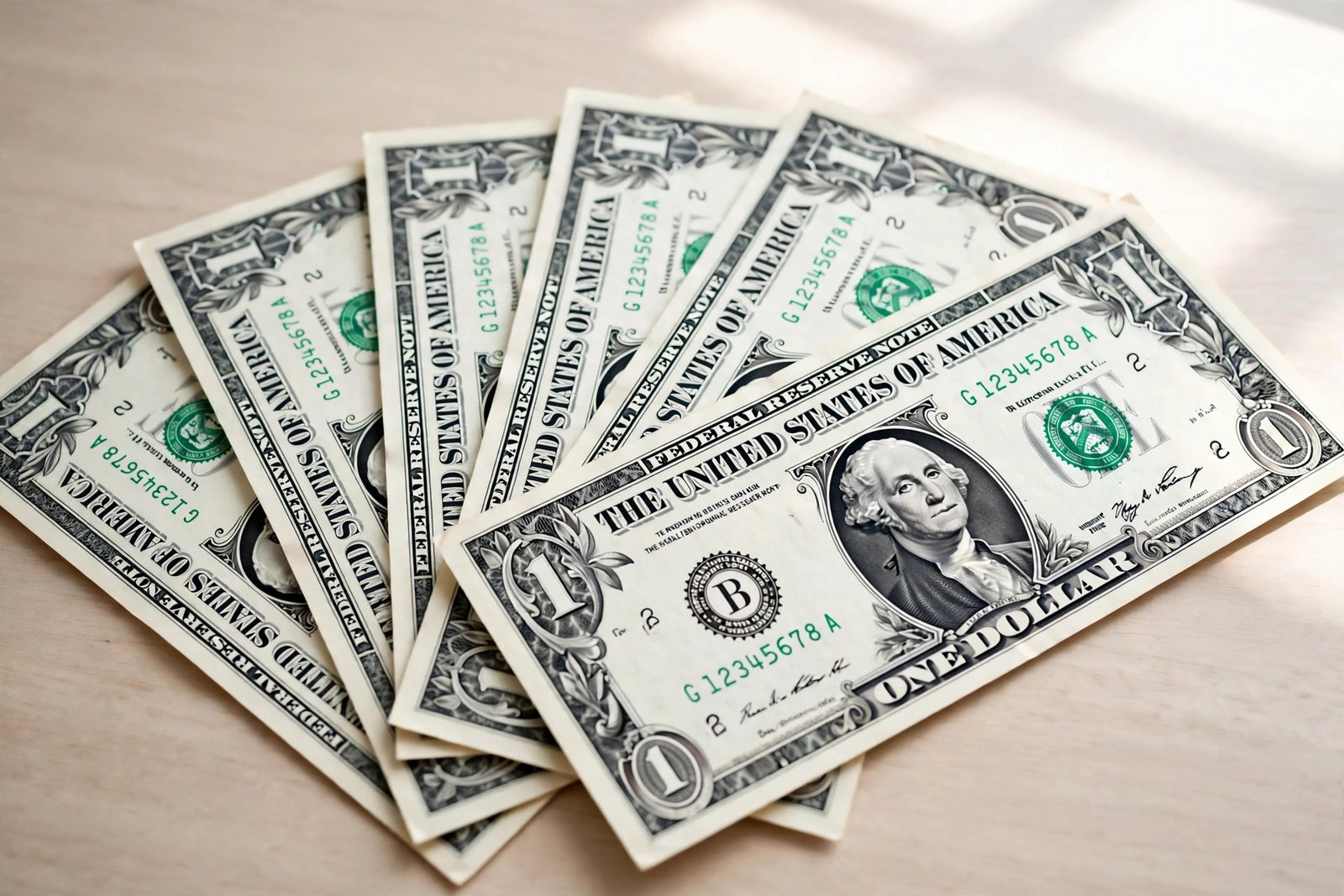
Pull a dollar bill out of your wallet and look at it. It is green. Pull out a five, a ten, a twenty, or a hundred, and the story is the same: green backs, green seals, green serial numbers. Americans handle this color every single day, yet most of us have never stopped to ask why. Other countries print their money in bright blues, pinks, purples, and oranges. Canada has polymer bills in vivid blue and red. Europe’s euro notes come in a rainbow of colors by denomination. So why did the United States settle on one steady shade of green and then never let it go?
The answer stretches back more than 160 years, to a nation at war with itself and desperate for cash. It involves a clever printing company, a brand-new technology called photography, and a government that discovered green ink was the hardest color in the world to fake. The green dollar was born out of crisis and locked in by a decision in 1929 that still shapes every bill in your pocket today.
A Nation at War Needed Money Fast
When the Civil War broke out in 1861, the United States faced a problem as urgent as any battlefield defeat: it needed money, and it needed it immediately. Until then, the federal government had never issued paper money for general circulation. Everyday paper currency came from hundreds of state-chartered banks, each printing its own notes in its own designs and colors, a confusing patchwork and a counterfeiter’s dream.
In the summer of 1861, the government contracted with the American Bank Note Company to print a new kind of federal paper money called Demand Notes, so named because they were redeemable on demand for gold coins at Treasury facilities. The following year, the government introduced United States Notes, a new series of paper money that was declared legal currency without gold backing. Both series featured reverse sides printed in a distinctive green ink patented by the American Bank Note Company. Americans quickly gave them a nickname that has survived ever since: greenbacks.
The name stuck because the color was impossible to miss. In an era when most banknotes were printed in black ink on plain paper, a bill with a bold green back stood out at a glance. Soldiers were paid in greenbacks. Shopkeepers accepted them. Farmers tucked them into coffee cans. Within a few short years, the color green and the idea of American money had fused together in the public mind.
Why Green? The Counterfeit Problem
Here is the honest truth, and the Bureau of Engraving and Printing says it plainly: no definite explanation survives for why green was chosen in the first place. The records of that decision are lost, and the Bureau itself states that no certain reason can be given. But historians and the Bureau’s own publications point to a strong and sensible explanation, and it has everything to do with stopping criminals.
The 1860s were the dawn of photography. Cameras were becoming cheaper and more common, and counterfeiters quickly realized that a photograph of a banknote could be used to make a convincing fake. The catch was that early cameras saw the world only in black and white. Anything printed in color lost its individuality when photographed, as the Bureau of Engraving and Printing explains in its publication Currency Notes. Green ink, in particular, photographed poorly. A counterfeiter who tried to copy a greenback with a camera ended up with a washed-out image that was easy to spot.
Green had another advantage that mattered just as much. Unlike inks in other colors, green ink could not be chemically removed from a note without disturbing the black ink printed over it. Removing the colored ink was an essential step in the counterfeiting process of the day, because criminals would bleach a low-denomination bill and reprint it as a higher one.
There was also a practical side. Green pigment was readily available in large quantities, and the green inks of the era were unusually stable. They resisted fading in sunlight and held up against chemical and physical wear far better than many competing colors. A bill that stays readable is a bill people trust, and in the middle of a war, trust was worth more than gold.
How Green Ink Survived the End of the War
When the Civil War ended in 1865, the greenback could easily have disappeared with it. The emergency was over, the government could have returned to gold-backed notes in any color it liked, and plenty of people expected exactly that. Instead, green stayed. As the banking system was streamlined in the years that followed, green-tinted money remained the standard, even as the Bureau of Engraving and Printing pushed private printers aside and took over the whole process in 1877.
The color survived another great transition in 1914, when the brand-new Federal Reserve System unveiled the first series of Federal Reserve Notes. Those notes, the direct ancestors of the bills in your wallet today, were green too. By then, the association was set in stone. Green was not just a color anymore. It was the look of American money, and Americans had come to trust it on sight.
Tradition played a part, but so did the original logic. Counterfeiting never went away, and green ink kept doing its quiet job. Every time the government had a chance to change the color, the same arguments came back: the pigment was cheap and plentiful, it resisted wear, and it was hard to fake.
The 1929 Decision That Locked It In
The real turning point came in the late 1920s, when the Treasury decided to redesign American currency and shrink every bill to a smaller size. The old large-size notes were expensive to print and awkward to carry, and the new small-size bills that debuted in 1929 are the same size as the ones we use today. That redesign was the perfect moment to rethink the color. The government could have switched to anything. It chose to stay green, and the Bureau of Engraving and Printing later gave three reasons for the decision.
First, pigment of that color was readily available in large quantities, which mattered when you are printing billions of notes. Second, the color was relatively high in its resistance to chemical and physical changes, meaning bills would survive longer in circulation. Third, and most interestingly, the public had come to psychologically identify the color green with the strong and stable credit of the government. Green meant America could pay its debts. Changing the color would have meant throwing away decades of built-up trust for no good reason.
That decision is why your wallet looks the way it does today.
What American Money Is Actually Made Of
Here is a surprise for anyone who has ever called a dollar bill paper money: it is not paper at all, at least not in the way we normally mean the word. United States currency is printed on a special blend of 75 percent cotton and 25 percent linen. That is closer to a shirt than to a page from a notebook, and it explains the crisp snap a fresh bill makes and the way an old one softens like cloth instead of crumbling like paper.
The material has been supplied by Crane Currency, a company based in Dalton, Massachusetts, since 1879. Look closely at any bill and you will see tiny red and blue fibers scattered across its surface. These are not printed on. They are synthetic security fibers mixed into the pulp while it is still wet, so they sit inside the material itself. Counterfeiters often try to fake them by printing red and blue specks on the surface, but the fakes sit flat on top, while the real fibers are woven in.
The printing itself is just as special. The Bureau of Engraving and Printing uses a technique called intaglio printing, in which massive presses force the cotton-linen blend into the recessed grooves of an engraved metal plate filled with ink. That is why the portrait and the borders of a real bill feel slightly raised when you run your fingernail across them. The black ink on the front even contains magnetic particles, which lets bank machines verify a bill by reading its magnetic signature.
Why Other Countries Went Colorful and America Did Not
Travel abroad and the difference is obvious. The euro uses a different color for each denomination, so a 5 euro note is gray, a 10 is red, a 20 is blue, and a 50 is orange. Canada, Australia, and many other countries use bright, distinct colors and even clear plastic windows to help people tell bills apart at a glance. So why has America stuck with one color for every denomination?
Part of the answer is simple inertia. By the time other countries began redesigning their currencies in bright colors, the green dollar was already one of the most recognized symbols on earth. Changing it would have been like changing the flag. The greenback had become a global brand, and the United States had no reason to give that up.
But there is a practical answer too. American bills rely on portraits and numerals rather than color to tell denominations apart, and the system works well enough that the government has never felt forced to change it. After a lifetime of handling them, most Americans can identify a bill by its face alone.
That said, the United States has not ignored color entirely. Starting with the redesigned $20 bill in 2003, the Treasury began adding subtle background colors to higher denominations: peach and blue tints on the $20, a soft orange and purple on the $50, and a pale blue ribbon on the $100. These colors are deliberately understated, a nod to modern design that never challenges green’s place as the dominant color. The message is clear: America will modernize its money, but it will not abandon its identity.
The Hidden Security in the Green of Today
Modern American bills carry far more security than green ink alone, and the green tradition now works alongside a whole toolkit of features designed to defeat counterfeiters. The most famous is the watermark, a faint image of the portrait embedded in the paper itself, visible when you hold the bill up to the light. Because it is created by varying the thickness of the cotton-linen fibers while the paper is still wet, it cannot be printed or photocopied onto a fake.
Then there is the security thread, a thin vertical strip embedded in the paper of every bill of $5 and higher. Hold the note to the light and you can see it running through the bill. Under ultraviolet light it glows a different color for each denomination, and it carries tiny microprinting that names the denomination. On the $100 bill, the thread reads USA 100 and glows pink under ultraviolet light.
Higher denominations also carry color-shifting ink. Tilt a $10, $20, $50, or $100 bill and the numeral in the lower right corner changes color, shifting from copper to green as the angle changes. The $100 bill adds a wide blue 3-D security ribbon woven into the paper, with bells and 100s that appear to move as you tilt the note. Add in the microprinting hidden along collars and borders, and you have a bill that is remarkably hard to fake convincingly.
All of this sits on top of the original green. The color that started as a cheap, durable, hard-to-photograph ink in 1861 is now the foundation of one of the most secure currencies in the world, backed by the Treasury, the Federal Reserve, the Bureau of Engraving and Printing, and the Secret Service working together.
How to Spot a Real Bill Like a Pro
You do not need special equipment to check your money. The Treasury’s own advice boils down to a simple habit: feel it, tilt it, and check it. Feel the raised printing on the portrait and the crisp texture of the cotton-linen blend. Tilt the bill and watch the color-shifting numeral change from copper to green. Hold it up to the light and look for the watermark and the security thread. If a bill feels smooth like ordinary paper or shows no thread when held to the light, it deserves a second look.
So the next time you pay for coffee or tip a server, take a second to look at the bill in your hand. That green is not an accident and it is not just tradition for tradition’s sake. It is a piece of Civil War history, a clever piece of 19th-century anti-counterfeiting engineering, and a symbol that the world has trusted for more than a century and a half. Green was chosen because it was hard to fake, it was kept because it was hard to wear out, and it endures because it became, quite simply, the color of America.
Related reading: US Money Facts: Why Coins Have Ridges and What a Penny Costs · The US Dollar as the World’s Reserve Currency, Explained · How US Zip Codes Work: History Explained
FAQs
Q: Why are US dollar bills green?
A: The green dates to the Civil War, when the government issued Demand Notes in 1861 and United States Notes in 1862 with green ink on the back, earning the nickname greenbacks. The Bureau of Engraving and Printing says no definite explanation survives, but green ink was likely chosen because it resisted fading, was readily available, and was hard for counterfeiters to reproduce with early black-and-white photography.
Q: What is US paper money actually made of?
A: It is not wood-pulp paper at all. US currency is printed on a blend of 75 percent cotton and 25 percent linen, with tiny red and blue security fibers embedded in the material. The blend has been supplied by Crane Currency of Dalton, Massachusetts, since 1879.
Q: When did US bills get their modern small size?
A: The small-size bills we use today were introduced in 1929, when the Treasury redesigned the currency to save on production costs. That redesign kept green ink for three reasons: the pigment was plentiful, it resisted chemical and physical changes, and the public identified green with the strong and stable credit of the government.
Q: Do other countries use green money too?
A: Many countries use colorful bills, with a different color for each denomination, and some use polymer plastic instead of cotton-linen blends. The United States has kept green as its dominant color while adding only subtle background tints to higher denominations since 2003.
Q: What security features should I check on a bill?
A: Feel the raised intaglio printing, tilt the bill to see the color-shifting numeral change from copper to green on denominations of $10 and up, and hold it to the light to find the watermark and the embedded security thread, which glows under ultraviolet light.