
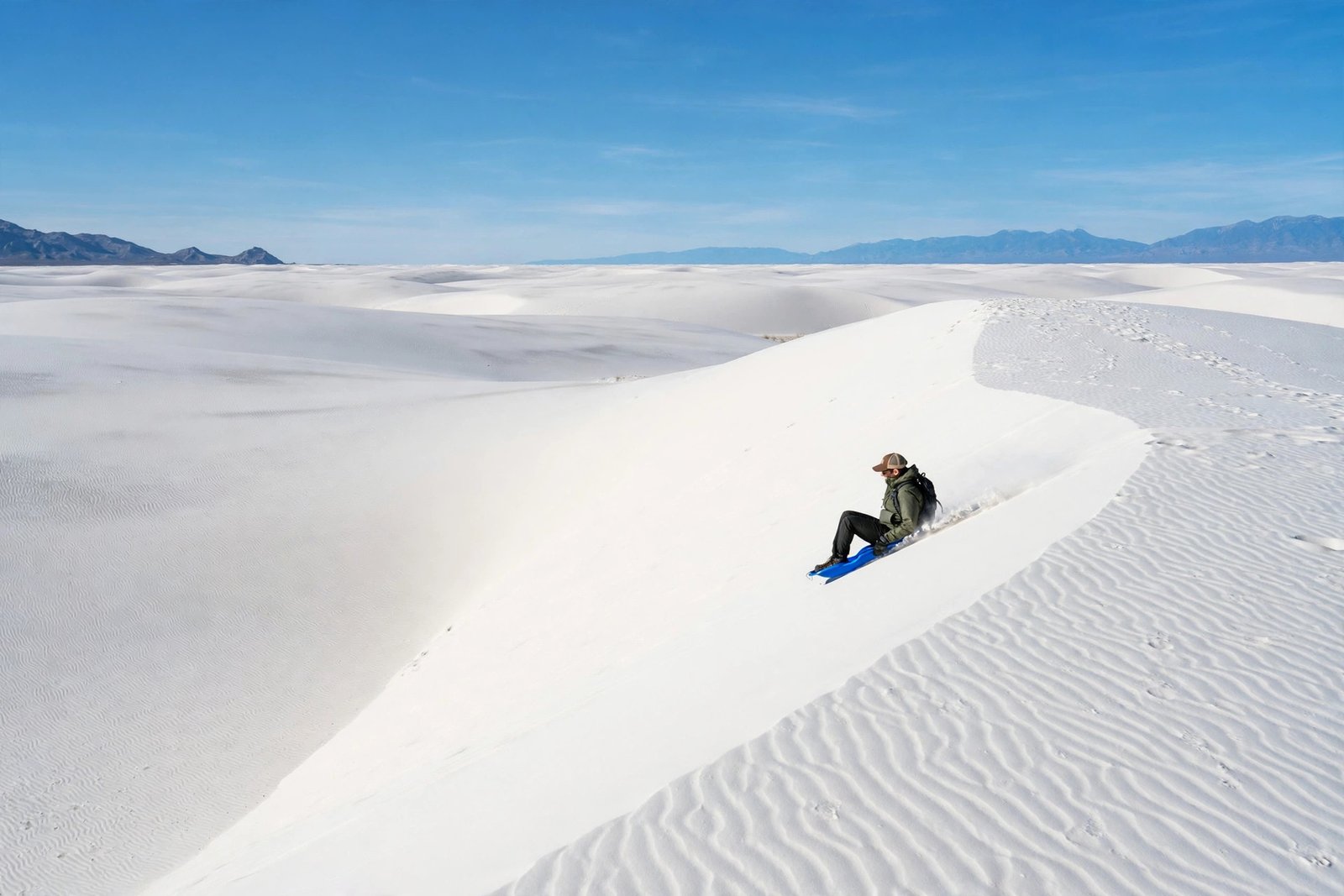
There is a place in southern New Mexico where the desert turns white, where dunes rise like snowdrifts under a blue sky, and where your footprints vanish behind you as the wind smooths the sand. White Sands National Park protects the world’s largest gypsum dune field, a landscape so unusual that first-time visitors often stop at the entrance and simply stare. It is not snow, it is not beach sand, and it is not a mirage, although on a hot afternoon it can look like all three at once.
Located in the Tularosa Basin in south-central New Mexico, White Sands covers a vast field of brilliant white dunes made of gypsum crystals. The National Park Service describes the dune field as covering 275 square miles, making it the largest gypsum dune field on Earth. The park protects a major portion of that field, with the remainder lying within the neighboring White Sands Missile Range. The dunes are young by geological standards, less than ten thousand years old, and still shifting with the wind.
For travelers who love national parks but want something different from mountains and canyons, White Sands is a hidden gem: easy to reach, unforgettable, and unlike anywhere else in the United States. A single day here can include sledding down a white dune, hiking across an open dune field, and watching the light change at sunset. This guide explains how the dunes formed, what to do, and how to plan a safe visit.
How the White Dunes Formed
The story of White Sands begins with water, not sand. Long ago, a large ancient lake, known as Lake Otero, covered much of what is now the Tularosa Basin. As the climate changed and the lake dried, it left behind mineral-rich deposits on the basin floor. Rainwater and groundwater continue to dissolve gypsum from the surrounding mountains and carry it toward low-lying areas such as Lake Lucero, a seasonal playa, or dry lakebed, in the park.
When the shallow water in Lake Lucero evaporates under the desert sun, it leaves gypsum behind. The gypsum forms crystals on the lakebed, and wind breaks those crystals into grains and carries them northeast across the basin. Over thousands of years, those grains have piled into dunes.
That process is still happening today. White Sands is what geologists call a wet dune system, shaped by both wind and groundwater. Moisture near the surface helps hold the sand in place, while dry, windy periods allow the dunes to shift. The result is a living landscape: dune crests move, interdune flats appear and disappear, and no two visits look exactly alike. The highest dunes reach about sixty feet, and the depth of gypsum sand across the field is about thirty feet below the surface between dunes, according to Park Service statistics.
Why the Sand Is White
Most desert sand is made of quartz and other minerals that give it a tan or reddish color. White Sands is different because its sand is almost pure gypsum, a soft mineral that is naturally white and translucent. Gypsum is unusual as a dune material because it dissolves in water, which is why gypsum dune fields of this size are so rare. In most places, rain would wash gypsum away before dunes could form. At White Sands, the basin has no outlet to the sea, so dissolved gypsum stays trapped, concentrates, and keeps rebuilding the dunes.
The whiteness has a practical effect that visitors notice immediately: gypsum sand does not absorb heat the way darker sand does. On a summer day, you can walk barefoot on the dunes without the burning sensation you might expect from a desert. That does not mean the desert is gentle. There is no shade on the open dunes, the sun reflects brightly off the white surface, and dehydration and sunburn are real risks. Sunglasses, sunscreen, a hat, and plenty of water are essential, even when the sand feels cool underfoot.
The brightness also creates extraordinary light. At midday, the dunes can look almost blindingly white against the sky. At sunrise and sunset, they take on soft pinks, golds, and purples as the low sun rakes across the dune crests. The best photographs often come in the first and last hours of the day.
Driving Dunes Drive
The main route through the park is Dunes Drive, an eight-mile paved road that winds from the visitor center deep into the heart of the dune field. It is the backbone of any visit, and most of the park’s trailheads, picnic areas, and sledding spots branch off it. Driving slowly is part of the experience. The road rises and falls with the dunes, and around each bend a new vista opens up, with the San Andres Mountains to the west and the Sacramento Mountains to the east framing the white expanse.
Stop at the overlooks and short trails along the way rather than rushing to the end. The Interdune Boardwalk, an accessible raised walkway, offers an easy introduction to dune ecology without a long hike. The Dune Life Nature Trail, about a mile long, introduces the plants and animals that survive in this harsh environment. Both are ideal for families, for visitors short on time, and for anyone who wants to understand the dunes before tackling a longer hike.
One important planning note: White Sands sits entirely within the White Sands Missile Range, and the park road and nearby U.S. Highway 70 can close for missile testing, sometimes for up to three hours. Closures are not daily, but they do happen, so check the park’s alerts and conditions page the day before your visit and again on the morning you travel. A little flexibility in your schedule will save frustration if a closure delays your arrival.
Sledding Down the Dunes
Sledding is the activity most visitors remember best, and for good reason. Sliding down a steep white dune on a plastic saucer feels like sledding on snow, except that you are in the Chihuahuan Desert in New Mexico. The National Park Service notes that excellent sledding dunes are located just outside the Alkali Flat Trailhead parking area, at the end of Dunes Drive, where tall dunes line the parking lot and offer plenty of sledding locations.
Sleds can be purchased or rented at the White Sands Trading Post gift shop in the visitor center area, or you can bring your own waxed plastic saucer. Wax helps the sled glide on gypsum sand, which behaves differently from snow. Choose a dune with a gentle slope and a flat run-out at the bottom, and check the run for plants, hard-packed sand, and other visitors before you start. Always sled feet first, never head first or standing up, and supervise children closely.
Safety matters here, especially for younger children. The Park Service advises that the visitor center is the only place in the park with drinking water, and suggests bringing about a gallon of water per person for a sledding visit, along with sun protection. Children ages five to nine are most susceptible to sledding injuries, so parents should not let young children sled alone, and older children should be coached to check for hazards such as vegetation and other visitors.
Hiking the Alkali Flat Trail
For hikers, the signature route is the Alkali Flat Trail, a strenuous five-mile round trip that climbs dune after dune to the dry lakebed of ancient Lake Otero. The trail is marked by posts with red diamond markers rather than a worn path, because the sand shifts constantly and a fixed trail would soon disappear. Following the markers, keeping the next post in sight, and turning back if blowing sand hides the route are essential skills here.
Allow about three hours for the full hike, and start early, especially in warmer months. There is no shade and no water along the trail, so carry far more water than you think you need, wear sun protection, and turn back when half your water is gone. The Park Service and experienced guides advise against starting the Alkali Flat Trail when temperatures are high, and hikers should be off the trail well before sunset.
If a five-mile dune hike sounds like too much, the shorter trails still deliver the White Sands experience. The Dune Life Nature Trail and the Interdune Boardwalk are both excellent, and a short walk from any Dunes Drive pullout into the dunes gives a taste of the landscape without a major commitment. The key is to respect the desert: tell someone your plan, carry water, and do not wander beyond the markers in poor visibility.
Sunset, Full Moon Nights, and Ranger Programs
White Sands changes completely as the day ends. The ranger-led Sunset Stroll, a roughly one-hour guided walk timed to end as the sun drops, is one of the park’s most popular programs. A ranger explains the geology, plants, and animals of the gypsum field while the light turns the dunes gold and then pink. The stroll is generally easy, requires no reservation, and meets near the end of Dunes Drive, though schedules vary by season, so check at the visitor center on the day you visit.
On selected evenings around the full moon, the park stays open late for Full Moon Nights, when visitors can experience the dunes under moonlight. The white gypsum reflects moonlight so strongly that the landscape glows, and shadows stretch across the dune crests in a way that feels almost unreal. Some Full Moon Nights include ranger talks, music, or cultural programs. These evenings are generally offered in the warmer months, and dates vary, so check the park’s event calendar in advance and arrive early, as parking can fill.
Other ranger programs include guided hikes to Lake Lucero, the playa where the gypsum dunes originate, offered on selected dates and requiring advance booking. For families, the Junior Ranger program at the visitor center gives children activities that turn a visit into a hands-on lesson in desert ecology.
Wildlife and Plants That Thrive in the White Desert
At first glance, White Sands looks lifeless, but it is home to a surprising community of plants and animals. The Park Service notes that more than eight hundred animal species live in the park, along with hundreds of plant species. Many animals here have adapted to the white landscape in remarkable ways: some insects and lizards are paler than their relatives elsewhere, blending into the gypsum, while others are active mainly at night to avoid the daytime heat.
Plants play a critical role in stabilizing the dunes. Species such as soaptree yucca anchor the leading edges of dunes with deep roots, slowing the wind and holding sand in place. In the areas between dunes, a living crust of tiny organisms helps bind the soil surface. Look for animal tracks in the sand, especially in the morning before the wind erases them: footprints of birds, rodents, foxes, and lizards tell the story of a busy nighttime desert.
Visitors should enjoy wildlife from a distance, never feed animals, and stay on designated routes where required. The desert ecosystem at White Sands is finely balanced, and small disturbances can take years to recover.
Practical Tips for Visiting White Sands
A little planning makes a White Sands visit far more comfortable. Entrance fees, as listed by the Park Service and recent guides, are twenty-five dollars per private vehicle, twenty dollars per motorcycle, and fifteen dollars per person on foot or bicycle, valid for seven days, with visitors under sixteen admitted free. The America the Beautiful pass is also accepted. Fees can change, so confirm the current rate on the Park Service fees page before you travel. The park is generally open daily, except Thanksgiving and Christmas Day, with hours varying by season, so check current hours before you go.
Water is the single most important item to bring. There is no water on the dunes, and the visitor center is the only place in the park where drinking water is available. Carry at least a gallon per person for a full day of sledding and hiking, plus extra in the car, and drink before you feel thirsty. Add sunscreen, sunglasses, a wide-brimmed hat, and lip balm to your kit, because reflected sunlight off white sand can burn skin and eyes quickly. Wear closed-toe shoes for hiking, though many visitors enjoy walking barefoot on the cool gypsum for short stretches.
There is no lodging, restaurant, or campground inside the park, and backcountry camping has been closed in recent years, so most visitors base themselves in nearby Alamogordo or Las Cruces and visit White Sands as a day trip. Alamogordo is a short drive away and offers hotels, restaurants, and fuel. Fill your tank, pack snacks, and bring a picnic if you plan to stay through sunset.
Finally, remember that weather and missile-range closures can alter plans with little notice. Check the park’s alerts page, watch the forecast for thunderstorms in summer, and be prepared to adjust. A flexible plan, plenty of water, and an early start will give you the best chance of experiencing White Sands at its most beautiful.
Frequently Asked Questions
Where is White Sands National Park? White Sands National Park is in south-central New Mexico, in the Tularosa Basin, about fifteen miles southwest of Alamogordo. It sits entirely within the White Sands Missile Range.
Why is the sand at White Sands white? The sand is almost pure gypsum, a naturally white mineral. Gypsum dissolved from surrounding mountains collects in Lake Lucero, crystallizes as the water evaporates, and is carried by wind into dunes.
Can you sled at White Sands National Park? Yes, sledding is allowed year-round on suitable dunes, especially near the Alkali Flat Trailhead. Waxed plastic saucers work best, sleds are sold or rented at the park gift shop, and visitors should always sled feet first.
How long is the Alkali Flat Trail? The Alkali Flat Trail is a strenuous five-mile round trip that takes about three hours. It is marked by posts, has no shade or water, and should be started early in the day with plenty of water.
When is the best time to visit White Sands? Spring and fall generally offer the most comfortable temperatures. Sunset and Full Moon Nights, offered in warmer months, are especially memorable, but always check current hours, closures, and program schedules before you go.
Related reading
Discover more American hidden gems on Trending 4: Marfa, Texas: Art Pilgrimage and the Marfa Lights, Apostle Islands: Sea Caves and Ice Caves, and The Monarch Butterfly Migration.
Sources: National Park Service, White Sands Inventory and Monitoring, National Park Service, Sledding at Alkali Flat Trailhead, and National Park Service, White Sands Park Statistics.