
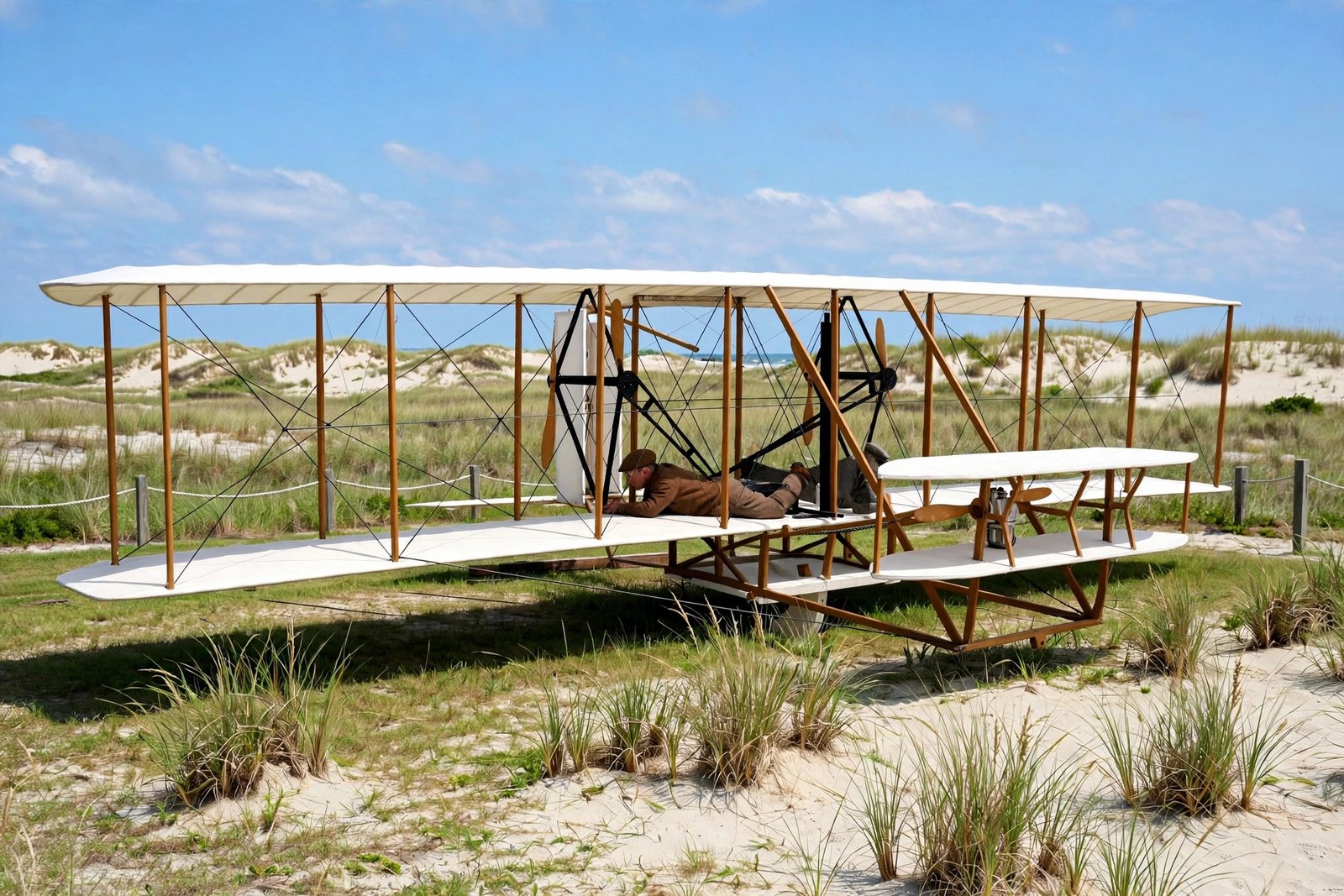
On a cold, windy morning in December 1903, two bicycle makers from Ohio did something no one had ever done before. On the sand dunes of North Carolina’s Outer Banks, Wilbur and Orville Wright lifted a heavier-than-air machine into the sky under its own power, kept it under control, and brought it safely back to the ground. The first flight lasted only 12 seconds. It changed the world forever.
Today, that windswept stretch of sand is home to the Wright Brothers National Memorial, and the fragile wood-and-fabric airplane that flew there hangs in the Smithsonian’s National Air and Space Museum in Washington, D.C. But on December 17, 1903, there was no crowd, no ceremony, and almost no one watching. Just two brothers, a handful of helpers from a nearby lifesaving station, and a machine they had built with their own hands.
The Bicycle Makers From Dayton
Wilbur Wright was born in 1867 and Orville Wright in 1871, and the brothers grew up in Dayton, Ohio, where they eventually ran a bicycle shop. Bicycles may seem like an odd starting point for aviation, but the work taught them exactly the skills they needed: how to build light, strong machines, how to balance competing forces, and how to test an idea, watch it fail, and try again. The brothers were careful, methodical experimenters, and they approached flying as an engineering problem to be solved step by step rather than a stunt to be attempted on a single daring day.
Their interest in flight went back to childhood, when their father, a bishop, brought home a small rubber-band-powered toy helicopter. As adults, they followed the work of glider pioneers closely, and the death of the German glider experimenter Otto Lilienthal in a crash in 1896 sharpened their determination. If humans were ever going to fly, the Wrights believed, the answer would not be brute power alone. It would be control. A flying machine had to be steered in the air the way a bicycle is steered on the road, constantly adjusted by its rider.
Why Kitty Hawk?
In 1900, the brothers began looking for a place to test their gliders. They needed steady winds, soft ground for landings, and privacy. They wrote to the U.S. Weather Bureau asking about windy locations, and the reply from Joseph Dosher, who staffed the Weather Bureau office at Kitty Hawk, helped convince them. Kitty Hawk, a tiny fishing village on North Carolina’s Outer Banks, offered strong, consistent winds off the Atlantic, tall sand dunes for launching gliders, and sand soft enough to cushion a crash. It was also remote, which suited two brothers who preferred to work without an audience.
From 1900 to 1902, the Wrights returned to Kitty Hawk again and again, each season building and testing gliders. They camped in rough conditions, endured storms, mosquitoes, and cold, and kept careful records of every flight. By the end of the 1902 season, they had solved the control problem that had defeated others. Their glider could be steered reliably in three directions: up and down, side to side, and banking into turns. That system of control, known as wing-warping, was the real breakthrough. Once they could control a glider, they believed, adding an engine was the next logical step.
The 1903 Flyer
Back in Dayton during the winter of 1902 and 1903, the brothers designed and built their powered machine, which they called the Flyer. It was a biplane, with two wings stacked one above the other, built from spruce wood and covered in cotton fabric. The brothers could not buy a suitable engine, so with the help of their shop mechanic, Charlie Taylor, they built their own lightweight gasoline engine. They also designed their own propellers, treating them not as simple fans but as rotating wings, an insight that made their propellers far more efficient than anything others were using.
The Flyer was flown lying face-down on the lower wing, with the pilot working the controls by hand and by shifting his hips in a cradle. It looked fragile, and it was. But it was also the product of years of patient testing. When the brothers shipped it back to Kitty Hawk in the fall of 1903, they believed they were ready. The season, however, tested their patience. Bad weather, broken parts, and a crankshaft that cracked during testing delayed them for weeks. While they waited, news arrived that Samuel Langley, the head of the Smithsonian Institution, had tried twice to launch his own powered machine, the Aerodrome, and failed both times. The Wrights kept working.
December 17, 1903: Four Flights
December 17 dawned cold and windy, with gusts strong enough that the men at the nearby Kill Devil Hills lifesaving station wondered whether the brothers would fly at all. The Wrights decided to try. To settle who would fly first, they tossed a coin. Orville won. At 10:35 in the morning, with Wilbur running alongside to steady the wing, Orville lifted off from a wooden starting rail laid on the level sand. The flight lasted 12 seconds and covered 120 feet, about the length of a city block, into a headwind of more than 20 miles per hour. A lifesaving station crewman named John T. Daniels, who had been asked to work the camera, captured the moment in one of the most famous photographs in history.
Three more flights followed before noon, with the brothers taking turns at the controls. The second flight, by Wilbur, lasted 12 seconds and covered 175 feet. The third, by Orville, lasted 15 seconds and covered 200 feet. The fourth and final flight, by Wilbur, was the best of the day: 59 seconds in the air and 852 feet over the ground. With each attempt, the brothers handled the machine a little better, proving that the flight was not luck. It was controlled, sustained, powered flight, repeated four times in a single morning.
The day ended with a dramatic twist. After the fourth flight, as the men stood talking, a strong gust of wind caught the Flyer and flipped it across the sand several times. The damage was so severe that the machine never flew again. The brothers packed it up and shipped it back to Dayton. They had no regrets. They had already done what they came to do.
The Telegram and the World’s Slow Reaction
That afternoon, Orville walked to the Kitty Hawk Weather Bureau office and sent a telegram to his father in Dayton. Its message was simple and triumphant: the brothers had made four successful flights that morning and would be home for Christmas. The news leaked from the telegraph office, and garbled, exaggerated versions appeared in newspapers. The brothers responded with a careful public statement in January 1904, setting out the real facts: four flights, made between 10:30 in the morning and noon, directly against the wind, starting from level ground under the machine’s own power alone.
Surprisingly, the world was slow to believe them. The flights had been witnessed by only a few people, and many experts simply could not accept that two bicycle makers had solved a problem that had defeated better-funded inventors. It took public demonstration flights in 1908, when Wilbur flew before stunned crowds in France and Orville flew for the U.S. Army at Fort Myer, Virginia, before skepticism finally gave way. Within a few short years, airplanes were crossing the English Channel, carrying mail, and preparing for war. The age of aviation had begun.
The Legacy: Memorial, Museum, and Modern Flight
The Wright brothers’ achievement rippled outward in ways they could hardly have imagined. Within a generation, air travel connected continents. Within two generations, humans flew faster than sound and then walked on the Moon. Every jet that crosses the Atlantic today descends from a fragile spruce-and-cotton biplane that stayed aloft for 12 seconds on a cold beach in North Carolina.
The places that remember that morning are worth a visit. The Wright Brothers National Memorial stands at Kill Devil Hills, near the original camp, where a granite monument rises above the dune and markers on the ground trace the distances of each of the four flights. A visitor center explains the brothers’ experiments, and replicas of the camp buildings and the 1903 Flyer help visitors picture the scene. Meanwhile, the original 1903 Wright Flyer itself is on display at the Smithsonian’s National Air and Space Museum in Washington, D.C., where millions of visitors each year stand before the machine that started it all.
Perhaps the most important part of the Wright story is not the machine at all, but the method. The brothers did not succeed because they were fearless daredevils. They succeeded because they were patient, observant, and willing to learn from failure. They tested gliders for years before they ever added an engine. They measured everything. And when the world doubted them, they answered not with arguments but with more flights. That is a lesson that still lifts anyone trying to do something that has never been done before.
Frequently Asked Questions
When was the first powered flight?
The first controlled, sustained, powered flight of a heavier-than-air machine took place on December 17, 1903, at Kitty Hawk, North Carolina, when Orville Wright flew the Wright Flyer for 12 seconds over a distance of 120 feet.
Who flew first, Wilbur or Orville Wright?
Orville flew first. The brothers tossed a coin to decide who would pilot the first attempt, and Orville won. Wilbur then flew the second and fourth flights, while Orville flew the first and third.
How far did the Wright Flyer fly on December 17, 1903?
There were four flights that day. The first covered 120 feet in 12 seconds, the second 175 feet in 12 seconds, the third 200 feet in 15 seconds, and the fourth, the longest, covered 852 feet in 59 seconds.
Why did the Wright brothers choose Kitty Hawk?
Kitty Hawk offered steady Atlantic winds, soft sand for safe landings, tall dunes for glider testing, and privacy. The brothers learned about its conditions from the U.S. Weather Bureau office there and tested gliders at the site from 1900 to 1902 before attempting powered flight.
Where can I see the original 1903 Wright Flyer today?
The original 1903 Wright Flyer is on display at the Smithsonian’s National Air and Space Museum in Washington, D.C. The flight site itself is preserved as the Wright Brothers National Memorial at Kill Devil Hills, North Carolina.
Related Reading
Keep exploring American innovation and history on Trending 4: GPS, the Internet, and the Moon Landing: American Inventions, Interstate Highway System Surprising Facts, and Statue of Liberty Dedication October 28, 1886. Learn more from the National Park Service’s Wright Flight classroom guide, the Smithsonian’s account of the Wrights’ flight, and the National Weather Service’s first flight history.