
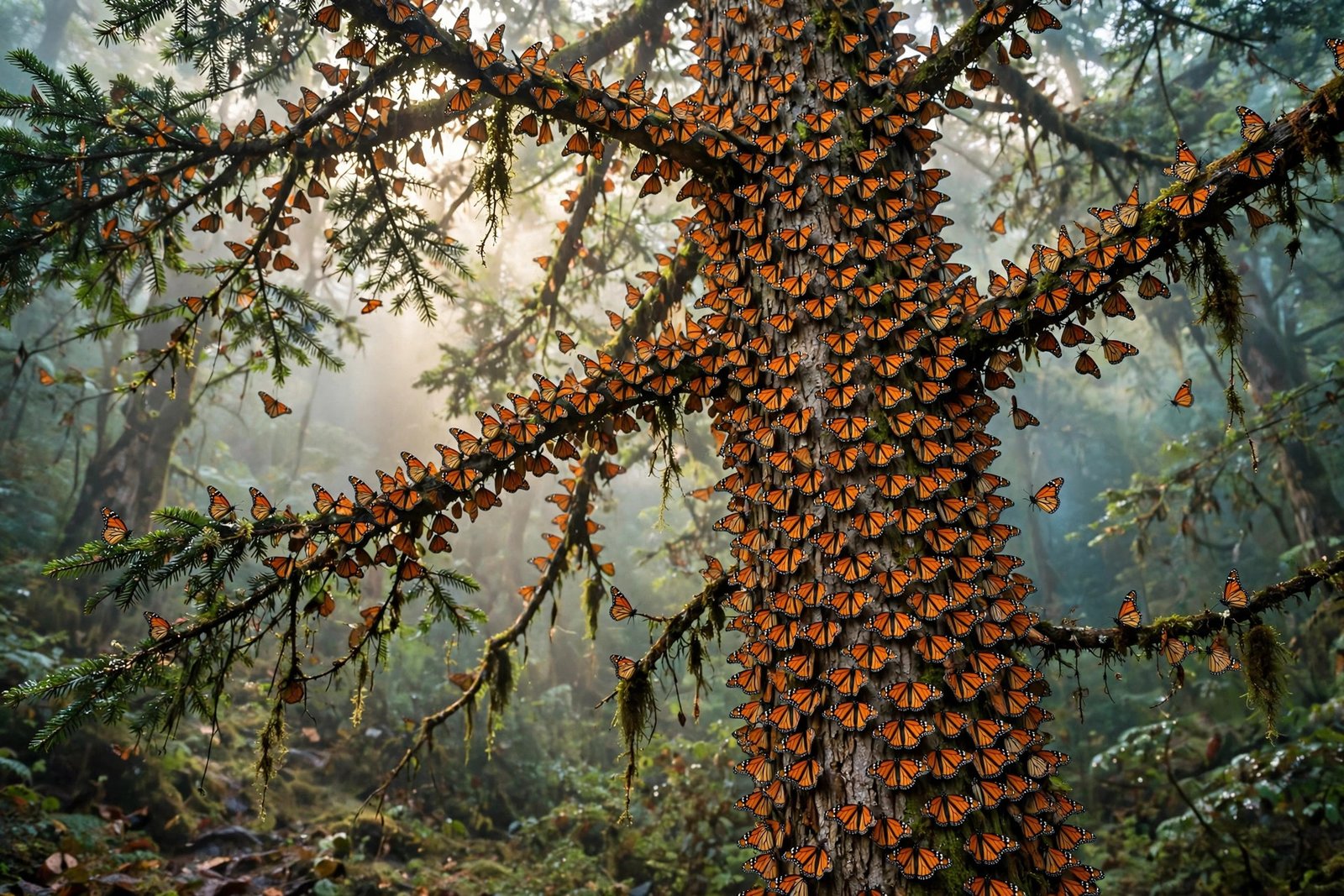
Every autumn, a butterfly weighing less than a paperclip does something no insect should be able to do. Eastern monarch butterflies — millions of them, none of whom has ever made the trip before — lift off from backyards and prairies across the United States and Canada and fly up to nearly 3,000 miles to a handful of mountain forests in central Mexico they have never seen. There, they cluster on oyamel fir trees so thickly that branches bend under their weight, and wait out the winter in a living orange blanket. Then, in spring, their descendants begin the journey home.
It is one of the great migrations on Earth, and for the past three decades it has been shrinking. The good news, arriving in the last two winter counts, is that ordinary people — schoolchildren, farmers, highway departments, and gardeners planting a scruffy native weed called milkweed — may finally be bending the curve.
A Four-Generation Relay
The monarch’s migration is not a round trip. It is a relay. The butterflies that leave Mexico in March are the great-grandparents of the ones that return the following November. As the overwintering generation flies north into Texas and the southern plains, the females lay eggs on fresh milkweed and die. Their caterpillars — which eat nothing but milkweed — grow, pupate, and emerge as a short-lived summer generation that pushes farther north, into the Midwest, the Great Lakes, and Canada. A third generation repeats the cycle through the high summer.
Then, in late August and September, something changes. The fourth generation emerges in a state scientists call reproductive diapause: instead of mating and dying within weeks, these "super generation" monarchs can live up to eight or nine months. Responding to cooling temperatures and shortening days, they turn south and fly — on thermal currents and favorable winds, sometimes more than fifty miles in a day — all the way to the oyamel forests of Mexico’s Monarch Butterfly Biosphere Reserve, in the states of Michoacán and México. How they navigate to the same few groves their ancestors used, with no guide and no memory, using the sun, the Earth’s magnetic field, and cues scientists still do not fully understand, remains one of biology’s genuine unsolved mysteries. The Encyclopaedia Britannica’s monarch entry lays out the life cycle and the migration in detail.
The Winter Forests of Oyamel
The destination is as specific as the journey is long. At elevations around 10,000 feet, oyamel fir forests create a rare microclimate: cool enough to slow the butterflies’ metabolism and conserve their fat, humid enough to keep them from drying out, and sheltered enough to protect them from lethal winter storms — mostly. The monarchs crowd together by the tens of millions in an area measured, in a good year, in a few dozen acres. Scientists do not count individual butterflies; they measure the area of forest the colonies occupy and estimate density from there.
That measurement tells the story of the decline. In the winter of 1996–97, eastern monarchs covered about 18 hectares — roughly 45 acres — of forest. By the winter of 2013–14, the colonies had shrunk to just 0.67 hectares, the lowest ever recorded. In 2023–24 they occupied only about one hectare. Against a long-term average that once ran into the hundreds of millions of butterflies, researchers estimate the eastern population has fallen by more than 80 percent since the 1990s. In 2022, the International Union for Conservation of Nature listed the migratory monarch as Endangered on its Red List; the butterfly was later assessed as Vulnerable — a distinction that reflects improving data and recent upticks, not a population anyone calls safe. Biologists generally consider about six hectares of occupied forest the minimum for the migration to be considered reasonably secure.
Why the Monarchs Disappeared
The milkweed collapse
The single biggest driver, most researchers agree, is the loss of milkweed from the American landscape — because for monarch caterpillars, milkweed is not a preference, it is the only food on Earth. Female monarchs lay eggs only on milkweed plants, and the caterpillars feed exclusively on their leaves, absorbing the plant’s bitter toxins, called cardenolides, which make the butterflies poisonous to predators. No milkweed, no monarchs. It is that simple.
In the late 1990s and 2000s, the widespread adoption of herbicide-tolerant corn and soybeans let farmers spray fields in ways that eliminated milkweed from vast areas of the Midwest — historically the monarch’s most productive breeding ground. Studies estimated the loss of well over a billion milkweed stems from agricultural land. Research reported by The Wildlife Society, drawing on Monarch Watch tagging data from more than two million butterflies, concluded that the loss of milkweed — not deaths during the fall migration itself — is the primary driver of the decline. Development, roadside mowing, and manicured landscaping removed much of the rest from the margins where the plant had always persisted.
Pressure at both ends, and in between
Milkweed loss was compounded by other blows. In Mexico, illegal logging in the 1990s and 2000s thinned the oyamel forests the colonies depend on, though monitoring by the World Wildlife Fund, the Mexican government, and local communities has sharply reduced large-scale deforestation since the mid-2000s. Along the migration route, drought in Texas can wither the nectar flowers adult monarchs need for fuel, and severe storms, unseasonable freezes, and a changing climate add year-to-year volatility. The western population — monarchs west of the Rockies that overwinter along the California coast — crashed even harder, falling from millions in the 1980s to fewer than 2,000 counted in 2020, before rebounding to a few hundred thousand in stronger years and dipping again, a roller coaster that underlines how weather-sensitive the species is.
The Milkweed Movement
The turnaround strategy follows directly from the diagnosis: put the plant back. Because milkweed is a hardy native perennial that grows in exactly the kinds of places America has in abundance — field edges, roadsides, rail corridors, schoolyards, and suburban gardens — the monarch became a rare endangered icon whose rescue could be crowd-sourced.
And it has been. Conservation groups such as Monarch Watch, founded at the University of Kansas, have distributed millions of milkweed plants and run the tagging program that has marked more than two million monarchs since 1992 to track the migration. The Xerces Society coordinates the Western Monarch Count, in which volunteers tally overwintering butterflies in California each Thanksgiving season. The National Wildlife Federation’s Garden for Wildlife and Mayors’ Monarch Pledge programs have recruited hundreds of cities to plant pollinator habitat and cut back mowing. Farmers and ranchers have enrolled acreage in conservation programs that protect prairie and plant milkweed back into working land. The U.S. Fish and Wildlife Service, which proposed listing the monarch as threatened under the Endangered Species Act in December 2024, built its approach around these voluntary partnerships — an acknowledgment that a butterfly breeding across a billion backyards cannot be saved by fences alone.
The science carries one important instruction: plant the right milkweed. Native species matched to your region — common milkweed in the East and Midwest, antelope horns in Texas, showy and narrowleaf in the West — support the migration’s timing. Tropical milkweed, popular in garden centers in the South, stays green year-round where winters are mild and can encourage butterflies to breed when they should be migrating, while also harboring higher levels of a debilitating parasite. Local native plants, local timing: that is the whole recipe.
Two Winters of Hopeful News
After the bleak count of 2023–24, the numbers turned. The annual survey by WWF-Mexico and Mexican authorities found monarchs occupying about 1.79 hectares in the winter of 2024–25 — nearly double the previous year. The following winter, 2025–26, brought a second consecutive increase: about 2.93 hectares across nine colony sites, a rise of roughly 64 percent, which researchers credited to wetter, more favorable weather during the spring breeding season and fall migration, including relief from the long Texas drought that had starved northbound butterflies of nectar and milkweed.
Scientists are careful, and readers should be too: two good winters do not erase a thirty-year decline, and 2.93 hectares is still only about half the six-hectare security threshold. Weather did much of this work, and weather can take it back in a single bad storm season in the oyamel forests. What has changed is the floor. Millions of new milkweed plants in the ground, from highway medians to kindergarten gardens, mean each favorable year now has more habitat to work with — more eggs laid, more caterpillars fed, more orange wings rising in September.
How to Join the Migration
The monarch is nearly alone among conservation causes in offering a to-do list a single household can finish in an afternoon. Plant native milkweed and fall-blooming nectar flowers. Skip the insecticides, which do not distinguish between pests and caterpillars. Leave a slightly wilder corner of the yard unmown through the season. If you are in the West, plant early-blooming natives for returning butterflies and report winter sightings to the Western Monarch Count. And if a chrysalis appears on your porch rail in September, understand what you are looking at: not just a butterfly in the making, but a traveler fueling up — on plants someone chose to grow — for a 3,000-mile flight to a forest it has never seen, guided by instructions written into its wings long before there was anyone to admire them.