
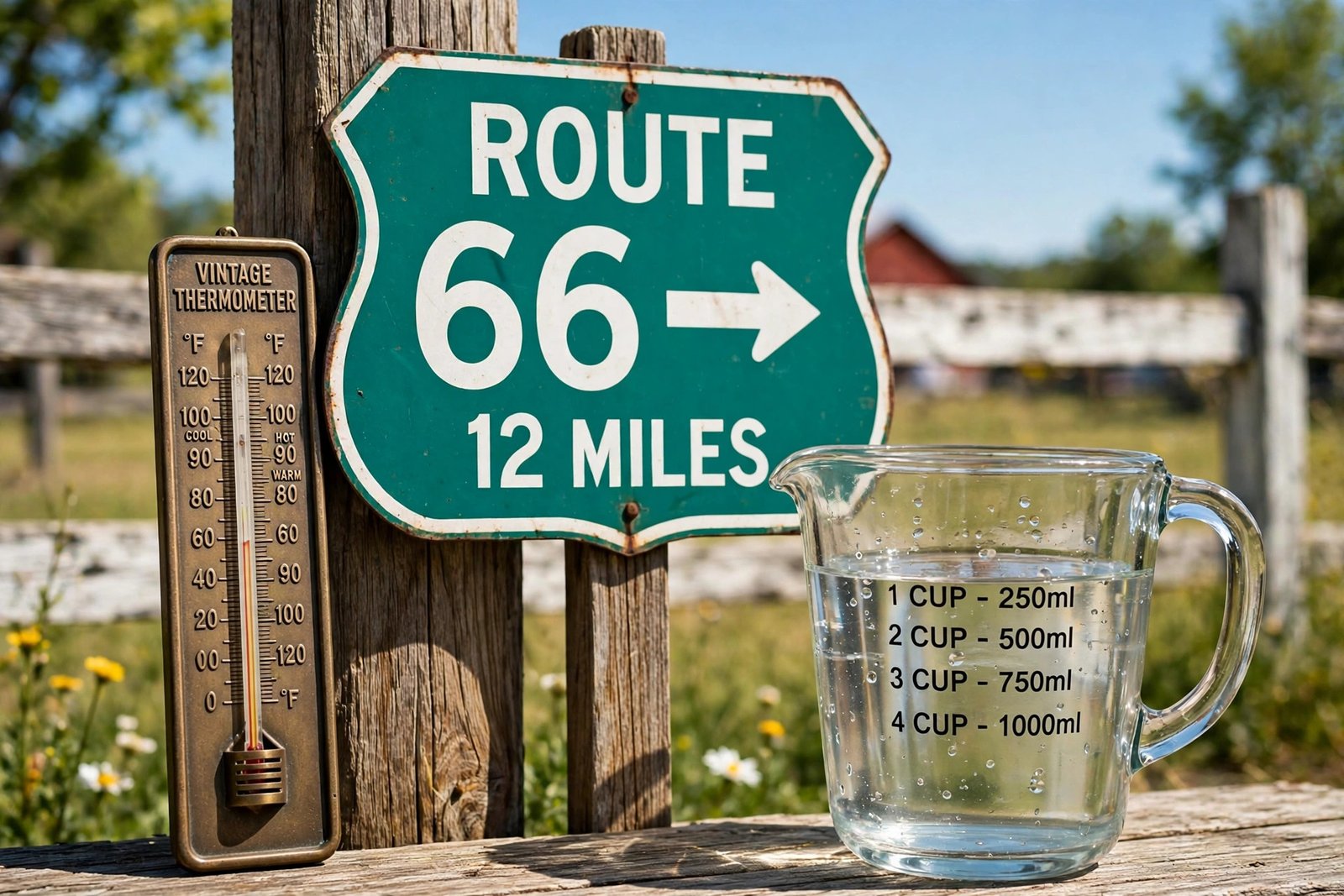
Ask an American how hot it is, how far away the next town is, or how much milk to buy, and you will probably hear Fahrenheit, miles, and gallons. Ask the same questions almost anywhere else in the world and the answers will come back in Celsius, kilometers, and liters. The United States is not confused about the difference. It simply never finished switching. That unfinished switch is one of the most interesting everyday facts about American life, because it touches history, politics, science, cooking, driving, and even the way we talk about the weather.
America lives in two measurement worlds at once. In the kitchen, we measure flour in cups and butter in tablespoons. In the laboratory, scientists measure in grams and milliliters. On the highway, speed limits are posted in miles per hour, while the cars themselves are often engineered in millimeters. Soda comes in two-liter bottles, but milk comes in gallons. A doctor may record your height in feet and inches and your medicine in milligrams on the same visit. This split did not happen by accident, and it did not happen overnight. It is the result of centuries of habit, a voluntary law that deliberately avoided forcing a change, and the very real cost and disruption of replacing a system that was already built into roads, factories, homes, and minds.
It Started With Britain, Not With a Plan
The American measurement system is a direct descendant of the units used in Britain when the colonies were founded. Settlers brought inches, feet, yards, miles, pounds, pints, quarts, and gallons with them because those were the units they already knew, traded in, and used to survey land, build houses, and bake bread. A foot was roughly the length of a human foot, an inch was roughly the width of a thumb, and a mile had older roots in Roman marching distances before Britain standardized it. These units were human-sized and practical in a world before calculators and global supply chains. They felt intuitive because they were tied to the body, to farming, and to daily work.
After independence, the new nation kept those units. The Constitution gave Congress the power to fix standards of weights and measures, but nation-building, westward expansion, trade, and war demanded more urgent attention. France, by contrast, introduced the metric system during its revolution in the 1790s, building a decimal system around units that could be defined, divided by ten, and used consistently. Thomas Jefferson, then Secretary of State, examined a decimal-based proposal in 1790, but Congress did not adopt a sweeping change. That early hesitation mattered. By the time metric ideas returned in force, American farms, factories, railroads, and towns were already laid out in customary units.
The Industrial Revolution then locked the system in place. Machines were built to inch-based specifications, tools were sized in fractions of an inch, land was divided in acres, and workers were trained in feet and pounds. Changing all of that would not have meant simply learning new words. It would have meant retooling factories, redrawing plans, replacing signs, rewriting cookbooks, and retraining millions of people. For businesses that sold mainly inside the United States, the benefit of switching seemed abstract, while the cost felt immediate and concrete. So the country stayed put, even as most of the rest of the world gradually moved toward metric.
Where Fahrenheit Came From
Temperature tells the same story in miniature. The Fahrenheit scale was proposed in 1724 by Daniel Gabriel Fahrenheit, a Polish-born Dutch physicist and instrument maker best known for his mercury thermometer. According to Encyclopaedia Britannica, Fahrenheit developed the scale in 1724 and it is still commonly used in the United States. In the version Americans use today, water freezes at 32 degrees Fahrenheit and boils at 212 degrees at standard atmospheric pressure. That gives 180 degrees between freezing and boiling, a range that many Americans find useful for everyday weather because it offers finer steps than the 100 degrees between freezing and boiling on the Celsius scale.
That finer grain is part of why Fahrenheit has loyal defenders. A move from 68 to 72 degrees Fahrenheit feels like a noticeable but gentle change in a room, while the same shift is only a couple of degrees in Celsius. Weather forecasters, cooks, and homeowners often say Fahrenheit feels more human for describing how the air feels on skin. Critics reply, fairly, that Celsius is easier to learn because water freezes at zero and boils at 100, and because it fits neatly with the rest of the metric system. Both arguments have merit. The reason Fahrenheit survived in the United States is not that Americans did a careful scientific comparison and chose it. It is that Fahrenheit was already in the thermometers, weather reports, ovens, and conversations when the question came up, and no one forced a replacement.
The same logic applies to miles, gallons, and inches. A mile per hour speed limit, a gallon of gas, a pint of berries, and a six-foot fence are not just measurements. They are phrases people grew up hearing. Children learn their height in feet and inches, runners talk about a four-minute mile, football fields are measured in yards, and recipes call for cups rather than milliliters. Familiarity is a powerful force, and in everyday life familiarity often beats elegance.
The 1975 Law That Made Conversion Voluntary
The closest America came to a national switch was in the 1970s. Congress passed the Metric Conversion Act in 1975, which created a United States Metric Board to coordinate and plan a process of voluntary metric conversion. The key word was voluntary. The law did not require Americans to abandon customary units, and it did not set a firm deadline for a mandatory change. According to the National Institute of Standards and Technology, Congress later declared the metric system the preferred system for trade and commerce in 1988, but the underlying approach remained voluntary for most everyday use. You can read the current policy in NIST’s own summary of metric policy and its history of metrication in law.
The Congressional Research Service history of the effort explains the sequence clearly: metric use had been legal in the United States since 1866, Congress authorized a study of conversion in 1968, the 1975 act set up a board to coordinate voluntary conversion, and that board was abolished in the early 1980s. The full background is available in the report on metric conversion and the federal role. In other words, the government encouraged metric use, especially for trade and federal work, but left the decision and the pace to companies, organizations, and individuals. That is why the transition looks patchy rather than complete.
Schools in the 1970s did teach metric, road signs in some places experimented with dual distances, and many Americans of that generation remember learning kilometers and liters with the expectation that a full switch was coming. Then momentum faded. Without a mandate, industries that saw no immediate benefit simply did not switch. Consumers did not demand metric-only packaging. Politicians did not want to spend political capital on a change that would annoy voters every time they checked the weather or followed a recipe. The voluntary approach avoided a fight, but it also guaranteed that the old system would survive wherever it was already comfortable.
There was also a cultural edge to the debate. For some Americans, customary units felt homegrown and familiar, while metric felt foreign or imposed from abroad. That framing was not fair to the science — metric is used by American scientists every day — but it was politically effective. A change that touches thermostats, speed limits, grocery labels, and school lessons touches daily life in a way that abstract policy rarely does. When a reform is felt in the kitchen and on the dashboard, resistance is personal, not just economic.
Where Metric Already Rules American Life
Here is the twist most visitors miss: the United States already uses metric a great deal, just not always where you can see it. Science is metric. Medicine is largely metric. The military uses metric for many purposes, including distances and navigation. Much of manufacturing, especially for products sold internationally, is designed in metric. Your two-liter soda bottle is metric, and so is the 750-milliliter wine bottle. Nutrition labels list grams and milligrams alongside customary servings, and packaged goods commonly carry both inch-pound and metric declarations.
Look closely at a grocery shelf and you will see the compromise. A box of cereal may list ounces and grams. A bottle of water may be sold as 16.9 fluid ounces, which is also 500 milliliters. A car engine may be described in liters even while the speedometer reads miles per hour. A runner may train for a 5K — five kilometers — while still describing a road trip in miles. Americans are not strangers to metric. They are bilingual in measurement, switching systems depending on context without always noticing the switch.
Even the customary units themselves are now defined through metric. NIST notes that current customary units are defined by metric units, with mass, length, and volume defined through the metric system since the Mendenhall Order of 1893. That is a wonderfully American detail: the inch you use to measure a bookshelf is ultimately anchored to the metric system, even if you never say the word meter. The country did not reject metric science. It kept metric science in the background while keeping customary language in the foreground.
Fun Comparisons That Show the Split
The split produces some delightful everyday contrasts. An American recipe may call for a cup of flour, a teaspoon of baking soda, and an oven set to 350 degrees Fahrenheit, while a European recipe for a similar cake calls for grams and 180 degrees Celsius. An American weather report warns of a high in the 90s, which sounds dramatic until you realize it is the 30s in Celsius. A British driver still talks about miles on the road, a reminder that Britain itself kept some customary road units even after adopting metric more broadly. An American traveler abroad must relearn speed limits, fuel quantities, and temperatures, while a visitor to the United States must do the reverse.
There are real costs to the split, and Americans have felt them. The most famous example is the loss of NASA’s Mars Climate Orbiter in 1999, when a mix-up between pound-seconds and newton-seconds contributed to the spacecraft entering the Martian atmosphere at the wrong altitude. That failure is often cited as a warning about mixing systems without careful conversion. It did not, however, trigger a national conversion, because the failure was in a specialized engineering context, not in daily life. In laboratories and aerospace work, metric discipline is already strict. The risk lives at the boundary where two systems meet, which is why careful labeling and double-checking matter more than slogans about one system or the other.
Will America Ever Go Fully Metric?
Probably not soon, and possibly not in a single dramatic moment. The likeliest future is more of the same gradual blending: more metric in science, medicine, manufacturing, and international trade, and more customary units in weather, cooking, sports, construction, and road travel. Younger Americans already grow up comfortable with liters in soda bottles, grams on nutrition labels, and kilometers in races. Electric vehicles, global supply chains, and online shopping expose people to metric every day. At the same time, no political leader has much to gain by telling voters their thermostats, recipes, and speed limits must all change at once.
So the next time you hear a forecast in Fahrenheit, fill a tank in gallons, or drive a road measured in miles, you are hearing history out loud. You are hearing colonial Britain, a 1975 law that chose encouragement over compulsion, an industrial economy built in inches, and a scientific world that quietly runs on metric behind the scenes. America does not use Fahrenheit, miles, and gallons because it never heard of Celsius, kilometers, and liters. It uses them because they were here first, they still work, and no one ever made the country give them up.
Frequently Asked Questions
Why does the US use Fahrenheit instead of Celsius?
The United States inherited Fahrenheit from earlier British and European practice, and the scale was already in common use for weather, cooking, and thermometers before metric conversion was seriously debated. The 1975 Metric Conversion Act made conversion voluntary, so there was no mandate to replace Fahrenheit in everyday life, even though Celsius is standard in science and in most other countries.
What did the Metric Conversion Act of 1975 actually do?
It established a United States Metric Board to coordinate and plan voluntary metric conversion, and later amendments declared metric the preferred system for trade and commerce. It did not require households, drivers, or cooks to switch, which is why metric grew fastest in federal work, science, medicine, and international trade rather than in weather reports and recipes.
Is the metric system illegal in the United States?
No. Metric use has been legal in the United States since 1866, and NIST states that current law permits either the metric system or the customary system. Many products carry both units, and science, medicine, and much of manufacturing use metric every day.
Where is metric most common in American daily life?
You will see it in two-liter soda bottles, nutrition labels measured in grams and milligrams, medicine doses, camera and electronics specifications, running races measured in kilometers, and car engines described in liters. You will hear customary units more often for weather, road distances, home construction, cooking, and sports.
Will the US ever switch completely to metric?
A sudden, complete switch looks unlikely because the cost and disruption would be enormous and there is no political mandate for it. A gradual blending is more likely, with metric continuing to grow in technical and international contexts while customary units remain familiar in everyday American life.
Related reading
If you enjoyed this look at everyday American quirks, explore more on Trending 4: US money facts, from coin ridges to the cost of a penny, surprising facts about the Interstate Highway System, and American inventions from GPS to the Moon landing.