
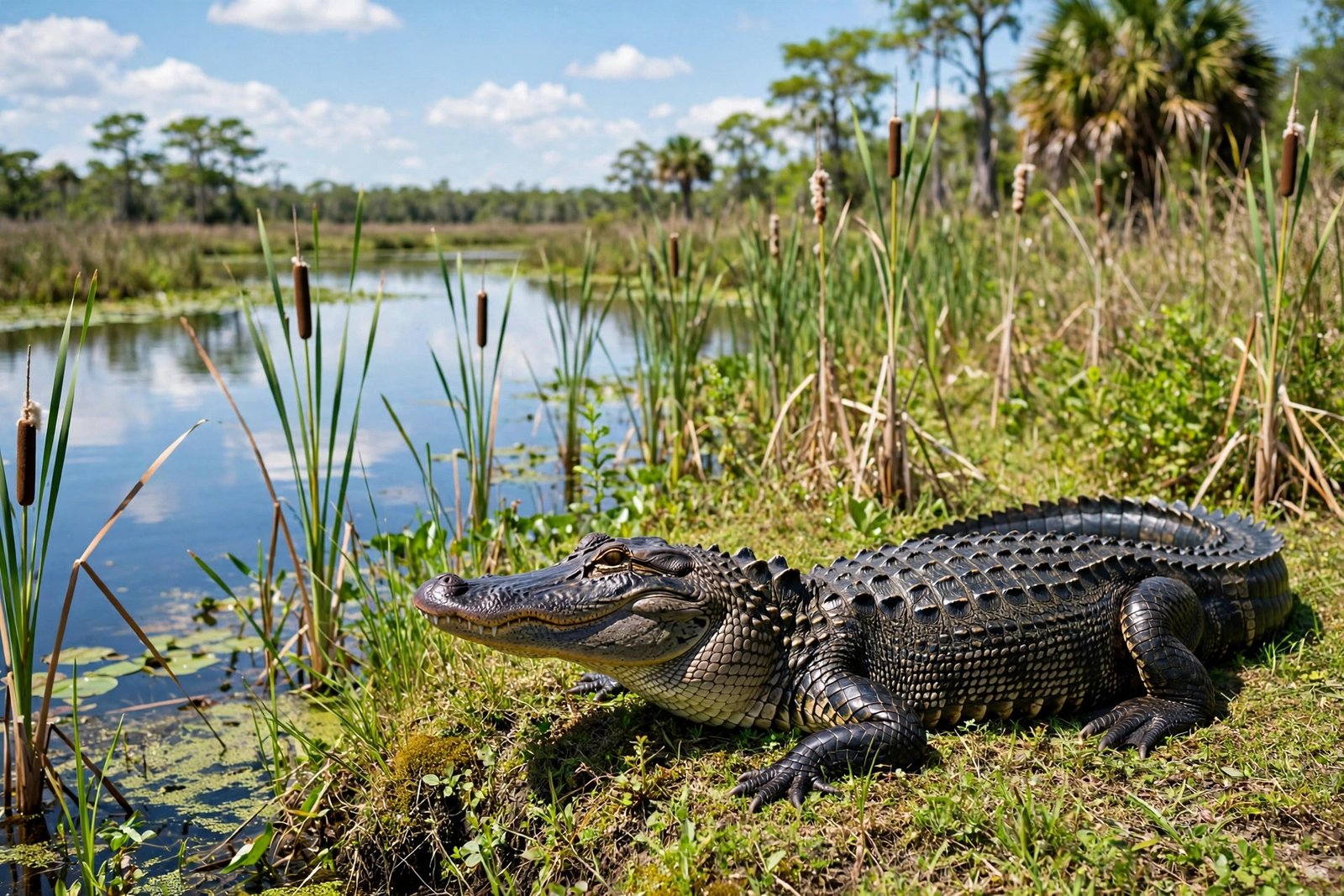
In the early 1960s, seeing an American alligator in the wild had become a rarity. A century of overhunting for hides, combined with habitat loss and pesticide pollution, had driven the species to the edge. By 1967, the American alligator received its first federal protection, and by 1973, the newly passed Endangered Species Act banned all hunting and commercial trade in alligator products. Today, the story has flipped completely. There are nearly five million American alligators in the southeastern United States, with about 1.25 million in Florida alone, according to the U.S. Fish and Wildlife Service, and the species is considered one of the greatest endangered species success stories in the world. The alligator’s comeback is a reminder that conservation, when it is sustained and science-based, can actually work.
The American alligator, Alligator mississippiensis, lives only in the United States, ranging across the southeastern states from North Carolina to Texas, with the largest populations in Florida and Louisiana. It is a keystone species, meaning its presence shapes the ecosystem around it. Alligators dig gator holes, depressions in wetlands that hold water during dry seasons and provide refuge for fish, turtles, birds, and other wildlife. Their nests, mounds of vegetation built by females, provide warmth for other reptiles and birds after the alligators hatch. Remove the alligator, and the wetland loses one of its engineers.
How the alligator nearly disappeared
The alligator’s decline began with its hide. Alligator leather was prized for boots, bags, belts, and luggage, and unregulated hunting in the late 19th and early 20th centuries slaughtered alligators by the millions. By the 1930s, the warning signs were unmistakable. Alabama banned alligator hunting in 1938 as populations plummeted, and other states followed in the early 1960s, enacting their own hunting bans as wild sightings grew rare. At the same time, wetlands were being drained for agriculture and development, and pesticides like DDT accumulated in alligator eggs, reducing hatching success.
Federal protection arrived in stages. In 1967, the alligator was listed under the Endangered Species Preservation Act, a precursor to the Endangered Species Act. When the Endangered Species Act passed in 1973, it prohibited all alligator hunting and stopped commercial trade in alligator products. States began monitoring their alligator populations systematically, and the combination of legal protection, habitat conservation, and an end to unregulated hunting gave the species room to recover. By 1979, populations had rebounded enough to support limited, regulated commercial trade, and alligators were included in Appendix II of the Convention on International Trade in Endangered Species, known as CITES, to ensure that any international trade would be legal, sustainable, and traceable.
In 1987, the U.S. Fish and Wildlife Service officially removed the American alligator from the endangered species list, a remarkably fast recovery by conservation standards. The species remains listed as threatened by similarity of appearance, a technical status that helps law enforcement distinguish alligator products from those of truly endangered crocodilians that might be passed off as alligator. The International Union for Conservation of Nature lists the American alligator as a species of least concern, a classification that would have seemed impossible in the 1960s.
A recovery built on partnerships
The Fish and Wildlife Service credits the recovery to creative partnerships between the federal government, tribes, states, and private landowners. State wildlife agencies in Florida, Louisiana, Georgia, and other range states monitor populations, set regulated hunting seasons where appropriate, and manage the commercial harvest. Alligator farming, which began as a conservation tool, now plays a central role: farmed alligators supply the leather market, reducing pressure on wild populations, and farming gives landowners a financial incentive to maintain and even restore wetlands, because healthy wetlands produce healthy alligators.
The economics are substantial. The American alligator leather industry is valued at hundreds of millions of dollars annually, and Louisiana’s farmed alligators alone produce skins valued in the tens of millions of dollars each year. Commercial harvests, carefully regulated by states, help conserve the species by aligning economic interests with habitat protection. It is a model that conservationists point to again and again: when local people benefit from a species’ survival, they become its fiercest protectors.
That model also extends to tourism. Alligator watching is now a major draw in Florida’s Everglades, Louisiana’s Atchafalaya Basin, and the Okefenokee Swamp on the Georgia-Florida border. Airboat tours, swamp tours, and wildlife refuges let visitors see alligators in their natural habitat, and the revenue supports local communities and conservation programs alike. The alligator, once hunted to near extinction, is now an icon of the Southeast, appearing on state flags, sports logos, and restaurant menus, a symbol of wild Florida and Louisiana as surely as the bald eagle is a symbol of the nation.
Living alongside alligators
Recovery has brought a new challenge: learning to live alongside a large predator that now thrives in a region where millions of people also live. Florida’s human population has grown enormously since the 1980s, and alligators now inhabit nearly every freshwater body in the state, from remote swamps to suburban retention ponds and golf course water hazards. Most encounters are harmless, and the chance of being attacked by an alligator remains extremely small, but attacks do occur, and they are almost always linked to human behavior: swimming in alligator habitat at dawn or dusk, feeding alligators, or approaching nests.
State wildlife agencies offer simple, consistent advice. Never feed an alligator; feeding teaches alligators to associate people with food, and fed alligators are the ones most likely to become dangerous. Keep pets on leashes near water, and do not let dogs swim in lakes or ponds where alligators live. Swim only in designated swimming areas during daylight hours, and keep a safe distance from any alligator you see. If an alligator becomes a nuisance, report it to your state wildlife agency rather than handling it yourself. These rules protect both people and alligators, because a habituated alligator often has to be removed, and removal usually means death for the animal.
For visitors, the safest way to see alligators is on a guided tour or from a boardwalk in a wildlife refuge or state park. The Everglades, the Okefenokee, and the Atchafalaya offer spectacular viewing, and rangers and guides can explain the alligator’s role in the ecosystem while keeping visitors at a safe distance. Seeing a wild alligator basking on a bank, its armored back glistening in the sun, is one of the great wildlife experiences in America, and it is an experience that was nearly lost forever.
What the alligator teaches us
The alligator’s story carries lessons that extend far beyond one species. First, laws matter. The Endangered Species Act, state hunting bans, and CITES trade controls gave the alligator the breathing room it needed, and without them, the species might not have survived. Second, science matters. Population monitoring, habitat research, and regulated harvest quotas ensured that recovery was real, not just hopeful. Third, economics matter. By making alligator conservation profitable for landowners and farmers, the recovery created allies instead of adversaries.
Those lessons are relevant to other species still struggling, from the Florida panther to the North Atlantic right whale. Not every recovery will follow the alligator’s path, and not every species has the alligator’s advantages: a large range, a high reproductive rate, and a valuable hide that made farming viable. But the alligator proves that extinction is not inevitable, and that a species written off in the 1960s can, within a single human lifetime, become abundant again.
As the Fish and Wildlife Service put it in celebrating the alligator in 2026, the survival of this species relies on the continued efforts of state wildlife agencies, tribes, businesses, international organizations, and the Service itself. The alligator’s comeback is not a finished story but an ongoing one, maintained by the same partnerships that created it. For now, though, the sight of an alligator sliding into a Florida swamp, or a Louisiana bayou, is a sight worth celebrating: a living reminder that America can still save what it nearly lost.
Frequently asked questions
How many American alligators are there today? Nearly five million in the southeastern United States, with about 1.25 million in Florida alone, according to the U.S. Fish and Wildlife Service.
When was the alligator removed from the endangered list? In 1987, after federal protection under the 1967 act and the Endangered Species Act of 1973 allowed populations to rebound.
Are American alligators dangerous? Alligators are large predators and should be treated with respect, but attacks on people are rare. Never feed alligators, keep pets leashed near water, and swim only in designated areas.
Where can I see wild alligators? In Florida’s Everglades, Louisiana’s Atchafalaya Basin, and the Okefenokee Swamp, on guided tours or from boardwalks in wildlife refuges and state parks.
Why is the alligator still listed as threatened by similarity of appearance? That technical status helps law enforcement distinguish legal alligator products from products of truly endangered crocodilians that might be passed off as alligator.
Related reading
- The American Bison Comeback: From Near Extinction to Success
- Florida Manatees: A Comeback in Slow Speed Zones
- Gray Wolf Recovery in the American West
Sources: U.S. Fish and Wildlife Service: Celebrating the American Alligator.