
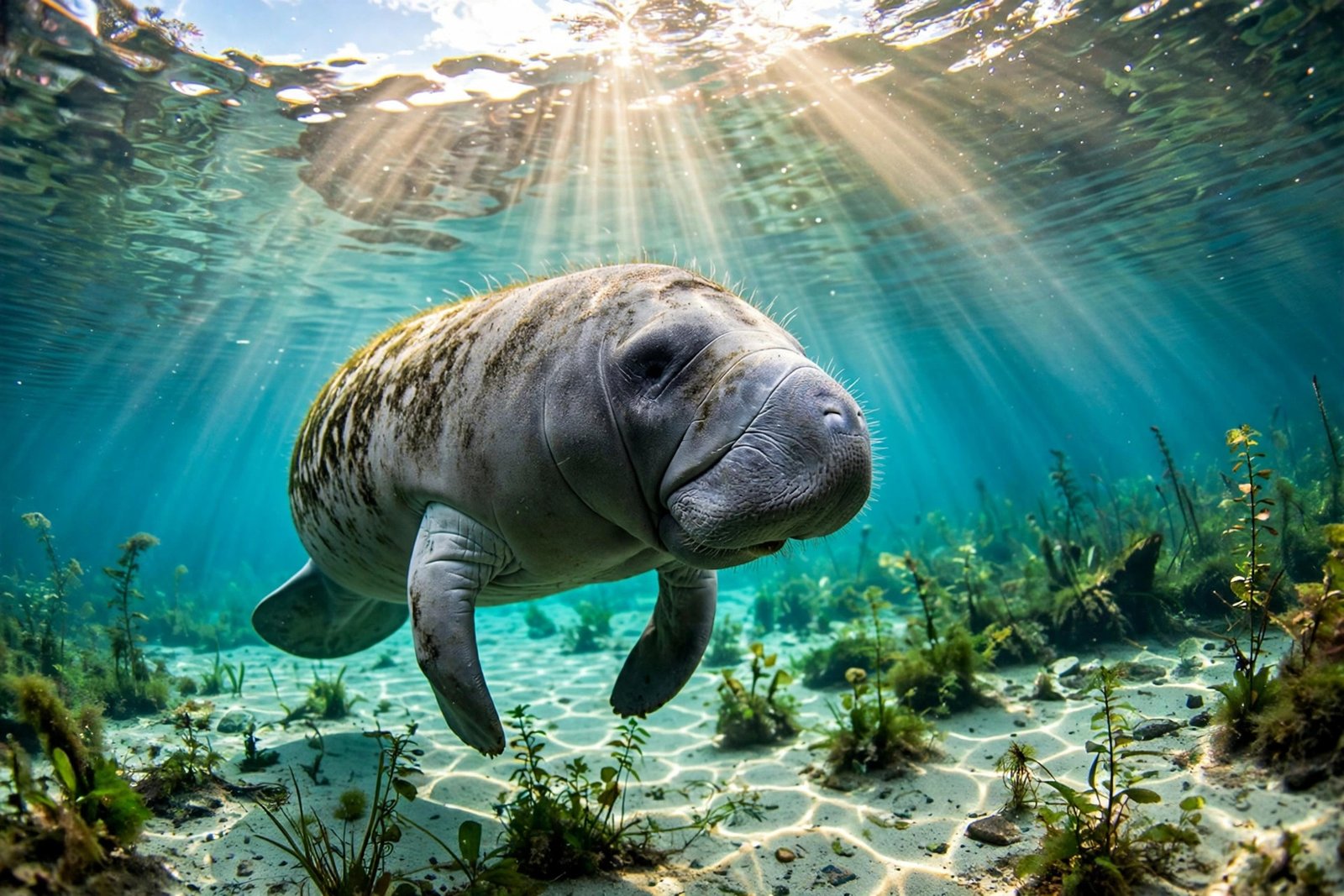
On a cold winter morning in Florida, the water in a spring run is a steady, clear blue, and just below the surface a gray, whiskered shape drifts slowly past. It is a manatee, a gentle giant the size of a small car, grazing on seagrass or resting in the warm water with its calf close beside it. Manatees have lived in Florida’s rivers, springs, and coastal waters for a very long time, and they have become one of the state’s most beloved animals. They are also one of its most vulnerable. Boat strikes, seagrass loss, and cold stress have all taken a heavy toll, and yet the manatee story is, against the odds, a story of recovery. Thanks to decades of protection, rescue work, and habitat conservation, more manatees are swimming in Florida waters today than were counted a generation ago, and visitors now have a real chance to see them, if they do it the right way.
Meet the Florida Manatee
The Florida manatee is a subspecies of the West Indian manatee, a large, slow-moving marine mammal with a rounded body, paddle-shaped flippers, and a flat, spatula-like tail. Manatees are herbivores, feeding on seagrass, algae, and other aquatic vegetation in freshwater and estuarine systems across the southeastern United States. They are famously slow, and that slowness is part of their charm: a manatee may spend much of its day grazing, resting, or surfacing gently to breathe, and it shows no interest in chasing, hunting, or bothering anyone. Despite their size, manatees are shy, and they tend to move away from noise and disturbance rather than toward it.
Manatees are also surprisingly social in a quiet way. Mothers and calves stay close together, and manatees often gather in warm-water refuges during winter, sometimes in large numbers. They navigate largely by touch, using sensitive whiskers to explore food and surroundings. A calf stays with its mother for an extended period, learning where to find food and warm water, which is one reason protecting mothers matters so much.
Florida manatees range widely in summer, when warm water lets them travel as far as Texas to the west and the northeastern coast to the north, but winter changes everything. Manatees cannot tolerate cold water for long, and when water temperatures drop, they must find warm-water refuges to survive. That seasonal migration to springs, power plant discharge areas, and other warm sites is the rhythm of manatee life in Florida, and it is also the reason why winter is both the best time to see manatees and the most important time to leave them alone.
A Comeback Worth Celebrating
The manatee comeback is real, and it is worth understanding in full. For much of the twentieth century, manatees were in serious trouble, hunted in earlier eras and later harmed by habitat loss, boat traffic, and cold snaps. Legal protection changed the trajectory. Manatees are protected under both the Endangered Species Act and the Marine Mammal Protection Act, and decades of conservation work by state and federal agencies, nonprofits, and local communities have helped the population recover. The U.S. Fish and Wildlife Service downlisted the West Indian manatee from endangered to threatened in 2017, a step that reflected population growth over the previous decades, even though the species remains protected and still faces serious threats.
The numbers tell a hopeful story, with important caveats. The Marine Mammal Commission’s Florida manatee profile reports a recent statewide abundance estimate of about 9,790 manatees, and notes that abundance has increased over the last thirty years. The U.S. Fish and Wildlife Service, in its recent review, cited a 2023 estimate from the Florida Fish and Wildlife Conservation Commission placing the population between 8,350 and 11,730 animals. The range reflects the difficulty of counting a wide-ranging aquatic animal, but the direction is clear: there are substantially more manatees today than there were when systematic counts began, when estimates were far lower.
One of the clearest recovery stories is at Blue Spring State Park in Orange City, where warm spring water draws manatees every winter. In the early years of monitoring, only a small number of manatees were recorded there. By 2005, the count had risen to more than two hundred, and in 2025 researchers recorded 736 adults and 80 calves in the spring run, described as the largest aggregation ever recorded there. Discover Wildlife’s report on the Blue Spring aggregation describes how decades of protection and research at the park helped make that recovery possible. Blue Spring is not the whole story, but it shows what sustained protection can do when habitat is kept safe and animals are given room to recover.
The Threats Manatees Still Face
Recovery does not mean safety. Manatees still face a combination of threats that can quickly reverse progress, and understanding them is the first step to helping. The most direct human-caused threat is boat strikes. Because manatees swim slowly, spend time near the surface, and are hard to spot in murky water, they are frequently hit by boats, and propeller and hull wounds can be fatal. The Marine Mammal Commission notes that vessel strikes are the primary cause of human-related manatee deaths. In 2019, a record year at the time, 137 manatees were struck and killed by boats in Florida, topping the previous record from the year before. Most adult manatees carry scars from boat encounters, a visible reminder of how crowded Florida’s waterways have become.
Seagrass loss is the quieter, longer-term threat. Manatees depend on seagrass for food, and when water quality declines, seagrass beds shrink. The Indian River Lagoon on Florida’s east coast suffered severe seagrass loss, and the resulting food shortage contributed to an unusual mortality event in the early 2020s, when a large number of manatees starved. In response, wildlife agencies ran a pilot supplemental feeding program in the winters of 2021-2022 and 2022-2023, providing romaine lettuce at a single site in the lagoon to help manatees through the cold months. The program was discontinued for the 2023-2024 winter when monitoring indicated that foraging resources had improved, but the episode showed how closely manatee survival is tied to the health of the water itself. Seagrass recovery is slow, and it depends on cleaner water, less nutrient pollution, and protection from propeller scarring in shallow beds.
Cold stress is the third major threat, and it is uniquely tied to Florida’s geography. Manatees need warm water, and when temperatures drop below about 68 degrees Fahrenheit, they seek refuge in springs and other warm-water sites. If a manatee cannot reach warm water in time, or if it is disturbed and leaves a refuge too early, it can develop cold stress syndrome, a condition that weakens the animal, suppresses its immune system, and can lead to death. Prolonged cold snaps, loss of warm-water habitat as power plants close or springs are degraded, and disturbance at winter refuges all increase the risk. Red tides, the harmful algal blooms that occur most often in southwest Florida, add another danger, as toxins can be inhaled at the surface or ingested with food. Together, these threats mean that manatees remain a threatened species, and that conservation work is far from finished.
Rescue, Rehabilitation, and Slow-Speed Zones
When a manatee is injured, sick, or stranded, a network of responders steps in. The Manatee Rescue and Rehabilitation Partnership, a cooperative group of agencies, aquariums, and nonprofits, coordinates rescue, treatment, and release, and the Florida Fish and Wildlife Conservation Commission and the U.S. Fish and Wildlife Service manage the overall recovery effort. Rescued manatees may be treated at facilities such as Homosassa Springs Wildlife State Park, which serves as a rehabilitation center, or at partner aquariums, before being released back into the wild when they are strong enough. The work is painstaking and often expensive, but released animals, tracked by researchers, provide valuable information about survival and habitat use.
Prevention matters as much as rescue, and that is where slow-speed zones come in. Florida has established manatee protection zones, including seasonal speed zones, in areas where manatees gather or travel. From April 1 through November 15, seasonal zones require boaters to slow down in certain areas, and winter zones protect animals around warm-water refuges during the colder months. The zones are marked by signs on the water, and maps are available from the Florida Fish and Wildlife Conservation Commission. Boaters are also urged to wear polarized sunglasses, watch for manatee footprints, the large circles on the surface that indicate an animal below, and avoid shallow seagrass beds where manatees graze. The Commission’s seasonal reminder to boaters sums up the message simply: go slow, look out below, and give manatees plenty of space.
Habitat restoration is the other half of prevention. Restoring seagrass beds, improving water quality, and protecting natural warm-water springs give manatees a better chance to feed, rest, and raise calves. These projects take years and require cooperation across agencies, local governments, and residents. Progress is uneven, but Blue Spring shows that when habitat is protected consistently, manatees respond.
Where to See Manatees Responsibly
Winter, from mid-November through March, is the best season for manatee viewing, because cold Gulf and ocean waters push manatees into warm springs and refuges. Blue Spring State Park, about an hour north of Orlando, is one of the best land-based viewing spots in the state. A boardwalk runs alongside the spring run, letting visitors watch manatees from above without entering the water or disturbing them. Because the park is popular in winter, day-use reservations may be required, so check capacity before you go, and arrive early for the calmest viewing.
Crystal River, on Florida’s Gulf Coast, is famous for a different reason: it is the only place in the United States where visitors can legally swim and snorkel with manatees, under strict rules and with licensed guides. The town sits on Kings Bay, fed by warm springs including Three Sisters Springs, and winter brings a large aggregation of manatees to the area. If you choose an in-water experience, go with a reputable, permitted operator, follow the guide’s instructions exactly, and practice passive observation: float quietly at the surface, keep your hands to yourself, and let manatees approach you if they choose. Never chase, touch, ride, or feed a manatee, and never separate a mother from her calf. Three Sisters Springs itself is closed to swimmers during the winter months to give resting manatees a sanctuary, and that closure should be respected without exception.
Other good viewing spots include Homosassa Springs Wildlife State Park, where an underwater observatory lets visitors watch manatees, including animals in rehabilitation, year-round, and Silver Springs State Park, where manatees visit during winter. Kayaking and paddleboarding can also offer wonderful manatee encounters, provided you keep your distance, move slowly, and avoid paddling directly over resting animals or through seagrass beds. Wherever you go, the manatee manners guide from Crystal River is a helpful checklist: practice passive observation, stay calm and quiet, give manatees the right of way, obey speed zones, and wear polarized sunglasses when boating.
How Visitors Can Help
The simplest way to help manatees is to be a careful visitor. If you boat, slow down in manatee zones, obey all posted signs, and keep a lookout for animals below the surface. If you paddle, avoid shallow seagrass beds and give any manatee you see a wide berth. If you swim or snorkel, float passively and never touch or pursue an animal. If you see a manatee that appears injured, distressed, entangled, or stranded, do not try to push it back into the water or handle it yourself. Instead, report it to the Florida Fish and Wildlife Conservation Commission’s Wildlife Alert Hotline at 888-404-FWCC, so trained responders can help. A quick, accurate report, with location and a description of what you saw, can save a life.
Beyond the water, visitors can support manatee conservation by choosing operators and parks that follow viewing guidelines, by learning about water quality and seagrass in the places they visit, and by supporting organizations that fund rescue, research, and habitat restoration. The U.S. Fish and Wildlife Service’s manatee listing review explains the current threatened status of the Florida manatee and the science behind it, and it is a good place to start for readers who want to understand the policy side of conservation. Small choices add up: a slower boat, a quieter paddle, a respectful distance, and a phone call when something looks wrong.
Manatees have survived a great deal, and their comeback is one of Florida’s genuine conservation success stories. It is not complete, and it is not guaranteed, but it is real, and it is still being written every winter in the springs and coastal waters of the state. The next chapter depends, in part, on the people who come to see these gentle giants. Go in winter, go quietly, give them space, and you will witness something remarkable: a wild animal, slow and unhurried, going about its life in warm, clear water, with a calf close behind and the whole future of its species, in some small way, resting on the choices we make on the water.
Frequently Asked Questions
When is the best time to see manatees in Florida? Winter, from mid-November through March, is the best season, because manatees gather in warm springs and refuges when coastal waters cool. Blue Spring State Park and Crystal River are among the most reliable winter viewing locations.
Can you swim with manatees in Florida? Crystal River is the only place in the United States where visitors can legally swim and snorkel with manatees, under strict rules and with licensed guides. Practice passive observation, never touch or chase a manatee, and respect seasonal closures such as the winter closure at Three Sisters Springs.
Why are manatees threatened? Manatees face boat strikes, seagrass loss, cold stress, loss of warm-water habitat, and red tide exposure. They were downlisted from endangered to threatened in 2017 as populations grew, but they remain federally protected and still face serious, ongoing threats.
What should I do if I see an injured manatee? Do not touch, move, or push the animal. Report it to the Florida Fish and Wildlife Conservation Commission’s Wildlife Alert Hotline at 888-404-FWCC, with the location and a description of what you observed, so trained responders can assist.
What are manatee slow-speed zones? Manatee protection zones, including seasonal speed zones from April 1 through November 15 and winter zones around warm-water refuges, require boaters to slow down or avoid certain areas. The zones are marked by signs on the water, and maps are available from the Florida Fish and Wildlife Conservation Commission.
Related Reading
Keep exploring American wildlife: The Monarch Butterfly Migration, The Bald Eagle Comeback, and The Apostle Islands Sea Caves.