
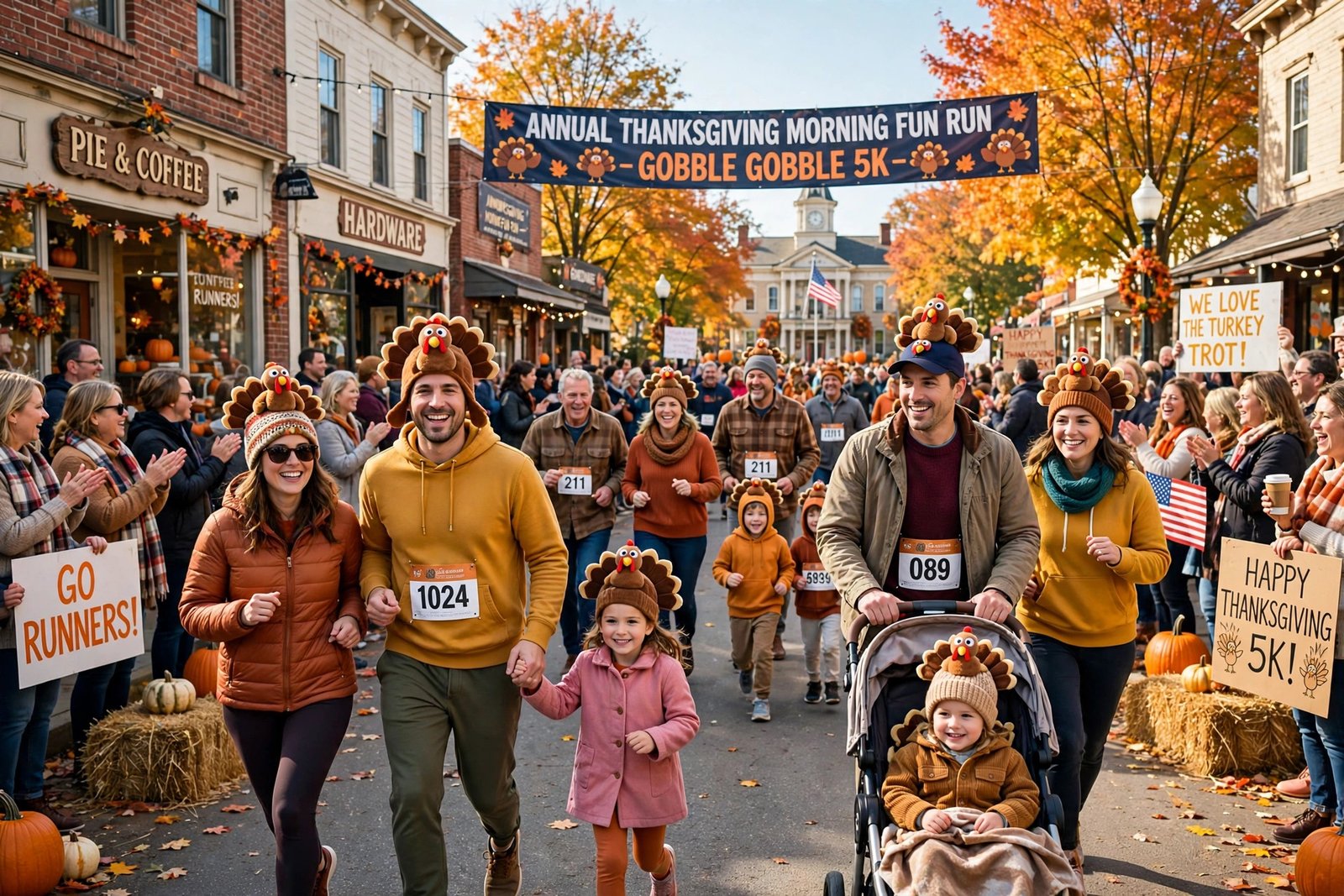
Before the turkey goes in the oven, before the parade starts on television, millions of Americans lace up their running shoes. The Turkey Trot, a footrace held on or around Thanksgiving Day, has become as much a part of the holiday as the meal itself. It is a tradition that stretches back to 1896, when six runners raced through Buffalo, New York, in what became the oldest continuously run footrace in the United States. Today, Turkey Trots take place in all 50 states, drawing more than a million participants in a single year.
The appeal is simple. A Turkey Trot is a chance to move before a day of eating, to gather with friends and family outdoors, and often to support a good cause, since many trots raise money for food banks and charities. Some are fiercely competitive, with elite runners chasing course records. Most are joyful and informal, with costumes, strollers, dogs, and walkers sharing the road. Whether you run a fast 5K or stroll a mile in a turkey hat, you are part of one of America’s happiest holiday traditions.
This guide explains the history of the Turkey Trot, the biggest races in the country, and how to find, prepare for, and enjoy one near you this Thanksgiving, on November 26, 2026.
A Tradition That Started in 1896
The oldest documented Turkey Trot is the Buffalo Turkey Trot, first run in 1896 in Buffalo, New York. It began with a handful of runners and has grown into an 8-kilometer race that draws around 14,000 participants each Thanksgiving morning. Its longevity makes it the oldest continuously run public footrace in the United States, older even than the Boston Marathon, and a point of pride for Buffalo.
Other historic trots followed. The Manchester Road Race in Manchester, Connecticut, began in 1927 with 12 runners and now draws more than 15,000, running its unusual 4.748-mile course through town. The Troy Turkey Trot in Troy, New York, began in 1916 with six runners and is now one of the largest and oldest in the country. The Cincinnati Thanksgiving Day Race, now more than a century old, began with 18 runners and has grown into a major 10K.
The tradition spread because it fits the holiday so well. Thanksgiving morning is a natural moment for a community event: people are home, families are together, and a morning race leaves the rest of the day free for cooking, travel, and the meal. Over time, towns across America added their own trots, each with local flavor, and the idea became a national institution.
How Big Are Turkey Trots Today?
Turkey Trots are bigger than ever. An estimated 1.1 million people took part in one of 936 Turkey Trots in 2024, spanning all 50 states, with Florida hosting the most individual trots at 56. That total is up sharply from less than 700,000 participants in 2011, showing how fast the tradition has grown. Of those 936 races, 322 hosted fields of more than 1,000 runners, up from 249 such races in 2023 and about 80 in 2017.
The largest trots are enormous community events. The Run to Feed the Hungry in Sacramento, California, draws more than 30,000 participants for its 5K and 10K, benefiting the Sacramento Food Bank and Family Services, and is often cited as the largest Turkey Trot in the country. The Turkey Trot in Chicago draws tens of thousands, the Dallas Turkey Trot draws more than 25,000, and the Detroit Turkey Trot, which began in 1983, has grown from a few thousand runners to one of Michigan’s largest races.
The most common distance is the 5K, offered by more than 90 percent of trots, according to race data. Other common options include 10Ks, one-mile fun runs, and kids’ races, so there is a distance for every age and ability. Many trots also offer virtual options, letting participants run wherever they are and still be part of the event.
Why People Run: Charity, Community, and Calories
Many Turkey Trots are fundraisers, and that is a large part of their appeal. The Sacramento race supports a food bank. The Grand Rapids Public Schools Turkey Trot, now in its 34th year, funds athletics for more than 5,000 student-athletes and raised over $300,000 in 2025. The Wheeler Mission Drumstick Dash in Indianapolis supports people experiencing homelessness. Running for a cause turns a morning jog into a contribution, and it gives the holiday a spirit of giving before the feast.
Community is the other draw. Turkey Trots are social events, where neighbors meet, families run together, and costumes add humor. Turkey hats, pilgrim outfits, and full turkey costumes are common, and some races hold costume contests. The Dallas Turkey Trot once set a record for the most people in turkey costumes on a course. For many families, the trot is the first event of the day, a shared memory that becomes a tradition in itself, passed from parents to children.
And yes, there is the practical matter of the meal. A morning run does not cancel out Thanksgiving dinner, and no serious runner claims it does, but moving before a long day of sitting and eating feels good, and it sets a relaxed tone for the rest of the day. The trot is less about burning calories and more about starting the holiday with energy and intention.
How to Find a Turkey Trot Near You
Finding a trot is easy. Running websites, local running clubs, and race calendars list trots by state and city, and many towns promote their trot through parks departments, YMCAs, and schools. If you are traveling for Thanksgiving, check the trot in your destination city early, since popular races can fill up, and some require registration weeks in advance.
When choosing a race, consider distance, course, and vibe. A 5K is a good first trot, walkable in under an hour for most people, and many races welcome walkers and strollers. A 10K is a bigger challenge, and a half marathon is for experienced runners. Check whether the course is flat or hilly, whether it is timed, and whether it supports a charity you care about. If you are running with children, look for a race with a kids’ run or a family walk option.
Register early if you can. Early registration is usually cheaper, guarantees a shirt and medal if those are offered, and helps organizers plan for crowds, water stations, and safety. Read the race instructions carefully: start time, parking, bag check, and whether the race is rain or shine. Thanksgiving morning can be cold in much of the country, so plan accordingly.
How to Prepare for Your First Turkey Trot
If you are new to running, a Turkey Trot is a forgiving first race. Train gradually in the weeks before Thanksgiving, building up to the distance with a mix of walking and running. A simple plan is to walk and run in intervals, increasing the running portion each week, until you can cover the distance comfortably. Do not try to set a personal record on your first trot; the goal is to finish feeling good.
On race morning, dress in layers. November mornings can be near freezing in the Northeast and Midwest, mild in the South, and variable in the West. A long-sleeve shirt, gloves, and a hat that you can tie around your waist if you warm up are good choices. Wear shoes you have already broken in, not brand-new ones. Eat a light breakfast, drink water, and arrive early enough to warm up, use the restroom, and find the start line without rushing.
Pace yourself. Start slower than you think you should, especially in a large field where the first mile is crowded. Walk if you need to; many participants walk part or all of the course, and there is no shame in it. Enjoy the costumes, the cheers, and the volunteers handing out water. Cross the finish line, collect your medal if there is one, and head home to the real reward: Thanksgiving dinner, earned in the best possible way.
Turkey Trots Worth Knowing
Beyond Buffalo, Manchester, and Sacramento, several trots have their own character. The Detroit Turkey Trot, run along part of the city’s Thanksgiving parade route, combines a race with a parade atmosphere. The Dana Point Turkey Trot in California offers ocean views and a festival feel. The Feaster Five Road Race in Andover, Massachusetts, draws more than 10,000 runners and supports local charities. The Grand Rapids trot, with its new 10K and family walk for 2026, shows how even established races keep evolving.
Each of these races tells a local story, and that is the point. A Turkey Trot is not a generic event dropped into a town; it is a town’s event, shaped by its streets, its charities, and its people. Running one while visiting family in another state is a wonderful way to see a place at its most welcoming, on a morning when everyone is in a good mood.
Related Reading
- Friendsgiving: How Americans Celebrate the Tradition
- The First Thanksgiving of 1621: History and Facts
- Thanksgiving 2026 Travel: Record Crowds and Busiest Days
Frequently Asked Questions
Q: What is a Turkey Trot?
A Turkey Trot is a footrace, usually a 5K, held on or around Thanksgiving Day in the United States. Most are fun, community events that welcome runners and walkers of all abilities.
Q: What is the oldest Turkey Trot?
The Buffalo Turkey Trot, first run in 1896 in Buffalo, New York, is the oldest continuously run public footrace in the United States.
Q: How many people run Turkey Trots?
An estimated 1.1 million people took part in 936 Turkey Trots in 2024, across all 50 states.
Q: What distance should a beginner choose?
A 5K is the best choice for most beginners. It is the most common Turkey Trot distance, offered by more than 90 percent of races, and it is walkable in under an hour.
Q: Do Turkey Trots support charities?
Many do. Turkey Trots commonly raise money for food banks, schools, and local charities, so check your local race to see which cause it supports.