
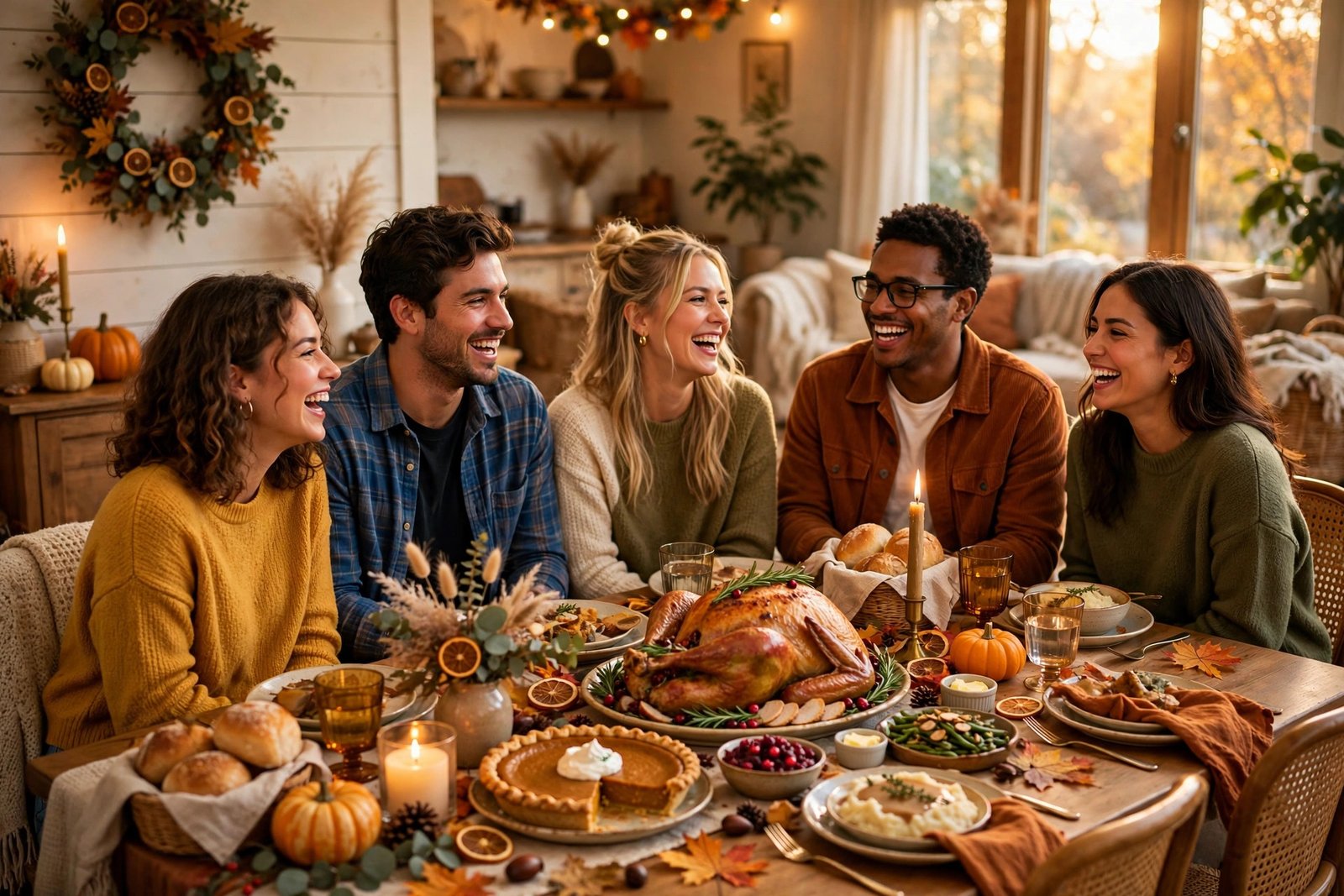
Every November, as Thanksgiving approaches, a second feast quietly takes shape across America. It happens the weekend before, the Wednesday night before, or the Friday after the big day. The guest list is not family — it is friends. The turkey may be traditional, or it may be tacos. The dress code is relaxed, the wine flows a little more freely, and nobody is keeping score about who carved the bird. This is Friendsgiving, and in less than two decades it has grown from an internet slang term into one of America’s most beloved modern traditions.
Friendsgiving is, at its simplest, a large meal eaten with friends on or near Thanksgiving. For some people it replaces the family gathering entirely. For most, it is a second celebration — a warm-up, or an encore, to the family holiday. Either way, it captures something real about how Americans live now: many of us live far from our hometowns, our closest people are often the ones we chose rather than the ones we were born to, and gratitude, it turns out, is not reserved for blood relatives.
What Exactly Is Friendsgiving?
Merriam-Webster defines Friendsgiving as a large meal eaten with friends during the Thanksgiving season. The word is a blend of “friends” and “Thanksgiving,” and its meaning is deliberately loose. A Friendsgiving can be a full turkey dinner with all the trimmings, a potluck of mac and cheese and store-bought pie, a backyard barbecue, or a night out at a restaurant. What matters is the company, not the menu.
Most Friendsgivings are potluck-style, with each guest bringing a dish or a drink. That shared effort is part of the appeal: nobody is stuck in the kitchen for two days while everyone else watches football. Instead, the cooking becomes a group project, and the meal becomes a showcase of everyone’s specialties — a friend’s famous sweet potato casserole, another’s experimental cranberry sauce, someone else’s decision to skip turkey entirely in favor of fried chicken or lasagna.
Timing is flexible too. Some groups gather on the Wednesday night before Thanksgiving, when friends who grew up together are back in town for the holiday. Others meet the weekend before, so the celebration does not collide with family plans. Still others gather on Thanksgiving Day itself, especially in cities full of transplants who cannot travel home. There is no official date, and that freedom is the point.
A New Word for an Old Idea
Celebrating Thanksgiving with friends is not new. People have been gathering with chosen family for the holiday for generations, especially those who lived far from home or whose family relationships were complicated. In the mid-1960s, Alice Brock and her husband Ray famously hosted Thanksgiving dinners for friends in Massachusetts, many of whom were estranged from their own families; those gatherings helped inspire Arlo Guthrie’s song “Alice’s Restaurant,” itself a Thanksgiving tradition. And in 1973, “A Charlie Brown Thanksgiving” showed Snoopy and the gang sharing a decidedly improvised holiday meal — popcorn, toast, and jelly beans — that looks a lot like a Friendsgiving in spirit.
What is new is the name. The earliest known uses of the word “Friendsgiving” in print date to 2007, appearing in posts on Usenet and on what was then Twitter, where it referred without explanation to an informal meal with friends. Merriam-Webster’s word detectives note that because the term appeared without explanation, it was probably already circulating in spoken English before it showed up in writing. The word slowly gained ground, then surged into national prominence in 2011, when a Baileys Irish Cream advertising campaign used it and it became a plot point on “The Real Housewives of New Jersey.” In January 2020, Merriam-Webster added Friendsgiving to the dictionary as an official entry.
Television helped the idea spread. The sitcom “Friends,” which aired from 1994 to 2004, featured a Thanksgiving episode in nearly every season, showing a group of young New Yorkers celebrating the holiday together year after year. Later shows like “New Girl” picked up the thread. For a generation of viewers, the image of friends gathered around a holiday table felt as natural as the family version — sometimes more so.
Why Friendsgiving Took Off
Several forces came together to make Friendsgiving a mainstream tradition. The first is distance. Millions of Americans now live far from the towns where they grew up, and Thanksgiving travel is expensive and crowded. For young adults early in their careers, flying home for a two-day visit — and then flying back — can be hard to justify, especially when many save their travel budget for a longer Christmas trip. Gathering with nearby friends is a joyful alternative, not a consolation prize.
The second force is the changing shape of family itself. More Americans are open about the fact that family gatherings can be stressful, and some people have strained relationships with relatives. Friendsgiving offers a space where everyone is there because they want to be. It is also especially meaningful in the LGBTQ+ community, where many people have built chosen families of close friends. The meal becomes a celebration of the people who show up for you, year after year, without obligation.
The third force is simply that Friendsgiving is fun. Without the weight of tradition — no one is guarding Grandma’s recipe, no one is hosting out of duty — the gathering can be playful. Hosts experiment with menus, guests try new recipes, and the whole evening tends to be looser and more relaxed than a formal family dinner. As one host told CNN, with Friendsgiving people are reinventing what holidays need to look like.
How Americans Celebrate Friendsgiving
There is no rulebook, but a few patterns show up again and again. The potluck is the most common format: the host provides the main dish and a place to gather, and guests sign up for sides, desserts, and drinks. Shared spreadsheets and group chats make the planning easy, and the best hosts keep it low-pressure — a bag of ice and a bottle of wine count as a contribution.
Many Friendsgivings lean into themes. Some groups dress up, others keep it casual in sweaters and jeans. Some add a game night, a movie marathon, or a walk after dinner. Some turn the gathering into a charitable occasion, asking guests to bring canned goods for a food bank or to donate to a cause. And many groups use the evening to test recipes before the family Thanksgiving — a low-stakes trial run for a new stuffing or pie.
Food-wise, tradition and invention live side by side. Turkey and ham still appear, but so do dishes that would never make the family table: vegetarian mains, spicy sides, fusion dishes, and desserts from every corner of the world. For hosts with dietary restrictions — vegan, gluten-free, or otherwise — Friendsgiving is often easier than a family meal, because the group can build the menu around what everyone actually eats. The result is a table that looks like modern America: varied, personal, and delicious.
Friendsgiving vs. Thanksgiving: Can You Do Both?
Absolutely — and most people do. The etiquette experts at the Emily Post Institute began fielding questions about Friendsgiving around the time the word entered common use, and their answer has been consistent: yes, you can host Friendsgiving and still go to your family Thanksgiving. In fact, that is the most common pattern. Friendsgiving is usually an addition to the family holiday, not a replacement for it.
That said, for some people Friendsgiving genuinely is the main event. People who live far from family, who work on Thanksgiving Day, or who simply prefer celebrating with friends may make Friendsgiving their only holiday meal. There is no wrong way to do it, and no rule that says gratitude must be expressed in only one room, on only one day.
One practical tip from seasoned hosts: schedule Friendsgiving at least a few days away from Thanksgiving if you can. That way, guests are not exhausted from two feasts in a row, and the host is not competing with travel plans. The weekend before Thanksgiving is a popular choice, and the Friday or Saturday after works well too, when leftovers are still plentiful and everyone is in a holiday mood.
How to Host a Great Friendsgiving
Hosting a Friendsgiving should feel joyful, not stressful. Start with a guest list that fits your space — eight to twelve people is a comfortable size for most homes. Send invitations early, ideally a few weeks ahead, and be clear about the format: potluck, themed, or fully hosted. A simple sign-up list prevents the classic problem of five people bringing mashed potatoes and nobody bringing dessert.
Keep the menu manageable. If you are providing the turkey or main dish, let guests handle the rest. Set up a drinks station so you are not playing bartender all evening, and have take-home containers ready — sending guests home with leftovers is a beloved Friendsgiving tradition in itself. Most importantly, build in time to actually enjoy your friends. The best Friendsgivings are not about perfect food; they are about the conversation, the laughter, and the feeling of being with your people.
For guests, the etiquette is simple: bring what you promised, arrive on time, and offer to help clean up. A small host gift — flowers, wine, or a candle — is always appreciated. And if you cannot cook, do not worry: a good store-bought pie or a bottle of something festive is a perfectly respectable contribution.
Friendsgiving in American Culture Today
Today, Friendsgiving is everywhere. Restaurants offer Friendsgiving specials, grocery stores stock Friendsgiving party supplies, and social media fills each November with photos of friends around crowded tables. Chain restaurants and meal-kit companies have embraced the holiday, and hosting guides appear each fall in magazines and newspapers. Even the White House has joined in: in 2022, President Joe Biden and First Lady Jill Biden celebrated a turkey dinner with service members at a Marine base several days before Thanksgiving, in a gathering widely described as a Friendsgiving-style event.
The tradition also reflects something deeper about American life. As more people build lives far from their hometowns, as friendships become central to how we weather hard years, and as the definition of family broadens, Friendsgiving gives that reality a name and a table. It is a holiday that was not handed down from history but invented by ordinary people, one potluck at a time — and then adopted so widely that the dictionary had to catch up.
So this November, whether you are hosting a crowd or bringing a single side dish to a friend’s apartment, know that you are part of a genuinely American story: a tradition that started with friends who could not go home for the holidays, and grew into a celebration of the people who make wherever you are feel like home.
Related reading
More seasonal reading on Trending 4: Thanksgiving travel and the busiest travel days, how Abraham Lincoln created Thanksgiving in 1863, and America’s small-town diners endure.
Frequently Asked Questions
What is Friendsgiving?
Friendsgiving is a large meal eaten with friends on or near Thanksgiving. It is usually potluck-style and can be held instead of, or in addition to, a traditional family Thanksgiving dinner. The word is a blend of “friends” and “Thanksgiving.”
When did Friendsgiving start?
The idea of celebrating Thanksgiving with friends is decades old, but the word itself first appeared in print in 2007, in Usenet posts and on Twitter. It rose to national prominence in 2011 through an advertising campaign and a reality TV episode, and Merriam-Webster added it to the dictionary in January 2020.
When should you host Friendsgiving?
There is no official date. Popular choices include the weekend before Thanksgiving, the Wednesday night before, or the weekend after. The key is to pick a time that does not clash with your guests’ family plans or travel, and to send invitations a few weeks in advance.
Do you have to serve turkey at Friendsgiving?
No. Turkey is optional at Friendsgiving, and many hosts skip it entirely. Popular alternatives include ham, fried chicken, lasagna, tacos, and vegetarian mains. Because the meal is usually potluck, the menu reflects what the guests actually like to cook and eat.
Can you celebrate both Friendsgiving and Thanksgiving?
Yes, and most people do. Friendsgiving is most often an additional gathering, not a replacement for family Thanksgiving. Etiquette experts confirm there is nothing wrong with enjoying both — one with your friends, one with your family. Sources: Merriam-Webster, NPR / WHRO, Friendsgiving history.