
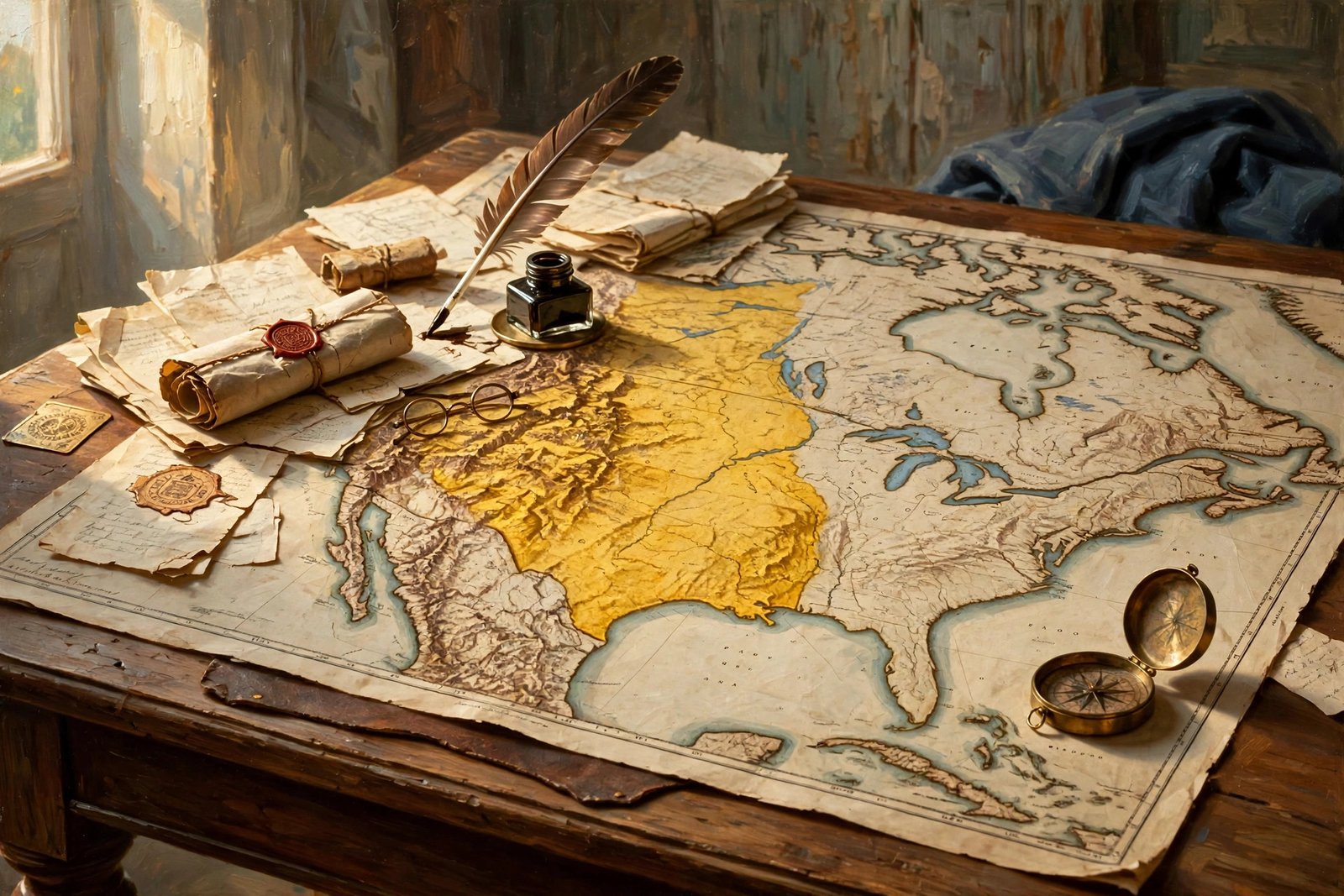
Imagine waking up one morning to learn that your country has doubled in size overnight. Not by winning a war, not by conquering a neighbor, but by signing a piece of paper in a room in Paris. That is exactly what happened to the United States in 1803, when President Thomas Jefferson’s diplomats bought an enormous stretch of the North American continent from France for $15 million. The deal, known as the Louisiana Purchase, added about 828,000 square miles to the young republic, land that would eventually become all or part of 15 American states. It was the greatest real estate bargain in history, and it happened almost by accident.
Jefferson never set out to buy half a continent. He sent his diplomats to Paris with a much smaller goal in mind: buy the port city of New Orleans. What they came home with instead redrew the map of North America, set the United States on the road to becoming a continental power, and launched one of the most famous expeditions in American history. This is the story of how it happened, why France was willing to sell, and what the purchase meant for the country Americans live in today.
A Young Nation With a River Problem
To understand the Louisiana Purchase, you have to understand the Mississippi River. In 1803, the United States was a narrow strip of a nation hugging the Atlantic coast, with its western border at the Mississippi. Beyond the river lay a vast territory claimed by foreign powers. But the river itself was the economic lifeline of the young republic. Farmers in the Ohio Valley and the new settlements of Kentucky and Tennessee had no easy way to get their crops to market except by floating them down the Mississippi to the port of New Orleans, where they could be loaded onto ocean-going ships.
Whoever controlled New Orleans controlled the economic future of the American West. For years, Spain had held the port, and American leaders had learned to live with that arrangement. Spain was a fading empire, and Jefferson believed he could manage it. Then the news arrived that changed everything: Spain had secretly transferred Louisiana back to France under the Treaty of San Ildefonso, and France was now ruled by Napoleon Bonaparte, the most ambitious military leader in Europe. Jefferson was alarmed. In a private letter, he called New Orleans the one single spot on the globe whose possessor was America’s natural and habitual enemy.
Jefferson’s fear was simple. A strong, aggressive France sitting at the mouth of the Mississippi could choke off American trade, tax American goods, or close the port entirely. The farmers of the West, already restless, might even break away and form their own country rather than depend on a foreign power for their livelihood. Jefferson decided he had to act, and act fast.
Napoleon and the Deal Nobody Expected
Across the Atlantic, Napoleon had his own problems, and they were about to make him the most generous seller in history. He had dreamed of rebuilding a French empire in North America, with Louisiana as its centerpiece and the sugar-rich Caribbean island of Saint-Domingue as its economic engine. That dream was collapsing. The French expedition sent to retake Saint-Domingue had been devastated by disease and by fierce resistance, and the colony was lost. At the same time, France was facing the imminent renewal of war with Great Britain, the greatest naval power on earth. A French territory across the ocean would be almost impossible to defend against the British navy, and Napoleon needed money and soldiers for the wars in Europe far more than he needed a distant wilderness.
Napoleon made a ruthless calculation: better to sell Louisiana to the Americans, pocket the cash, and deny the territory to Britain than to lose it in a war for nothing. The decision was his alone, and it was made with startling speed. What Jefferson wanted to buy was a single port. What Napoleon was suddenly willing to sell was an entire empire.
The Negotiators in Paris
The American side of the negotiation was handled by two men who have become legends of American diplomacy. Robert R. Livingston was the American minister to France, a seasoned diplomat who had been in Paris working the New Orleans question for months. James Monroe was the special envoy Jefferson sent to help him, a future president who arrived in Paris in April 1803 carrying instructions to buy New Orleans and the surrounding territory, with authorization to offer as much as $10 million for it.
Monroe’s arrival came just in time. Only days before he reached Paris, the French Treasury Minister, Francois Barbe-Marbois, had stunned Livingston by offering to sell not just New Orleans but the entire Louisiana Territory. The price was $15 million, which worked out to less than three cents an acre. Livingston and Monroe had no authorization to buy the whole territory, and no way to ask Jefferson for permission quickly. A letter across the Atlantic took weeks in each direction, and Napoleon could change his mind at any moment.
The two diplomats made a daring gamble. They seized what Jefferson would later call the fugitive occurrence and negotiated the deal anyway, haggling the price and working out the terms on their own authority. On April 30, 1803, they signed the treaty, with the document formally dated to that day. Their instructions had allowed them to spend up to $10 million for a port city. They had spent $15 million for half a continent, and they had no idea whether their president would be thrilled or furious.
Fifteen Million Dollars: What America Actually Paid
The price of the Louisiana Purchase has become one of the most quoted numbers in American history: $15 million for about 828,000 square miles, or roughly 530 million acres, at less than three cents per acre. By any measure, it was an astonishing bargain. The United States paid roughly $18 per square mile for land that would one day hold some of the most productive farmland, busiest river ports, and fastest-growing cities in the world.
The money itself was arranged through two great European banking houses, Baring and Company of London and Hope and Company of Amsterdam, which provided the cash for the transaction. The United States repaid them with bonds over a 15-year period at 6 percent interest, which brought the final cost of the purchase to a considerably higher figure than the headline $15 million. Even so, the deal remains one of the great bargains of history, and the land has repaid its cost many thousands of times over.
It is worth pausing to grasp the scale. The territory stretched from the Mississippi River in the east to the Rocky Mountains in the west, from the Gulf of Mexico in the south to the Canadian border in the north. It more than doubled the size of the United States in a single stroke, adding land that today forms all or part of 15 states: Louisiana, Missouri, Arkansas, Iowa, Minnesota, North Dakota, South Dakota, Nebraska, Kansas, Oklahoma, Colorado, Wyoming, Montana, Idaho, and New Mexico, with small portions reaching into what is now Texas and Canada.
A Constitutional Headache
When news of the treaty reached Washington, Jefferson faced a problem of his own making. He was delighted by the deal, but he was also a strict believer in limited government, and he could not find anywhere in the Constitution that gave the president the power to buy foreign territory. For a time, he worried the purchase was unconstitutional and even considered asking Congress to amend the Constitution to allow it.
In the end, practical politics won out. Jefferson and Secretary of State James Madison persuaded Congress to ratify and fund the purchase, arguing that the treaty-making power covered the deal and that the opportunity was too good to lose. The Senate ratified the treaty on October 20, 1803, by a vote of 24 to 7. The Federalist opposition warned that the purchase would dilute the power of the Eastern states and saddle the country with an ungovernable wilderness. They were outvoted, and the precedent they feared became the model for every later American territorial expansion, from Florida to Alaska.
The Transfer: December 20, 1803
The formal handover took place in New Orleans on December 20, 1803, in a ceremony that captured the strangeness of the moment. The French flag was lowered and the American flag raised over the city, in front of crowds that included French and Spanish residents who had just learned they were now Americans. The transfer had actually happened in two stages: Spain formally handed Louisiana to France only weeks earlier, and France then handed it to the United States, a chain of ceremonies that left some residents unsure which flag was supposed to be flying.
For the people who already lived in the territory, the change was profound and complicated. French and Spanish settlers, free people of color, enslaved people, and Native American nations all suddenly found themselves under a new government with new laws. The purchase transferred a claim to the land, but the United States still had to negotiate, and often fight, for control of it on the ground over the decades that followed. The story of the Louisiana Purchase is also the story of the peoples whose homelands were traded between empires without their consent, a fact that historians today treat as inseparable from the triumph of the deal.
Lewis and Clark: The Expedition the Purchase Made Possible
Jefferson had been planning an exploration of the West even before the purchase was final. He had already dispatched Meriwether Lewis and William Clark to explore the Missouri River and find a route to the Pacific, and the purchase transformed their mission from a diplomatic probe of foreign territory into a survey of America’s own new land. The Corps of Discovery set out from Illinois on May 14, 1804, just five months after Louisiana officially transferred to the United States.
Over the next two years, Lewis and Clark and their party traveled thousands of miles up the Missouri, across the Rocky Mountains, and down the Columbia River to the Pacific Ocean, then all the way back. They mapped rivers and mountain passes, documented hundreds of plants and animals new to science, and established relations, sometimes friendly and sometimes tense, with dozens of Native American nations. Their journals remain one of the great treasures of American history, and their journey fixed the new territory in the American imagination as a land of possibility.
The expedition would have been unthinkable without the purchase. Before 1803, Lewis and Clark would have been trespassers in French territory. After it, they were explorers in their own country, carrying the flag into a West that now belonged, at least on paper, to the United States.
What the Purchase Changed Forever
The Louisiana Purchase changed the United States in ways that are still visible today. It gave the country control of the Mississippi River and the port of New Orleans, securing the economic future of the West. It provided the land for the great westward migration of the 19th century, the farms of the Great Plains, the cattle towns, the railroads, and eventually the cities of St. Louis, Kansas City, Denver, and Minneapolis. It set the precedent that the United States could grow by purchase as well as by war, a precedent that would be followed in Florida, Texas, Oregon, and Alaska.
It also changed the balance of American politics. The new territory raised urgent questions that would haunt the nation for the next sixty years: would slavery be allowed to spread into the new lands, and would the new states be free or slave? Those questions led to the Missouri Compromise, the Kansas-Nebraska Act, and eventually the Civil War itself. The purchase did not cause those conflicts, but it created the stage on which they played out.
Perhaps the most remarkable thing about the Louisiana Purchase is how much of it was luck. Jefferson wanted a port and got a continent. Napoleon wanted cash for a European war and gave away an empire. Two diplomats exceeded their instructions and were rewarded instead of punished. And a nation that had been a coastal republic woke up as a continental power, with a destiny that now stretched from the Atlantic to the Pacific. The $15 million check was the easy part. Living up to the land it bought has taken more than two centuries, and the work is still going on.
Related reading: Lewis and Clark: The Expedition That Opened the American West · How America Got 50 States: The Order They Joined · The Gettysburg Address: Lincoln’s 272 Words of History
FAQs
Q: How much did the United States pay for the Louisiana Purchase?
A: The United States paid $15 million for about 828,000 square miles, roughly 530 million acres, which worked out to less than three cents per acre. The money was arranged through the banking houses of Baring and Company of London and Hope and Company of Amsterdam, and the United States repaid them with bonds over 15 years at 6 percent interest.
Q: Why did Napoleon sell Louisiana to the United States?
A: Napoleon had lost the Caribbean colony of Saint-Domingue, which was meant to be the economic engine of his North American empire, and France was facing a renewed war with Great Britain. He needed money and soldiers for Europe more than he needed a distant territory he could not defend, so he chose to sell it to the Americans rather than lose it to the British.
Q: Who negotiated the Louisiana Purchase for the United States?
A: Robert R. Livingston, the American minister to France, and James Monroe, the special envoy sent by President Thomas Jefferson. They were authorized to spend up to $10 million for New Orleans, but French Treasury Minister Francois Barbe-Marbois offered them the entire territory for $15 million, and they signed the treaty on April 30, 1803, without waiting for new instructions.
Q: Which modern states came from the Louisiana Purchase?
A: The territory eventually formed all or part of 15 states: Louisiana, Missouri, Arkansas, Iowa, Minnesota, North Dakota, South Dakota, Nebraska, Kansas, Oklahoma, Colorado, Wyoming, Montana, Idaho, and New Mexico, with small portions in what is now Texas and Canada.
Q: How did the Louisiana Purchase lead to the Lewis and Clark expedition?
A: President Jefferson had already planned an expedition to explore the Missouri River, but the purchase turned it from a probe of foreign land into a survey of America’s own new territory. The Corps of Discovery, led by Meriwether Lewis and William Clark, set out from Illinois on May 14, 1804, just five months after the transfer was completed.