
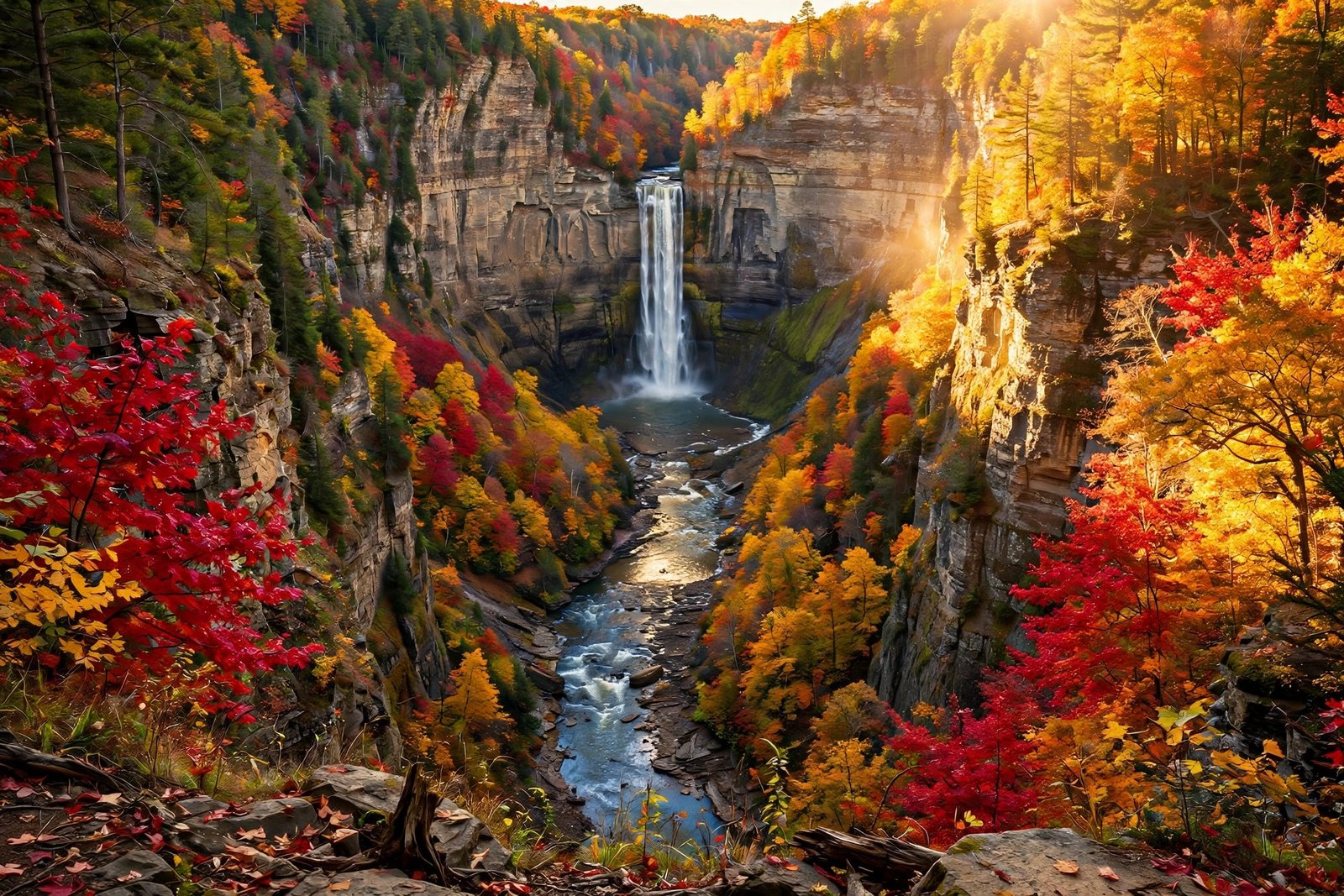
Stand on the rim at Inspiration Point on a clear autumn morning and you will understand why Letchworth State Park has been called the Grand Canyon of the East for more than a century. Below you, the Genesee River winds through a gorge so deep that the far wall seems to rise out of a painting, and the sound of Middle Falls drifts up through the trees. It is the kind of place that makes first-time visitors stop mid-sentence, and then reach for a camera.
Yet for all its drama, Letchworth remains one of New York’s great hidden gems. It sits in the rolling farmland of western New York, about 35 miles southwest of Rochester and 60 miles southeast of Buffalo, far from the crowds that gather at Niagara Falls. The park covers 14,427 acres and stretches roughly 17 miles along the Genesee River, yet many Americans outside the region have never heard of it. Those who have been tend to come back, in spring for the thunder of high water, in autumn for the color, and in winter for the strange beauty of frozen falls.
Why They Call It the Grand Canyon of the East
The nickname is not an exaggeration. The Genesee River has carved a gorge through the park whose rock walls rise up to 550 feet in places, narrowing to about 400 feet across above the middle of the three great falls. The walls expose layers of Devonian-age rock, mostly shales with bands of limestone and sandstone, laid down hundreds of millions of years ago when this part of New York lay beneath a shallow sea. Standing at the rim, you are looking at a cross-section of deep time, with a living river still doing the carving at the bottom.
The Seneca people, who lived in this valley long before the park existed, called it Sehgahunda, the Vale of the Three Falls. That name captures what makes Letchworth different from its desert namesake. The Grand Canyon in Arizona overwhelms with sheer scale and bare rock. Letchworth answers with water and forest: a green canyon, walled in trees, with waterfalls pouring through it. It is smaller, softer, and in its own way just as unforgettable.
The Genesee River: The Sculptor of the Gorge
Every great canyon needs a river with patience, and the Genesee has had thousands of years to work. The river flows northward through western New York toward Lake Ontario, and as it passes through the park it drops over a series of ledges and cuts steadily downward through the rock. The deepest and most dramatic stretch is Portage Canyon, the southern section of the park, where all three of the major waterfalls are found.
Geologists read the gorge walls like pages in a book. The layered shales and sandstones record ancient seas, and the river’s steady cutting keeps exposing fresh rock. After heavy rain or the spring snowmelt, the Genesee runs high and brown, and the falls roar with a power that reminds you the canyon is still being made. In late summer, when the water drops, the river turns green and clear, and the rocks at the base of the falls show their shapes.
Three Waterfalls, Each With Its Own Character
Letchworth is best known for three large waterfalls on the Genesee River, the Upper, Middle, and Lower Falls. On top of those, as many as 50 smaller waterfalls pour in from the tributary streams that feed the river, so after a good rain the whole gorge seems to leak silver. Each of the three great falls has its own personality, and it is worth seeing all three.
Upper Falls
Upper Falls sits at the southern end of the park, near the Portage Bridge, the high railroad viaduct that carries trains across the gorge. It is the first of the three falls the river meets as it flows north, and the setting is dramatic: the river squeezes between the gorge walls, drops over the ledge, and runs on toward the canyon below, with the iron bridge arching overhead. The viewpoint near the bridge is one of the most photographed spots in the park, especially when a train crosses and a plume of mist rises from the falls.
Middle Falls
Middle Falls is the star of the park. At 107 feet high and 285 feet wide, it is the tallest and broadest of the three, and many visitors consider it the most beautiful waterfall in New York State. The falls pour over a wide, curved ledge into a deep pool, and on sunny days the mist throws rainbows across the gorge. The view from the lawn of the Glen Iris Inn, perched on the gorge rim above the falls, is the classic Letchworth postcard. Come at sunset, when the light turns the water gold, and you will see why people plan whole trips around this one view.
Lower Falls
Lower Falls is the most secluded of the three, tucked into a quieter stretch of the gorge and reached by a trail that descends the canyon wall on stone stairways. The walk down is part of the experience: the sound of the river grows louder with every step, the air cools, and the trees close in. At the bottom, the falls spill into a calm pool, and a stone footbridge crosses the river nearby. It is the falls to visit when you want a little solitude, and it rewards the effort of the climb back up.
Keep an eye out, too, for Inspiration Falls, a seasonal ribbon waterfall near Inspiration Point that drops about 350 feet down the gorge wall after rain or snowmelt. It is a thin, graceful thread of water rather than a thundering cascade, and it only flows when conditions are right, which makes catching it feel like a small piece of luck.
The Man Who Saved the Gorge: William Pryor Letchworth
Letchworth State Park exists because one man fell in love with this gorge and refused to let it be spoiled. William Pryor Letchworth (1823-1910) was a Buffalo industrialist who began buying land along the Genesee in 1859. Over the following decades he built up a 1,000-acre estate, which he called Glen Iris, after the Greek goddess of the rainbow, and made his home in a white-pillared mansion overlooking Middle Falls.
Letchworth was not a man who kept beauty to himself. He opened his grounds to visitors, built trails and viewpoints, and tended the estate for more than half a century as a kind of private park. In 1906, he bequeathed the 1,000-acre estate to New York State, and it became the heart of the newly created Letchworth State Park. His former home is now the Glen Iris Inn, a restaurant and inn where guests can still sit on the lawn and watch the falls he loved. The park has since grown to more than 14,000 acres around his original gift, but its spirit is still his: a place saved from development and held open for everyone.
Hiking the Park: More Than 66 Miles of Trails
With over 66 miles of trails, Letchworth is a hiker’s park as much as a sightseeing park. The trail system runs along the gorge rim, drops down to the river, and winds through the hardwood forests that cover most of the park. Some paths are gentle, paved or level walks between overlooks, suited to families and casual strollers. Others are serious hikes, with steep descents, stone staircases, and long climbs back to the rim.
The Gorge Trail, which follows the river along the canyon, is the classic walk, linking the falls and the main viewpoints in one long, rewarding route. Shorter trails lead to quiet corners of the forest, to tributary waterfalls, and to overlooks that most visitors drive straight past. Wherever you walk, wear sturdy shoes: the trails near the falls can be muddy and slippery, and the stone steps down to Lower Falls are steep. Bring water, give yourself more time than you think you need, and remember that the climb out of a 550-foot gorge is a workout.
Beyond hiking, the park offers camping and cabins in season, and the Genesee draws paddlers: guided whitewater rafting trips run on the river when conditions allow. On calm mornings, hot air balloons sometimes drift over the gorge, giving a small number of lucky passengers the view the hawks get. And the Glen Iris Inn, with its restaurant overlooking Middle Falls, is a fine reward at the end of a long day on the trails.
The Best Viewpoints
Letchworth is a park of overlooks, and a few stand out. Inspiration Point, near the park’s visitor center, gives the sweeping view that stops people in their tracks: the gorge opening out below, the river bending away, and the forested walls stretching to the horizon. The Great Bend Overlook, where the river makes a sharp turn, is another favorite, especially in autumn when the hillsides turn red and gold.
For the falls themselves, the viewing areas at Middle Falls and Upper Falls are the essential stops, and the lawn at the Glen Iris Inn may be the single best seat in the park. Photographers should plan for early morning or late afternoon, when low light rakes across the gorge walls and the mist at Middle Falls catches the sun. And do not rush: the gorge changes with the light, and a viewpoint you visited at noon can look like a different place at sunset.
When to Visit Letchworth
Letchworth State Park is open year-round, and every season has its case. Spring is the season of water: snowmelt and rain swell the Genesee, and the falls run at their fullest and loudest. Summer brings warm weather, green forests, and the park’s full range of facilities, from camping to the inn’s restaurant, making it the easiest season for a family trip.
Autumn is the season many regulars swear by. The hardwood forests that line the gorge turn brilliant shades of red, orange, and gold, and the contrast with the dark river below is spectacular. Fall weekends are the park’s busiest time, so arrive early. Winter is the quiet season: the crowds thin out, the waterfalls freeze into curtains of ice, and the snow-covered gorge feels like a different world. Cold-weather visitors come for cross-country skiing and the stillness, and for the sight of the frozen falls.
Planning Your Visit: Practical Tips
A little planning goes a long way at Letchworth. The park has several entrances, with the southern entrance near Castile and the northern entrance near Mount Morris being the most commonly used, so check a map and pick the entrance closest to what you want to see first. A vehicle entry fee is typically charged, and rates and hours can change, so check the current details on the New York State Parks website before you go.
Arrive early on autumn weekends, when the parking areas near the popular overlooks fill up. Cell service can be patchy down in the gorge, so download maps ahead of time rather than relying on your phone. Dress in layers: the temperature at the bottom of a deep, shaded gorge can be noticeably cooler than at the rim. Stay on marked trails and behind railings near cliff edges, because the gorge walls are steep and the rock can be loose. And if you want to stay overnight, book early: the Glen Iris Inn and the park’s campgrounds and cabins are popular, and the nearby towns of Mount Morris and Castile offer additional places to stay.
Related reading
If you enjoyed this guide, keep exploring America’s hidden places: Valley of Fire State Park in Nevada, Great Sand Dunes National Park in Colorado, and Dry Tortugas National Park in Florida.
Frequently Asked Questions
Where is Letchworth State Park?
Letchworth State Park is in Livingston and Wyoming counties in western New York, about 35 miles southwest of Rochester and 60 miles southeast of Buffalo. The park follows the Genesee River for roughly 17 miles.
Why is it called the Grand Canyon of the East?
The nickname comes from the park’s deep Genesee River gorge, whose rock walls rise up to 550 feet in places. The scale of the gorge, combined with its three major waterfalls, reminded early visitors of the Grand Canyon, and the name stuck.
How many waterfalls are in Letchworth State Park?
There are three major waterfalls on the Genesee River: Upper, Middle, and Lower Falls. In addition, as many as 50 smaller waterfalls flow in from tributary streams, including the seasonal Inspiration Falls.
How much time do you need at Letchworth?
A full day is enough to see the three main waterfalls, the best overlooks, and the Glen Iris Inn. If you want to hike the longer trails, camp, or explore at a slower pace, plan for a weekend.
Is there an entrance fee for Letchworth State Park?
A vehicle entry fee is typically charged. Fees and hours can change, so check the current information on the official New York State Parks website before your visit.
For planning details, see the official park page at New York State Parks: Letchworth State Park, the park’s background at Letchworth State Park on Wikipedia, the visitor guide at America’s State Parks, and local information at Explore Letchworth.