
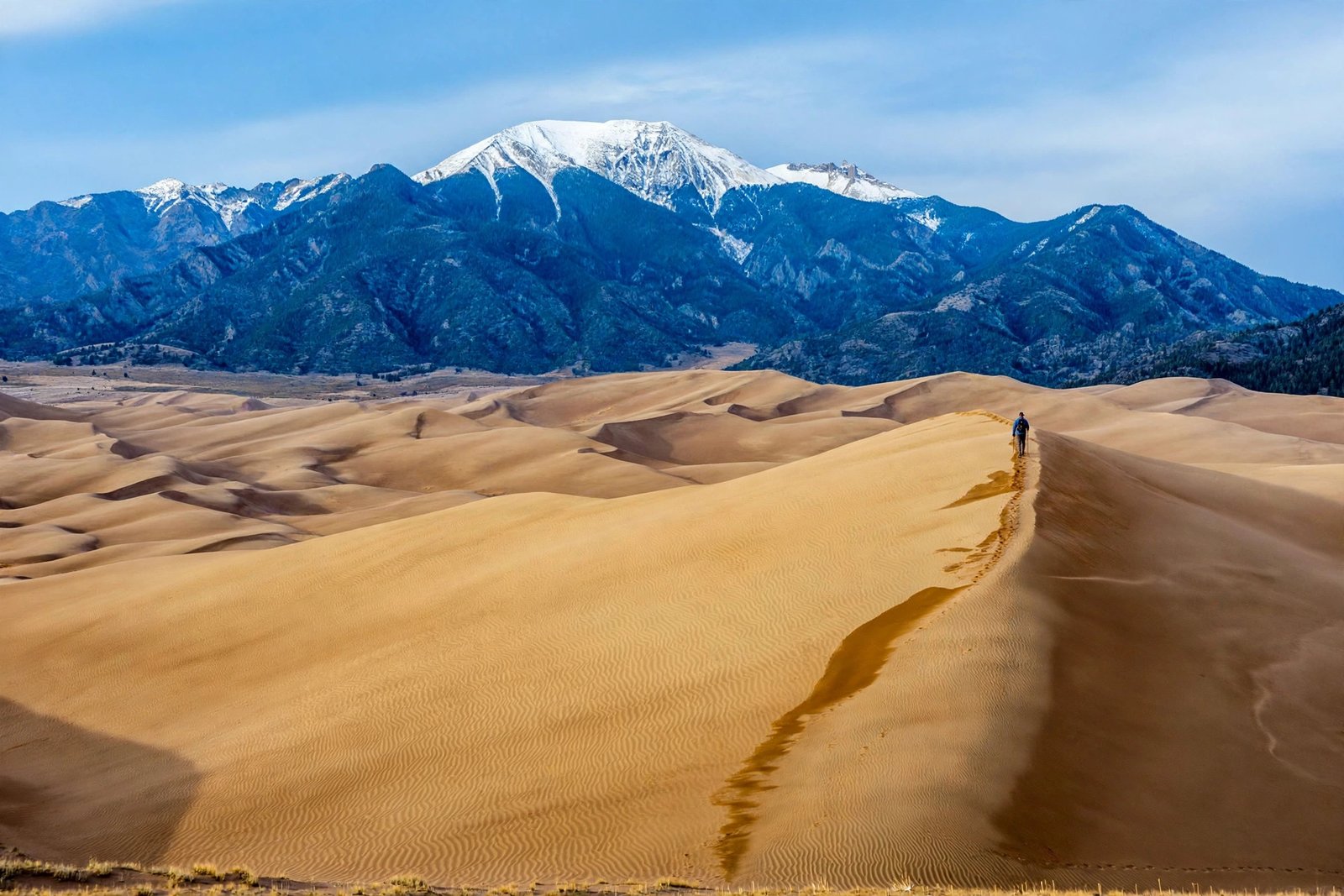
In southern Colorado, where the Sangre de Cristo Mountains rise sharply from the San Luis Valley floor, there is a landscape that seems impossible. Towering waves of sand, some of the tallest in North America, stretch for miles beneath snow-capped peaks. This is Great Sand Dunes National Park and Preserve, a place where a high desert, a mountain range, and an ancient wind-blown sand deposit meet to create one of the most surprising sights in the American West.
Visitors often arrive expecting a small patch of dunes and find something far grander: a vast dunefield covering roughly thirty square miles, with ridges and valleys that shift with the wind. On a clear morning, the contrast is breathtaking. Golden sand glows against dark mountains, and in spring, a creek winds through the base of the dunes, drawing families to splash in its shallow, surging waters. It is a park that rewards curiosity, whether you come to sandboard down a steep slope, hike to a high ridge, or simply sit and watch the light change across the sand.
Great Sand Dunes is also a place of quiet superlatives and deep history. The sand itself has been gathering here for thousands of years, blown from the valley floor and trapped by the mountains. People have traveled through this valley for generations, and the park today protects not only the dunes but also mountains, wetlands, grasslands, and alpine lakes. For travelers seeking a hidden gem far from crowded viewpoints, it is hard to beat.
A Desert in the Shadow of the Mountains
The story of Great Sand Dunes begins with wind and water. Over thousands of years, streams and erosion carried sand and sediment from the surrounding mountains into the San Luis Valley. Prevailing winds then pushed that sand toward the Sangre de Cristo range, where the mountains acted as a natural trap. Instead of blowing onward, the sand piled up at the foot of the range, building the dunefield we see today. Opposing winds from different directions help keep the dunes in place, sculpting sharp ridges and deep valleys that change subtly with each season.
The setting makes the park feel almost surreal. The San Luis Valley is a high, dry basin, and the Sangre de Cristo Mountains tower above it. Standing on the main dune ridge, you can look one way toward endless sand and the other way toward forested slopes and rocky summits. That juxtaposition is what surprises most first-time visitors. It is not a desert in the Sahara sense, but a high-altitude sand sea tucked against a mountain wall, shaped by forces that are still at work.
The park and preserve together protect a remarkable range of ecosystems. Beyond the dunefield, the preserve includes alpine tundra, forests, and wetlands. That variety supports wildlife from elk and mule deer to birds, small mammals, and insects adapted to sandy soils. It also means a visit can combine very different experiences in a single day, from walking barefoot on warm sand to hiking a forested mountain trail.
The Tallest Dunes in North America
Great Sand Dunes is home to the tallest sand dunes in North America, a distinction that draws adventurers from around the world. The most famous is Star Dune, a massive, star-shaped formation whose ridges radiate in several directions. Reaching its summit is a serious hike, a steep and strenuous climb through soft sand that can take hours, but the reward is a panoramic view across the entire dunefield and the valley beyond.
A more accessible high point is High Dune, which rises from the first major ridge of the dunefield. Many visitors make this their goal, and the climb, while challenging, is achievable for reasonably fit hikers. There is no maintained trail on the dunes themselves. Instead, hikers pick their own routes, following ridgelines where the sand is firmer and the walking is easier. The park advises starting early, especially in summer, when the sand surface can become very hot by midday.
Walking on dunes is harder than it looks. Every step sinks, and progress is slower than on a normal trail. But that effort is part of the experience. The silence on the dunes is striking, broken only by wind and the occasional call of a bird. Photographers love the early morning and late afternoon, when low light carves shadows into the ridges and turns the sand shades of gold and orange. Whether you climb to a summit or simply wander the lower slopes, the dunes offer a sense of scale and solitude that is rare in popular parks.
Medano Creek: A Seasonal Surprise
One of the park's most beloved features appears only in spring and early summer. Medano Creek flows along the base of the main dunefield, fed by snowmelt from the Sangre de Cristo Mountains. In a typical year, the creek runs strongest in late spring, when warm days melt high snowpack and send water down to the valley. Visitors wade, splash, and build sand castles along its banks, and children delight in the creek's gentle waves.
The creek is famous for a phenomenon called surge flow. Instead of flowing steadily, the water pulses in small waves as sand builds up and releases in the streambed. The result is a rhythmic rise and fall that feels almost like a tiny tide. It is a fascinating natural quirk and a reminder that this landscape is constantly changing, shaped by water as much as by wind.
By late summer, Medano Creek usually slows to a trickle or dries up in places, and by autumn the creek bed may be mostly sand again. That seasonal rhythm is part of the park's charm and a good reason to check conditions before visiting. The National Park Service posts current creek flow information, so visitors planning a spring trip can time their visit for the best water levels. Even when the creek is low, the wide, flat area at the base of the dunes remains a popular spot for picnics and play.
Sandboarding, Sledding, and Hiking
For many visitors, the highlight of Great Sand Dunes is sliding down it. Sandboarding and sand sledding are popular activities, and the park allows them on the dunes in areas away from vegetation and the creek. Specialized sandboards and sleds work best, since ordinary snow sleds and snowboards do not slide well on sand. Rentals are available from shops outside the park, and many visitors bring their own gear. The experience is thrilling: a steep, fast descent with a soft landing, followed by a long, sandy climb back to the top.
Hiking opportunities extend well beyond the dunes. Trails in the park and preserve lead through forests, along streams, and up to alpine lakes. The Mosca Pass Trail climbs through aspen and evergreen forest to a historic mountain pass. The Wellington Ditch Trail and the Sand Pit area offer easier walks near the dunes. For experienced hikers, routes into the preserve's high country provide solitude and dramatic mountain scenery.
The park also offers horseback riding on designated routes, and the surrounding San Luis Valley is a gateway to other attractions, including hot springs and wildlife refuges. Because the park sits at high elevation, visitors should take time to acclimate, drink plenty of water, and protect themselves from strong sun. The dry air and intense sunlight at altitude can catch newcomers by surprise, so hats, sunscreen, and extra water are essential.
Dark Skies and Quiet Nights
When the sun sets, Great Sand Dunes reveals another treasure: exceptionally dark night skies. Far from major cities, the park offers views of the Milky Way, constellations, and planets that are increasingly rare in a light-polluted world. The park has been recognized for its dark skies, and rangers sometimes offer nighttime programs that introduce visitors to astronomy and the nocturnal desert.
Camping in the park's campground puts you right at the edge of the dunes, making it easy to watch sunset colors fade from the sand and then look up at a sky full of stars. Even a short evening walk from the campground can feel magical, as the dunes cool and the air fills with the sounds of night insects and distant coyotes. Photographers prize the park for night sky images, with dunes silhouetted against star fields.
Stargazing here is best on moonless nights, when the Milky Way is most vivid. Visitors should bring warm layers, since high desert nights can turn chilly even after a hot day, and a red flashlight helps preserve night vision. Whether you join a ranger program or simply spread a blanket on the sand, a night at Great Sand Dunes is an unforgettable part of the visit.
Planning Your Visit
Great Sand Dunes National Park is open year-round, and each season offers a different experience. Spring brings Medano Creek and wildflowers. Summer is the busiest season, with warm days and cool nights. Autumn offers crisp air, golden aspen, and smaller crowds. Winter transforms the dunes with snow, creating a striking contrast and a quiet, almost empty park for those prepared for cold and wind.
The park's visitor center is the best first stop. Rangers can advise on current conditions, dune safety, creek levels, and trail options. The center also offers exhibits on the park's geology, ecology, and human history. Entrance fees apply, and the park's campground operates on a reservation system during the busy season, so booking ahead is wise. There are no lodging or restaurants inside the park, but nearby towns offer motels, cabins, and hot springs resorts.
Before you go, check the official park website for alerts, weather, and road conditions. The main park road is paved and accessible to ordinary vehicles, but some backcountry roads in the preserve require high clearance. Cell service is limited in the park, so download maps and information in advance. With a little preparation, a trip to Great Sand Dunes becomes one of those rare travel experiences that exceeds every expectation.
For current conditions, hours, and safety guidance, visit the official Great Sand Dunes National Park and Preserve page from the National Park Service.
Related Reading
- Channel Islands National Park: California's Hidden Gem Guide
- White Sands National Park: New Mexico's Gypsum Dunes
- Cumberland Island, Georgia: Wild Horses Guide
Frequently Asked Questions
Q: Where is Great Sand Dunes National Park?
It is in southern Colorado, in the San Luis Valley, at the foot of the Sangre de Cristo Mountains. The park is a drive from Alamosa, the nearest town with services, and is reachable by paved road.
Q: What are the tallest dunes in the park?
Great Sand Dunes is home to the tallest sand dunes in North America. Star Dune is the tallest, and High Dune on the first ridge is a popular hiking goal. There is no marked trail on the dunes, so hikers choose their own routes along the ridges.
Q: When does Medano Creek flow?
Medano Creek typically flows in spring and early summer, fed by snowmelt from the Sangre de Cristo Mountains. It is usually strongest in late spring and often slows or dries up by late summer. Check the park's current conditions before visiting.
Q: Can you sandboard at Great Sand Dunes?
Yes, sandboarding and sand sledding are allowed on open dune areas away from vegetation and the creek. Specialized sandboards and sleds work best, and rentals are available from shops outside the park.
Q: Is Great Sand Dunes good for stargazing?
Yes, the park is known for its dark night skies and offers excellent views of the Milky Way and constellations, especially on moonless nights. Rangers sometimes offer nighttime programs, and camping near the dunes makes evening skywatching easy.