
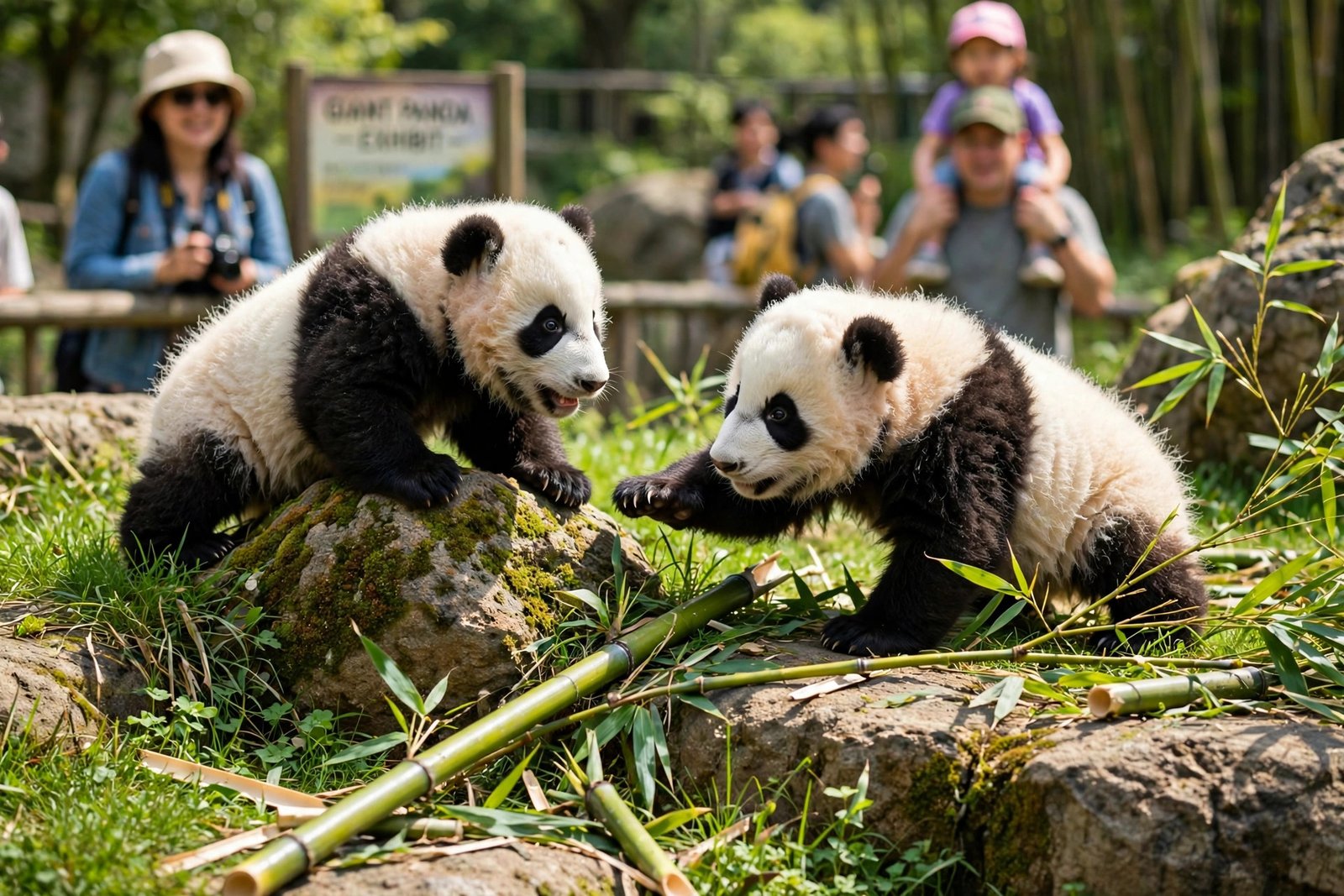
On Friday, November 6, 2026, two giant pandas stepped into the public eye in Atlanta for the first time, and the city fell in love all over again. Ping Ping and Fu Shuang, a male and a female panda who arrived in Atlanta in late September, made their public debut as Zoo Atlanta opened the all-new Arthur M. Blank Panda Grove, a renovated habitat built for their comfort and for the visitors who have waited nearly two years to see pandas in Atlanta again. The opening was the end of a long wait and the start of a new chapter for one of America's most beloved zoo programs. For families in Georgia and across the Southeast, it was a chance to meet two animals who are, in every sense, new neighbors. For Zoo Atlanta, it was the public launch of a conservation partnership that stretches back more than a quarter of a century, and that now has a fresh ten-year agreement behind it.
Meet Ping Ping and Fu Shuang
Ping Ping is a male giant panda, and Fu Shuang is a female. Both were born at the Chengdu Research Base of Giant Panda Breeding in China, one of the world's most important centers for panda research and breeding. Ping Ping was born on March 17, 2020, and Fu Shuang was born on October 18, 2020, according to Zoo Atlanta. That makes both pandas six years old, young adults in panda terms, at an age when they are active, curious, and full of personality. They are not cubs, and they are not elderly animals. They are in the prime of their lives, and they have a decade ahead of them in Atlanta.
Their names carry meaning, as panda names often do. Fu Shuang is pronounced Foo Shwong, and Zoo Atlanta has helped visitors learn the pronunciation as part of the welcome. Ping Ping's name is part of a name given at birth to him and his twin brother, representing a blessing for a smooth and healthy life, according to Zoo Atlanta. That detail is a small window into the care that goes into panda breeding in China, where names are chosen with intention, and where each animal's identity is part of a larger story of conservation. For American visitors, learning the names is the first step in getting to know the animals as individuals rather than as generic pandas.
The Journey to Atlanta
Ping Ping and Fu Shuang arrived in Atlanta on September 27, 2026, aboard a dedicated Boeing 777 aircraft known as the FedEx Panda Express. The plane touched down at Hartsfield-Jackson Atlanta International Airport, one of the busiest airports in the world, and the pandas were then transported to Zoo Atlanta. The journey from Chengdu to Atlanta is long, and moving two large animals by air requires careful planning, from the crates they travel in to the temperature and the food they are given along the way. The FedEx Panda Express is a specially prepared aircraft, and its use for panda transport has become a familiar part of how pandas move between China and the United States.
Arthur M. Blank Panda Grove: A New Home
The pandas' new home is the Arthur M. Blank Panda Grove, a renovated habitat that opened on November 6, 2026, the same day as the pandas' public debut. The grove is a complete update of Zoo Atlanta's original giant panda habitat, funded by a $6 million grant from the Robert W. Woodruff Foundation. It is named for Arthur Blank, the co-founder of The Home Depot and the owner of the Atlanta Falcons, whose support for Zoo Atlanta's panda program dates back to 1999. The naming recognizes a long history of support, and it signals that the new habitat is meant to be a lasting part of the zoo.
The design of the grove also reflects what zoos have learned about panda care over the past 25 years. Modern panda habitats are not cages with a viewing window. They are complex environments that try to give the animals choices, from sunny spots and shady spots to high perches and quiet corners. They include bamboo, of course, and they include enrichment, the term zoos use for objects, scents, and activities that keep animals mentally stimulated. A good habitat is one in which a panda can behave in ways that are natural for the species, and in which visitors can watch that behavior without disturbing it. The Panda Grove, by the accounts of the opening coverage, was designed with both goals in mind.
Zoo Atlanta's Panda History: 1999 to 2024
To understand why the return of pandas to Atlanta matters so much, it helps to know the history. Zoo Atlanta's giant panda program began in 1999, when a young pair of pandas, Lun Lun and Yang Yang, arrived from China. Lun Lun, a female, was born on August 25, 1997, at the Chengdu Research Base of Giant Panda Breeding, and Yang Yang, a male, was her partner. They arrived in Atlanta on November 5, 1999, aboard a specially equipped cargo plane, and they made their first appearance on American soil as two-year-olds. The zoo had spent millions of dollars preparing a new panda habitat for them, and the city welcomed them with enthusiasm. In the first year of their debut, the zoo's attendance reached one million for the first time, a sign of how much the pandas meant to Atlanta.
Lun Lun and Yang Yang went on to become one of the most successful panda pairs in the world outside China. Over 25 years, they produced seven offspring, born between 2006 and 2016, including two sets of twins. Their cubs were Mei Lan, born in 2006, Xi Lan, born in 2008, Po, born in 2010, twins Mei Lun and Mei Huan, born in 2013, and twins Ya Lun and Xi Lun, born in 2016. All seven offspring now live at the Chengdu Research Base of Giant Panda Breeding in China, in keeping with the terms of the loan agreement, under which cubs born abroad return to China when they are of age. The successful rearing of two sets of twins was a particular achievement, and it made Zoo Atlanta a leader in panda breeding and care.
The partnership came to an end, for a time, in October 2024. On October 12, 2024, Lun Lun, Yang Yang, and their two youngest offspring, Ya Lun and Xi Lun, departed Atlanta aboard a FedEx Panda Express plane, bound for Chengdu. They arrived safely the next day. The departure was marked by a farewell event at the zoo, and it left Atlanta without pandas for the first time in 25 years. For nearly two years, the panda habitat stood empty, and the city waited to see whether pandas would return. The announcement in April 2026 that a new agreement had been reached, and that two new pandas would come to Atlanta, ended that wait. The arrival of Ping Ping and Fu Shuang in September, and their debut in November, closed a gap that had lasted almost two years.
Why Americans Love Giant Pandas
Giant pandas hold a special place in American life. They are among the few animals that almost everyone recognizes, and they inspire a level of affection that few other zoo animals match. Part of that is their appearance. The black-and-white coat, the round face, the dark patches around the eyes, and the gentle, almost human way they sit and eat bamboo make them instantly endearing. Part of it is their rarity. For most of American history, pandas were animals that most people could only see in pictures or in a handful of zoos. That scarcity made them precious, and it made a visit to see them feel like a special occasion.
The wild population of giant pandas is estimated at about 1,864 animals, according to China's national panda survey, a figure also used by Smithsonian conservation resources. Those pandas live in mountain forests in central China, at elevations of roughly 5,000 to 10,000 feet, in broadleaf and coniferous forests with bamboo. They are solitary animals for much of the year, and they spend most of their waking hours eating. That is because bamboo, which makes up about 99 percent of a panda's diet, provides relatively little nutrition, so a panda must eat a great deal of it to survive. According to the Smithsonian's National Zoo, a panda may consume roughly 70 to 100 pounds of bamboo in a day, and may spend 10 to 16 hours foraging and eating. That is a remarkable amount of time to spend on a single activity, and it is one of the reasons pandas seem so calm and focused when visitors watch them.
What Visitors Can Expect
Visitors to Zoo Atlanta who want to see Ping Ping and Fu Shuang should plan ahead. The zoo is located at 800 Cherokee Avenue SE in Atlanta, Georgia. Regular hours are weekdays from 9 a.m. to 5 p.m., with last entry at 3:30 p.m., and weekends from 9 a.m. to 6 p.m., with last entry at 4:30 p.m., according to visitor information published before the opening. The opening day itself had a delayed opening, and visitors were advised to check the zoo's website for updates. Ticket prices vary by date, so visitors should check current options on the zoo's tickets page before going, and they should consider buying tickets in advance, especially on weekends and during school holidays, when the panda habitat is likely to be busy.
Conservation Beyond the Cute Faces
There is also a broader lesson in the panda story. The change in the panda's conservation status, from Endangered to Vulnerable in 2016, is often cited as one of the clearest successes in modern conservation. It happened because of sustained effort over decades, by the Chinese government, by conservation organizations, by zoos, and by local communities. It happened because forests were protected, because reserves were created and expanded, because poaching was controlled, and because captive breeding programs, including the one at Zoo Atlanta, helped to build a safety net for the species. That success is not permanent, and it will need continued effort to maintain. But it shows what is possible when conservation is treated as a long-term commitment rather than a short-term project.
Related Reading
For more on American wildlife and the animals that share our landscapes, see our related coverage:
- American Black Bear Hibernation Facts Guide
- American Bison Comeback: Near-Extinction Success
- Florida Manatees Comeback and Slow Speed Zones
For primary information on the pandas and their debut, see Zoo Atlanta's announcement that the pandas have landed, Zoo Atlanta for visitor information and updates, and the Fox 5 Atlanta report on the pandas' arrival. For background on the debut, see the Asia Daily report on the pandas' debut.
Frequently Asked Questions
Who are Ping Ping and Fu Shuang?
Ping Ping is a male giant panda and Fu Shuang is a female giant panda, both born at the Chengdu Research Base of Giant Panda Breeding in China. Ping Ping was born on March 17, 2020, and Fu Shuang was born on October 18, 2020, according to Zoo Atlanta. Both are six years old.
When did the pandas make their public debut?
Ping Ping and Fu Shuang made their public debut at Zoo Atlanta on Friday, November 6, 2026, when the zoo opened the renovated Arthur M. Blank Panda Grove. They had arrived in Atlanta on September 27, 2026, and spent about a month in a routine quarantine period before the debut.
How long will the pandas stay in Atlanta?
The pandas are in Atlanta under a new International Cooperative Research Agreement on Giant Panda Conservation between Zoo Atlanta and the China Wildlife Conservation Association. The agreement runs for ten years.
Are giant pandas still endangered?
No. The International Union for Conservation of Nature changed the giant panda's status from Endangered to Vulnerable in 2016, after population growth associated with forest protection and restoration. Vulnerable still means the species faces a significant risk in the wild, and conservation work continues.
What is the Arthur M. Blank Panda Grove?
The Arthur M. Blank Panda Grove is Zoo Atlanta's renovated giant panda habitat, which opened on November 6, 2026. It was funded by a $6 million grant from the Robert W. Woodruff Foundation and features expanded indoor dayrooms, new climbing structures, pools, water features, and redesigned outdoor habitats.