
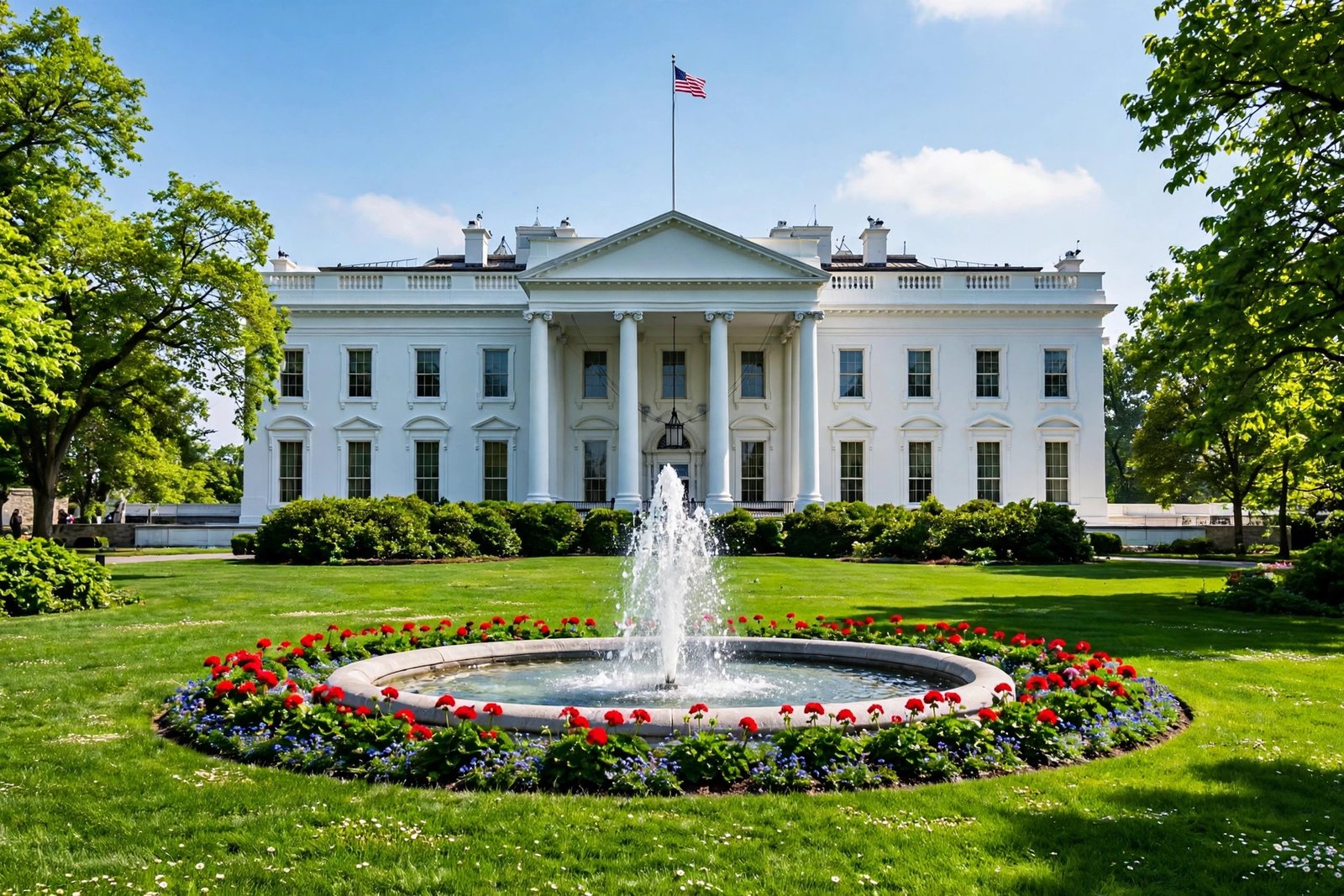
Everyone knows the White House is white. It is one of the most famous buildings in the world, and its color is right there in its name. But have you ever stopped to wonder why? The answer is more interesting than you might expect. It involves a practical 18th-century building material, a fire set by an invading army, a myth that has fooled generations of visitors, and a president who made a nickname official with the stroke of a pen.
The real story is better than the myth. The White House was not painted white to hide the damage of a fire. It was white before the fire ever happened, and the reason had nothing to do with how it looked. It had everything to do with keeping the building standing through cold winters. Here is how the most famous house in America got its color, and its name.
A New Capital Needs a President’s House
The story begins with the founding of Washington, D.C. itself. In 1790, Congress passed the Residence Act, establishing a new permanent capital on the banks of the Potomac River. The young nation needed a seat of government, and that meant a house for its president. A design competition was held in 1792, and the cornerstone of the new President’s House was laid on October 13 of that year.
Construction took eight years, from 1792 to 1800, and it was a massive undertaking for the new republic. Workers quarried sandstone, shaped it by hand, and raised the walls of a grand neoclassical mansion on a rise above the Potomac. The house was ready just in time: in November 1800, President John Adams moved in, becoming the first president to live in the White House. George Washington, who had chosen the site and overseen the plans, never lived there himself. He had left office in 1797, three years before the house was finished.
James Hoban and an Irish Inspiration
The winning design came from James Hoban, an Irish-born architect who had trained in Dublin before emigrating to America. Hoban’s plan won the competition and a cash prize, and he went on to supervise the building’s construction. His model was Leinster House in Dublin, the grand Georgian mansion that today houses the Irish parliament, and the resemblance is still clear in the White House’s balanced facade, its tall windows, and its restrained classical detail.
Hoban built the house from Aquia Creek sandstone, quarried in Virginia and ferried up the Potomac. The stone was warm and handsome, but it had a serious flaw: it was porous. Like a sponge, it soaked up rain, and in the freezing winters of the new capital, that trapped water could freeze, expand, and crack the stone. Hoban and his builders needed a way to protect the walls, and the solution they chose would define the building’s identity for centuries.
The Real Reason It Was Painted White
In 1798, two years before the house was even finished, workers coated its sandstone walls with a lime-based whitewash. Whitewash was a standard protective finish in the 18th century: a mixture based on lime that sealed the pores of the stone, shed rain, and kept freezing water out of the masonry. The white color was incidental. The point was protection, not decoration.
This is the detail that undoes the popular myth. The White House was already white years before British soldiers ever set foot in Washington. People were calling it the White House as early as 1811, three years before the fire. The whitewash was refreshed periodically through the early years of the house, and the pale color became so closely tied to the building that the nickname spread on its own, in letters, newspapers, and everyday conversation.
The Night the White House Burned: August 24, 1814
On August 24, 1814, during the War of 1812, British forces marched into Washington, D.C. and set fire to the White House, the Capitol, and other government buildings. The attack came after American forces had been defeated at the Battle of Bladensburg, and the British targeted the symbols of the young republic. The burning was also, in part, retaliation for the destruction American troops had caused in Canada, including the burning of York, now Toronto.
As the British approached, First Lady Dolley Madison fled the house, carrying with her a full-length portrait of George Washington by Gilbert Stuart, along with important papers and valuables. The soldiers set the mansion ablaze, and the fire destroyed the interior and charred much of the exterior. The thick sandstone walls, however, remained standing. When the smoke cleared, the shell of the President’s House was still there, blackened but upright, waiting to be rebuilt.
Rebuilding From the Ashes
The government turned to the one man who knew the building best: James Hoban, its original designer. Hoban was hired to supervise the rebuilding, and he set about restoring the mansion to his original design. The work took about three years, and the house was habitable again by 1817, in time for President James Monroe’s administration. The burned exterior walls were kept and repaired rather than torn down, a decision that preserved the original structure.
During the reconstruction, the walls were coated with a lead-based white paint, replacing the old lime whitewash, and by 1818 the building was painted with white paint in the modern sense. This is where the myth was born: because the house was freshly painted white just after the fire, generations of visitors assumed the paint had been applied to cover the scorch marks. In reality, the white coating predated the fire by a decade and a half, and the new paint was simply a continuation of the same protective tradition.
The fire is not entirely hidden, though. According to the White House Historical Association, the scorch marks of the fire are still visible today: two areas of the house have been left unpainted, preserving the blackened stone as a quiet reminder of the night the mansion burned.
From Nickname to Official Name
For most of the 19th century, the building’s official name was not the White House at all. It was formally the President’s House, and during the Victorian era the name Executive Mansion was used on official letterhead. But the nickname refused to go away. Everyone called it the White House, and the name appeared in newspapers, books, and everyday speech for decades.
In 1901, President Theodore Roosevelt settled the matter. He ordered new stationery bearing the letterhead “White House – Washington,” replacing the older “Executive Mansion” inscription, and made the White House the building’s official name. The name that had begun as a description of whitewashed sandstone, and survived a fire and a century of informal use, was finally formal. Roosevelt also launched a major renovation the following year, in 1902, moving the president’s working offices into the newly built West Wing and reshaping the house for the modern presidency.
The White House Today
Today, the White House at 1600 Pennsylvania Avenue NW in Washington, D.C. is both the official residence and the workplace of the president of the United States. The house has 132 rooms across six levels, and it has been home to every president since John Adams. It has been enlarged, renovated, and rebuilt over the years, most dramatically in the Truman renovation of 1949 to 1952, when the entire interior was dismantled and rebuilt while the historic sandstone walls were held in place.
Yet for all the changes, the building you see from Pennsylvania Avenue is still recognizably James Hoban’s house: the same sandstone walls, the same neoclassical lines, and the same white coating that was first applied in 1798 to protect soft stone from winter ice. Presidents have come and gone, wings have been added, and the world around the house has changed beyond recognition. The white walls remain.
The next time you see a picture of the White House, remember what its color really means. It is not a cover-up for a fire, and it is not a decoration. It is a practical choice made by builders in the 1790s, a nickname that ordinary people gave to a pale stone house, and a name that a president finally made official more than a century later. The White House is white because, from the very beginning, white was the color that kept it standing.
Related reading
Keep exploring American history: How America Got 50 States, How Abraham Lincoln Created Thanksgiving in 1863, and The Statue of Liberty Dedication on October 28, 1886.
Frequently Asked Questions
Was the White House always white?
No. When it was first built, its walls were grayish Aquia Creek sandstone. The first lime-based whitewash was applied in 1798, two years before the house was finished, to protect the porous stone from freezing and cracking.
Was the White House painted white to cover fire damage?
No, that is a myth. The house was already white years before British forces burned it on August 24, 1814, and people were calling it the White House as early as 1811. The white coating was a protective whitewash, not a cover-up.
When did the White House officially get its name?
In 1901, President Theodore Roosevelt made “White House” the building’s official name, ordering new stationery with the letterhead “White House – Washington.” Before that, the official name was the Executive Mansion.
Who designed the White House?
The White House was designed by James Hoban, an Irish-born architect who won the design competition in 1792. He modeled the building on Leinster House in Dublin, and he later supervised its rebuilding after the fire of 1814.
Who was the first president to live in the White House?
John Adams was the first president to live in the White House, moving in during November 1800. George Washington, the first president, never lived there because the house was not finished until after he left office.
Sources: the White House Historical Association’s account of the rebuilding at whitehousehistory.org, the history of the building at Wikipedia, the official White House site at whitehouse.gov, and background on the 1901 renaming at Firstpost.