
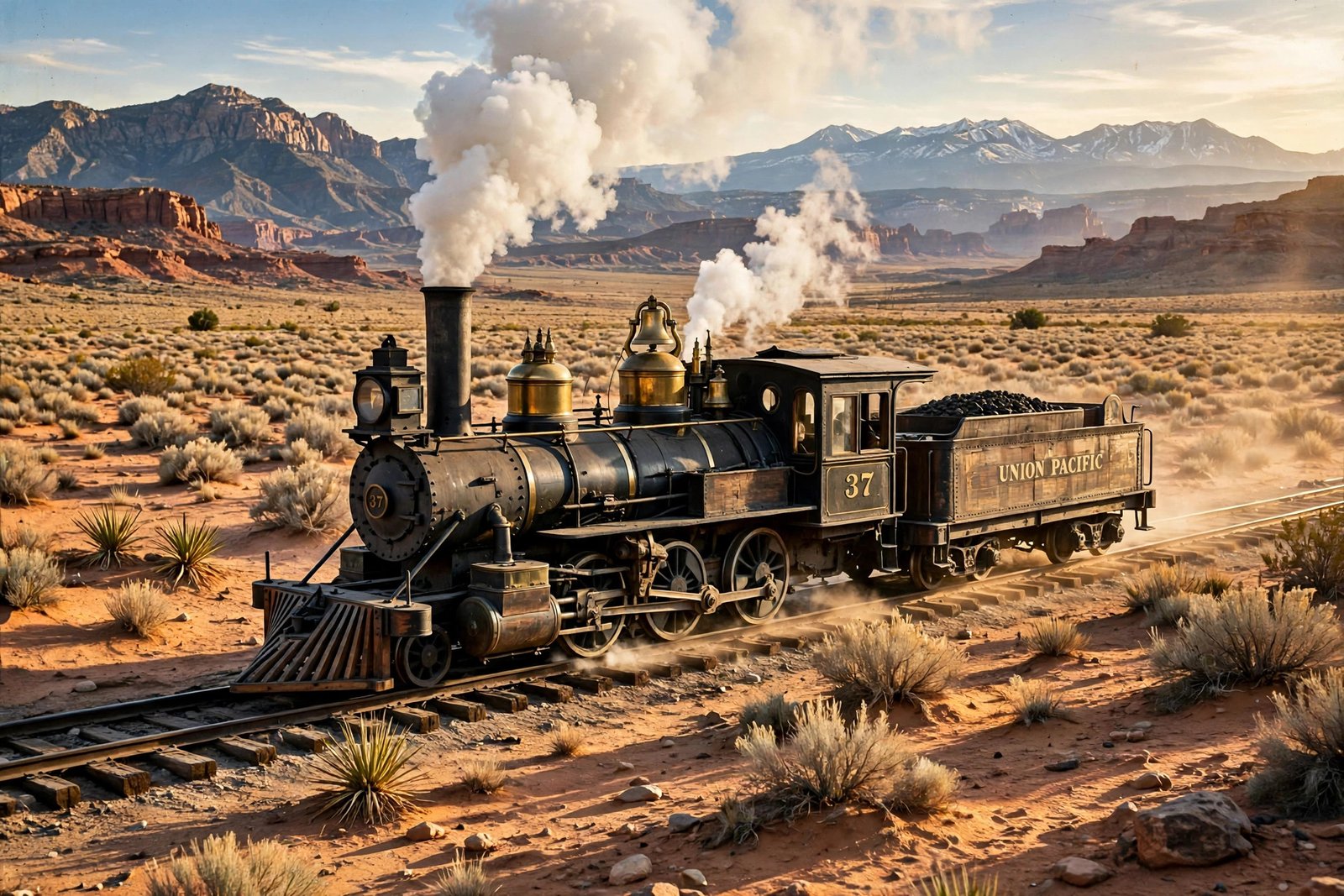
On May 10, 1869, at Promontory Summit, Utah, two locomotives nosed toward each other until they were nearly touching. A crowd of railroad workers, soldiers, and officials stood around a single polished tie made of California laurel wood. A silver hammer rose and fell, a telegraph operator tapped out one word — “done” — and the news raced across the country. The Central Pacific and Union Pacific railroads had met, and the United States was connected by rail from coast to coast for the first time.
The ceremony lasted only a few hours, but it ended a six-year building effort across mountains, deserts, and plains, and it began a new America. Before the railroad, crossing the continent took months of hard, dangerous travel. After it, a person could ride from New York to San Francisco in about a week. Towns sprang up along the tracks, farms and ranches spread across the plains, and the nation began to think of itself as one connected country.
Yet the story is not only one of celebration. The railroad was built by thousands of laborers in brutal conditions, many of them Chinese and Irish immigrants whose names rarely appear in the famous photographs. And for the Native peoples whose lands the tracks crossed, the railroad brought loss — of hunting grounds, of the bison herds, and of a way of life. To understand the railroad honestly, we have to hold both truths at once.
A Nation Divided by Distance
In the 1850s, the United States was split in two by geography. California had joined the Union in 1850 after the Gold Rush drew hundreds of thousands of people west. But between the settled East and the booming West lay nearly two thousand miles of mountains, desert, and open prairie with no reliable way across.
A traveler heading to California from New York faced three bad choices. The overland route by wagon took four to six months, crossing deserts and mountain passes where illness, accidents, and bad weather claimed many lives. The sea route around South America was even longer. The fastest option was to sail to Panama, cross the isthmus by canoe and mule, and board another ship up the Pacific coast — a journey that still took weeks and carried its own dangers from tropical disease.
Mail was slow, news was stale, and the federal government struggled to govern territory it could barely reach. Everyone agreed the country needed a railroad across the continent, but the debate over the route dragged on for years, tangled up with the fight over slavery and the balance of power between North and South. It was only after Southern states seceded and the Civil War began that Congress could finally act on a northern route.
The Law That Launched a Railroad
On July 1, 1862, President Abraham Lincoln signed the Pacific Railroad Act. The law chartered two companies and offered them generous government support: land grants along the route and government bonds paid per mile of track completed. The Union Pacific Railroad would build west from Omaha, Nebraska. The Central Pacific Railroad would build east from Sacramento, California. Wherever they met would be the joining point.
The deal pushed both companies to build as fast as possible, because they were paid by the mile. The government also granted them alternating sections of land along the right of way — land the railroads could sell to settlers, creating customers and towns along the line. The system encouraged speed, and speed is exactly what it produced. It also encouraged waste, and both companies would later be shadowed by scandals over how the money was handled.
Construction began in 1863. The Central Pacific broke ground in Sacramento on January 8, 1863. The Union Pacific broke ground in Omaha on December 2, 1863. From the start, the two companies faced very different problems. The Central Pacific had to cross the Sierra Nevada, some of the most rugged mountain terrain in the country. The Union Pacific had to cross the open plains, where the challenges were distance, weather, and supply.
The Central Pacific: Tunnels Through the Sierra
The Central Pacific’s first hundred miles were the hardest railroad construction ever attempted in America up to that time. The line had to climb from the Sacramento Valley floor to a pass more than 7,000 feet high in the Sierra Nevada, blasting tunnels through solid granite, cutting ledges into cliff faces, and building wooden trestles across deep ravines. In winter, snow piled up dozens of feet deep in the high passes.
The company struggled to find workers, so it turned to Chinese immigrants, many of whom had come to California during the Gold Rush. By the peak of construction, more than 10,000 Chinese laborers worked on the Central Pacific — the great majority of its workforce. They drilled and blasted the Summit Tunnel, a 1,659-foot tunnel through solid granite at the top of Donner Pass, working from both ends and from a vertical shaft in the middle. They handled nitroglycerin, a powerful and unstable explosive, lowering themselves in baskets down cliff faces to set charges.
Avalanches, explosions, rockfalls, and disease killed many of them, though the companies kept poor records and the true death toll is not known. For decades, their contribution was left out of the official story and the famous photographs — including the celebrated image of the golden spike ceremony, in which no Chinese worker appears. Modern historians have worked to correct that omission, and the workers’ role is now recognized as central to the achievement. Once the Sierra was behind them, the crews crossed the Nevada desert at a remarkable pace. On April 28, 1869, a Central Pacific crew laid ten miles of track in a single day — a record of railroad construction that still stands.
The Union Pacific: Racing Across the Plains
The Union Pacific faced a different kind of hardship. Its route ran west across the Great Plains, through Nebraska and Wyoming and into Utah. The terrain was flatter, but the distances were enormous, and everything the workers needed — rails, ties, food, water, tools — had to be hauled hundreds of miles from the East.
The Union Pacific’s workforce was made up largely of Irish immigrants, many of them veterans of the Civil War, along with German and Italian immigrants. Estimates put the workforce at 8,000 to 10,000 men at its peak. They lived in temporary tent towns that moved with the end of the track, places with names like Cheyenne and Laramie that later became permanent cities. Winter storms, summer heat, and attacks on survey parties added to the danger.
The Union Pacific’s chief engineer, Grenville Dodge, was a former Union general who had surveyed much of the route himself during the war. As the two companies neared each other in Utah in the spring of 1869, the competition turned into an outright race. Because each company was paid by the mile, each wanted to lay as much track as possible before the meeting point was fixed. The government finally settled the question, choosing Promontory Summit, north of the Great Salt Lake, as the junction.
May 10, 1869: The Golden Spike
The ceremony was first planned for May 8, 1869, but bad weather and a labor dispute that delayed the Union Pacific’s train pushed it back two days. When the day arrived, special trains brought officials and guests to the summit. Leland Stanford, president of the Central Pacific, and Thomas Durant, vice president of the Union Pacific, were the men of the hour. The Central Pacific’s locomotive, the Jupiter, and the Union Pacific’s No. 119 stood nose to nose on the tracks, decorated with flags and flowers.
Four ceremonial spikes had been brought for the occasion. The most famous was the golden spike, a 17.6-karat gold spike made in San Francisco and engraved with the names of the Central Pacific’s officers and the dates of the project. A second golden spike, a silver spike from Nevada, and a spike of gold, silver, and iron from Arizona were also presented. The spikes were tapped into a polished laurelwood tie with a silver hammer in a symbolic gesture.
Both Stanford and Durant swung at the spike and missed it, to the amusement of the crowd. A workman then drove the final ordinary iron spike into a regular tie, completing the line. At 12:47 p.m., the telegraph operator sent the single word “done” across the country, and celebrations erupted from coast to coast. Church bells rang in New York and cannons fired in San Francisco.
The famous photograph of the moment — chief engineers Samuel Montague of the Central Pacific and Grenville Dodge of the Union Pacific shaking hands over the last rail, with the two locomotives nearly touching — became one of the most reproduced images in American history. What the photograph does not show is just as important: the Chinese workers who had laid the final rail that morning were absent from the frame. It is also worth noting that the ceremony did not create a single unbroken rail line from the Atlantic to the Pacific that day. The railroad joined Omaha to Sacramento — about 1,776 miles of new track — and the true coast-to-coast connection came together over the following months as connecting lines and bridges were completed.
From Months to a Week
The change the railroad brought was sudden and sweeping. A journey that had taken four to six months by wagon now took about a week by train. Mail that once traveled for weeks arrived in days. Fresh fruit from California orchards could reach Eastern markets, and manufactured goods from Eastern factories flowed west at prices ordinary families could afford.
Towns grew up wherever the railroad stopped. Cheyenne, Laramie, Ogden, Reno, and Sacramento all grew as railroad towns, and new settlements appeared along the line across Nebraska, Wyoming, Utah, and Nevada. Cattle ranching boomed because beef could now be shipped by rail to Eastern cities, and mining towns in Nevada and Utah could ship ore cheaply and receive supplies in return.
The railroad also changed how Americans thought about time itself. Before the railroad, every town kept its own local time, set by the sun. A train schedule that crossed the continent could not run on hundreds of local times, so the railroads pushed for standard time zones — a system the whole country eventually adopted. The railroad, in a very real sense, helped create modern American time.
The Human Cost
The railroad’s benefits were not shared equally, and its costs fell hardest on people who had no say in the project. For the Native peoples of the plains — the Lakota, Cheyenne, Arapaho, Shoshone, Paiute, and others — the railroad cut through hunting grounds, disrupted the migration of the bison herds, and brought a flood of settlers, soldiers, and hunters into their lands. The great bison herds, which had sustained Plains peoples for generations, were hunted nearly to extinction in the decades that followed, in part because the railroad made it easy to ship hides and meat east and to bring sport hunters west.
The railroad also brought the United States Army deeper into the West, and the decades after 1869 saw a series of wars and forced removals as the government pushed Native peoples onto reservations. The tracks that joined the country together also helped divide Native peoples from their land. Any honest account of the transcontinental railroad has to include this. The golden spike was a triumph of engineering and a turning point for the nation — and it was also a turning point in a longer story of loss for the people who had lived on those lands for centuries before the first rail was laid.
The Legacy of the Golden Spike
Today, the site of the ceremony is preserved as Golden Spike National Historical Park in Utah, where visitors can see replicas of the Jupiter and No. 119 locomotives, walk the original grades, and stand on the spot where the last spike was driven. The original golden spike is displayed at Stanford University, and reenactments mark the anniversary every year.
The railroad itself is still in use. Freight trains still run the route across the plains and through the Sierra, carrying containers from the ports of California to the cities of the East. More than a century and a half later, the transcontinental railroad still stands as a measure of what a young nation could do when it decided to cross a continent — and as a reminder that great achievements have human costs, and that the full story includes the workers in the tunnels and the Native peoples whose world changed forever when the tracks arrived.
Related Reading
Want more stories about how America grew westward? Read about the Lewis and Clark expedition that first mapped the route to the Pacific, the Louisiana Purchase of 1803 that doubled the size of the nation, and the Interstate Highway System that later rebuilt American travel.
Frequently Asked Questions
When was the transcontinental railroad completed?
The first transcontinental railroad was completed on May 10, 1869, when the Central Pacific and Union Pacific railroads met at Promontory Summit, Utah Territory. A golden spike was driven to mark the occasion, and the telegrapher sent the word “done” across the country at 12:47 p.m.
Which two companies built the transcontinental railroad?
The Central Pacific Railroad built east from Sacramento, California, and the Union Pacific Railroad built west from Omaha, Nebraska. The two companies were chartered by the Pacific Railroad Act of 1862, signed by President Abraham Lincoln, and both received federal land grants and bonds paid per mile of track.
How long did it take to cross the country before the railroad?
Crossing the continent by wagon took four to six months, and the journey was dangerous, with risks from illness, accidents, and bad weather. After the railroad opened, the same trip by train took about a week.
Who actually built the transcontinental railroad?
Thousands of laborers built the line. The Central Pacific’s workforce was largely Chinese immigrants — more than 10,000 at the peak of construction — who did much of the hardest and most dangerous work, including blasting tunnels through the Sierra Nevada. The Union Pacific’s workforce was largely Irish immigrants, many of them Civil War veterans, along with German and Italian immigrants.
Learn more from the University of Utah’s Golden Spike exhibit, the Utah Division of State History, the Library of Congress, and the American-Rails guide to the Transcontinental Railroad.