
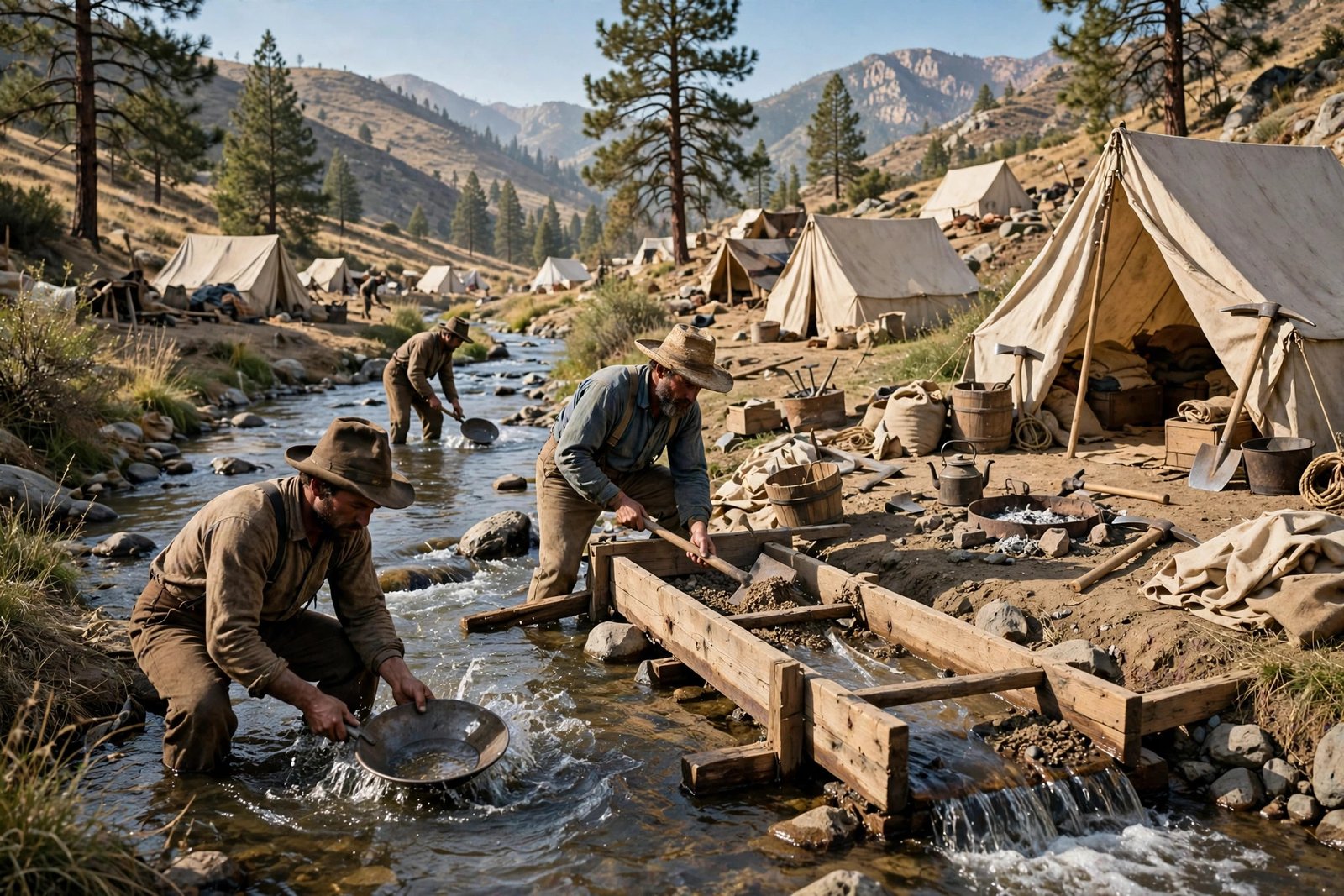
On a cold January morning in 1848, a carpenter inspecting a sawmill in the foothills of California’s Sierra Nevada noticed something shiny in the water. He picked it up, turned it over in his hand, and realized it was gold. He could not have known it then, but that small, glittering find would set off one of the largest mass migrations in American history, build a great city almost overnight, bring a new state into the Union, and change the United States forever. The California Gold Rush began with a single discovery at Sutter’s Mill, and within a few short years it had remade California, and America with it.
The Discovery at Sutter’s Mill
The discovery happened on January 24, 1848, when James W. Marshall, a carpenter and sawmill operator, found gold flakes in the tailrace of a sawmill he was building for John Sutter on the South Fork of the American River at Coloma, California.
Marshall showed what he had found to his crew, and he and Sutter privately tested the metal. The tests showed that it was gold. Sutter was dismayed rather than delighted. He wanted to keep the news quiet because he feared what a mass search for gold would do to his plans for an agricultural empire. His fear was well founded. Word leaked out anyway, first to workers and neighbors, then to the wider settlement, and then, in the spring of 1848, to the world beyond California.
Marshall himself did not get rich from the discovery. That is one of the ironies of the Gold Rush: the man who started it all ended his life without the fortune so many others chased. His name, though, is now fixed in American history, and the discovery site is preserved today at Marshall Gold Discovery State Historic Park in Coloma. You can read the Smithsonian’s account of the discovery at smithsonianmag.com.
How the News Spread Around the World
At first, the news traveled slowly. California in early 1848 was a remote place, recently taken from Mexico, with a small non-Native population of about 14,000 people. The first gold seekers were local residents, including Native Americans, Californios, and American settlers already living in the region. In March 1848, San Francisco newspaper publisher and merchant Samuel Brannan helped spread the word in California itself, and by August of that year the New York Herald had reported the discovery on the East Coast.
The turning point came on December 5, 1848, when President James K. Polk confirmed the discovery of gold in an address to Congress. Once the president himself had said it, the news could no longer be dismissed as rumor, and the rush began in earnest.
The Forty-Niners Arrive
The men and women who came in 1849 became known as the forty-niners, a name that has stuck ever since. The rush itself is usually dated from 1848 to 1855, but 1849 was the year the great wave arrived, and the name captures that moment. By 1855, it is estimated that at least 300,000 gold seekers, merchants, and other immigrants had arrived in California from around the world. That figure, about 300,000 people in seven years, is the one most histories cite, and it gives a sense of the scale: a small, sparsely settled territory became a crowded, booming society in less time than a child takes to finish school.
About half of those newcomers arrived by sea and about half came overland, on the California Trail and other overland routes. The sea journey could mean sailing around South America, a voyage of many months, or crossing the Isthmus of Panama and catching another ship on the Pacific side. The overland journey meant months on the trail, crossing plains, deserts, and mountains, with hardship and often death along the way. Both routes were dangerous, expensive, and uncertain, and both were crowded with people who had sold farms, left jobs, and borrowed money for the chance of a fortune.
California’s non-Native population tells the story in numbers. It stood at about 14,000 when Marshall found gold, rose to nearly 100,000 by the end of 1849, and continued to swell to some 250,000 by 1852. Few places in American history have grown that fast, and the speed of the change shaped everything that followed, from the founding of towns to the demand for government, law, and order.
San Francisco: From Village to Boomtown
No place shows the Gold Rush transformation more clearly than San Francisco. In 1846, it was a small settlement of about 200 residents. By 1848, its population had risen to about 1,000. By 1850, it had reached about 25,000 full-time residents, and by 1852 it was a boomtown of about 36,000 people. In six years, a sleepy port town became a major city, with tent cities, wooden buildings, shops, saloons, banks, newspapers, and a harbor crowded with ships.
San Francisco grew because it was the gateway to the goldfields. Ships arrived from around the world, and their crews often abandoned them to head for the mines, leaving empty hulls in the harbor. Merchants set up stores to sell picks, shovels, pans, food, clothing, and lodging to miners at high prices, and many of them made more money than the miners themselves. The city became a financial and commercial center, a port for trade with Asia and Latin America, and a meeting place for people from every part of the world.
Other towns grew the same way. Sacramento, Stockton, and many smaller settlements began as Gold Rush camps and supply towns. Some faded when the gold ran out. Others survived, grew into cities, and still carry the names and street plans of their Gold Rush beginnings.
California Becomes a State
The Gold Rush did more than build cities. It pushed California into statehood at a speed no other state had matched. In 1849, delegates met in Monterey to draft a state constitution, which prohibited slavery and defined the state’s boundaries. California applied for statehood directly, without first becoming an organized territory, which was unusual. On September 9, 1850, California was admitted to the Union as the 31st state, as part of the Compromise of 1850, a series of bills aimed at addressing the controversy over the expansion of slavery.
That speed mattered for the nation as well as for California. The question of whether new western states would allow slavery was the central political argument of the time, and California’s admission as a free state shifted the balance in Congress.
The sudden influx of gold also reinvigorated the American economy. Between 1848 and 1855, California produced an estimated 750,000 pounds of gold, a flood of new wealth that flowed into banks, businesses, and trade across the country. Gold from California helped finance railroads, factories, and farms, and it gave the United States a stronger place in world trade. The economy of the whole nation felt the effect of what had been found in a millrace at Coloma.
A New, Diverse California
The Gold Rush made California one of the most ethnically diverse places on Earth at the time. Newcomers arrived from the eastern United States, from Ireland and Germany and other parts of Europe, from Mexico, Chile, and Peru, and from China. They brought different languages, foods, religions, and customs, and they built a society that was far more mixed than the rest of the United States in the 1850s.
Chinese immigrants arrived in large numbers, especially after 1851, drawn by the same hope of gold that drew everyone else. They called California Gum San, or Gold Mountain. By 1853, about 24,000 young men, mostly from Canton in southeastern China, had arrived in California. They worked in the mines, and later on railroad construction, in farming, fishing, and laundry work, and in many other trades. They faced intense discrimination, including the Foreign Miners’ Tax of 1850, which targeted non-citizen miners, and mob violence. Anti-Chinese sentiment grew for decades and eventually contributed to the federal Chinese Exclusion Act of 1882, the first major American law restricting immigration by nationality.
Other groups faced discrimination as well. Latin American miners, who often had more mining experience than newcomers from the East, were pushed out of rich claims. The diversity of Gold Rush California was real, and it left a lasting mark on the state’s culture, food, and identity, but the promise of a fresh start was not open to everyone in the same way.
The Darker Side: Native Californians
Any honest account of the Gold Rush has to face its darkest consequence. The Gold Rush had severe effects on Native Californians and accelerated the decline of the Native American population from disease, starvation, and violence. Whole Indigenous societies were attacked and pushed off their lands by the gold seekers. The sudden arrival of hundreds of thousands of newcomers disrupted hunting, gathering, and farming, spread diseases to which Native peoples had little resistance, and brought armed conflict to valleys and hillsides that had been home to Native communities for thousands of years.
The numbers are stark. California’s Native American population declined from approximately 150,000 in 1848 to about 30,000 by 1870, one of the most rapid demographic collapses in American history. Historians now describe this period as including the California genocide, a term that reflects the organized violence, forced removal, and state policies that targeted Native peoples during and after the Gold Rush. The Smithsonian, in its account of the discovery, notes that the unquenchable demand for gold spurred a mass migration and fueled the genocide of Native communities.
This is not a footnote to the Gold Rush. It is central to the story. The gold that built San Francisco and brought California into the Union was found on land that Native peoples had lived on for generations, and the wealth it created came at a terrible human cost. Remembering that cost does not erase the achievement or the adventure of the forty-niners, but it keeps the story honest, and it helps explain why the Gold Rush is still debated and studied today.
The Environmental Cost
The Gold Rush also left deep scars on California’s landscape, many of which are still visible today. At first, miners used simple methods: panning in streams, digging shallow pits, and washing gravel by hand. As the easy surface gold ran out, mining became industrial. Miners cleared vast stretches of forest for building materials and fuel, destroying wildlife habitat and disrupting ecosystems across the Sierra Nevada foothills.
Starting in the 1850s, hydraulic mining used high-pressure water cannons to blast away entire hillsides. The technique sent enormous amounts of sediment into rivers and streams, choking waterways, killing fish, and causing flooding in downstream farming areas. River courses were permanently changed, valleys were filled with mining debris, and formerly forested hillsides were stripped bare. The damage was so severe that hydraulic mining was eventually banned by the Sawyer Decision in 1884, after farmers sued the mining companies and a federal judge ruled in their favor. The case is now seen as an early landmark in American environmental law.
Miners also used mercury to separate gold from ore, and an estimated 7,600 tons of mercury were released into California’s waterways during the Gold Rush era. That contamination persists in some areas today and remains an environmental and public health concern. The full environmental impact is described in detail at fiveable.me, and the broader history of the rush is summarized at geo.libretexts.org.
What the Gold Rush Left Behind
By 1855, the great rush was fading. The easy gold was gone, and mining had become the work of companies with machines, not lone prospectors with pans. Many forty-niners went home, some richer and many poorer. Others stayed, building farms, businesses, and towns, and their children became Californians. The population that had arrived in a rush stayed to build a state.
The legacy of the Gold Rush is still with us. It gave California its diverse population, its major cities, its ports, and its place as an economic powerhouse. It gave America the idea, still powerful today, that a person could start over in the West and make a new life, an idea that became part of the American Dream. It also gave the country a warning about what can happen when a rush for wealth outruns law, fairness, and care for the land and for the people already living there.
The Gold Rush changed how Americans thought about distance and opportunity. Before 1848, California was a remote territory at the edge of the map. After the rush, it was a state, a destination, and a symbol. Roads, bridges, and eventually railways connected mining areas to cities and ports, and San Francisco’s harbor expanded to handle trade with the rest of the world. The gold did not last forever, but the state it built did.
Today, you can still visit the places where it happened. Coloma, where Marshall found gold, preserves the discovery site. Old mining towns in the Sierra foothills keep their Gold Rush streets, shops, and cemeteries. The gold is mostly gone, but the story remains, and it is still one of the most important stories in American history.
Frequently Asked Questions
When did the California Gold Rush begin?
The California Gold Rush began on January 24, 1848, when James W. Marshall discovered gold at Sutter’s Mill in Coloma, California, while building a sawmill for John Sutter on the South Fork of the American River. The rush itself is usually dated from 1848 to 1855, with the great wave of arrivals coming in 1849.
Who were the forty-niners?
The forty-niners were the gold seekers who came to California in 1849, the peak year for Gold Rush immigration. The name comes from the year 1849. By 1855, about 300,000 people had arrived in California from the rest of the United States and from around the world, about half by sea and about half overland.
When did California become a state?
California became the 31st state on September 9, 1850, as part of the Compromise of 1850. Delegates had drafted a state constitution in Monterey in 1849, and California applied for statehood directly, without first becoming an organized territory. The rapid population growth caused by the Gold Rush made statehood possible far sooner than it would otherwise have happened.
What happened to Native Americans during the Gold Rush?
The Gold Rush had devastating consequences for Native Californians. The arrival of hundreds of thousands of newcomers brought violence, displacement from traditional lands, and the spread of disease. California’s Native American population fell from approximately 150,000 in 1848 to about 30,000 by 1870. Historians now describe this period as including the California genocide.