
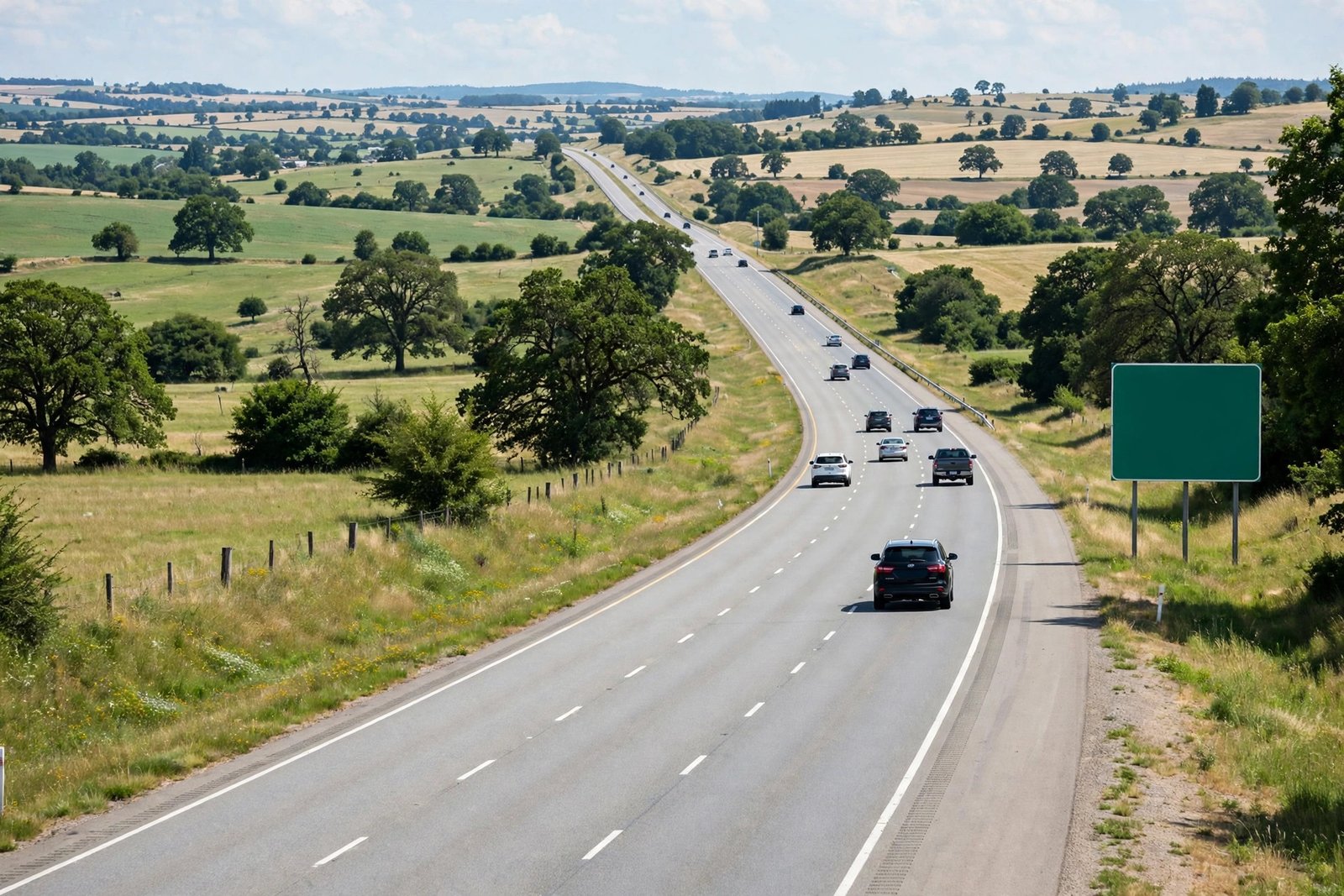
Every time you get behind the wheel in America, you do something that would look wrong to about a third of the people on Earth. You drive on the right side of the road, sit on the left side of the car, and pass other vehicles on your left — while drivers in Britain, Japan, India, and Australia do the exact opposite. It feels so natural that most Americans never stop to ask why. The answer is older than the automobile, older than the United States itself, and it starts not with a law or a car company but with a man sitting on a horse, holding a whip.
America drives on the right because of freight wagons. That is the short version, and it is the one the Federal Highway Administration’s own history supports. The longer version runs through colonial roads, a Pennsylvania turnpike, a revolution in France, and a car called the Model T.
The Short Answer: It Started With Horses
Long before anyone had an engine, a steering wheel, or an argument about who had the right of way at a four-way stop, Americans were already keeping to the right. Research collected by the Federal Highway Administration indicates that right-hand travel predominated in colonial America from the time of the earliest settlements. Horseback riders, ox teams, wagon drivers, and even pedestrians generally kept to the right.
That was unusual. For centuries, most of the world had traveled on the left. The reasons were practical and a little violent: most people are right-handed, and on horseback, keeping left put your sword arm toward oncoming strangers, ready to draw your weapon if the meeting turned unfriendly. Archaeologists have found evidence of left-side travel in Roman road ruts, and in 1300, Pope Boniface VIII reportedly directed pilgrims heading to Rome to keep to the left.
The Teamster’s Seat: Why the Left Rear Horse Mattered
The key figure in this story is the teamster, the driver of a heavy freight wagon pulled by a team of two, four, or six horses. These wagons usually had no driver’s seat. Instead, the teamster rode the left rear horse — the wheel horse, closest to the wagon — in the style known as postilion driving. He held the reins or jerk line in his left hand and a long black-snake whip in his right, which meant his right hand, the hand most people favor, stayed free to control the team.
That seating position created a problem of vision. Sitting on the left side of the wagon, the driver could see the left side of his vehicle clearly but had a poor view of the right. When another wagon approached, he needed to judge the gap between the two vehicles, and the only way to do that reliably was to have the oncoming wagon pass on his left — his visible side. The natural solution was to keep his own wagon to the right side of the road, so that oncoming traffic came past on the left, where he could watch the clearance and avoid clipping wheels.
Multiply that decision by thousands of wagons on thousands of miles of rutted colonial roads, and a habit became a custom.
The Conestoga Wagon: America’s Freight Hauler
The wagon that turned this habit into a national pattern was the Conestoga, a heavy commercial vehicle introduced around 1750 in the vicinity of Lancaster, Pennsylvania. Forget the lightweight covered wagons of Hollywood westerns: the Conestoga was a freight hauler, built to move large loads of produce and goods between Lancaster County farms and the markets of Philadelphia, pulled by teams of several horses over rough roads.
The Conestoga gave added impetus to right-hand travel because it was exactly the kind of wagon that required a teamster riding the left wheel horse. As trade between Lancaster and Philadelphia grew, so did the volume of these big wagons on the road, and so did the number of drivers keeping right to judge their clearance.
Pennsylvania Makes It Law in 1792
For all that, right-hand travel in early America was a custom, not a law. Rose found that no formal rule of the road was adopted by the new country or any state until 1792. In that year, Pennsylvania approved legislation to establish a turnpike from Lancaster to Philadelphia — the Philadelphia and Lancaster Turnpike, one of the first major road projects in the young nation. The charter legislation provided that travel would be on the right-hand side of the turnpike.
According to the Federal Highway Administration, this was the first formal keep-right rule adopted by a state. It mattered because the Lancaster turnpike was one of the busiest commercial roads in America, carrying the very Conestoga wagons whose drivers had made keeping right a habit. The law simply wrote down what the wagoners were already doing.
Other states followed. In 1804, New York became the first state to prescribe right-hand travel on all public highways, not just on a single turnpike. By the time of the Civil War, right-hand travel was followed in every state. There was never a national vote or a federal law about which side to drive on — the states arrived at the same answer one by one, because the wagons had already decided it for them.
Why America Didn’t Just Copy Britain
It is a fair question: America was founded by British colonists, so why didn’t it simply inherit Britain’s left-hand rule? Part of the answer is the wagons. Britain’s narrow streets and lighter carts never produced the same heavy freight-wagon culture, so the teamster’s logic never took hold there. Part of it is the break with Britain itself. After a revolution fought against the crown, there was little enthusiasm for importing the mother country’s road rules, especially when the local custom worked better.
Britain, meanwhile, doubled down on the left. In the 1700s, officials told riders to keep left, and the Highway Act of 1835 locked left-hand travel into law — and exported that habit through the empire to Australia, New Zealand, India, South Africa, and the Caribbean. That is why the map of left-driving countries today still traces the outline of the old British Empire, with a few notable exceptions like Japan and Thailand, which were never British colonies but kept left for their own historical reasons.
The French Revolution and Napoleon: How Europe Went Right
America was not the only place rethinking the road in the late 1700s. In France, before the Revolution, the aristocracy rode on the left side of the road, forcing peasants over to the right. After the storming of the Bastille in 1789, aristocrats who wanted to keep a low profile joined the peasants on the right, and an official keep-right rule was introduced in Paris in 1794. What had been a class marker became a statement of equality: everyone on the same side of the road.
Then came Napoleon. His armies carried the keep-right rule into the countries they conquered — the Low Countries of Belgium, the Netherlands, and Luxembourg, Switzerland, Germany, Poland, and parts of Spain and Italy. The states that resisted Napoleon kept the left: Britain, the Austro-Hungarian Empire, and Portugal. That division between left and right in Europe stayed largely fixed for more than a hundred years, until after the First World War, when the remaining left-driving countries on the continent switched one by one.
The exact reasons France switched are still debated by historians — some say the revolutionaries wanted nothing to do with a rule the Pope had decreed, others that they simply wanted to be different from the English — but the effect is not in doubt. Napoleon spread right-hand traffic across continental Europe, and most of the countries he conquered kept it even after he was defeated. Today, all of mainland Europe drives on the right, and only four European countries still drive on the left: the United Kingdom, Ireland, Malta, and Cyprus.
The Model T Locks It In
By the early 1900s, America drove on the right and Britain drove on the left, but the question of where the driver should sit inside the car was still open. Early automobiles put the steering wheel in different places, and some American cars had it on the right. Henry Ford settled the matter in 1908 with the Model T, the first mass-market car, which placed the driver on the left.
That was not a random quirk. A left-hand steering wheel pairs naturally with right-side driving: it puts the driver near the centerline of the road, improving sightlines when passing, and it lets passengers step out onto the curb instead of into traffic. The side you drive on came first, and the driver’s position was standardized afterward — the car adapted to the road, not the other way around.
The Rest of the World: Who Still Drives on the Left
Today, around 75 countries and territories drive on the left, while roughly 165 drive on the right. The exact count varies depending on whether overseas territories and dependencies are counted separately from their parent countries — about 54 generally recognized sovereign countries drive on the left, and the total rises to roughly 75 when territories are included.
The numbers hide a striking fact: those 75 left-driving places are home to roughly a third of the world’s population, about 35 percent. India alone accounts for a huge share of that total, and the left-driving world also includes Indonesia, Pakistan, Bangladesh, Japan, the United Kingdom, Australia, and New Zealand. So while right-hand traffic covers far more countries, the split in people is much closer than the split in flags.
The left-driving map is mostly a map of history. The former British Empire dominates it — the UK, Ireland, much of southern and eastern Africa, the Caribbean, and parts of Asia and the Pacific. Japan is the famous exception: it was never a British colony, yet it drives on the left. Guyana and Suriname are the only two countries in mainland South America that drive on the left.
The American Exception: The U.S. Virgin Islands
There is one place under the American flag where drivers keep to the left: the U.S. Virgin Islands. The territory is the only U.S. jurisdiction where the rule of the road is to drive on the left, a holdover from Danish colonial rule. When the United States purchased the islands from Denmark in 1917, it preserved the left-side rule rather than switching, much as the British Virgin Islands, the Bahamas, and Jamaica kept left-side driving after their own colonial eras.
The result is one of the strangest driving environments in the world. Because most vehicles on the islands are imported from the mainland United States, they are left-hand drive — the steering wheel is on the left, as in any American car. But the cars drive on the left side of the road, so the driver sits on the outside edge of the lane, next to the shoulder, rather than toward the centerline.
Could America Ever Switch Sides?
Countries have switched sides before, and the most famous example shows why America almost certainly never will. On September 3, 1967, Sweden moved from left-side to right-side traffic in a single day, in an operation known as Dagen H — H Day, for hogertrafik, right-hand traffic. At 4:50 in the morning, all traffic stopped, vehicles carefully moved to the other side of the road, and at 5:00 they set off again, driving on the right. It worked, but it required years of preparation, new road signs, rebuilt intersections, and a massive public information campaign.
Sweden switched because most of its neighbors already drove on the right, and because most Swedish cars were already left-hand drive — the same mismatch the U.S. Virgin Islands lives with today. America faces neither pressure: its neighbors, Canada and Mexico, both drive on the right, its entire road network and vehicle fleet are built around right-hand traffic, and there is no practical reason to change. The cost and chaos of switching a continental road system would be enormous, and the benefit would be nothing at all.
So the next time you pull out of your driveway, spare a thought for the teamster on the left rear horse. He was not thinking about history, or revolutions, or the design of the Model T. He was trying not to clip another wagon’s wheels on a rutted road in Pennsylvania — and the habit he formed became a custom, then a law, then a national standard, and finally something so ordinary that almost nobody thinks to ask about it.
Frequently Asked Questions
Why does America drive on the right side of the road?
America drives on the right mainly because of heavy freight wagons in the 1700s. Teamsters rode the left rear horse so their right hand stayed free for the whip, and keeping to the right let them judge the clearance when oncoming wagons passed on their left. Pennsylvania made it law for the Lancaster-Philadelphia turnpike in 1792, New York required it on all public highways in 1804, and by the Civil War every state followed the right-hand rule.
How many countries drive on the left?
Around 75 countries and territories drive on the left, including the United Kingdom, Ireland, Japan, India, Australia, and New Zealand. About 54 of those are generally recognized sovereign countries; the rest are territories and dependencies. Together they are home to roughly a third of the world’s population, about 35 percent. Roughly 165 countries and territories drive on the right.
Why does Britain drive on the left while America drives on the right?
Britain kept the old left-hand rule, which dated back to horseback travel and was locked into law by the Highway Act of 1835, and exported it through its empire. America broke with it because heavy Conestoga freight wagons made right-hand travel safer for teamsters, and the newly independent states had little interest in copying British customs. The two countries simply followed different practical traditions that hardened into law.
Does anywhere in the United States drive on the left?
Yes — the U.S. Virgin Islands. It is the only U.S. jurisdiction where traffic keeps to the left, a holdover from Danish colonial rule that survived the 1917 transfer of the islands to the United States. Most cars there are left-hand-drive American models, so drivers sit on the outside edge of the lane rather than toward the centerline.