
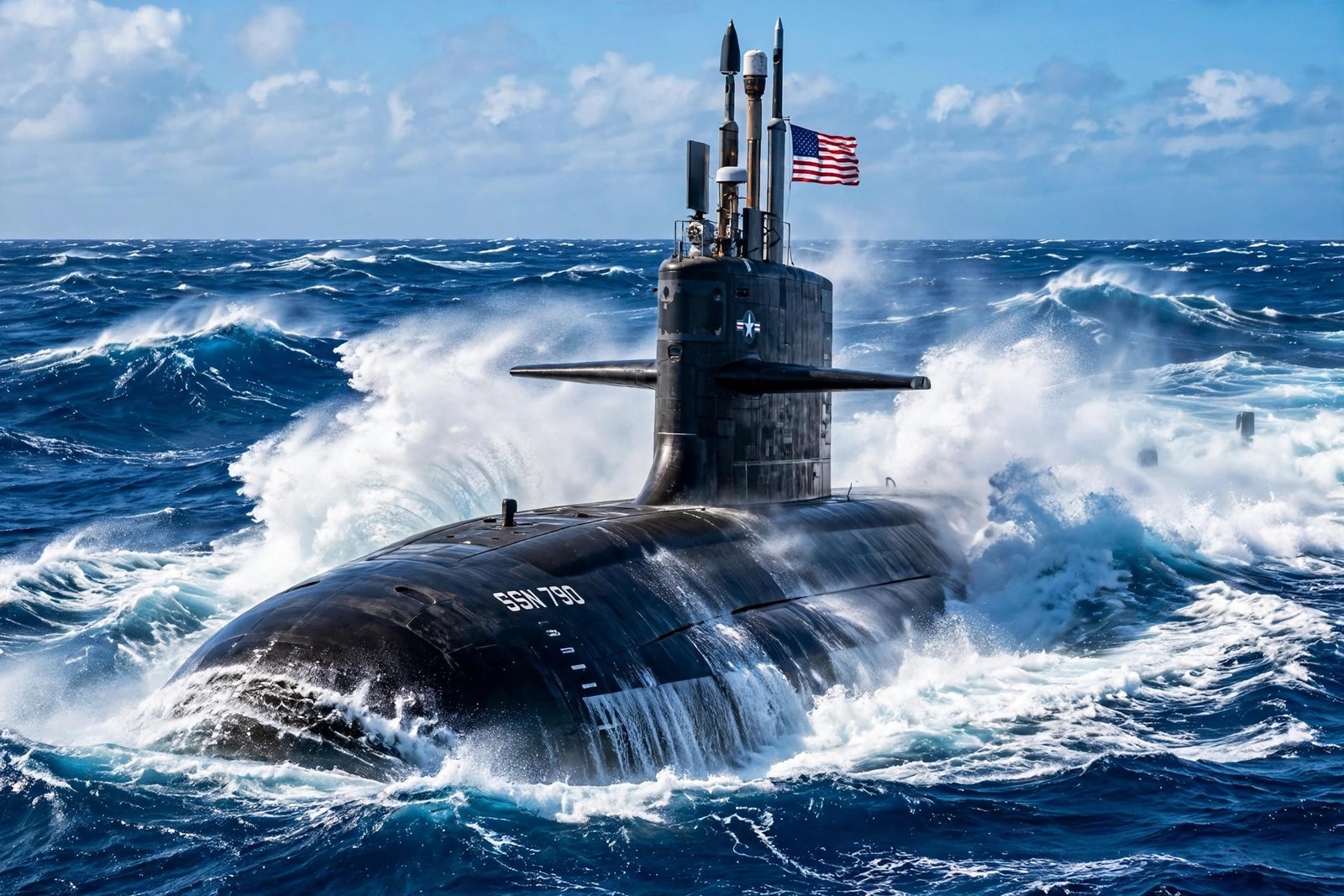
Somewhere beneath the surface of the ocean, far from sunlight and far from headlines, an American submarine is on patrol right now. No one can see it. No satellite can track it in real time. No rival navy can be certain exactly where it is. That invisibility is the point. For more than a century, the United States Navy has relied on submarines to do the work that cannot be done in the open: to watch, to wait, to deter, and, if ever called upon, to strike with overwhelming force from a place no enemy can reach.
The men and women who serve aboard these boats call their community the Silent Service, and the nickname has stuck for a reason. Submariners do not seek attention. Their missions are rarely discussed in public, their patrol routes are closely guarded, and their successes are often measured by the crises that never happened. Yet the submarine force sits at the very center of American military power. It carries the most survivable part of the nation’s nuclear deterrent, it gathers intelligence in waters where no surface ship could go unnoticed, and it gives American leaders options in a crisis that no other platform can match.
What the Silent Service Really Means
The phrase Silent Service describes more than quiet engines. It describes a culture. Submarine crews are small, tightly knit, and highly trained. Every person aboard must qualify in submarines, which means learning the systems of the entire boat, from the reactor plant to the sonar room to the torpedo room, well enough to stand watch in an emergency. That shared standard creates a level of trust that is hard to find anywhere else in the military. When a boat is hundreds of feet below the surface, there is no calling for outside help. The crew is the help.
From USS Holland to the Nuclear Age
The American submarine story begins with a small, experimental boat and a bold idea. On April 11, 1900, the United States Navy purchased the Holland VI, a 53-foot submarine designed by John Philip Holland, for 150,000 dollars. The boat became USS Holland, the nation’s first commissioned submarine, and April 11 is still marked as the birthday of the United States Submarine Force. The early boat was powered by a gasoline engine on the surface and batteries underwater, a combination that seems primitive today but set the pattern for submarine propulsion for decades to come.
The real revolution arrived in the 1950s, and it arrived in Groton, Connecticut. On January 17, 1955, USS Nautilus sent a now-famous message: Underway on nuclear power. Nautilus, commissioned the previous year, was the world’s first nuclear-powered submarine, and nuclear power changed everything. A nuclear submarine could stay submerged for weeks and months at a time, limited mainly by food and the endurance of its crew. It could travel at high speed underwater, cross oceans without refueling, and operate in the Arctic under the ice. The age of the true submarine, a boat designed to live underwater rather than merely visit it, had begun.
The Virginia Class: The Modern Attack Submarine
Today, the workhorse of the American attack submarine fleet is the Virginia class. These are fast-attack submarines, known by the hull designation SSN, built to hunt other submarines and surface ships, gather intelligence, support special operations forces, and launch cruise missiles at targets ashore. They are among the quietest and most capable submarines ever built, and they represent the current standard for undersea warfare.
A Virginia-class boat carries advanced sonar, including a large aperture bow array that gives its crew a detailed picture of the water around them. Instead of a traditional periscope that a sailor looks through with an eye, the newest boats use photonics masts, slender retractable masts packed with cameras and sensors that feed images to screens in the control room. The design frees space, improves awareness, and reflects how much submarine warfare has become a contest of sensors and computing power as well as steel and propulsion.
The Virginia class also carries serious firepower. In addition to torpedoes, the boats can launch Tomahawk land-attack cruise missiles, giving them the ability to strike targets far inland from the sea. The newest Block V boats add the Virginia Payload Module, an extra hull section with four large-diameter payload tubes. That module raises the Tomahawk capacity of a Virginia-class boat from 12 missiles to 40, a major increase in strike power. It is a sign of how the Navy is adapting the class as older missile-carrying submarines retire, asking each new boat to do more with every deployment.
Virginia-class submarines are built in Groton, Connecticut, and Newport News, Virginia, continuing a shipbuilding tradition that goes back more than a century. Each boat takes years to build, and each one is a reminder that undersea power is not bought quickly. It is built slowly, crew by crew and hull by hull, and it is maintained by a network of shipyards, suppliers, and sailors that spans the country.
The Ohio Class and the Nuclear Triad
If the Virginia class is the sword of the submarine force, the Ohio class is its shield, and the most consequential part of the American nuclear deterrent. Ohio-class ballistic missile submarines, known as SSBNs and nicknamed boomers, carry Trident II D5 submarine-launched ballistic missiles. Each Ohio-class SSBN carries up to 24 Trident missiles, and the Navy operates 14 of these boats as the sea-based leg of the nuclear triad, alongside land-based intercontinental ballistic missiles and Air Force bombers.
The logic of the triad is straightforward, and it is why submarines matter so much for deterrence. Land-based missiles sit in fixed silos. Bombers sit on airfields. Both can, in theory, be targeted. A ballistic missile submarine at sea, however, is extraordinarily hard to find. It patrols in the vastness of the ocean, silent and mobile, and it can remain on station for months. That survivability is the point. As long as American SSBNs are at sea, no adversary can be confident of destroying the American ability to respond, and that uncertainty is what deters attack in the first place.
Four Ohio-class boats were converted in the early 2000s into guided missile submarines, known as SSGNs, carrying conventional Tomahawk cruise missiles instead of nuclear weapons. Each converted boat can carry up to 154 Tomahawk missiles, along with special operations personnel and equipment, making them among the most powerful conventional strike platforms in the Navy. Those SSGNs are scheduled to retire in the coming years, and the Virginia Payload Module is one of the ways the Navy plans to preserve strike capacity as they leave service. The Columbia class, now in production, is being built to replace the Ohio-class SSBNs and carry the sea-based deterrent into the decades ahead.
Life Beneath the Surface
Life aboard a submarine is unlike life aboard any other warship, and it is not for everyone. Space is tight. Sailors sleep in bunks stacked close together, share small showers and heads, and eat in a mess area that doubles as a classroom and a gathering place. There are no windows and no sunlight for weeks at a time. The day is divided into watches, usually six hours on and six hours off, and the rhythm of work, sleep, and drills repeats without weekends or holidays at sea. Fresh food runs out early in a patrol, and the menu gradually shifts to frozen and canned stores. Mail arrives rarely, and contact with home is limited.
Training for that life begins in Groton, Connecticut, home of the Naval Submarine School and Naval Submarine Base New London. Every American submariner passes through Groton at some point, learning the fundamentals of submarine systems, damage control, escape procedures, and the discipline of life underwater. The school is demanding by design, because the ocean is unforgiving and the margin for error is small. A sailor who qualifies in submarines earns the right to wear the dolphins, the submarine warfare insignia, and that badge carries weight throughout the Navy.
Naval Submarine Base New London: Home of the Submarine Force
Naval Submarine Base New London, located in Groton, Connecticut, across the Thames River from the city of New London, is known as the Home of the Submarine Force. Its history goes back to 1868, when Connecticut conveyed land along the Thames to the Navy, but its submarine story began in earnest in 1915, when the first submarines arrived in Groton. In June 1916, the installation was formally designated as a submarine base, the Navy’s first, and it has been central to the submarine force ever since.
Today the base is home to attack submarines, the Naval Submarine School, the Undersea Warfighting Development Center, and the Submarine Force Library and Museum, where the historic ship Nautilus is preserved as a museum. Groton is often called the Submarine Capital of the World, a title that reflects both the base and the Electric Boat shipyard nearby, where submarines have been built for generations. The museum, the school, and the shipyard together make Groton a place where the past, present, and future of American submarines meet in a single town.
Why Submarines Still Matter
In an age of satellites, drones, and cyber warfare, it is fair to ask why submarines still matter. The answer is that the ocean remains the largest hiding place on Earth, and a submarine remains the hardest weapon to find and destroy. Satellites can see surface ships. Radar can track aircraft. But the deep ocean defeats most sensors, and a quiet nuclear submarine can operate in that darkness for months. That invisibility gives American leaders something no other platform can offer: a force that can be present without being seen, that can gather information without provoking a confrontation, and that can deter without threatening in public.
The future of the force is already taking shape. The Columbia class will carry the nuclear deterrent for decades to come. The Virginia class will continue to grow in numbers and capability. New technologies, from unmanned underwater vehicles to improved sonar and quieting, will extend what submarines can do. But the mission will remain what it has always been: to patrol silently, to deter attack, to gather knowledge, and to be ready. The Silent Service does not ask for attention. It asks only to be ready when America needs it, beneath the seas, out of sight, and always on watch.
Related reading
For more on American military power, see US aircraft carriers and sea power, the US Air Force and American air power, and Hoover Dam and the engineering power of America.
Frequently asked questions
Why are US Navy submarines called the Silent Service?
The nickname reflects both the stealth of the boats and the culture of their crews. Submarines operate quietly to avoid detection, and submariners traditionally keep their patrols and missions private. The name has been used for generations to describe a community that does vital work without seeking public attention.
What is the difference between an attack submarine and a ballistic missile submarine?
An attack submarine, such as a Virginia-class boat, hunts other submarines and ships, gathers intelligence, supports special operations, and can launch cruise missiles at targets ashore. A ballistic missile submarine, such as an Ohio-class boat, carries Trident ballistic missiles and serves as the sea-based leg of the nuclear triad, with deterrence as its primary mission.
How long can a nuclear submarine stay submerged?
A nuclear-powered submarine can remain submerged for very long periods, limited mainly by food supplies and crew endurance rather than by fuel or air. Nuclear propulsion removes the need to surface to recharge batteries or take in air for the engines, which is why modern American submarines can stay underwater for months at a time.
Where is the Home of the Submarine Force?
Naval Submarine Base New London in Groton, Connecticut, is known as the Home of the Submarine Force. It was designated the Navy’s first submarine base in 1916 and remains home to the Naval Submarine School, attack submarines, and the Submarine Force Library and Museum, where USS Nautilus is preserved.
What will replace the Ohio-class submarines?
The Columbia class is being built to replace the Ohio-class ballistic missile submarines as the sea-based leg of the nuclear deterrent. The new boats will carry Trident II D5 missiles and are designed to serve for decades, continuing the deterrent mission that the Ohio class has carried since the 1980s.
Sources and further reading: the US Navy, Naval Submarine Base New London, the State of Connecticut on the history of the Groton submarine base, and the US Naval Institute on the Submarine Force Library and Museum.