
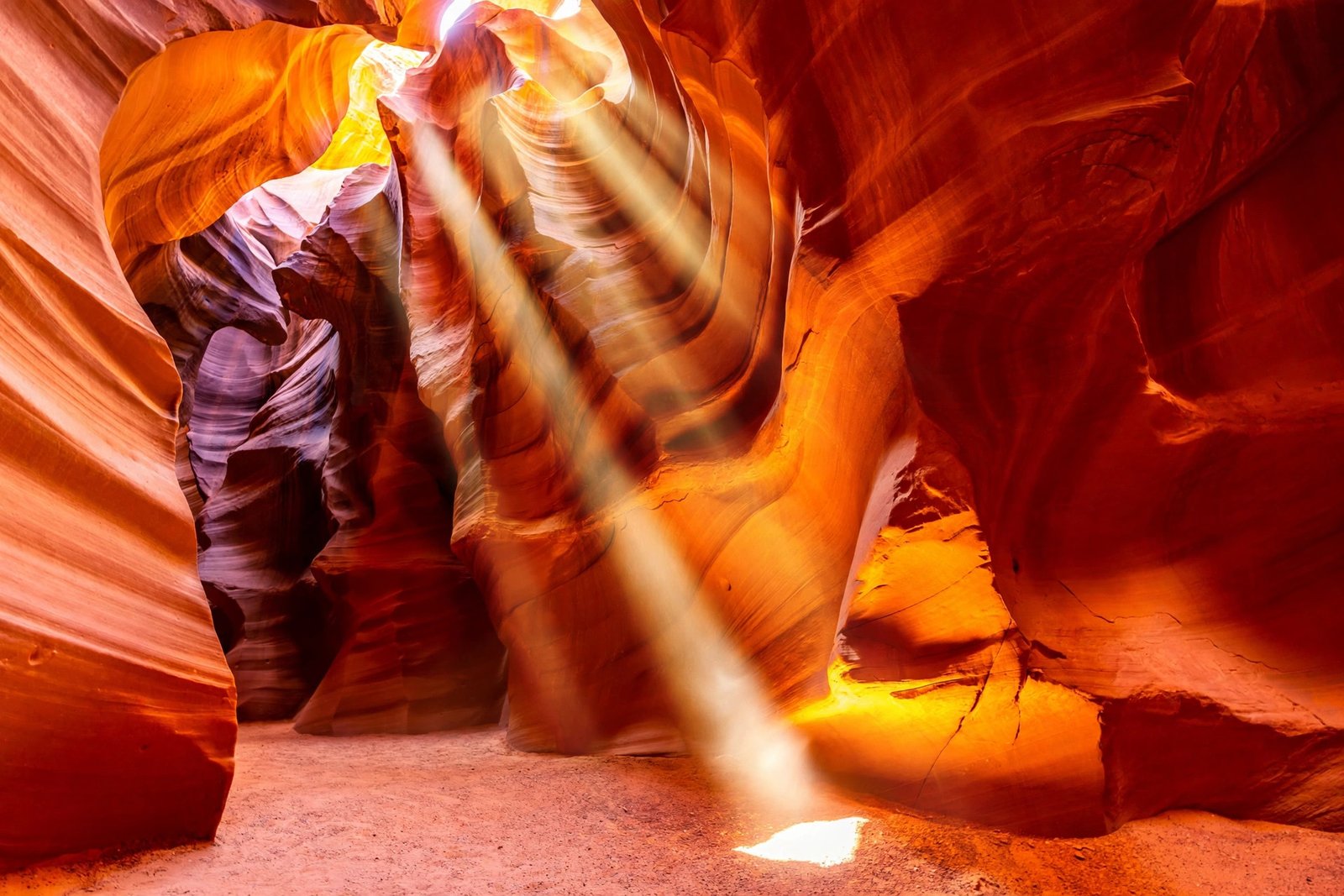
There is a place in the Arizona desert where sunlight falls through a crack in the earth and turns solid rock into flowing ribbons of orange, pink and violet. You walk in at ground level, look up, and the walls curve overhead like waves frozen in mid-air. That place is Antelope Canyon, the most photographed slot canyon in the United States.
What makes it special is not just how it looks. It is how you get there, who owns the land, and how easily its beauty can turn dangerous. The canyon lies on Navajo Nation land near Page, in far northern Arizona, and you cannot simply drive up and hike in. Every visit happens on a guided tour with an authorized Navajo guide.
Where Is Antelope Canyon — and Why You Can’t Just Walk In
Antelope Canyon sits just east of Page, Arizona, near the Arizona–Utah border and just south of Lake Powell, in the LeChee Chapter of the Navajo Nation. Page is the gateway town, and the canyon is part of Lake Powell Navajo Tribal Park, managed by Navajo Nation Parks and Recreation.
The first fact every visitor needs is that Antelope Canyon is not a national park, and it is not open to independent hiking. The Navajo Nation’s rule is plain: tour guides are mandatory at all Antelope Canyon locations. You book a tour with an authorized Navajo operator, meet your guide at the designated meeting point, and enter with the group. The official list of authorized operators is published by Navajo Nation Parks and Recreation: Navajo Nation Parks & Recreation — guided tour operators.
There are good reasons for the rule. The canyon is a narrow slot with a single-file path in places, so unguided crowds would quickly damage the soft sandstone. It is also a sacred place for the Navajo people. And there is safety: flash floods can fill the canyon with water in minutes, even when the sky above it is clear. Guides carry radios, watch the weather across the whole drainage basin, and can call off a tour when conditions turn.
How Water Carved a Masterpiece Out of Solid Rock
Antelope Canyon’s walls are Navajo Sandstone, a rock that began as sand. Around 190 million years ago, during the Jurassic period, this part of the American Southwest was a vast desert of towering sand dunes. Over immense stretches of time those dunes were buried, compacted and cemented into solid rock.
The canyon itself is far younger than the rock. Millions of years ago, the Colorado Plateau was uplifted, cracking the sandstone and tilting the land so water would run faster downhill. Then the real sculptor went to work: flash flooding. During the monsoon season, intense rainstorms dump huge amounts of water onto the broad, hard-baked basin above the canyon. The dry ground absorbs almost nothing, so the water races downhill, funnels into cracks in the sandstone, and pours through the narrow passages carrying sand, pebbles and debris. That gritty water acts like liquid sandpaper, scouring the walls into the flowing curves that make the canyon look like frozen waves.
The colors are chemistry. Iron oxide minerals in the sandstone — hematite, goethite and limonite — produce the reds, oranges, pinks and purples that shift with the light, while white bands appear where the iron is absent. Because the canyon is so narrow, most light reaching the floor is reflected light bouncing from wall to wall, which is why the colors change by the hour. That is also the danger. Rain does not have to fall near the canyon for a flood to arrive — a storm dozens of miles upstream can send a wall of water into the slots with little warning. The most tragic reminder came on August 12, 1997, when a flash flood swept through Lower Antelope Canyon and killed 11 tourists. The storm had dropped rain into the canyon’s basin about seven miles upstream. That disaster reshaped how the canyon is managed, and tours are now cancelled at the first sign of flood risk.
Upper vs. Lower Antelope Canyon: Which One Should You Visit?
The two famous sections could hardly be more different, even though they were carved by the same forces from the same rock. Choosing between them — or deciding to see both — is the biggest decision in planning a visit.
Upper Antelope Canyon, known in Navajo as Tsé bighánílíní — “the place where water runs through rocks” — is the one in most of the famous photographs. Its floor is wide and flat, so the walk inside is easy, and the canyon is reached by a truck ride from the meeting point. The payoff is the light: on clear days from roughly April through September, shafts of sunlight drop straight down through openings in the ceiling and strike the sandy floor. The trade-offs are crowds and cost. Upper is the busier of the two, and the midday beam slots are the most expensive and the hardest to book.
Lower Antelope Canyon, known in Navajo as Hazdistazí — “spiral rock arches” — is longer, narrower and more adventurous. You descend metal stairways and ladders into the earth and walk roughly a mile round trip through winding corridors. The light here is softer, painting the walls in deep purples, blues and oranges, and photographers often prefer it for texture and color. Lower draws smaller crowds and is generally less expensive. The catch is the stairs: five flights of them, plus ladders and narrow squeezes, make it unsuitable for anyone with limited mobility. If you want the iconic light beams or cannot manage stairs, choose Upper. If you want a longer walk, richer colors, fewer people and a lower price, choose Lower. If you have the time, do both — Lower in the early morning, Upper around midday.
The Light Beams: When They Appear and How to See Them
The light beams are the reason Upper Antelope Canyon is famous, and they are also the most misunderstood part of a visit. They are not there all year, and they are not guaranteed on any given day. The sun has to be high enough for its rays to drop almost vertically through the narrow openings in the canyon roof. In Upper Antelope Canyon, that generally means clear, sunny days from April through September, with the best odds on the late-morning tours — operators point to the slot around 11:20 a.m. as the strongest chance. In Lower Antelope Canyon, beams are rarer, appearing most often from late spring through mid-fall, roughly between 10 a.m. and 1 p.m. Clouds end the show, and operators generally do not cancel or refund for cloud cover alone.
April, May and early June offer beams before the monsoon season begins in mid-June, with mild temperatures and stable weather. July through September still brings beams, but it is also monsoon season, when afternoon storms can cancel tours outright. Late fall and winter have no beams at all in Upper Canyon and far fewer visitors — but the low, angled winter light creates its own stark beauty, and off-season discounts are common. Do not build your whole trip around a beam photograph: book the midday slot if you can, and enjoy the canyon even if the beams stay away. The reflected colors are extraordinary at any hour.
A Sacred Place on Navajo Land
Antelope Canyon is not just a scenic attraction. It is a sacred place within the Navajo Nation, and the Navajo names for its sections describe the land itself: water running through rocks, spiral arches of stone. Guides share stories and history of the canyon and the Navajo people, and that cultural interpretation is part of what the tour fee supports. The canyon became a Navajo Tribal Park in 1997, the same year guided-only access was formalized. Visiting respectfully is simple: follow your guide, stay with the group, do not touch or carve the walls, and leave nothing behind. Drones, dogs and firearms are prohibited on Navajo Nation land, and littering, rock climbing, camping and scattering ashes are all forbidden inside the tribal park. Photography rules change from time to time, so check the current rules with your operator before you arrive.
How to Visit: Tours, Fees and Booking
Book in advance. Reservations are highly recommended year-round and are often essential in spring, summer, holidays and weekends, when the popular time slots sell out weeks — sometimes months — ahead. Book directly through an operator listed on the Navajo Nation Parks and Recreation site, and confirm whether your meeting point is in Page or at the canyon itself. Arrive 30 to 45 minutes early; tours leave on schedule and late arrivals are generally not refunded.
Understand the costs. There are two parts to what you pay. The Navajo Nation charges a separate entry fee — currently $15 per person, per location, per day, according to Navajo Nation Parks and Recreation — and the guided tour itself costs extra. Tour prices vary by operator, season and time slot, with the midday Upper Canyon beam tours costing the most. Based on operator listings checked in late 2026, adult tour prices generally fell in the $75 to $140 range, but prices change, so always confirm the total at booking and check whether the entry fee is included or added separately. The National Park Pass is not accepted at Navajo tribal parks.
Expect a tour of about one to two hours — typically around 90 minutes door to door, including the truck ride or walk to the entrance. Group sizes are managed, the route is one-way, and your guide will point out the best photo spots. Watch the weather: tours are cancelled when there is any flash flood risk in the drainage basin, even if it is sunny over the canyon itself, so have a backup plan for Page, such as Horseshoe Bend or Lake Powell. And remember the clock: Page, Arizona stays on Mountain Standard Time all year and does not observe daylight saving time, so if you are driving in from Utah or Nevada, double-check the time difference.
Photography Tips for Antelope Canyon
Antelope Canyon is one of the most photographed places on Earth, and one of the trickiest to photograph well. The light inside is dim, the contrast between bright beams and dark walls is extreme, and the colors your eyes see are not always what a camera records. Forget the flash — it flattens the colors and annoys everyone around you. Let the camera gather the reflected light instead, and be ready for slow shutter speeds; a phone’s night mode or a higher ISO setting will do far more for you than a flash ever will. Protect your gear from sand, keep a lens cap on between shots, and carry a small cloth for the lens. Look up and look down, not just straight ahead: some of the best compositions are the patterns overhead where the walls nearly meet, or the rippled sand at your feet. Shoot in raw format if your camera or phone supports it. And listen to your guide — they know where the famous formations are and will show you exactly where to aim. Tripods are not permitted on standard sightseeing tours, and rules on video, GoPros and selfie sticks have varied over the years, so check the current policy when you book.
The Best Time to Visit Antelope Canyon
There is no single best month — it depends on what you want most. Late March through mid-May and mid-September through October are the sweet spots for most visitors: the light beams are working in Upper Canyon, the temperatures in Page are comfortable, and the monsoon storms of high summer have not yet arrived or have already passed. Summer brings the most reliable beams and the biggest crowds, plus the hottest weather and afternoon thunderstorms that can cancel tours. Winter is the quiet season: from November through February the beams are weak or absent and Lower Canyon runs reduced hours — but the crowds thin to almost nothing, prices drop, and the canyon takes on a stark, almost sculptural beauty that summer visitors never see. If solitude matters more to you than sunbeams, winter is a wonderful time to go.
Beyond the Canyon: What Else to See Near Page
Antelope Canyon takes only a couple of hours, so most visitors pair it with the other landmarks around Page. Horseshoe Bend, the famous curve of the Colorado River, is a short drive from town — visit it at sunset if you can. Lake Powell’s marinas offer boat tours and kayak rentals, and Glen Canyon Dam, just outside Page, has a visitor center and guided dam tours. If you have more time, Monument Valley Navajo Tribal Park — another Navajo-guided destination — is within a day’s drive. But there is no rush. Antelope Canyon alone is worth the journey.
Frequently Asked Questions
Can you visit Antelope Canyon without a tour?
No. Antelope Canyon lies on Navajo Nation land within Lake Powell Navajo Tribal Park, and Navajo Nation Parks and Recreation requires a guide at every Antelope Canyon location. Independent entry is not permitted.
Which is better, Upper or Lower Antelope Canyon?
Upper is flatter and easier, with the famous midday light beams from April through September — but it is busier and more expensive. Lower is longer and narrower, with stairs and ladders, softer and more colorful light, and smaller crowds and lower prices.
When is the best time to see the light beams?
On clear, sunny days from roughly April through September, around midday — operators point to the late-morning tours, around 11:20 a.m., as the best chance in Upper Antelope Canyon. Clouds prevent the beams, and they do not appear in late fall and winter.
How much does it cost to visit Antelope Canyon?
There are two charges: a Navajo Nation entry fee, currently $15 per person, per location, per day, plus the guided tour price, which varies by operator, season and time slot. Based on operator listings checked in late 2026, adult tours generally ran from about $75 to $140.
Is Antelope Canyon dangerous?
It can be. The canyon is carved by flash floods, and floods can arrive with little warning from storms miles away — the 1997 flood that killed 11 tourists in Lower Antelope Canyon is a sobering reminder. That is why guided tours are mandatory and why tours are cancelled at the first sign of flood risk.
Related reading
Love hidden places? Explore more of America’s secret corners with our guides to Hocking Hills, Ohio’s hidden gem, Letchworth State Park, New York’s Grand Canyon of the East, and the Bisti Badlands of New Mexico.