
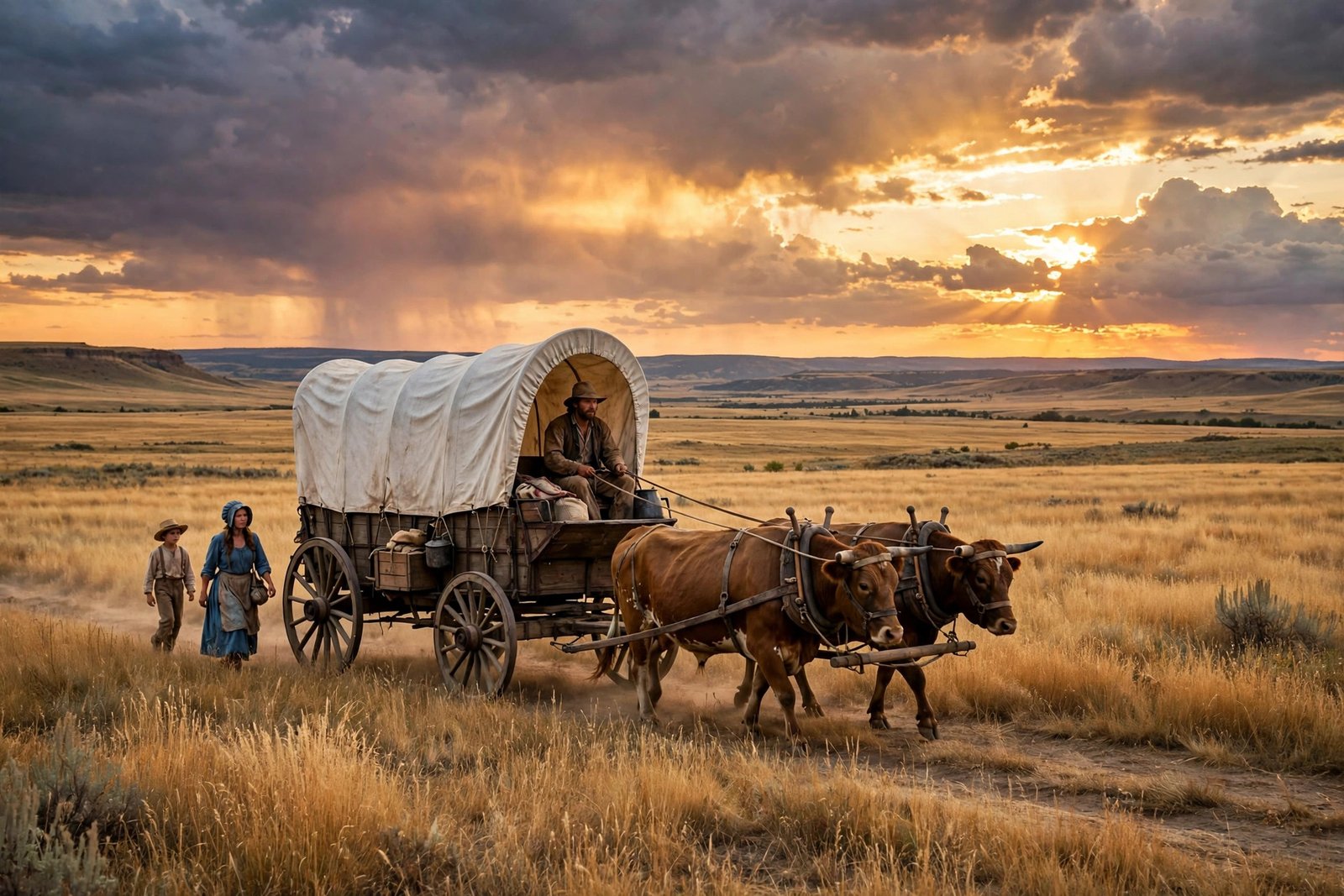
In the spring of 1843, nearly a thousand men, women, and children gathered on the muddy banks of the Missouri River near Independence, Missouri. They had sold their farms and packed everything they owned into canvas-covered wagons. Ahead of them lay more than 2,000 miles of prairie, desert, and mountain — a journey of four to six months on foot, with no guarantee of arriving alive. They were headed for Oregon, a place most of them had never seen, drawn by stories of rich soil, mild weather, and free land. Their journey would become one of the great migrations in American history, and the dusty track they carved across the continent would be remembered as the Oregon Trail.
Between the early 1840s and the completion of the transcontinental railroad in 1869, somewhere between 300,000 and 500,000 people traveled west on the Oregon Trail and the related California and Mormon trails that shared much of its route. Historians still argue over the exact numbers — John D. Unruh Jr. estimated about 296,000 travelers to Oregon, California, and Utah between 1840 and 1860, while Merrill Mattes put the figure closer to 350,000. What nobody disputes is the scale: an entire generation of Americans picked up their lives and walked to the Pacific. For a full overview of the competing estimates, the Oregon Trail encyclopedia’s summary of the emigration years lays them out side by side.
The trail itself was not a road in any modern sense. It was a braid of wagon ruts, river crossings, and landmarks worn into the landscape by thousands of wheels and hooves. The National Park Service, which administers the Oregon National Historic Trail today, describes it as a corridor stretching across more than 2,000 miles and six states. Congress designated it a National Historic Trail in 1978, and you can still see the original wagon ruts in places like Guernsey, Wyoming, where the wheels cut so deep into the sandstone that the grooves are several feet deep.
Why Thousands of Americans Headed West
The people who took the Oregon Trail were not adventurers in search of thrills. Most were farm families from the Midwest and the Upper South who were chasing something very practical: land. In the 1840s, good farmland in the settled East was getting expensive and scarce, and the Panic of 1837 had left many families in debt. Oregon, by contrast, was described in letters, guidebooks, and newspaper reports as a promised land of deep soil, gentle rain, and towering forests.
Those glowing reports were not entirely wrong, but they were heavily advertised. Missionaries like Marcus and Narcissa Whitman, who traveled west in 1836, wrote letters home describing the Willamette Valley in glowing terms. Guidebooks promised that a family could claim hundreds of acres and build a prosperous farm. The federal government eventually made the offer official: the Donation Land Claim Act of 1850 gave settlers hundreds of acres of free land in the Oregon Territory, with larger claims for married couples. That law alone drove a surge of migration in the early 1850s, with the busiest year on the western trails coming in 1852, when Unruh estimated that about 70,000 people set out, roughly 10,000 of them bound for Oregon.
But land was only part of the story. Some emigrants were fleeing debt or failed crops. Some were young couples looking for a fresh start that the crowded East could not offer. Some were driven by religious faith, including the Mormon pioneers who followed the same route to Utah beginning in 1847. And after 1849, tens of thousands more used the eastern half of the trail on their way to the California gold fields.
The trail also ran through the homelands of Native peoples who had lived there for thousands of years — the Pawnee, Sioux, Cheyenne, Crow, Shoshone, Cayuse, Nez Perce, and many others. The route itself followed Indigenous footpaths and trading routes that fur traders had learned from Native guides. The Park Service’s own trail FAQ is explicit on this point: the trail’s geography was Indigenous before it was American. Relations between emigrants and Native peoples were more complicated than the old movies suggested. The National Oregon/California Trail Center notes that most tribes did not object to travelers passing through, and many emigrants traded with Native communities for food, horses, and guidance. Conflict did happen, especially in the western stretches, but the records show it was a small share of the trail’s overall death toll.
The Great Migration of 1843
The year 1843 changed everything. Before then, only a trickle of emigrants had attempted the crossing, and many doubted that wagons could make it over the Rocky Mountains at all. That spring, a wagon train of roughly 700 to 1,000 people — accounts differ on the exact count — set out from the Independence area with more than 100 wagons and thousands of head of cattle. The group, guided in part by Marcus Whitman, crossed the mountains and reached Oregon that fall. Their success proved that large-scale family migration was possible, and the floodgates opened.
The 1843 train became known as the Great Migration, and it set the pattern for every train that followed. Emigrants organized themselves into companies, elected a captain, and agreed on rules for the road. Trains typically left Missouri in April or May, timed to arrive in Oregon before the winter snows closed the mountain passes. Leaving too early meant muddy trails and swollen rivers; leaving too late meant being caught in the Blue Mountains in October with snow on the ground.
A Day on the Trail: Life in a Wagon Train
Daily life on the Oregon Trail was defined by routine, and the routine was grueling. Most emigrants walked the entire way. Wagons were reserved for supplies, small children, and the sick — there was no room for healthy adults to ride. A typical day began before dawn, with the cook building a fire from buffalo chips or sagebrush, since firewood was scarce on the plains. Breakfast was coffee, bacon, and hard bread. By sunrise the train was moving, and it would cover 15 to 20 miles before making camp in the late afternoon.
The wagons themselves were smaller than most people imagine. The classic covered wagon was about ten feet long, carried around 2,000 pounds of supplies, and was pulled by oxen — not horses. Oxen were slower but stronger, cheaper, and far less likely to be stolen or to wander off. A family needed flour, bacon, coffee, sugar, dried beans, and salt, along with tools, seed, clothing, and bedding.
Women’s work on the trail was relentless. They cooked over open fires in wind and rain, washed clothes in rivers, cared for sick children, and often walked the same miles as the men. Many kept diaries, and those diaries are among the most valuable records we have of the journey. Children, for their part, walked, herded animals, gathered fuel, and played in the wagon ruts when the train stopped. Meals were plain and repetitive — flour, bacon, and coffee for weeks at a time, with fresh meat only when a hunt succeeded.
Danger and Death on the Journey
Here is where the honest history gets hard to pin down, because the death toll on the Oregon Trail is genuinely uncertain. The National Oregon/California Trail Center and the Bureau of Land Management’s interpretive center in Baker City, Oregon, estimate that perhaps 10 percent of the people who made the trip died along the way — roughly 20,000 to 30,000 deaths. Other historians, working from different counts, put the number lower, between 12,500 and 20,000. Nobody kept a complete count, and the true number will never be known exactly. What the sources agree on is that disease, not violence, was the great killer.
Cholera was the most feared disease on the trail. Spread through contaminated water — often from latrines dug too close to campgrounds — it could kill a healthy person within hours through catastrophic dehydration. Large cholera epidemics swept the trail population in 1849, 1850, and 1852, the years of heaviest travel. The Bureau of Land Management’s Oregon Trail FAQ, published by the National Historic Oregon Trail Interpretive Center, gives the fullest account of the death toll and its causes. Typhoid fever and dysentery, both also spread by poor sanitation, claimed many more lives. These deaths were largely preventable — boiling water would have stopped cholera — but the germ theory of disease was still decades away, and emigrants had no idea their drinking water was the problem.
Accidents were the second leading cause of death. As many as 300 emigrants drowned trying to cross rivers between 1840 and 1860. Wagons overturned on steep descents, children fell under wheels, and accidental gunshots — from firearms carried loaded in wagons or handled carelessly — killed more people than most travelers expected. The diaries are full of sudden, senseless losses: a child who slipped from a wagon, a man who drowned in a river that looked shallow, a mother who died of cholera two days after feeling perfectly fine.
Against the popular image, conflict with Native peoples caused only a small fraction of deaths. Historical records indicate that fewer than 400 emigrants were killed by Native peoples between 1840 and 1860, while emigrants killed roughly 426 Native people in the same period, according to figures cited by the Oregon Trail Center. Violent encounters were real and sometimes terrible — the Whitman killings of 1847, in which Marcus and Narcissa Whitman and others at their mission were killed by Cayuse people, led to the Cayuse War — but most of the trail’s graves were dug for victims of disease and accident, not battle.
Landmarks Along the Way
The trail was marked by landmarks that emigrants watched for the way modern travelers watch for highway signs. Chimney Rock, a towering sandstone spire in present-day Nebraska, was the first great landmark on the plains. Scotts Bluff, also in Nebraska, was a massive formation that signaled the approach to the high plains. Fort Laramie, in present-day Wyoming, was the first real outpost after weeks on the prairie — a place to rest, repair wagons, and buy supplies at steep prices.
Independence Rock, a huge granite outcrop in Wyoming, was a milestone and a deadline. Emigrants tried to reach it by July 4th — the rock was nicknamed the Register of the Desert because thousands of travelers carved their names into its surface. Reaching it by Independence Day meant the train was on schedule.
South Pass, in present-day Wyoming, was the key to the whole journey. It was a broad, gentle gap through the Rocky Mountains — so gradual that many emigrants did not even realize they had crossed the Continental Divide. The pass was the highest point of the trail by elevation, and it was the reason wagons could cross the Rockies at all. Without South Pass, there would have been no Oregon Trail.
Beyond South Pass, the trail followed the Snake River across present-day Idaho to Fort Hall, a trading post where the Oregon, California, and Mormon trails diverged. From Fort Hall, the Oregon-bound emigrants faced the hardest part of the journey: the crossing of the Blue Mountains in eastern Oregon and the descent to the Columbia River. Until 1846, most emigrants finished the trip by floating down the Columbia on rafts. After that, many paid a toll of five dollars per wagon to use the Barlow Road, a rough track cut around the south side of Mount Hood that finally brought them to Oregon City.
The End of the Trail and Its Legacy
The Oregon Trail era effectively ended on May 10, 1869, when the first transcontinental railroad was completed at Promontory Summit in Utah Territory. A journey that had taken four to six months could now be made in about a week. Wagon traffic on the trail fell away quickly, though some emigrants kept using the route into the 1880s. The railroad did not just end the trail — it transformed the West, bringing settlers, goods, and telegraph lines to places that had been weeks from civilization.
The trail’s legacy is still visible across the American West. The wagon ruts at Guernsey, Wyoming, are preserved as a National Historic Landmark. Scotts Bluff National Monument in Nebraska, Fort Laramie National Historic Site in Wyoming, and the Whitman Mission National Historic Site in Washington all protect pieces of the story. The National Historic Oregon Trail Interpretive Center near Baker City, Oregon, tells the full arc of the migration.
Today, the trail draws a different kind of traveler. Hikers, history lovers, and road trippers follow the route by car, stopping at the same landmarks the emigrants watched for. Nearly two centuries after the first wagons rolled west, the Oregon Trail remains what it always was: a line across the continent, worn by ordinary people doing an extraordinary thing. If you want the broader sweep of the story, History.com’s Oregon Trail overview is a good place to start.
Related reading
- Lewis and Clark Expedition: America’s West Journey
- Transcontinental Railroad 1869: America Connected
- Louisiana Purchase 1803: America Doubled Overnight
Frequently Asked Questions
How long was the Oregon Trail?
The Oregon Trail ran about 2,170 miles from Independence, Missouri, to Oregon City, Oregon, though sources often round it to roughly 2,000 miles. The National Park Service notes that the official trail, including alternate routes, is about 2,250 miles. The journey typically took four to six months.
How many people traveled the Oregon Trail?
Estimates vary. Historians generally put the number at 300,000 to 500,000 people between the early 1840s and 1869, counting the Oregon, California, and Mormon trails that shared the route. John D. Unruh Jr. estimated about 296,000 travelers to Oregon, California, and Utah from 1840 to 1860, while Merrill Mattes estimated closer to 350,000.
How many people died on the Oregon Trail?
The exact death toll is not known, and estimates differ. The Bureau of Land Management’s interpretive center estimates that about 10 percent of travelers died — roughly 20,000 to 30,000 people. Other historians put the figure lower, at 12,500 to 20,000. Disease, especially cholera, was the leading cause of death, followed by accidents and drowning.
What was the Great Migration of 1843?
The Great Migration of 1843 was the first large-scale wagon train to cross the Oregon Trail — roughly 700 to 1,000 people with more than 100 wagons, guided in part by Marcus Whitman. Its success proved that families could cross the Rocky Mountains by wagon, and it opened the floodgates for the mass migrations that followed.
Where does the Oregon Trail start and end?
The trail traditionally began at Independence, Missouri, on the Missouri River, though St. Joseph, Missouri, and other jumping-off towns were also used. It ended at Oregon City, Oregon, at Willamette Falls — the first incorporated city west of the Rocky Mountains.