
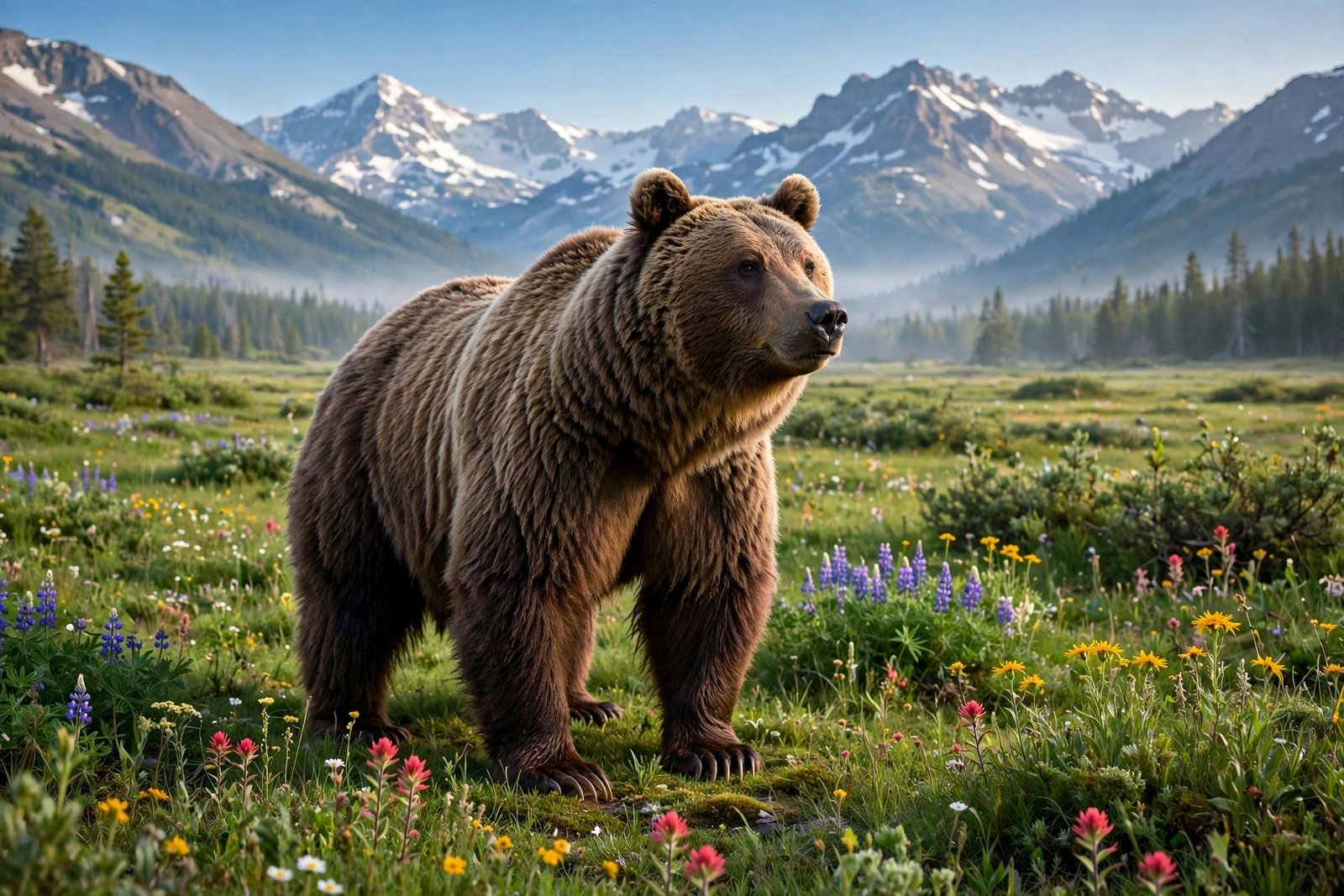
There is a moment every Yellowstone visitor hopes for and, if they are honest, slightly dreads: a grizzly bear stepping out of the sagebrush into open ground, massive and unhurried, with the whole valley suddenly holding its breath. It is the kind of sight that explains why the grizzly bear has become the living symbol of the American West. In Yellowstone National Park, the bear is not a zoo exhibit or a logo on a souvenir shirt. It is a wild animal, moving through the same valleys and meadows where elk graze and rivers cut through volcanic rock, exactly as its ancestors did long before the park existed.
This guide brings together what the National Park Service and the U.S. Fish and Wildlife Service report about Yellowstone’s grizzlies: how many there are, how they live, where and when to look for them, and, most importantly, how to stay safe while sharing their country.
How Many Grizzly Bears Live in Yellowstone?
The honest answer depends on where you draw the line. The National Park Service estimates that roughly 150 to 200 grizzly bears have home ranges that fall partly or wholly inside Yellowstone National Park itself. Step back to the wider Greater Yellowstone Ecosystem, which covers more than 22 million acres across Wyoming, Montana, and Idaho, including Grand Teton National Park and surrounding national forests, and the number grows to roughly 1,030 to 1,050 bears, according to recent estimates reported from the Interagency Grizzly Bear Study Team.
The figures shift a little from year to year because they are estimates, not a head count. Biologists track the population with DNA from hair samples, GPS collars, and sightings of females with cubs, and the estimate is revised as new data comes in. The National Park Service has reported that the estimated Greater Yellowstone Ecosystem grizzly population increased from 136 in 1975 to a peak of about 1,030 in 2024. More recent reporting put the 2025 estimate at around 1,055. The small differences between those numbers reflect different survey years and methods, not a sudden surge or collapse. What matters is the direction of travel over fifty years: from a remnant to a population that has filled much of the available habitat.
From Near Extinction to Recovery
When Yellowstone was established in 1872, grizzly bears ranged across much of the American West, from Alaska to Mexico. Over the following century, hunting, habitat loss, and conflict with livestock and settlements pushed them into a few isolated pockets. By 1975, when the federal government listed the grizzly bear as threatened under the Endangered Species Act, only about 136 bears remained in the Greater Yellowstone Ecosystem.
The listing changed everything. Hunting stopped. Garbage dumps inside the park, where bears had learned to feed and where dangerous encounters were common, were closed. Food storage rules were tightened so bears could not learn to associate people with meals. Biologists began the long, patient work of monitoring females with cubs, tracking mortality, and protecting the core habitat the bears needed to breed and raise young.
The recovery was slow because grizzlies reproduce slowly. A female typically does not breed until she is several years old, and she raises cubs for two or three years before breeding again. That means a population cannot bounce back in a season or two, no matter how good the conditions are. It took decades of steady protection for the numbers to climb past 500, the recovery goal set when the bears were listed, and then past 1,000.
The recovery has not settled the debate about the bears’ future. In January 2025, the U.S. Fish and Wildlife Service rejected petitions to remove Greater Yellowstone grizzlies from the threatened list, keeping federal protections in place. Meanwhile, Wyoming, Montana, and Idaho have pressed for state management, arguing that the population has exceeded its recovery goals for years, while conservation groups argue that the bears still need federal protection because their habitat is fragmented and conflicts with people are rising. The debate is political, but the biology is not in dispute: the population recovered because it was protected, and it stays healthy only as long as the habitat and the protections hold.
The Biology of a Yellowstone Grizzly
A grizzly bear is a subspecies of the brown bear, with the scientific name Ursus arctos horribilis. The name fits. An adult male in the lower 48 states typically weighs 400 to 600 pounds, and an adult female 250 to 350 pounds, according to the U.S. Fish and Wildlife Service. Yellowstone bears run a little smaller on average: the National Park Service reports an average adult male of about 413 pounds and an average adult female of about 269 pounds in the Yellowstone area. The heaviest known male in the Greater Yellowstone Ecosystem weighed 715 pounds. Adults stand about three and a half feet at the shoulder and can reach about eight feet tall when they stand on their hind legs.
Grizzlies are omnivores, and Yellowstone’s bears are among the most varied eaters of any large mammal in North America. They eat more than 260 kinds of food, including roots, grasses, berries, whitebark pine nuts, army cutworm moths, ants and other insects, fish, elk calves, rodents, and carrion. They dig, graze, fish, and scavenge, shifting with the seasons and with what the landscape offers. In spring, they follow the green-up and scavenge winter-killed animals. In summer, they graze and hunt for moths and other insects in high alpine areas. In autumn, they gorge on pine nuts and berries, packing on fat for the long winter ahead.
The energy demands are enormous. The National Park Service reports that a grizzly normally needs 5,000 to 8,000 calories a day during the active season, but during the autumn feeding frenzy known as hyperphagia, a bear may eat up to 20,000 calories a day. A bear can gain several pounds a day in the weeks before denning, and it needs every ounce of that fat to survive the winter.
Hibernation: The Long Winter Sleep
Each winter, Yellowstone’s grizzlies disappear into dens dug into steep, often north-facing slopes, where wind-blown snow piles up as insulation. In the lower 48 states, grizzlies den for four to six months, typically entering their dens between October and December. Males tend to go in later than females and come out earlier, with males often emerging in early spring and females with newborn cubs emerging later.
Hibernation in a bear is not the deep, unresponsive sleep of a ground squirrel. Bears are sometimes called shallow hibernators because their body temperature drops only slightly, staying within about 12 degrees of normal, and they can wake and react to danger. But the changes are still dramatic. In the den, a bear does not eat, drink, urinate, or defecate. Breathing slows to as little as one breath every 45 seconds, and metabolism drops by roughly half. A bear can emerge in spring 15 to 30 percent lighter than it went in, according to the National Park Service.
Cubs are born in the den in midwinter, tiny and blind, and nurse on milk that is about 30 percent fat. By the time the family emerges in spring, the cubs are sturdy enough to follow their mother through the snow. A mother grizzly is fiercely protective of her cubs, and she will stay with them for two or three years, teaching them where to find food and how to survive before they strike out on their own. That long period of care is one reason the population grows slowly, and one reason a mother with cubs deserves the widest possible berth from visitors.
Where and When to See Grizzly Bears
The two most famous bear-watching areas in Yellowstone are Lamar Valley in the northeast and Hayden Valley in the center of the park. Both are wide, open valleys where bears can be spotted from a distance with binoculars or a spotting scope, which is exactly how it should be done. Lamar Valley, often called America’s Serengeti for its wolves, elk, bison, and bears, is the best bet in spring, when bears emerge from dens and graze the new green grass along the Lamar River. Hayden Valley is strong in spring and early summer too, when bears hunt for elk calves and graze in the meadows along the Yellowstone River.
Timing matters as much as place. Bears are most active at dawn and dusk, when the light is low and the air is cool. Midday in summer, they often rest in the shade of trees or in cool, high country. Spring is the season of mothers with cubs, and autumn is the season of hyperphagia, when bears feed almost constantly in daylight to build fat. Winter is the quiet season: most bears are in their dens, and the park’s interior roads are closed to regular vehicles.
Staying Safe in Bear Country
Yellowstone is bear country, and every visitor shares the landscape with animals that are powerful, fast, and unpredictable. The National Park Service’s safety rules are simple, and they are not suggestions. Stay at least 100 yards, about 91 meters, from bears and wolves, and at least 25 yards from all other animals. Never approach a bear, never feed a bear, and never place yourself between a mother and her cubs.
Carry bear spray and know how to use it before you need it. Keep it immediately available, on your hip or chest strap, not buried inside your pack. The Park Service advises spraying when a charging bear is 60 feet away or closer, and standing your ground rather than running. Running can trigger a chase response, and a grizzly can run far faster than any person, reaching speeds that make escape on foot impossible.
If you encounter a bear, stay calm. Do not run. Quietly back away or detour around the animal, and stop if backing away seems to agitate it. Watch for signs of bear activity before you walk into it: tracks, scat, dig sites, scratched trees, and dead animals, which bears may defend as a food source. Avoid carcasses entirely. Hike in groups of three or more when you can, make noise on the trail, especially around blind corners and in thick brush, and be extra alert at dawn and dusk and near streams, where sound is masked.
Food storage is a safety rule, not a housekeeping preference. Store food, garbage, and scented items in hard-sided vehicles or in the bear-proof boxes provided at campgrounds, and cook and sleep at least 100 yards apart in the backcountry. A bear that learns to associate people with food becomes a danger to the next person it meets, and bears that repeatedly seek human food are often removed or killed. Keeping a clean camp protects the next visitor, and it protects the bear.
Why the Grizzly Still Matters
The grizzly bear matters because it is an umbrella species: protecting the vast, connected habitat a grizzly needs also protects elk, wolves, cutthroat trout, whitebark pine, and hundreds of other species that share the same landscape. It matters because it is a measure of whether the American West can still hold a large, wild predator alongside ranches, highways, and towns. And it matters because it is, quite simply, one of the most impressive animals on the continent, a creature that can dig a den in frozen ground, survive a winter without eating, and raise cubs in country that would defeat most other mammals.
If you go to Yellowstone, go early, bring binoculars, keep your distance, and remember what you are looking at. A grizzly bear in Lamar Valley at dawn is not a photo opportunity that owes you anything. It is a wild animal in the last great stronghold of its kind in the lower 48 states, doing what grizzlies have done for thousands of years. Watch it, respect it, and leave it exactly as wild as you found it.
Frequently Asked Questions
How many grizzly bears are in Yellowstone National Park?
About 150 to 200 grizzly bears have home ranges partly or wholly inside Yellowstone National Park, according to the National Park Service. The wider Greater Yellowstone Ecosystem holds roughly 1,030 to 1,050 bears. The numbers are estimates that change with new survey data.
Are grizzly bears in Yellowstone still endangered?
Grizzly bears in the lower 48 states are listed as threatened under the Endangered Species Act, a status they have held since 1975. In January 2025, the U.S. Fish and Wildlife Service rejected petitions to remove Greater Yellowstone grizzlies from the list, so federal protections remain in place.
How far away should I stay from a grizzly bear?
Stay at least 100 yards, about 91 meters, from bears and wolves in Yellowstone, and at least 25 yards from all other animals. Never approach a bear, and never get between a mother and her cubs.
Do I need bear spray in Yellowstone?
Yes. The National Park Service advises all hikers to carry bear spray and know how to use it, keeping it immediately available rather than inside a pack. Spray when a charging bear is 60 feet away or closer, and stand your ground instead of running.
When is the best time to see grizzly bears in Yellowstone?
Spring and autumn are the best seasons, and dawn and dusk are the best times of day. Lamar Valley and Hayden Valley are the most reliable viewing areas. Sightings are never guaranteed, so arrive early, bring binoculars or a spotting scope, and scan the valley edges and riverbanks.
Related Reading
Keep exploring America’s wild places with these stories from Trending 4: American Black Bear Hibernation Facts, The American Bison Comeback: From Near Extinction to Success, and Gray Wolf Recovery in the American West.
Sources: National Park Service, Yellowstone Grizzly Bear Facts; National Park Service, Yellowstone bear safety guidance.