
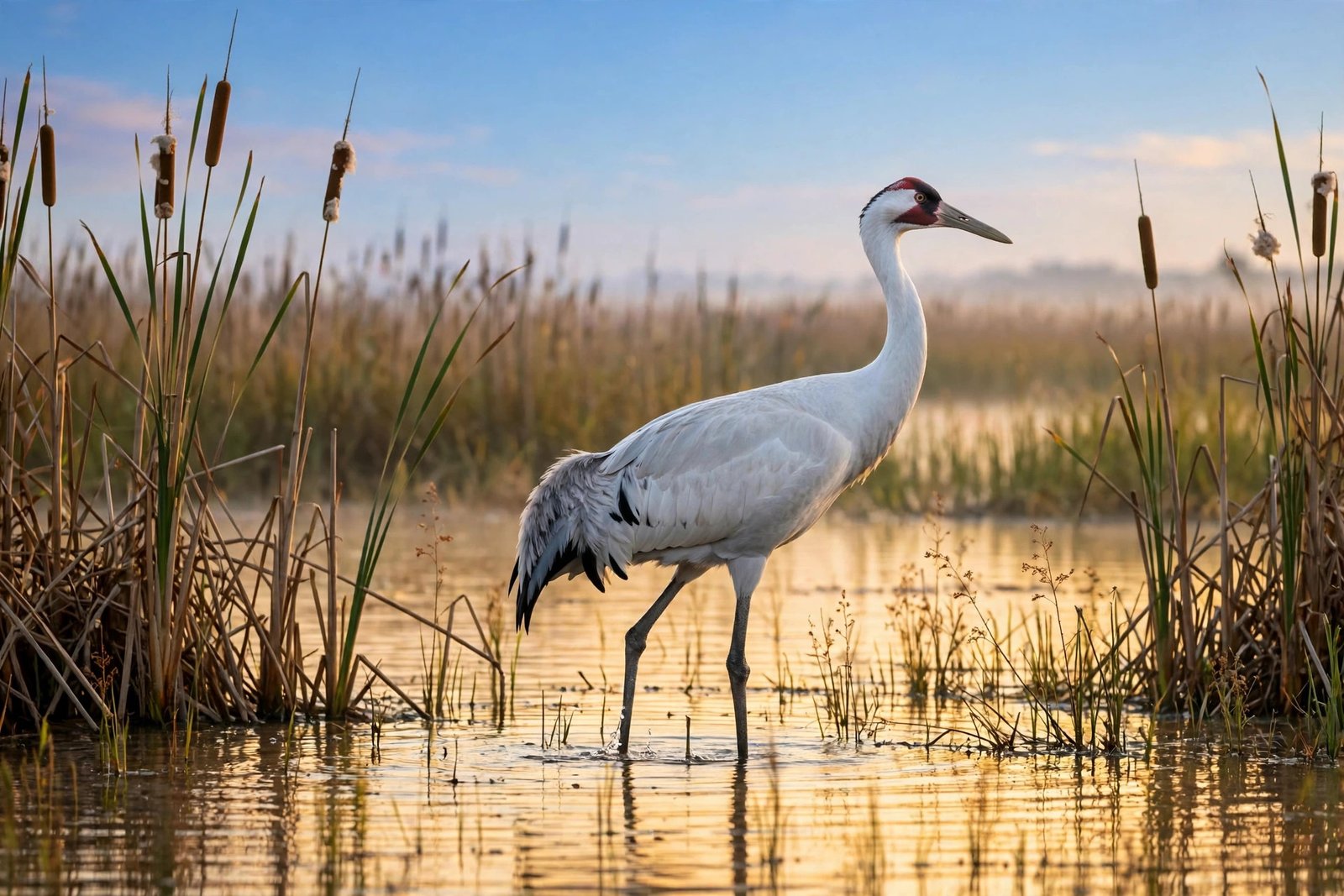
Imagine a bird so tall that it stands eye to eye with a child, so white that it seems to glow against a marsh at dawn, and so rare that, within living memory, the entire species could have fit into a single small room. That bird is the whooping crane, North America’s tallest bird — and its story is one of the greatest comebacks in the history of wildlife conservation.
In 1941, the whooping crane was nearly gone. The wild migratory flock that wintered on the Texas coast had been reduced to just 15 birds. Counting a small non-migratory group in Louisiana, only 21 whooping cranes were left alive anywhere in the world. One bad winter, one disease outbreak, or one oil spill in the wrong place could have finished the species forever.
Meet North America’s Tallest Bird
The whooping crane (Grus americana) is a bird that is hard to forget once you have seen one. It stands about five feet tall — roughly 1.5 meters — making it the tallest bird native to North America. Its wingspan reaches six and a half to seven and a half feet, and it weighs around 15 pounds, with males slightly heavier than females. Its plumage is a brilliant white, set off by black wingtips, a black “moustache” stripe, and a crown of red skin on its head. In flight, its long neck stretches straight out and its long legs trail behind it, a silhouette that is unmistakable against the sky.
A Bird That Once Filled a Continent
It is hard to picture now, but whooping cranes were once a familiar bird across much of North America. Historically, they ranged from central Canada south to Mexico, and from Utah to the Atlantic coast, according to the U.S. Fish and Wildlife Service. Before the pressures of settlement, hunting, and habitat loss took their toll, the population is believed to have numbered between 15,000 and 20,000 birds.
Whooping cranes were hunted for food and for sport, and their feathers were prized. More damaging still was the loss of the wetlands they depended on. As prairies were plowed, marshes were drained, and coastlines were developed, the cranes lost the shallow-water feeding grounds they needed at every stage of their long migration. By 1860, the population had already fallen to roughly 1,400 birds. The decline continued through the early decades of the twentieth century, and by the 1930s the species was in serious trouble.
The Crash: How 1941 Left Just 21 Birds
By 1941, the whooping crane was at the edge of extinction. The numbers from that year are worth stating carefully, because they are often quoted in shortened form. The famous figure — 15 birds — refers to the wild migratory flock that wintered at Aransas National Wildlife Refuge in Texas. But there were also six more birds in a small non-migratory population at White Lake in Louisiana. That made 21 whooping cranes alive in the world in 1941, all told.
The Louisiana birds did not last. By 1947, only one bird survived from the White Lake population. It was captured and transferred to the Aransas population in 1950. From that point on, hope for the species rested on a single flock — the one that wintered in Texas and bred somewhere in the far north, in a place nobody had yet found.
The Turning Point: Finding the Nesting Grounds
The first great breakthrough in the recovery came in 1954, when a fire crew flying over Wood Buffalo National Park in Canada spotted whooping cranes on their breeding grounds. Until that moment, nobody knew where the Aransas flock went to nest. The discovery meant that biologists could finally watch the birds where they bred, count their nests, and — most importantly — collect eggs for a captive breeding program.
That program began in earnest in 1967, the same year the species was listed as threatened in the United States under early endangered-species law. It was later listed as endangered in 1970, and it became one of the first species protected when the Endangered Species Act was signed in 1973. Egg collection from Wood Buffalo began in 1967 as well. Biologists took one egg from nests where the cranes had laid two, knowing that usually only one chick survives in the wild anyway. The collected eggs were hatched and raised at captive breeding centers, including the Patuxent Wildlife Research Center in Maryland.
Eggs, Patience, and a Crane Named Tex
One of the most famous chapters in the recovery involves a crane named Tex. Tex was a female whooping crane hatched at the San Antonio Zoo in 1967. She had been raised by people and had imprinted on humans, which meant she did not behave like a wild crane — and she would not lay a fertile egg. In 1976, ornithologist George Archibald, co-founder of the International Crane Foundation in Baraboo, Wisconsin, began working with Tex, using artificial insemination to help her produce a fertile egg. It was painstaking, hands-on conservation, and it succeeded. The techniques pioneered at Patuxent, the International Crane Foundation, and a program at the Calgary Zoo grew into a robust multi-institutional captive breeding program that supplied the cranes used in several reintroduction efforts.
Teaching Cranes to Fly: The Ultralight Aircraft
Building a captive population was only half the job. The other half was getting captive-raised cranes back into the wild — and teaching them to migrate. A crane raised by people does not know the way from Wisconsin to Florida, and migration is a learned behavior, passed from parents to chicks on the wing. Without wild parents to follow, young cranes needed a teacher.
The solution was one of the most creative ideas in conservation history. The International Whooping Crane Recovery Team decided to use ultralight aircraft as teaching tools, leading young whooping cranes on their first migration from Wisconsin to wintering grounds in the southeastern United States. Pilots in small, slow-flying aircraft dressed in crane costumes, so the young birds would follow the plane rather than imprint on people, and guided them along a migration route they could then repeat on their own. The effort was led by the Whooping Crane Eastern Partnership, a coalition of government agencies and private organizations, and it captured the public imagination around the world.
The eastern migratory population it helped create breeds mainly in Wisconsin and winters in the southern United States. Today that flock numbers roughly 60 to 80 birds, according to International Crane Foundation estimates. It is not yet self-sustaining — it still needs help from captive breeding and careful management — but it exists, and that alone would have seemed impossible in 1941.
Louisiana: Bringing the Cranes Home
The recovery has not stopped with the eastern flock. In 2011, the U.S. Fish and Wildlife Service and its partners began reintroducing whooping cranes to the White Lake Wetlands Conservation Area in Louisiana — the same region where the last non-migratory Louisiana cranes had died out in the 1940s. It was the fourth reintroduction of the species into the wild, and the only one in an area where the birds had historically lived. Today, a non-migratory flock of roughly 70 birds lives year-round in Louisiana.
Where the Numbers Stand Today
The Aransas–Wood Buffalo flock — the original wild flock, the only one that is fully self-sustaining, breeding and migrating without human assistance — reached a record 557 birds in the winter 2024–2025 survey, the first time it had ever exceeded 550. The U.S. Fish and Wildlife Service reported an estimated 540 birds wintering at and near Aransas during the 2025–26 season, keeping the main flock above 500 wild birds for the ninth consecutive year. The total population, including the reintroduced flocks and birds in captive breeding programs, is just over 830 birds as of 2025, according to the International Crane Foundation — roughly 560 in the main migratory flock, about 140 in the two reintroduced populations in Wisconsin and Louisiana, and around 130 in captivity.
Those numbers represent an extraordinary recovery from 21 birds. But the species remains listed as endangered under the Endangered Species Act, and the criteria for downlisting it to threatened are demanding. One of the recovery criteria is reaching 1,000 birds in the Aransas–Wood Buffalo population and holding that level for 10 years. At current growth rates, population models have suggested that milestone could be reached within a couple of decades — but models are not guarantees, and the cranes still face serious threats.
Why Recovery Is Still Fragile
Habitat is the biggest concern. Whooping cranes depend on shallow wetlands at every stop on a migration of roughly 2,500 miles between Canada and Texas. Wetlands continue to be drained, developed, and degraded along the migration corridor, and drought on the Texas coast can shrink the shallow bays and marshes where wintering cranes feed on blue crabs. When the cranes’ food is scarce in winter, fewer chicks are raised the following summer.
Power lines are another serious danger. Cranes are large, heavy birds that fly low on takeoff and landing, and collisions with power lines kill whooping cranes every year. Disturbance matters too: cranes that are flushed repeatedly from feeding areas burn energy they cannot spare, and nesting cranes in the far north need quiet, remote wetlands to raise their single chick successfully.
Then there is the simple math of crane biology. A pair raises at most one chick a year, and young birds take years to mature. That means the population can only grow slowly, and a few bad years can erase a decade of gains. Conservationists sometimes describe the whooping crane as a species that recovers one chick at a time — and after eighty years, they are still counting chicks, one by one.
How to See a Whooping Crane
For bird lovers, seeing a whooping crane in the wild is a bucket-list experience, and there are good, responsible ways to do it. The best place is Aransas National Wildlife Refuge on the Texas coast, where the main flock winters from roughly November through March. The refuge offers viewing areas, and boat tours from the nearby town of Rockport take visitors into the shallow bays where cranes feed — close enough to see them well, far enough away not to disturb them.
Frequently Asked Questions
How many whooping cranes were left in 1941?
There were 21 whooping cranes alive in the world in 1941. The often-quoted figure of 15 refers to the migratory flock that wintered at Aransas National Wildlife Refuge in Texas; six more birds lived in a non-migratory population at White Lake, Louisiana. The Louisiana birds died out by the late 1940s, leaving the Aransas flock as the species’ only hope.
How many whooping cranes are there today?
The total population is roughly 830 birds as of 2025, according to the International Crane Foundation. The main Aransas–Wood Buffalo flock numbers more than 500 birds — a record 557 in the winter of 2024–2025 — and the rest are in reintroduced flocks in Wisconsin, Louisiana, and Florida, plus birds in captive breeding programs.
What is the whooping crane’s scientific name?
Why did whooping cranes almost go extinct?
Hunting and habitat loss. Cranes were hunted for food and sport, and the wetlands they depended on were drained and developed as the continent was settled. By 1860 the population had already fallen to roughly 1,400 birds, and by 1941 only 21 remained. Legal protection, beginning with the Migratory Bird Treaty Act of 1918, and the creation of refuges at both ends of the migration route, helped stop the decline.
How were whooping cranes brought back?
Through captive breeding and reintroduction. After the breeding grounds were found in Wood Buffalo National Park in 1954, biologists collected eggs and raised cranes at centers such as Patuxent Wildlife Research Center and the International Crane Foundation. Captive-raised birds founded new flocks in Wisconsin, Louisiana, and Florida, and ultralight aircraft were used to teach young cranes their migration route. The Aransas–Wood Buffalo flock, protected at both ends of its range, recovered on its own once it had room to grow.
Are whooping cranes still endangered?
Yes. The whooping crane remains listed as endangered under the Endangered Species Act. One criterion for downlisting it to threatened is reaching 1,000 birds in the Aransas–Wood Buffalo population and maintaining that level for 10 years. The flock is growing at more than 4 percent a year, but habitat loss, power-line collisions, and drought on the Texas coast still threaten its future.
Where is the best place to see a whooping crane?
Related reading
Sources: U.S. Fish and Wildlife Service: Whooping Crane Population Reaches Record High; National Wildlife Federation: Whooping Crane; Cornell Lab: Whooping Crane Population Hits Historic High in 2018.