
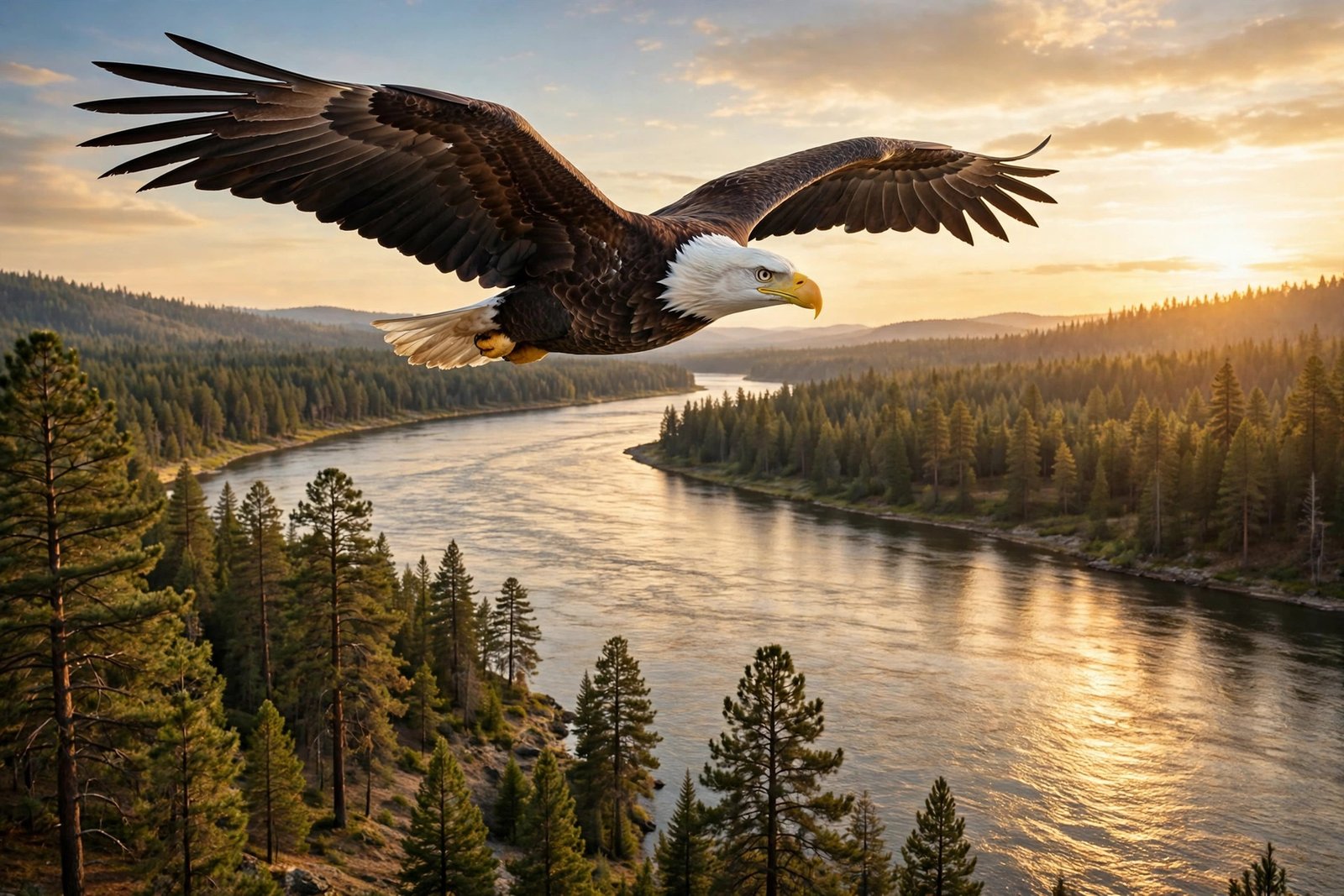
Stand on the bank of almost any big American river in winter today — the Mississippi, the Susquehanna, the Columbia — and there is a decent chance you will see a bald eagle working the water, white head flashing in the low sun. It feels ordinary. It is anything but. Within living memory, that sight was vanishing from the United States. In 1963, surveyors could find only 417 nesting pairs of bald eagles in the entire lower 48 states. America’s national symbol was on its way out of America.
The recovery that followed is now the most famous conservation success story in the country’s history. The most recent federal estimate, from surveys in 2018 and 2019 and published by the U.S. Fish and Wildlife Service in 2021, put the bald eagle population in the lower 48 at about 316,700 individual birds, including roughly 71,467 occupied nesting territories — a more than fourfold increase since 2009 alone. In December 2024, the eagle finally received a title it had somehow never legally held: it was formally designated, by an act of Congress signed into law, as the national bird of the United States. This is how a species went from 417 pairs to that moment.
A Symbol Chosen, Then Slowly Lost
The bald eagle entered American identity on June 20, 1782, when Congress adopted the Great Seal with the eagle at its center — olive branch in one talon, arrows in the other, a shield on its chest. The bird was a deliberate choice: native only to North America, powerful, long-lived, and free-ranging over the continent’s lakes and coasts. For the republic’s first century and a half, eagles were simply part of the landscape, nesting from Florida’s mangroves to the Great Lakes to the Pacific Northwest.
But abundance hid a steady grinding down. Eagles were shot as vermin and for sport; in Alaska, a territorial bounty paid on eagles from 1917 to 1953 rewarded the killing of more than 100,000 birds, under the mistaken belief that they threatened salmon fisheries and fox farms. Egg collectors prized their shells. Development cleared the tall shoreline trees they nested in, and logging and farming pushed them away from waterways. Congress responded with the Bald Eagle Protection Act of 1940, later expanded to golden eagles, which banned killing, selling, or disturbing eagles without a permit. In much of the country, numbers stabilized. Then chemistry intervened.
DDT and the Eggshell Catastrophe
After World War II, American agriculture embraced DDT, a powerful insecticide sprayed widely on crops and wetlands to control insects. DDT washed into waterways, accumulated in fish, and concentrated as it moved up the food chain — a process called biomagnification. Eagles, eating fish day after day, built up high levels of DDE, DDT’s breakdown product, in their bodies.
DDE did not usually kill adult eagles outright. It did something quieter and more devastating: it interfered with calcium deposition, so females laid eggs with shells too thin to bear a parent’s weight. Nests filled with crushed eggs. Year after year, pairs held territory, built nests, courted — and produced almost no young. Rachel Carson’s 1962 bestseller Silent Spring carried the warning to a mass audience, using the disappearing eagle as one of its emblematic cases, and helped ignite the modern environmental movement.
By 1963, the count in the contiguous United States had collapsed to those 417 known nesting pairs. In much of the Northeast and Midwest, a whole generation grew up never seeing a wild eagle. The bird on the Great Seal, the dollar bill, and every federal building had become, in the flesh, a rarity.
The Turn: Laws With Teeth
The comeback was not an accident, and it was not quick. It took a stack of laws, each doing a different job. The Environmental Protection Agency, under Administrator William Ruckelshaus, banned nearly all domestic uses of DDT in 1972 — the single most important decision in the eagle’s recovery, because it stopped the eggshell thinning at its source. The Endangered Species Act of 1973 then listed the bald eagle among its first protected species, making it illegal to harm eagles or damage their habitat and requiring federal agencies to put recovery first. Underneath it all stood the older shields: the Bald and Golden Eagle Protection Act and the Migratory Bird Treaty Act, which still protect eagles today.
With DDT out of the food chain, eggshells thickened again within a few breeding seasons. But in many states there were simply no eagles left to breed. So biologists rebuilt populations by hand.
Hacking, Foster Nests, and Patience
The hands-on work had a name: hacking. Wildlife agencies took young eagles — often from healthy populations in Canada, the Great Lakes, or Alaska — and raised them in artificial nest towers in states where eagles had been wiped out, feeding them without human contact until they fledged. The young birds imprinted on the release landscape and, years later, returned to breed there. New York’s program, begun in the 1970s, is credited with restoring eagles to the Northeast; Pennsylvania, which bottomed out at just three nesting pairs in 1983, imported eaglets from Canada and rebuilt from there; New Jersey, down to a single nest through much of the 1970s, climbed back the same way.
Biologists also moved eggs and chicks into the nests of pairs whose own eggs had failed, guarded nests through the season, bought and protected shoreline habitat, and enforced the law against shooters. None of it was glamorous. All of it compounded. Eagles mature slowly — they do not breed until about age five, and a wild bird can live twenty years or more — so recovery was always going to be measured in decades, not seasons. The U.S. Fish and Wildlife Service’s account of the delisting credits exactly this combination: legal protection, the DDT ban, captive breeding and reintroduction, law enforcement, and habitat protection around nest sites.
2007: Graduation Day
The milestones came in steps. In 1995, the eagle was reclassified from endangered to threatened across the lower 48 — a formal acknowledgment that the trajectory had reversed. On June 28, 2007, the Fish and Wildlife Service announced the bald eagle’s removal from the endangered and threatened species list altogether. The count that justified it: at least 9,789 nesting pairs in the contiguous United States, up from 417 — comfortably beyond the recovery goal of 3,900 pairs that biologists had once set as ambitious.
Delisting did not mean unprotected. The Bald and Golden Eagle Protection Act and the Migratory Bird Treaty Act still make it a federal offense to kill, injure, sell, or disturb an eagle, its nest, or its eggs, and the Service kept monitoring the population under a post-delisting plan. Think of it as a patient leaving intensive care rather than leaving the hospital: stable, thriving, and still checked on.
The Numbers Today
The fuller picture arrived with the Service’s updated population report, released in 2021 from 2018–2019 survey data. Using aerial surveys and thousands of citizen-science reports from eBird, biologists estimated about 316,700 bald eagles in the lower 48, with roughly 71,467 occupied nesting territories. That was more than four times the estimate from just a decade earlier. State stories mirror the national one: Pennsylvania passed 300 nesting pairs, New Jersey climbed from one nest to several hundred, and winter counts along the Mississippi River now gather thousands of eagles below the dams where open water concentrates fish.
Eagles have also adapted in ways that would have startled the biologists of 1963. They nest on cell towers and channel markers, fish suburban reservoirs, and scavenge landfills and roadkill alongside their wilder hunting. The species the founders chose for its wild majesty has proven equally good at living next door to us — provided the water is clean and nobody is shooting.
The Final Honor: National Bird, At Last
Here is the strangest footnote in the whole story. For 242 years, the bald eagle was America’s national bird in every way except the law. It appeared on the Great Seal, on currency, on passports and presidential seals — but Congress had never actually designated a national bird. That oversight ended when a bipartisan bill, championed by eagle advocates including Minnesota lawmakers — Minnesota is home to one of the largest eagle populations and the National Eagle Center in Wabasha — passed Congress unanimously. On December 23, 2024, President Joe Biden signed Public Law 118-206, formally designating the bald eagle as the national bird of the United States.
The law’s findings read like a summary of the whole saga: the eagle as a symbol of independence, strength, and freedom since 1782; a species unique to North America; and a bird central to the spiritual life of Indigenous peoples, who had revered it for millennia before there was a United States at all.
What the Eagle Proves
The bald eagle’s comeback is often told as a feel-good story, and it is one. But its real value is as evidence. It demonstrates, with numbers no one can argue with — 417 pairs to more than 71,000 nesting territories — that environmental law can work when it targets the actual cause of a decline, that recovery takes sustained money and patience across administrations, and that a species written off as doomed can refill a continent’s skies within a single human lifetime. Lead ammunition and fishing tackle, collisions, electrocution, and habitat loss still kill eagles, and biologists keep a careful watch. But the next time one crosses the road in front of you, remember: your grandparents’ generation nearly lost that bird forever, and then, deliberately, changed its mind.