
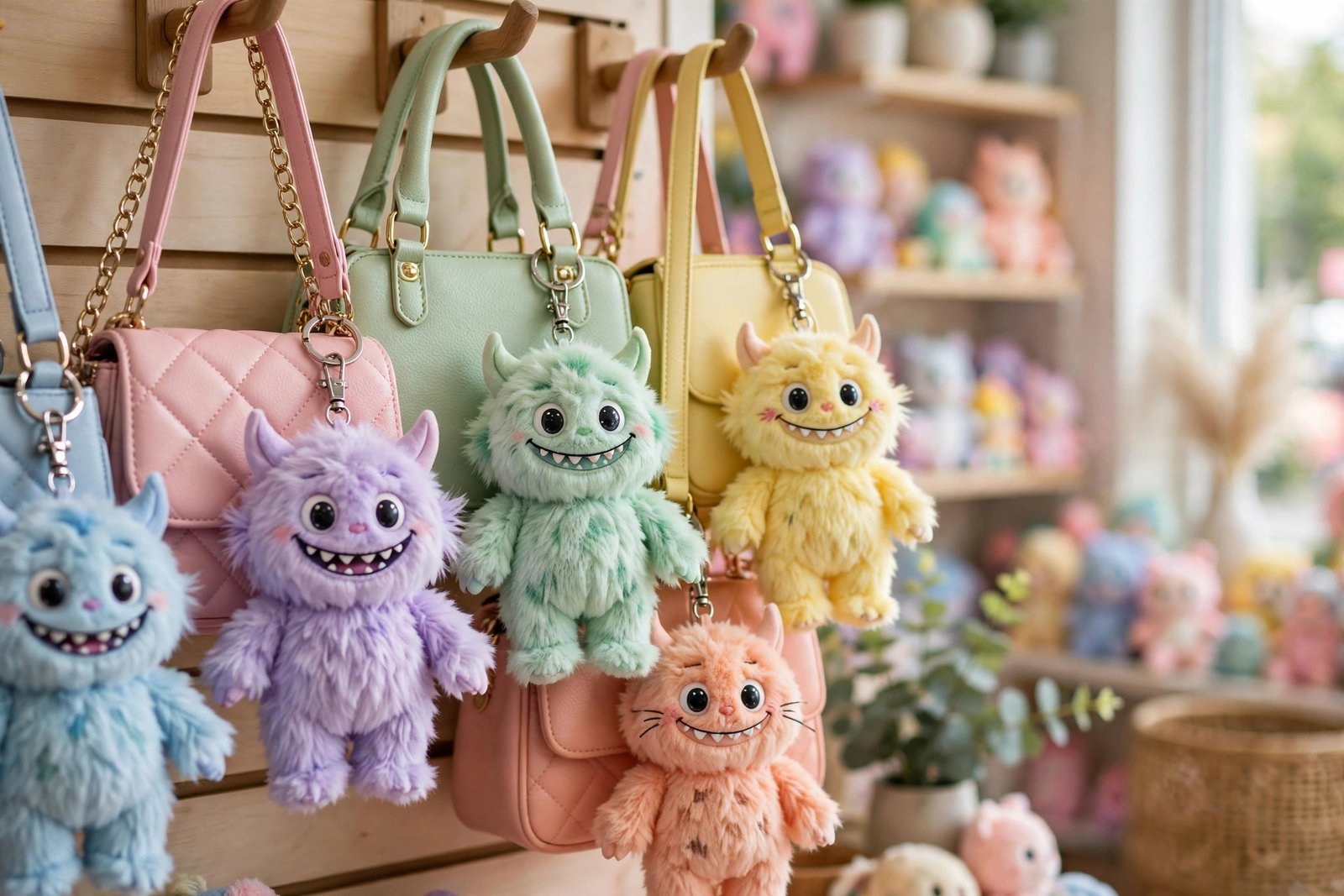
Two years ago, you could not walk through an American mall without seeing one. The little monster with the pointed ears, the wide eyes, and the grin full of sharp teeth hung from handbags, backpacks, and belt loops everywhere. People lined up before stores opened and paid several times the retail price on resale sites just to get the one they wanted. Labubu was not just a toy. It was the defining craze of 2025, a plush monster that turned a Chinese toy company into a stock market sensation. Now the numbers tell a very different story. Pop Mart, the company behind Labubu, has reported that its revenue fell by almost half in the summer of 2026, with sales in the Americas down by as much as three quarters.
The Numbers: A Plunge With No Place to Hide
The news arrived on October 27, 2026, when Pop Mart filed a business update with the Hong Kong stock exchange. The company’s unaudited revenue for the third quarter of 2026 — the months of July, August, and September — fell 45 to 50 percent compared with the same period a year earlier. Every region declined. Mainland China, the company’s home market, fell 25 to 30 percent. Europe and other markets fell 50 to 55 percent. Asia-Pacific outside China fell 65 to 70 percent. And the Americas, the region that includes the United States and was the engine of Labubu’s global explosion, fell 70 to 75 percent — the steepest drop of all.
The BBC revisited the figures on November 7, 2026, in a feature on fans moving on from the craze, framing the American decline at a minimum of 70 percent. The Financial Times linked the slump directly to fading demand for Labubu, and Pop Mart’s shares fell to their lowest level in about 18 months after the disclosure. Banks cut their forecasts, with HSBC warning it would take longer for the business to stabilize.
Two details in the filing matter. First, the figures cover everything Pop Mart sells, not Labubu alone, and the company does not break out Labubu sales separately in this update. Labubu is the company’s biggest character by a wide margin, but the numbers themselves describe the whole company. Second, this was the first quarter in which all four of Pop Mart’s regions declined at the same time. It was a global cooldown, hitting hardest exactly where the craze had burned brightest.
How a Picture-Book Monster Conquered America
Labubu began quietly, a long way from the mall queues and the resale frenzy. The character was created by Kasing Lung, a Hong Kong-born illustrator based in Belgium, who introduced Labubu in 2015 as part of his picture-book series The Monsters, inspired by Nordic folklore. Labubu is a mischievous forest elf with tall pointed ears, wide eyes, and a row of sharp little teeth — cute and slightly menacing at the same time, a combination the toy world calls ugly-cute. For years the character lived mostly in books and in small runs of toys produced by a Hong Kong company called How2Work.
The turning point came in 2019, when Lung signed an exclusive licensing deal with Pop Mart, the Beijing-based toy retailer founded in 2010 by Wang Ning. Pop Mart turned Labubu into a blind-box product: a sealed package in which the buyer does not know which figure from a series they are getting until they open it. Pop Mart also began selling Labubu as a plush bag charm, with a clip that let owners hang the little monster from a handbag like a piece of jewelry.
For several years, Labubu grew steadily in Asia. Then, in April 2024, the character’s world changed in a single weekend. Lisa, a member of the K-pop group BLACKPINK, was photographed with a Labubu charm clipped to her handbag, and she posted about the toy on social media. Other celebrities followed — Rihanna and Dua Lipa among them — and within months Labubu had moved from collector shelves onto handbags around the world. In May 2025, Pop Mart temporarily paused Labubu sales at its stores in the United Kingdom after reports of customers fighting over stock.
Why the Fall Was So Steep: The Impossible Comparison
The first thing to understand about the third-quarter numbers is that they are measured against an almost impossible comparison. The third quarter of 2025 was the biggest in Pop Mart’s history. Revenue that quarter rose 245 to 250 percent year over year, and overseas revenue rose 365 to 370 percent. In the Americas, revenue in that quarter rose by 1,265 to 1,270 percent — roughly thirteen times the level of the year before. That was the peak of the Labubu frenzy, the quarter when the whole world seemed to want one at once.
Pop Mart’s chief operating officer, Si De, pointed to that comparison as the main reason for the decline, and the arithmetic backs him up. Start with a rough index: if the third quarter of 2024 is 100, the same quarter of 2025 was about 345 to 350, and the third quarter of 2026, after a fall of 45 to 50 percent, lands around 173 to 193. Even after the plunge, Pop Mart was still selling roughly 70 to 90 percent more than it had two years earlier. The business did not collapse back to where it started. It fell back from an extraordinary peak to a level still far above its pre-craze size.
The regional pattern tells the same story in a different way. Mainland China, where Pop Mart’s customer base is deepest and its store network oldest, fell the least, at 25 to 30 percent. The Americas, where the craze was newest and most dependent on a single character and a single viral moment, fell the most. Research firm Bernstein noted in April 2026 that fan bases for Pop Mart characters other than Labubu were thin in the United States, making it hard to convert a burst of excitement into repeat purchases.
The Signs Were There Before the Numbers
Anyone watching closely could see the cooling start well before Pop Mart filed its October update. The resale market, which had been the clearest sign of the mania, went soft first. During the peak, rare Labubu figures sold on resale platforms for many times their retail price. By the autumn of 2026, that premium had largely vanished. One report in November noted that a Big into Energy Labubu blind box listed on Pop Mart’s American website at 26.99 dollars was averaging about 6 dollars across recent resale sales on StockX — below retail, not above it.
The half-year results had already hinted at the turn. The Monsters, the wider character line that includes Labubu, brought in 4.45 billion yuan in the first half of 2026, down from 4.81 billion yuan in the same period a year earlier. The Americas had also already slipped in the first half, with revenue in the region falling from 2.265 billion yuan to 1.892 billion yuan, a decline of 16.5 percent. The third quarter did not come out of nowhere. It was the moment a slowdown became a rout.
The store network kept growing even as sales fell, which tells its own story about the company’s bet. Pop Mart operated more than 500 shops in more than 30 countries as of early 2026, and its store count in the Americas more than doubled over the year, rising from 41 to 86 locations in the first half of 2026 alone. Opening stores is a long-term decision, and it suggests Pop Mart believes the American market is worth investing in even after the craze fades.
What Pop Mart Is Doing Next
Pop Mart is not standing still. The most visible part of that effort is Hollywood. In March 2026, Pop Mart and Sony Pictures announced plans to develop a feature film starring Labubu, directed by Paul King, the filmmaker behind Paddington, Paddington 2, and Wonka. King will produce and direct the film and co-write the screenplay with Steven Levenson, the writer of the musical Dear Evan Hansen. The film is planned as a live-action and CGI hybrid, and Labubu’s creator, Kasing Lung, is attached as an executive producer. No release date, cast, or plot details have been announced.
The company is also trying to spread its bets. In March 2026, Pop Mart put Labubu together with Hello Kitty in a blind-box series, pairing its own character with one of the most durable brands in the business. It has continued to launch new series and collaborations with fashion houses and artists. The challenge is that none of its other characters has Labubu’s reach in America, and the rest of the portfolio has not yet picked up the slack.
Management has also moved to protect the business while sales are weak: cutting inventory, defending profit margins, and waiting for the holiday season. Si De has said the company expects the fourth quarter, with its holiday shopping, to bring an improvement from the third quarter, and that customer traffic in most overseas countries and regions has become steadier. The holiday numbers, when they arrive early in 2027, will be the next real test.
Is Labubu Dead, or Just Normal Now?
The honest answer is neither, and both framings miss what usually happens to a craze. Labubu is not dead. The character still has a film in development, hundreds of stores selling its products, and a fan base large enough to make Pop Mart one of Hong Kong’s best-performing consumer stocks during the boom. Characters that reach that scale rarely vanish entirely. They shrink, settle into a smaller and more loyal audience, and wait for the next moment that puts them back in front of a mass audience.
But Labubu is also not coming back to the summer of 2025, and anyone telling collectors otherwise is selling something. The conditions that created the peak — a viral celebrity moment, a brand-new product in a brand-new market, empty shelves, and a resale frenzy — cannot be repeated on demand. Pop Mart’s own management has described 2026 as a year of adjustment, and that is the right word. Adjustment means smaller, steadier, and less spectacular — a toy business rather than a gold rush.
For American shoppers, the cooling has a practical upside that gets lost in the business coverage: Labubu is available again. The queues are gone, the fights are gone, and the figures are sitting on shelves at normal prices. For the collectors who loved the character before it was famous, that is arguably a good thing. The monster they liked in a picture book is still there, on the shelf, at the price on the tag.
What Collectors Should Know Now
If you own Labubu figures, the resale market deserves a hard look before you buy more as an investment. The days when almost any Labubu blind box could be flipped for a profit are over, and resale prices reported in November show ordinary figures trading below retail. Rare and secret figures still command real money — one identified secret figure averaged about 70 dollars across recent resale sales — but the gap between ordinary and rare has widened sharply. Buy the figures you like, and treat anything beyond that as a gamble, not a plan.
Authenticity matters more now, too. A craze that big always attracts counterfeits, and the cooling market has not made them disappear. The safest way to buy is through Pop Mart’s own stores and its official website, or through authorized retailers listed on the company’s store locator. If a deal looks far cheaper than the official price, that is usually the reason.
Finally, watch the calendar rather than the headlines. The fourth-quarter holiday results, due early in 2027, will show whether the third quarter was the bottom or the start of a longer slide. The Labubu film, still without a release date, is the longer-term event to watch: if it lands well, it could give Labubu a second life with a new generation of children.
Frequently Asked Questions
Why did Pop Mart’s sales fall so sharply? Pop Mart reported third-quarter 2026 revenue down 45 to 50 percent year over year, with the Americas down 70 to 75 percent. The company blamed an exceptionally strong comparison: the same quarter of 2025 was its biggest ever, with revenue up 245 to 250 percent. The figures cover all Pop Mart products, not Labubu alone.
Who created Labubu? Labubu was created by Hong Kong illustrator Kasing Lung, who introduced the character in his picture-book series The Monsters in 2015. Pop Mart signed an exclusive licensing deal with Lung in 2019 and turned Labubu into a blind-box toy line.
How did Labubu become famous? The character went viral in 2024 after BLACKPINK member Lisa was seen with a Labubu bag charm in April of that year. Other celebrities followed, and the plush charm became a fashion accessory around the world.
Is there really a Labubu movie coming? Yes. Pop Mart and Sony Pictures announced in March 2026 that they are developing a feature film starring Labubu, directed by Paul King of Paddington and Wonka fame. It will be a live-action and CGI hybrid, and it is still in early development with no release date announced.
Is Labubu still worth collecting? That depends on why you collect. As an investment, the resale market has cooled sharply, with ordinary figures trading at or below retail. As a toy and a character, Labubu is widely available again at normal prices, which is good news for fans who simply like the monster.
Related Reading
America loves a viral moment — and Labubu is far from the first. Read about the Dubai chocolate craze sweeping America, the Trader Joe’s mystery tote bags that went viral in November 2026, and the November 2026 TikTok trends, from Mariah Carey season to the latest viral sounds.
Sources: Seoul Economic Daily on the third-quarter results; Pirates and Princesses on the Americas decline and the BBC report; BXTData on the base effect and regional split; Dopamine Kart on Labubu’s origins and the 2024 viral moment; Open magazine on resale prices and The Monsters revenue; iChongqing on the Labubu film announcement.