
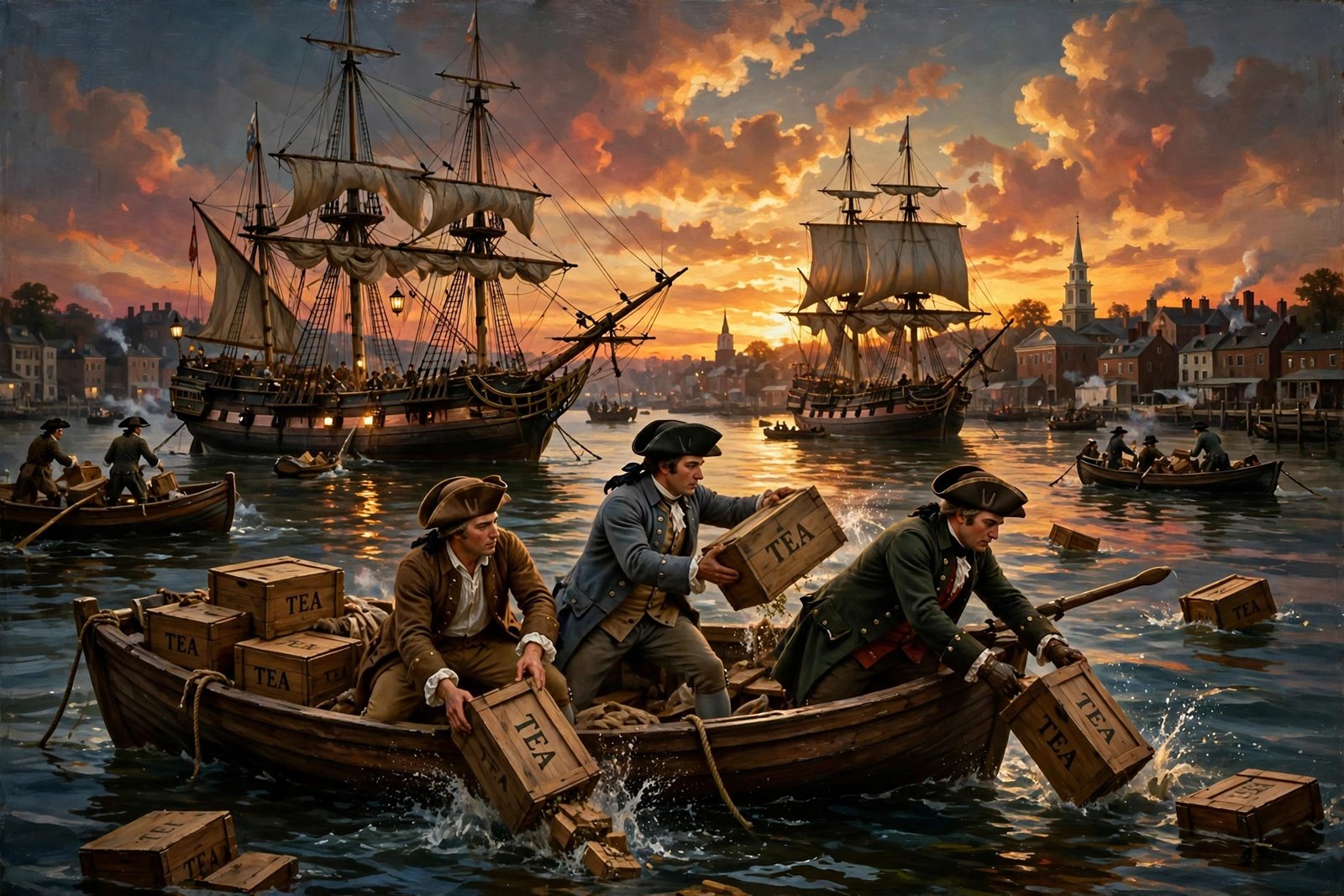
On a cold December night in 1773, a group of colonists in Boston did something that still echoes through American history. They boarded three British ships, broke open hundreds of chests of tea, and dumped the cargo into the harbor. It was a bold, illegal, and carefully planned act of protest. It was also a turning point. Within a few short years, the colonies and Britain would be at war, and the United States would be on its way to independence.
Today, the Boston Tea Party is one of the most famous events in American history. Schoolchildren learn about it, tourists visit a museum ship in Boston Harbor, and the phrase itself has become shorthand for standing up to unfair power. But the real story is richer and more interesting than the simple version most of us remember. It was not a spontaneous riot. It was not really about the price of tea. And the men who took part knew exactly how much trouble they could be in.
This is what really happened on the night of December 16, 1773, why the colonists felt they had no other choice, and how one night of destroyed tea helped set America on the road to revolution.
Boston in 1773: A City on Edge
To understand the Boston Tea Party, you first have to understand Boston in the early 1770s. The city was one of the busiest ports in British America, full of merchants, sailors, dockworkers, and shopkeepers. It was also a hotbed of political argument. For years, colonists had been arguing with Britain over taxes and who had the right to make laws for them.
The core complaint was simple, and it became one of the most famous slogans in American history: no taxation without representation. Colonists were being taxed by the British Parliament, but they had no elected representatives sitting in that Parliament. To many of them, that was not just unfair. It was a violation of their rights as British subjects.
Tensions had already boiled over more than once. British soldiers had been stationed in Boston, and confrontations between soldiers and townspeople were common. Trust between the colonial government and ordinary people was wearing thin.
Boston was also home to organized groups of activists. The best known was the Sons of Liberty, a network of colonists who opposed British taxation and organized protests and boycotts. Samuel Adams, one of the leading voices in Boston politics, was closely associated with the group.
What Was the Tea Act of 1773?
The immediate trigger for the Boston Tea Party was a British law called the Tea Act of 1773. Understanding that law is important, because the popular idea that the Tea Party was a protest against expensive tea gets the story backwards in an interesting way.
The Tea Act was designed to help the British East India Company, a powerful trading company that was struggling financially and sitting on a huge surplus of tea. The act gave the company a monopoly on tea sales in the colonies, so it could sell its tea directly in America, cutting out colonial merchants.
Here is the twist: the Tea Act actually made the company’s tea cheaper in the colonies, not more expensive. But the tax on tea remained in place. That tax was the real problem for the colonists. Accepting the cheaper tea would have meant accepting Parliament’s right to tax them without their consent. For the Sons of Liberty and many other colonists, the principle mattered more than the price.
There was also a practical worry. If the East India Company was allowed to sell directly and undercut everyone else, colonial merchants feared they would be driven out of business. A monopoly granted by Parliament today, they reasoned, could be followed by other monopolies tomorrow. The Tea Act therefore looked like a threat to both political liberty and everyday livelihoods.
Colonists in other ports took action too. In several colonial cities, ships carrying the company’s tea were turned away or the tea was left to sit untouched on the docks. Boston, however, became the place where the standoff reached its breaking point.
The Standoff in Boston Harbor
In late 1773, ships carrying East India Company tea arrived in Boston Harbor. The situation quickly became a tense waiting game. Colonial law and the governor’s orders meant the ships could not simply turn around and leave without unloading or paying the duty on the tea. The colonists, meanwhile, were determined that the tea would not be unloaded and sold.
For weeks, meetings were held and arguments were made. Crowds gathered. The Sons of Liberty helped organize mass meetings where thousands of people discussed what to do. The mood was serious. Everyone understood that whatever happened next would have consequences, and that backing down would be seen as surrender on the tax question.
The deadline mattered. If the tea stayed on board past a certain point, customs officials could seize it and sell it to pay the duty. The colonists did not want that either. As the days ticked by, the pressure built. By December 16, the moment of decision had arrived.
That evening, a large meeting was held in Boston. When word came that the governor would not allow the ships to leave without unloading, the meeting broke up and the quietly prepared plan went into action.
The Night of December 16, 1773
On the night of December 16, 1773, a group of Massachusetts colonists, members of the Sons of Liberty, boarded three British ships anchored in Boston Harbor: the Dartmouth, the Eleanor, and the Beaver. The men were disguised as Mohawk Indians, a disguise meant to hide their identities and to send a symbolic message that they were acting as Americans, not as British subjects.
What happened next was remarkably organized. The men did not loot the ships or attack the crews. According to historical accounts, the ships’ crews largely did not resist, and the boarders were disciplined about their task. They broke open the chests of tea and dumped the contents into the water. By the end of the night, they had destroyed 342 chests of tea.
That was an enormous amount of cargo. The destroyed tea was worth roughly £10,000 at the time, a huge sum in the eighteenth century. In modern terms, it represented a fortune, and everyone involved knew that destroying private property on that scale would provoke a furious response from Britain.
The work took hours, and it was done in full view of the city. Crowds watched from the shore. The men worked methodically, chest after chest, until the harbor water was dark with tea. When they were finished, they left the ships, reportedly taking care not to damage anything else on board. The message was deliberate: this was not theft and it was not a drunken rampage. It was a political protest aimed at a specific policy.
For more detail on the ships and the night itself, the Boston Tea Party Ships & Museum offers exhibits and historical background drawn from the event, and History.com provides a clear overview of the Tea Party and its place in the run-up to the Revolution.
Who Organized It, and Why the Disguise?
Samuel Adams and the Sons of Liberty organized the protest. Adams was a master organizer and writer who had been arguing against British taxation for years. The Sons of Liberty provided the network, the planning, and the people willing to take the risk.
The Mohawk disguises have often been misunderstood. The men were not pretending to be Native Americans in any literal sense, and the disguise was not a costume for fun. It served two purposes. First, it made it harder for British authorities to identify individual participants and prosecute them. Second, it carried symbolism. By dressing in a way associated with America rather than Britain, the protesters were presenting themselves as a distinct American people taking action in their own cause.
Secrecy mattered because the act was illegal. Destroying that much property could lead to arrest, imprisonment, and ruin. Many participants kept their involvement quiet for years afterward.
It is also worth noting what the protesters did not do. They did not burn the ships. They did not steal the tea for themselves. They did not harm the crews. That restraint was part of the point. The Sons of Liberty wanted the destruction to be seen as a principled stand, not as lawlessness, and they wanted ordinary colonists, including those who were unsure about such a drastic step, to see it that way too.
Britain Strikes Back: The Coercive Acts
Britain’s response was swift and severe. Parliament passed a series of laws in 1774 known as the Coercive Acts, which the colonists called the Intolerable Acts. The laws were meant to punish Boston and to show the other colonies what would happen if they defied British authority.
The most damaging measure closed Boston Harbor until the destroyed tea was paid for. For a port city that depended on trade, that was a devastating blow. Ships could not come and go freely, merchants lost business, and dockworkers lost work. Other measures tightened British control over Massachusetts government and made it easier for British officials to operate without answering to local authorities.
Parliament hoped the punishment would isolate Boston and frighten the other colonies into obedience. It had the opposite effect. Colonists elsewhere saw the closing of Boston Harbor as an attack on all of them, and aid poured into Boston from other colonies to help residents through the blockade.
From Protest to Revolution
The road from the Boston Tea Party to full-scale revolution was short. In 1774, the First Continental Congress met, bringing together delegates from across the colonies to coordinate a response to British policies. That meeting was itself a major step. Colonies that had often acted separately were now working together as a body, discussing shared grievances and shared action.
The Congress organized a boycott of British goods and sent petitions to Britain restating the colonists’ position. But the underlying dispute over taxation and representation remained unresolved, and both sides were hardening their positions. Britain continued to insist on Parliament’s authority over the colonies. The colonies continued to insist that they could not be taxed without representation.
Fighting began at Lexington and Concord in April 1775, when British troops marched out of Boston to seize colonial military supplies and met armed resistance. Those first shots marked the beginning of the American Revolutionary War. The men who dumped tea into Boston Harbor less than a year and a half earlier could hardly have known how quickly events would move, but they understood they were taking part in something larger than a dispute over one cargo.
By 1776, the colonies would declare independence. The Tea Party did not by itself cause the Revolution, but it was a decisive moment in the chain of events. It showed that colonists were willing to take dramatic, costly action over a principle, and it showed Britain that the dispute was not going to be settled by ignoring colonial complaints.
Why the Boston Tea Party Still Matters
The Boston Tea Party still matters because it captures a question that never really goes away: what do people do when they believe a law is unjust and normal channels have failed? The colonists had petitioned, boycotted, and argued for years.
It also matters because it reminds us that history is made by choices. The men who boarded those ships chose to risk punishment. Parliament chose a harsh response that united rather than divided the colonies. Delegates chose to meet together in 1774 rather than face Britain alone.
For visitors today, Boston Harbor still tells the story. The museum ships and the harbor itself give a sense of the place where it happened, and it is easy to imagine the cold night and the crowds watching from shore as chest after chest went into the water.
And for anyone studying American history, the Tea Party is a useful starting point for understanding the Revolution itself. It was not the beginning of the argument, and it was not the end. It was the moment when argument turned into action, and when both sides began to understand that compromise might no longer be possible.
What the Boston Tea Party Was Not
Because the story is so famous, a few misunderstandings have stuck to it over the years. Clearing them up makes the real event even more interesting.
First, it was not a protest against high tea prices. As noted above, the Tea Act actually made East India Company tea cheaper. The protest was about the tax and the monopoly, and about the principle that Parliament should not tax colonists who had no voice in Parliament.
Second, it was not a spontaneous riot by an angry mob. It was planned and organized by the Sons of Liberty, carried out by men who knew what they were doing, and disciplined in its execution. That planning is part of why it had such a powerful political effect.
Third, it was not universally popular at the time, even among colonists. Some thought destroying private property went too far and worried about the consequences. Others feared that such a bold act would provoke exactly the kind of crackdown that followed.
Finally, it was not the first or only act of colonial resistance. Boycotts, protests, and clashes had been happening for years. The Tea Party stands out because of its drama, its scale, and its consequences, not because it came out of nowhere.
Related Reading
- Lewis and Clark: The Journey West
- How Abraham Lincoln Created Thanksgiving
- The Gettysburg Address: Lincoln’s 272 Words
FAQ
When did the Boston Tea Party happen?
The Boston Tea Party happened on the night of December 16, 1773, in Boston Harbor, Massachusetts.
How many chests of tea were dumped into Boston Harbor?
The colonists dumped 342 chests of tea into Boston Harbor, from the three ships Dartmouth, Eleanor, and Beaver.
Why did the colonists dump the tea?
They were protesting the Tea Act of 1773, which gave the British East India Company a monopoly on tea sales in the colonies while keeping the tax on tea in place. For the colonists, accepting the tea would have meant accepting Parliament’s right to tax them without representation.
Who organized the Boston Tea Party?
Samuel Adams and the Sons of Liberty organized the protest. The men who boarded the ships were disguised as Mohawk Indians.
What happened after the Boston Tea Party?
Britain responded with the Coercive Acts in 1774, called the Intolerable Acts by the colonists, which closed Boston Harbor and tightened control over Massachusetts. The First Continental Congress met later in 1774, and fighting began at Lexington and Concord in April 1775.