
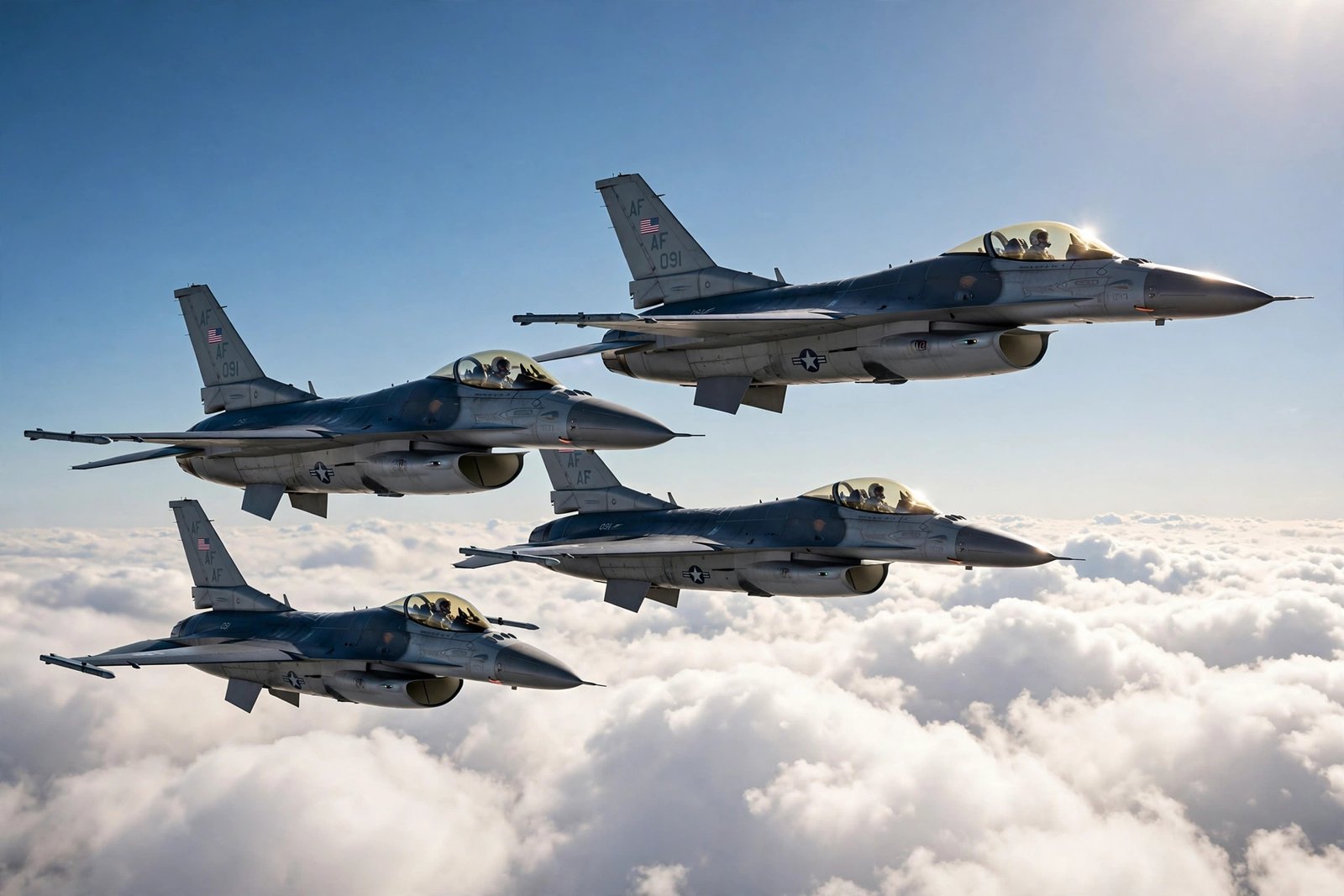
Every day, somewhere in the world, an American aircraft is in the sky, a satellite is passing overhead, or a cargo plane is touching down on a runway most people have never heard of. The force behind all of it is the United States Air Force, the youngest of America’s armed services and, by most measures, the most powerful air force on the planet. Born in the aftermath of the Second World War, shaped by the Cold War, and remade again and again by new technology, the Air Force has become the backbone of American power: the service that can reach any point on Earth, watch it from above, and, when called upon, strike it. This is the story of how it came to be, what it flies, and why air power matters so much to the United States.
Born in 1947: A Separate Service
The United States Air Force became an independent service on September 18, 1947. Its roots go back much further, to August 1, 1907, when the U.S. Army created an Aeronautical Division within the Signal Corps, but for forty years American military aviation lived inside the Army. The Second World War changed that. By 1945, the Army Air Forces had grown into a vast, globe-spanning organization, and its leaders argued that air power deserved a seat at the table equal to the Army and the Navy.
Congress agreed. The National Security Act of 1947, signed by President Harry S. Truman on July 26, 1947, created the Department of the Air Force, and on September 18, 1947, the first Secretary of the Air Force, W. Stuart Symington, was sworn into office, marking the day the Air Force officially became a separate branch. A week later, General Carl A. Spaatz became its first Chief of Staff. The new service inherited the people, the planes, and the traditions of the Army Air Forces, but it had its own mission now: to organize, train, and equip forces primarily for prompt and sustained offensive and defensive air operations. Less than a month after independence, on October 14, 1947, Captain Chuck Yeager broke the sound barrier in the X-1, a first taste of the technological ambition that would define the service.
The Five Core Missions
Today, the Air Force describes its work through five core missions: air supremacy, global integrated intelligence, surveillance and reconnaissance, rapid global mobility, global strike, and command and control. The language is formal, but the ideas are simple. Air supremacy means controlling the sky so that American and allied forces can operate below it. Intelligence, surveillance, and reconnaissance means watching, listening, and understanding what is happening on the ground and in the air. Rapid global mobility means moving troops and supplies anywhere in the world, fast. Global strike means the ability to hit a target anywhere on Earth. And command and control means tying it all together so that the right information reaches the right commander at the right moment.
These missions have not changed much since 1947, but the tools have changed beyond recognition. The service that began with propeller-driven fighters and bombers now flies stealth aircraft, operates satellites, and fights in cyberspace. The Air Force’s stated mission today is to fly, fight, and win in air, space, and cyberspace, and its promise to the nation is summed up in three words: Global Vigilance, Reach and Power. It is a mission that touches every other branch, because no American operation on land or at sea can count on success without the sky above it.
The Bombers: B-52, B-1, and B-2
No aircraft symbolizes American air power better than the B-52 Stratofortress. First flown in the 1950s, the B-52 is a long-range heavy bomber that has outlived every expectation, serving for more than seven decades and still flying today. Its longevity is a testament to the design and to the Air Force’s habit of upgrading its aircraft rather than replacing them. Alongside it flies the B-1B Lancer, a supersonic bomber built for speed and flexibility, and the B-2 Spirit, a flying-wing stealth bomber whose shape makes it hard to detect on radar. Together, the three bombers form the airborne leg of America’s long-range strike capability.
That capability is managed by Air Force Global Strike Command, a command established on October 24, 2008, to put more emphasis on the service’s nuclear assets. The command later assumed control of all Air Force bomber aircraft, and it oversees the bombers and the land-based intercontinental ballistic missiles that form two legs of the nation’s nuclear deterrent. The point of a deterrent is that it never has to be used, and the bombers are part of that logic: aircraft that can take off from bases in the United States, fly anywhere on the planet, and return, carrying a message that American reach is not limited by distance.
The Fighters: F-22 and F-35
If the bombers are the heavyweights, the fighters are the sharp edge. The F-22 Raptor is the Air Force’s premier air superiority fighter, built to dominate the sky in a fight against other aircraft. Its stealth design, its speed, and its sensors were built for a single purpose: to make sure no enemy aircraft can challenge American control of the air. The F-35A Lightning II, flown by the Air Force and allied air forces around the world, is a multirole stealth fighter designed to do many jobs at once, from striking ground targets to gathering intelligence to working in a network with other aircraft.
They do not fly alone. The fighter fleet also includes the F-15 Eagle in its several variants, the workhorse F-16 Fighting Falcon, and the A-10 Thunderbolt II, the rugged close air support aircraft built around a powerful cannon and beloved by the ground troops it protects. Each aircraft has a role, and together they give the Air Force the ability to fight for the sky, support troops on the ground, and strike targets deep in enemy territory. The mix is part of what makes the service so formidable: it is not one great aircraft, but a whole system of them, trained to work together.
Airlift and Refueling: The Invisible Superpower
For all the attention the fighters and bombers get, the Air Force’s most important capability may be the one that never fires a shot. Airlift is the business of moving forces and supplies through the air, and the Air Force’s global reach capability gives the United States the ability to deliver troops, equipment, and humanitarian aid to crisis locations anywhere in the world. The big cargo aircraft, the C-17 Globemaster III and the C-5M Super Galaxy, can carry tanks, helicopters, and field hospitals across oceans. The C-130 Hercules, a rugged transport in service for generations, can land on rough strips where nothing else can.
Aerial refueling makes it all possible. Tanker aircraft pass fuel to other planes in midair, extending their range until distance stops mattering. A fighter can cross an ocean, a bomber can stay on station for hours, a cargo plane can reach a disaster zone on the other side of the world without stopping. The Berlin Airlift of 1948 and 1949, when American and allied aircraft fed a blockaded city for more than a year, set the pattern: the Air Force has been answering humanitarian crises with cargo planes ever since, from earthquake relief to hurricane response. When Americans see pallets of food and medicine being unloaded on a distant runway, they are watching the quiet side of American power, and it is just as real as the loud side.
From the Air Force to the Space Force
For most of its history, the Air Force also owned America’s military space mission. Its satellites handled communications, navigation, missile warning, and surveillance, and its Space Command ran the constellations that the entire military depended on. In 2019, that mission became a service of its own. On December 20, 2019, President Donald Trump signed the Fiscal Year 2020 National Defense Authorization Act, which established the United States Space Force as the sixth branch of the armed forces, the first new military service since the Air Force itself was created in 1947.
The Space Force remains part of the Department of the Air Force, a structure similar to the relationship between the Marine Corps and the Department of the Navy, with both services led by the same civilian Secretary of the Air Force. The split reflected a simple reality: space had become too important, and too contested, to be one mission among many. Satellites guide the GPS in every American phone, warn of missile launches, and carry the communications that link forces around the world. The Air Force gave up its space mission, but the two services still work side by side, and the Air Force’s own history as a service born from a split, from the Army in 1947, makes the parallel hard to miss.
Why Air Power Matters to American Power
American power rests on a simple geographic fact: the United States is separated from most of the world by two oceans. Air power is what makes that distance irrelevant. A Navy carrier can project power from the sea, but an air base can project it from the sky, faster and farther. The Air Force’s ability to move, watch, and strike anywhere on Earth is what lets the United States respond to a crisis in hours rather than weeks, and it is what deters rivals from testing American resolve in the first place.
There is also the human side. The Air Force is made up of airmen, officers, and civilians, from pilots and maintainers to cyber operators and medics, and its bases are communities that anchor towns across the country. The service’s reach depends on those people as much as on its aircraft, and its history is full of their stories: the airlift crews who fed Berlin, the test pilots who broke the sound barrier, the maintainers who keep seventy-year-old bombers flying. The machines get the photographs, but the people make the power real. That is the truth behind the Air Force’s claim to be the world’s most powerful air force. It is not just the size of the fleet or the sophistication of the technology, though both are real. It is the combination of global reach, constant vigilance, and the people who keep the whole system flying, day and night, in every corner of the world.
FAQs
Q: When was the US Air Force founded?
A: The Air Force became an independent service on September 18, 1947, when the first Secretary of the Air Force, W. Stuart Symington, was sworn into office under the National Security Act of 1947.
Q: What are the Air Force’s core missions?
A: The five core missions are air supremacy, global integrated intelligence, surveillance and reconnaissance, rapid global mobility, global strike, and command and control.
Q: What bombers does the US Air Force fly?
A: The bomber fleet includes the B-52H Stratofortress, the B-1B Lancer, and the B-2A Spirit stealth bomber, all overseen by Air Force Global Strike Command.
Q: What is the difference between the F-22 and the F-35?
A: The F-22 Raptor is a dedicated air superiority fighter built to dominate other aircraft in the sky, while the F-35A Lightning II is a multirole stealth fighter designed for a wider range of missions, from ground strikes to intelligence gathering.
Q: When was the Space Force created, and how does it relate to the Air Force?
A: The United States Space Force was established on December 20, 2019, as the sixth branch of the armed forces. It is organized within the Department of the Air Force, alongside the Air Force, and both services share the same civilian Secretary of the Air Force.
Q: What is Air Force Global Strike Command?
A: Air Force Global Strike Command was established on October 24, 2008, to oversee the service’s nuclear assets. It controls all Air Force bomber aircraft and the land-based intercontinental ballistic missile force.
Related reading: US Aircraft Carriers: American Sea Power Explained, US Space Force: America’s Newest Military Branch Explained, and Hoover Dam: The Engineering Power of America.
Sources: Wikipedia: United States Air Force, U.S. Senate Resolution Commemorating the Air Force’s 70th Anniversary, Wikipedia: United States Space Force, United States Space Force Chronology 2019-2024.