
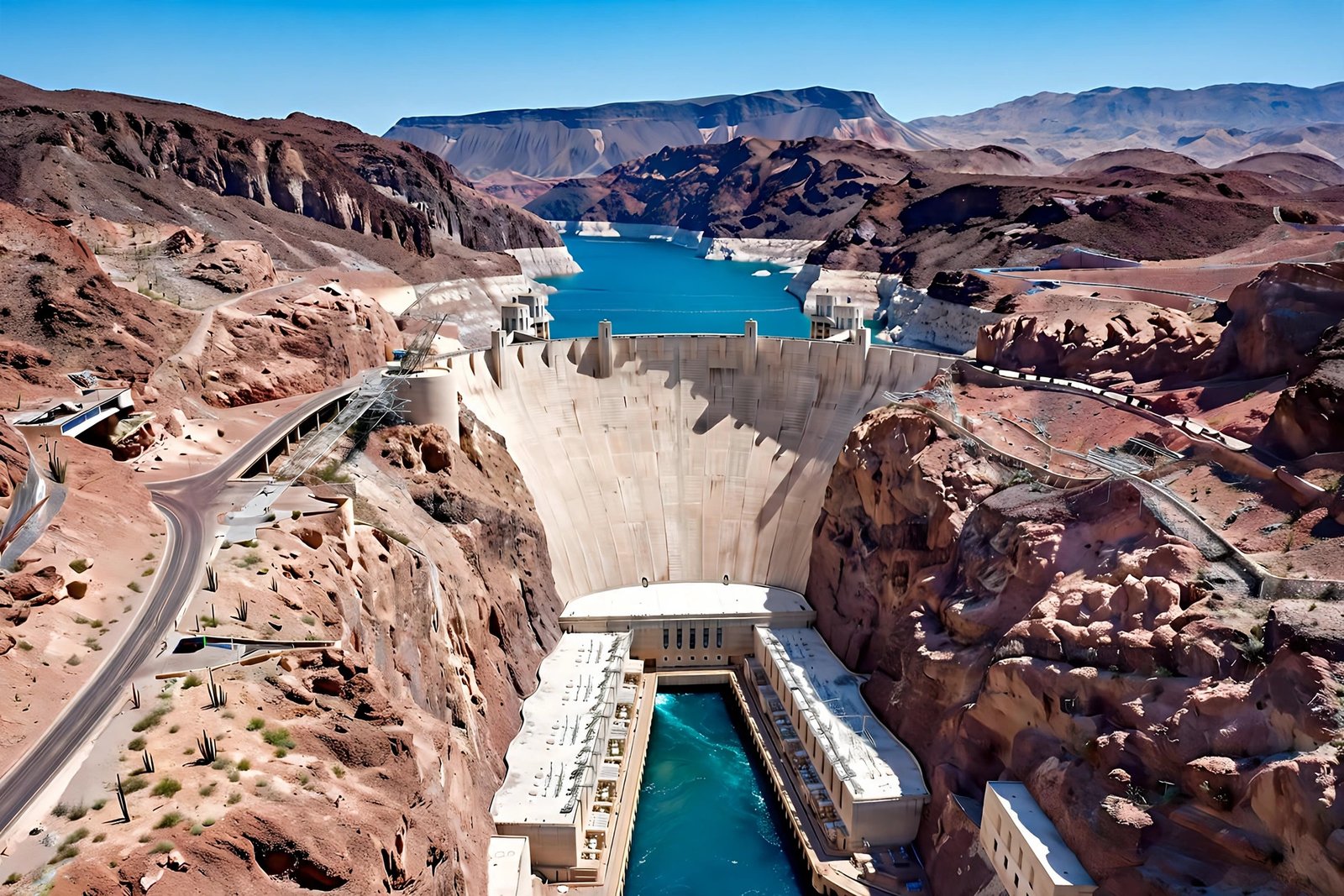
Stand on top of Hoover Dam on a clear desert morning and the scale is hard to take in all at once. Below you, the Colorado River squeezes through Black Canyon. Behind you, Lake Mead stretches toward the horizon. Beneath your feet, a curved wall of concrete 726 feet tall holds back one of the largest reservoirs in the United States and powers homes across three states. It is easy to see why, nearly ninety years after it opened, Hoover Dam remains one of America’s most visited engineering landmarks.
Built during the Great Depression, Hoover Dam was a bet on American ingenuity at a moment when the country desperately needed work, water, and hope. It tamed a wild river, made modern Las Vegas and the growth of the Southwest possible, and showed what a nation could build when it aimed high. Today, as the Colorado River faces drought and changing demands, the dam’s story is also a story about how we manage water and power in a hotter, drier West.
A Wild River That Needed Taming
Before Hoover Dam, the Colorado River was both a lifeline and a menace. In wet years, spring floods could devastate farms and towns downstream. In dry years, water was scarce when farmers needed it most. The river’s flow varied wildly from season to season, making irrigation unreliable and settlement risky.
By the early twentieth century, leaders in the Southwest wanted a dam that could do several jobs at once: control floods, store water for dry years, provide irrigation, and generate hydroelectric power. The site chosen was Black Canyon, on the Arizona-Nevada border, where steep canyon walls could anchor a massive concrete structure. The project was authorized as part of the Boulder Canyon Project, and construction became one of the signature public works of the Depression era.
The human cost and effort were immense. Thousands of workers, many desperate for jobs, came to the Nevada desert to build the dam. They worked in brutal summer heat, blasted tunnels through canyon walls, diverted the entire Colorado River around the construction site, and poured concrete on a scale never attempted before. According to the U.S. Bureau of Reclamation, 96 men were killed in industrial accidents during construction between 1931 and 1936, and none were buried in the concrete, despite a persistent myth to the contrary.
How Hoover Dam Was Built
Construction began in 1931 and the dam opened in 1936, more than two years ahead of schedule by some accounts. The first challenge was the river itself. Engineers built cofferdams and blasted four diversion tunnels through the canyon walls so the Colorado River could be routed around the dam site while work proceeded in the dry riverbed.
Next came the concrete. Hoover Dam contains about four and a half million cubic yards of concrete, enough, as the Bureau of Reclamation memorably notes, to build a two-lane road from Seattle to Miami or a four-foot-wide sidewalk around the Earth at the equator. Pouring all that concrete in one solid block would have created dangerous heat as it cured, potentially taking more than a century to cool. Engineers solved the problem by pouring the dam in interlocking blocks and running cooling pipes through them, a technique that became a model for later large dams.
The dam is a concrete gravity-arch structure, meaning it uses both its enormous weight and its curved shape to hold back water. It is 726 feet tall, 1,244 feet long at the crest, 45 feet wide at the top, and 660 feet thick at its base, as thick as two football fields laid end to end. Four intake towers rise above the reservoir and divert water into huge steel penstocks, pipes 30 feet wide that carry water down to the powerhouse at the base of the dam.
The design was not only functional but beautiful. Architect Gordon Kaufmann gave the dam and its powerhouse an Art Deco character, with streamlined towers, decorative details, and sculptures that celebrated the workers and the power of the river. The result is a structure that feels both industrial and monumental, a cathedral of concrete in the desert.
The Powerhouse: How Water Becomes Electricity
Hoover Dam’s powerhouse sits at the base of the dam, where falling water does its work. Water from Lake Mead drops about 500 feet through the penstocks to turn seventeen Francis-type hydraulic turbines, which in turn drive generators. The plant’s total installed capacity is about 2,080 megawatts, making it one of the most powerful hydroelectric plants in the United States when it was completed and still a major source of clean, renewable power today.
Each generator is enormous. The Bureau of Reclamation notes that each of the seventeen generators can supply electricity to about 100,000 households, and that at full power the plant could supply a city of 750,000 people. Each generator weighs about four million pounds, roughly as much as four and a half fully loaded Boeing 747 aircraft. Water moving through the generators at peak periods is enough to fill fifteen average swimming pools every second.
Power from Hoover Dam is shared across the Southwest. Nearly half goes to Southern California, including the Metropolitan Water District of Southern California and the city of Los Angeles, with the remainder going to Nevada and Arizona. Congress originally authorized a fifty-year power contract running from 1937 to 1987, and later legislation extended power allocations, with current arrangements running until 2067 and a share set aside for Native American tribes, electric cooperatives, and other entities. The dam is owned by the United States government and operated by the Bureau of Reclamation, which took over operation of the powerhouse in 1987.
Annual generation varies with river flows and reservoir levels. In recent years, lower water levels in Lake Mead have reduced generation compared with wetter decades, a reminder that even a giant like Hoover Dam depends on the health of the river that feeds it. In 2020, for example, annual generation was about 3.3 terawatt-hours. Engineers continue to adapt operations, including efficiency upgrades, to make the most of available water.
Lake Mead: The Reservoir Behind the Dam
Hoover Dam impounds Lake Mead, named for Elwood Mead, the Bureau of Reclamation commissioner who oversaw the project. When full, Lake Mead extends about 115 miles upstream and is one of the largest artificial lakes in the world. It stores water for farms and cities, provides recreation for millions of visitors, and serves as a buffer against drought and flood.
Lake Mead is part of the larger Colorado River system that supplies water to about forty million people across seven states and Mexico, though exact demand figures shift with agreements and usage. The reservoir’s famous white bathtub ring, exposed rock left behind as water levels have fallen, has become a visible symbol of drought in the West. Recent years have brought both alarm and cautious optimism, as wetter winters have helped levels recover somewhat from historic lows, even as long-term pressures from climate change, population growth, and overallocation remain.
Recreation is a major part of Lake Mead’s modern identity. The Lake Mead National Recreation Area, managed by the National Park Service, draws visitors for boating, fishing, swimming, hiking, and camping. Marinas, beaches, and desert trails surround the reservoir, and the dam itself remains a top attraction, with tours of the powerhouse, the visitor center, and the Mike O’Callaghan-Pat Tillman Memorial Bridge downstream, which offers a spectacular view of the dam from above.
A Depression-Era Jobs Machine
Hoover Dam was also a social project. At the height of the Great Depression, it provided thousands of jobs when unemployment was devastating families across America. Workers lived first in tent camps and then in Boulder City, a federally built town created specifically for dam workers and their families. Boulder City still exists today, a quiet desert community with a proud dam heritage and a ban on gambling that sets it apart from nearby Las Vegas.
The workforce was diverse and, by the standards of the time, remarkably organized for such a remote project. Men worked as high scalers, dangling from ropes to clear loose rock from canyon walls, as drillers, concrete pourers, electricians, and cooks. Women also played roles, though often overlooked in early histories, including in offices, schools, and support work, and at least one woman, Mabel Macferran Rockwell, was involved in the design and installation of power generating machinery.
The dam was originally called Boulder Dam during construction, then renamed Hoover Dam in 1947 in honor of President Herbert Hoover, under whom the project was authorized. It was designated a National Historic Civil Engineering Landmark, recognizing its importance to American engineering history. For many visitors, the dam’s story is inseparable from the story of American resilience during hard times.
Hoover Dam Today: Tourism, Power, and a Changing River
Today, Hoover Dam attracts millions of visitors each year. As many as 20,000 vehicles a day cross the 45-foot-wide top of the dam between Nevada and Arizona, though through traffic now largely uses the bypass bridge. Guided tours take visitors deep inside the dam to see the generators, the tunnels, and the inner workings that most people never imagine when they admire the structure from outside.
The dam’s role has evolved. Flood control and water storage remain vital, but the conversation around Hoover Dam is now dominated by the future of the Colorado River. States, tribes, farmers, cities, and Mexico are negotiating how to share a river whose flows are declining as the climate warms. Hoover Dam sits at the center of those talks, both literally and symbolically, because Lake Mead’s level is a key indicator of the river system’s health.
Engineers and water managers are also looking at new ideas, including pumped-storage hydropower concepts that would use Hoover Dam and Lake Mead as part of a giant battery for solar and wind power. Such proposals are still in study phases and face technical, environmental, and financial hurdles, but they show how a ninety-year-old structure continues to inspire new thinking about clean energy.
For travelers planning a visit, the best advice is simple. Arrive early to avoid crowds and desert heat, book powerhouse tours in advance when possible, bring water and sun protection, and take time to walk the bridge for the classic view. The visitor center offers exhibits on construction, geology, and the river system that make the dam’s story come alive for kids and adults alike.
Why Hoover Dam Still Inspires America
Hoover Dam endures because it represents more than concrete and kilowatts. It represents a moment when America decided to solve big problems with big ideas, to put people to work building something that would serve generations, and to tame a river without forgetting its power.
It also represents a lesson in humility. The engineers who built Hoover Dam could not foresee today’s drought, today’s population, or today’s climate. The dam they built must now be managed differently than they imagined, with conservation, cooperation, and adaptation at the forefront. That is not a failure of their vision. It is the natural next chapter for any great infrastructure: built for one era, adapted for the next.
Whether you come for the engineering, the history, the views, or simply the thrill of standing on a wall that holds back a river, Hoover Dam rewards the visit. It is a reminder that the American West was not just settled, it was engineered, and that the choices made in Black Canyon in the 1930s still shape life in Las Vegas, Los Angeles, Phoenix, and farms across the Southwest today.
For official facts and visitor information, see the U.S. Bureau of Reclamation Hoover Dam facts page and the Britannica overview of Hoover Dam, plus background on the Boulder Canyon Project.
Related reading
- Interstate Highway System: Surprising Facts
- GPS, Internet, Moon Landing: American Inventions
- Artemis II Moon Data: NASA Next Steps
Frequently Asked Questions
When was Hoover Dam built?
Construction began in 1931 and Hoover Dam opened in 1936. It was built during the Great Depression as part of the Boulder Canyon Project on the Colorado River.
How tall is Hoover Dam?
Hoover Dam is 726 feet tall and 1,244 feet long at the crest. It is 45 feet wide at the top and 660 feet thick at its base, making it one of the tallest concrete arch-gravity dams in the United States.
How much electricity does Hoover Dam generate?
Hoover Dam’s powerhouse has an installed capacity of about 2,080 megawatts from seventeen turbines. Actual annual generation varies with water levels and river flows, and was about 3.3 terawatt-hours in 2020.
Where is Hoover Dam located?
Hoover Dam sits in Black Canyon on the Colorado River, on the border between Arizona and Nevada, about 30 miles southeast of Las Vegas. It impounds Lake Mead, which stretches about 115 miles upstream.
Can you visit Hoover Dam?
Yes, Hoover Dam is open to visitors year-round, with a visitor center, exhibits, and guided powerhouse tours. The Mike O’Callaghan-Pat Tillman Memorial Bridge nearby offers one of the best panoramic views of the dam.