
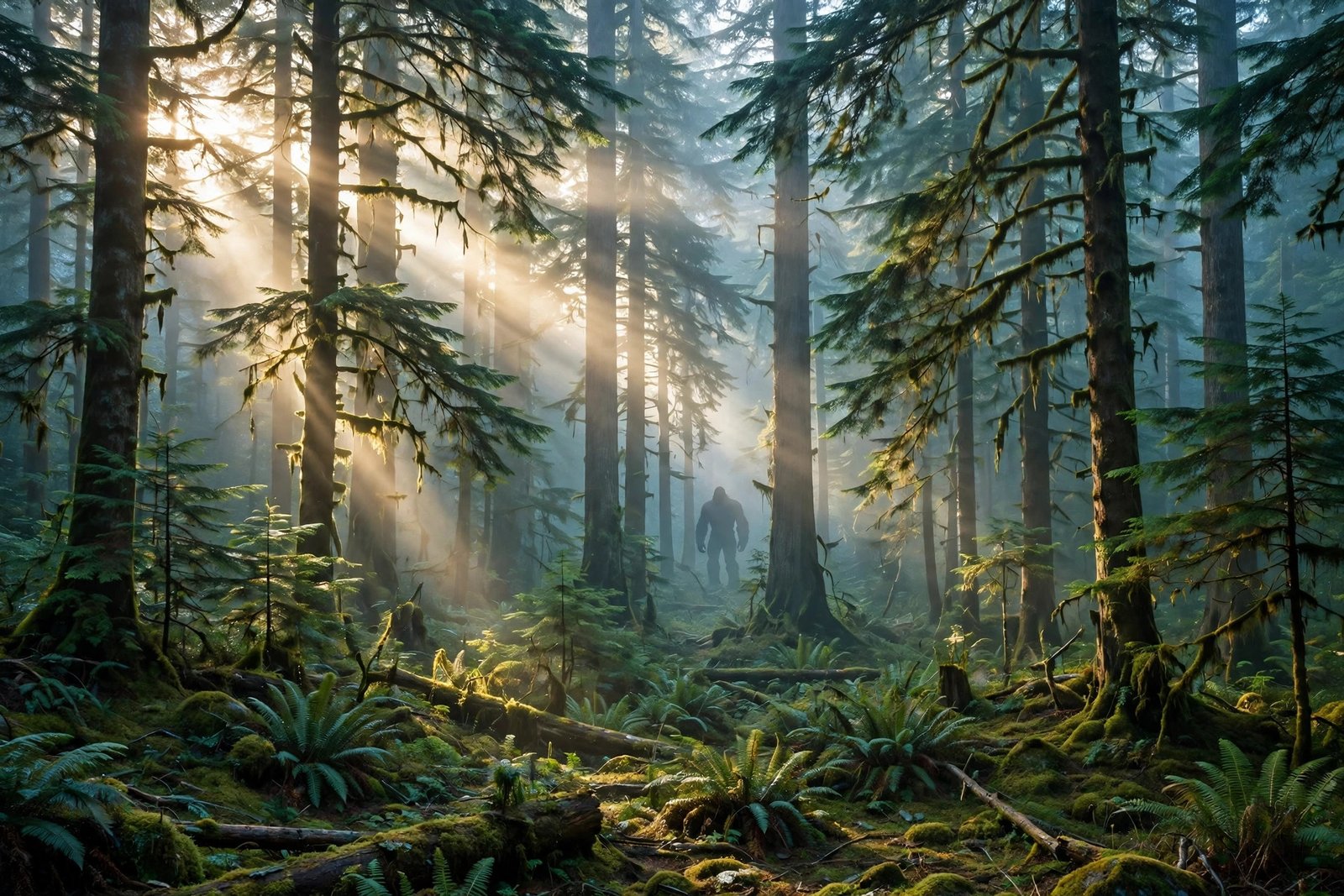
Somewhere in the tall pines of the Pacific Northwest, a tall, hair-covered figure is said to step out of the trees, pause, and then vanish back into the forest before anyone can get a clear look. That image, repeated in campfire stories, blurry photographs, television shows, and small-town festivals, is Bigfoot, and it has held America’s imagination for well over half a century. No verified body, skeleton, or DNA sample has ever established that such a creature exists, and mainstream scientists regard Bigfoot as a combination of folklore, misidentification, and hoax. Yet the legend refuses to fade. It survives because it is more than a monster story: it is a story about wilderness, about what might still be hiding just beyond the trail, and about ordinary people hoping to be the ones who finally solve it.
Where the Name Bigfoot Came From
The modern Bigfoot story did not begin with a sighting in the deep woods. It began with footprints on a logging road. In 1958, bulldozer operator Jerry Crew was working on a road-building project in the Six Rivers National Forest in Humboldt County, California, near Bluff Creek, when he found a set of unusually large, human-like footprints sunk into the soft dirt. Crew and his coworkers talked about other strange happenings around the work site, and the crew began referring to the supposed track-maker as Big Foot. Crew made a plaster cast of one of the prints and took it to the local newspaper, the Humboldt Times.
Columnist Andrew Genzoli wrote about the tracks, and Crew appeared holding one of the casts on the front page of the newspaper on October 6, 1958. The story was picked up by wire services and larger newspapers, and the one-word name Bigfoot quickly entered everyday language. It is worth pausing on what happened next, because it shapes everything that follows. Years later, after the death of Ray Wallace, a logging company man who had worked in the area, his family said Wallace had made some of the Bluff Creek tracks as a prank, using carved wooden feet. That account strongly suggests that at least part of the 1958 excitement was a hoax, although it does not, by itself, explain every track or sighting reported elsewhere. The name, however, had already escaped its origins. As Smithsonian Magazine explains in its history of the legend, the Bluff Creek publicity helped turn regional folklore into a modern media phenomenon.
The other common name, Sasquatch, has a different history. It comes from words used by Indigenous peoples of the Pacific Northwest, adapted into English in the early twentieth century, and it is often used interchangeably with Bigfoot today. That shared vocabulary can be misleading, though. Indigenous traditions across North America include many distinct stories of large, hairy, or wild beings, and those stories are not all the same tale, nor are they simply early sighting reports of a single animal. Respecting that distinction matters: Bigfoot as a pop-culture figure is a modern creation built from older traditions, newspaper stories, hoaxes, and genuine wilderness encounters that were never fully explained.
The Patterson-Gimlin Film of 1967
If 1958 gave Bigfoot its name, 1967 gave it a face. On October 20, 1967, Roger Patterson and Bob Gimlin, two men on horseback in the Bluff Creek area of northern California, reported encountering a large, hair-covered figure walking along a creek bed. Patterson filmed the encounter with a handheld 16mm camera. The resulting footage, known as the Patterson-Gimlin film, runs for less than a minute. Its most famous moment comes when the figure turns its upper body and looks back toward the camera before walking toward the tree line.
The film became, and remains, the most famous piece of Bigfoot evidence ever produced. Supporters have argued for decades that the figure’s proportions, build, and walking style would have been very difficult to fake with a costume in 1967. Skeptics have argued, just as firmly, that the footage shows a person in a suit. Patterson maintained until his death that the creature on the film was real, while Gimlin has consistently denied taking part in any hoax. The original film itself is missing, which means modern researchers cannot subject it to the kind of direct forensic testing that might settle the argument. The Bigfoot Field Researchers Organization’s account of the Patterson-Gimlin footage describes the Bluff Creek setting and the plaster casts the men made after the encounter, and it remains a useful starting point for readers who want the reported details without the embellishment.
Why does a shaky, minute-long film still matter? A moving image, however grainy, felt more persuasive than a footprint or a secondhand story, and the film has never been conclusively debunked to everyone’s satisfaction. Every new analysis keeps it in circulation, introducing Bigfoot to each new generation. The film proved nothing, but it made Bigfoot impossible to ignore.
Famous Reported Sightings Beyond Bluff Creek
Bigfoot reports are not confined to northern California. Enthusiast databases list reported sightings from nearly every American state except Hawaii, along with reports from Canada, and the details vary widely. Some witnesses describe a tall figure crossing a road at night. Others report strange knocks, howls, or a strong, unpleasant smell in the woods. Still others describe footprints, broken branches, or structures of stacked logs that they interpret as shelters. The reports share a pattern, though: they are usually brief, they happen in poor light or at a distance, and they leave behind little that can be independently tested.
That pattern is important, because it points to the most likely explanations for many reports. A black bear standing upright, seen briefly through trees, can look surprisingly human in shape. A person in dark clothing, a distant animal, or even a trick of shadow and expectation can fill in the rest. Memory is also less reliable than it feels, especially in a startling moment. A witness who has heard Bigfoot stories may, quite honestly, interpret an unclear shape as the creature they already know about. None of this means that every witness is lying or foolish. It means that human perception in the woods is fallible, and that folklore gives the brain a ready-made shape to reach for when something unfamiliar appears.
There have also been outright hoaxes, and they have done real damage to serious investigation. Faked footprints, staged photographs, and invented encounters have repeatedly wasted researchers’ time and made it harder for the public to take any new claim seriously. The Wallace story from Bluff Creek is the best known example, but it is far from the only one. For readers, the lesson is simple: a single photograph, footprint, or story, however striking, is not evidence of a new species. Scientists look for patterns that can be repeated, tested, and confirmed by independent observers, and Bigfoot reports, so far, have not produced that kind of evidence.
What Scientists Actually Say
The scientific consensus is clear, even if it is unsatisfying to believers. There is no verified physical specimen of Bigfoot, no confirmed DNA, and no fossil record of a large, upright ape living in North America in recent times. Hair samples attributed to Bigfoot that have been tested have turned out to belong to known animals. Footprint casts have often been explained as misidentified bear tracks, distorted by melting snow or soft mud, or as outright fakes. And the absence of a body is a serious problem for the theory: a breeding population of large mammals would leave remains, droppings, and other traces that would eventually be found, especially in forests that are now crossed by roads, trails, and trail cameras.
That does not mean scientists have ignored the subject entirely. Anthropologist Grover Krantz, a professor at Washington State University, spent decades arguing that Bigfoot deserved serious study, and he paid a professional price for it. Smithsonian Magazine’s profile of Krantz describes a serious scholar of human evolution whose Bigfoot work made him a figure of jokes among colleagues, even as enthusiasts remember him as a pioneer. Krantz never claimed to have seen Bigfoot himself; he studied reports and footprint casts and tried to build a case from anatomy and evolution. His story is a reminder that the line between open-mindedness and credulity is thin, and that wanting something to be true is not the same as proving it.
Skeptics also ask a pointed question that has only grown sharper with time. As Smithsonian Magazine notes, cameras are now everywhere, from phones to trail cameras to drones, yet the quality of Bigfoot evidence has not improved. If a large animal were roaming American forests, the argument goes, someone would have captured a clear, unambiguous image by now. Believers respond that wild animals avoid people, that forests are vast, and that absence of evidence is not evidence of absence. That is true as far as it goes, but it is not a positive case. Science does not accept a creature into the record on the basis that it might, someday, be found. It waits for evidence that holds up.
Why the Legend Persists
If the evidence is so weak, why is Bigfoot still everywhere? The first answer is cultural. Bigfoot is a uniquely American myth for a country that once imagined its frontier as endless. As forests have shrunk and wilderness has become something most people visit rather than live in, Bigfoot has become a symbol of the wild itself: a creature that lives beyond the road, beyond the cell signal, beyond certainty. Believing in Bigfoot, even half-seriously, is a way of saying that the world is not yet fully mapped, and that mystery still has a place in it.
The second answer is personal. Bigfoot offers ordinary people a shot at a world-changing discovery without a laboratory, a degree, or funding. Anyone with a camera and a weekend can go looking, and that democratic quality is part of the appeal. Television shows, podcasts, books, and online communities have turned that search into a shared hobby, where a new report, however thin, becomes a conversation starter. The community matters as much as the creature. People stay for the friendships, the hikes, the storytelling, and the feeling of being part of an investigation that never quite closes.
The third answer is commercial, and it is not a criticism. Bigfoot sells. Towns near reported sighting areas have built museums, gift shops, and festivals around the legend. Movies, from horror to family comedy, have used Bigfoot as a ready-made star. The creature’s image, tall, shaggy, and instantly recognizable, works on a T-shirt, a coffee mug, or a roadside statue in a way that few other cryptids can match. That commercial life keeps the legend visible even for people who have never set foot in a forest, and it gives small towns a story to rally around.
Bigfoot Culture and Festivals Today
Nowhere is Bigfoot’s cultural life more visible than in the small towns that celebrate it. Willow Creek, California, calls itself the Bigfoot Capital of the World, and its annual Bigfoot Daze festival draws visitors for a parade, an ice cream social, and a visit to the town’s China Flat Museum and its Bigfoot collection. A guide to the annual Bigfoot Daze festival in Willow Creek describes a one-day, community-run event where enthusiasts swap sighting stories and newcomers learn the local lore. Similar gatherings take place in other states, from the Pacific Northwest to the Appalachians, each with its own flavor: some lean into serious research talks, others into family fun, costumes, and local food.
For travelers, these festivals are worth visiting even if you are skeptical. They celebrate local history, storytelling, and small-town pride, and they show how folklore stays alive today. Go curious rather than credulous: enjoy the parade, visit the museum, and talk to locals. If you hike afterward, follow ordinary trail safety, carry water, tell someone your plans, and respect wildlife, including the bears behind many reported sightings.
How to Think About Bigfoot
So where does that leave us? Bigfoot is best understood as folklore with a long, tangled history, not as a proven animal waiting for its official discovery. The 1958 footprints gave it a name, the 1967 film gave it an image, and decades of stories, hoaxes, misidentifications, and genuine mysteries have kept it alive. Scientists are right to demand better evidence, and enthusiasts are right to enjoy the search, as long as the search is honest about what it has and has not found. The legend persists not because the evidence is strong, but because the story speaks to something deeper: a longing for wilderness, for wonder, and for the possibility that the world still has secrets.
That may be Bigfoot’s real legacy. Long after the footprints have washed away, the creature will still walk through American culture, tall and shaggy and just out of focus. If you ever see something large and hairy moving through the trees, note exactly where and when, and report it to a local wildlife agency. You probably saw a bear, but you will have a great story either way.
Frequently Asked Questions
Is Bigfoot real? There is no verified scientific evidence that Bigfoot exists. No body, skeleton, or confirmed DNA sample has ever been produced, and scientists regard the creature as folklore, misidentification, and hoax rather than a real living animal. Sightings remain reported folklore, not proven fact.
Where did the name Bigfoot come from? The name comes from 1958, when logging worker Jerry Crew found large footprints near Bluff Creek, California, and the Humboldt Times published his story. Columnist Andrew Genzoli popularized the name Bigfoot, and wire-service coverage spread it across the country.
What is the Patterson-Gimlin film? It is a short 16mm film shot on October 20, 1967, by Roger Patterson and Bob Gimlin at Bluff Creek, California, showing a figure they said was Bigfoot walking away from the camera. It runs for less than a minute and remains the most famous, and most disputed, piece of Bigfoot evidence.
Why do people still believe in Bigfoot? People are drawn to the mystery, the wilderness symbolism, and the community around the search. Many reports can be explained by misidentified wildlife, hoaxes, poor visibility, and the power of expectation, but the legend offers a sense of wonder that facts alone do not replace.
Can I visit Bigfoot country? Yes. Towns like Willow Creek, California, host festivals and museums celebrating the legend, and the surrounding forests offer excellent hiking. Go for the scenery and the stories, follow trail safety, and respect local wildlife and private land.
Related Reading
Keep exploring America’s strangest stories: Mothman of Point Pleasant, The Bell Witch of Tennessee, and The Marfa Lights of Texas.