
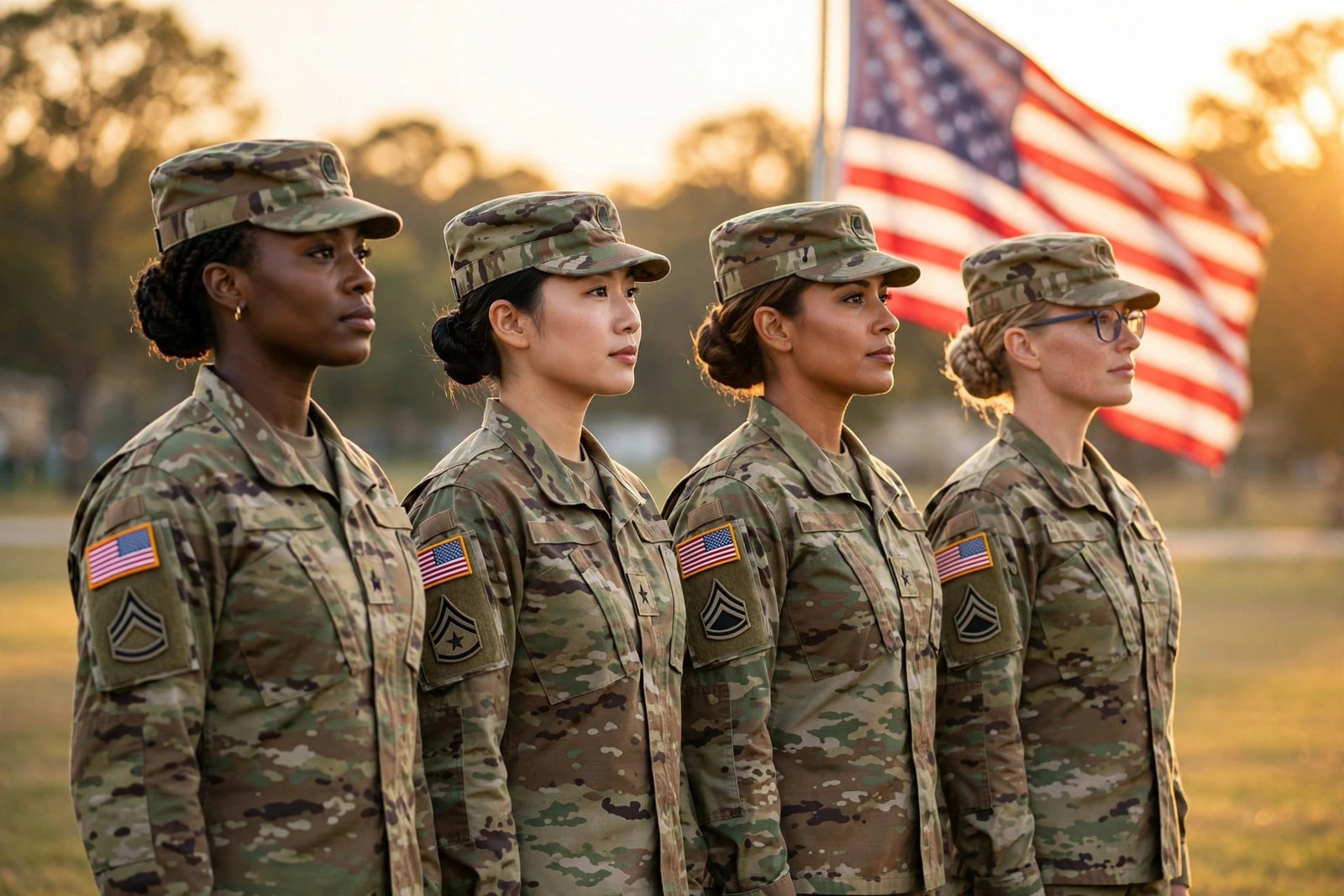
For most of American history, women served in the United States Army long before the Army officially allowed them to enlist. They cooked, nursed, carried water to cannon crews, sewed uniforms, smuggled messages, and in some cases picked up muskets and fought. Their names were not always recorded, their service was not always recognized, and their pay, when it existed at all, was far below that of the men beside them. Yet without them, the Army as we know it today would not exist.
The story of women in the U.S. Army is not a single breakthrough moment. It is a long chain of pioneers, each pushing the door open a little further for the next generation. From a woman who disguised herself to fight in the Revolutionary War to the first women to earn the Ranger tab in 2015, each step was contested, each step was hard-won, and each step changed what America expected its military to be.
Women Who Served Before Women Could Serve
During the Revolutionary War, the Continental Army had no place for women soldiers, but women were there anyway. Hundreds followed their husbands, fathers, and brothers to camp as so-called camp followers. They washed clothes, cooked meals, nursed the sick, and mended uniforms. Some, under fire, carried water to artillery crews, a job that put them directly in the path of enemy cannon fire.
The most famous of these women is Molly Pitcher, whose story has become part of American folklore. According to tradition, Mary Ludwig Hays carried water to soldiers during the Battle of Monmouth in 1778 and, when her husband collapsed at his cannon, took his place on the gun crew. Historians note that the Molly Pitcher story blends the experiences of several real women and may be partly legend rather than a precise account of one person. What is not in doubt is that real women did perform exactly this kind of work under fire, and that the legend endures because it captures something true about their courage.
Deborah Sampson went further than almost anyone. In 1782, she disguised herself as a man under the name Robert Shurtliff and enlisted in the Continental Army. She served for more than a year, fought in skirmishes, and was wounded before her identity was discovered while she was being treated for illness. After the war, she petitioned Congress for a pension, and after a long struggle she received one, a remarkable recognition for a woman of her era. Sampson’s story is well documented, and she remains one of the earliest known examples of a woman serving in combat disguised as a man.
These early pioneers matter because they established a fact the Army would spend two centuries catching up to: women were already on the battlefield, already taking risks, and already contributing to American military success, whether or not the rules acknowledged them.
The Army Nurse Corps and the Birth of Official Service
The first permanent, official place for women in the Army came through medicine. The Army Nurse Corps was established in 1901, giving women a formal, recognized role in military service for the first time. Army nurses served in the Spanish-American War era and then in far greater numbers during World War I, when thousands of nurses deployed to field hospitals in France.
These nurses worked in conditions that are hard to imagine today. Field hospitals near the front lines treated appalling wounds with limited supplies, and nurses worked long shifts through bombing raids and disease outbreaks, including the influenza pandemic of 1918. Their service proved something important: women could serve under the discipline and danger of military life and perform essential work that the Army could not do without.
Yet the Nurse Corps was still a limited opening. Nurses were officers in practice but their rank and status were ambiguous for years, and the door it opened was a narrow one, restricted to a single profession. The broader fight for women to serve in the Army in many roles was still decades away.
Readers interested in the official history of Army nursing can explore resources from the U.S. Army Center of Military History, which documents the Nurse Corps and its campaigns in detail.
World War II and the WAAC and WAC
World War II changed everything. With millions of men needed for combat, the Army faced a severe shortage of personnel for the vast support effort behind the fighting. The answer was the Women’s Army Auxiliary Corps, created in 1942, which became the Women’s Army Corps, or WAC, in 1943, when its members gained full military status.
WACs served in hundreds of jobs: clerks, radio operators, mechanics, photographers, drivers, code clerks, and supply specialists. They served not only in the United States but overseas, in North Africa, Europe, and the Pacific, often close to danger. More than a hundred thousand women served in the WAC during the war, freeing men for combat roles and keeping the Army’s enormous logistical machine running.
The WAC experience also revealed the prejudice women soldiers faced. They were mocked in the press, subjected to rumors about their character, and held to strict standards of appearance and conduct that male soldiers never faced. Despite that, WACs performed with distinction, and their service made it politically and practically impossible to return to an Army with no women at all.
The war also saw women serving in other branches and in civilian roles vital to the military, from factory work to flying military aircraft as WASPs. But within the Army itself, the WAC was the breakthrough that turned women’s service from an exception into an institution.
The 1948 Integration Act and the Long Road After
In 1948, Congress passed the Women’s Armed Services Integration Act, which for the first time made women a permanent part of the regular armed forces, including the Army. It was a landmark, but it came with heavy restrictions. Women were capped at a small percentage of total strength, they could not hold permanent high rank, they were barred from combat roles, and they could be discharged for becoming pregnant or for marrying in some circumstances.
For the next several decades, women in the Army served under these limits while steadily expanding what they actually did. The Vietnam War era brought thousands of Army nurses to Southeast Asia, where they treated casualties in combat hospitals under fire. The all-volunteer force era of the 1970s opened many more military occupational specialties to women, and the WAC itself was disbanded in 1978 as women were integrated into the regular Army rather than kept in a separate corps.
By the 1990s and the Gulf War, women were serving in large numbers in support roles that put them close to combat, even though formal combat roles remained closed. The contradiction became impossible to ignore: women were already exposed to combat conditions, already under fire, and already earning combat decorations, while the rules still insisted they were not in combat.
This long middle period of Army women’s history is sometimes overlooked, but it is where the groundwork for full integration was laid, one assignment, one promotion, and one policy change at a time.
Combat Roles Open: 2013, 2015, and the First Women Rangers
The decisive change came in the 2010s. In 2013, the Department of Defense lifted the ban on women in combat roles, directing the services to open positions unless a specific exception could be justified. In 2015, after extensive study, the Pentagon announced that all combat roles would be open to women who met the same standards as men.
That same year, two women made history in one of the Army’s most demanding schools. First Lieutenant Kristen Griest and First Lieutenant Shaye Haver became the first women to graduate from the U.S. Army Ranger School and earn the Ranger tab. Ranger School is a grueling leadership course known for sleep deprivation, hunger, and punishing physical demands, and it had never before had a woman graduate. Their success, on the same standards as their male classmates, was a powerful answer to doubts about whether women could meet the Army’s toughest tests.
In the years since, women have entered infantry, armor, artillery, and special operations roles in the Army. The change has not been without debate, but the principle is now settled: in the U.S. Army, any role is open to any soldier who meets its standards. The U.S. Army today describes itself as a force built on talent, and women are part of that force at every level, from new recruits to general officers.
What Their Service Changed
The pioneers of women in the Army changed more than military policy. They changed how America thinks about citizenship and duty. Each generation of women soldiers proved that service to the country was not defined by gender, and each generation forced the institutions around them to live up to that truth.
They also changed the Army itself. An Army that draws on the full talent of the American people is stronger, more capable, and more representative of the nation it defends. The nurses, clerks, mechanics, drivers, officers, and Rangers who opened these doors did not only serve their country. They made the country fairer, and they made its Army better.
Today, women serve in the Army in every career field, command units, and shape the future of the force. Their story is still being written, by every woman who enlists, every officer who leads, and every pioneer who refuses to accept that some door is closed for good.
Frequently Asked Questions
Who was the first woman to serve in the U.S. Army? There is no single answer, because women served unofficially from the Revolutionary War onward. Deborah Sampson, who enlisted disguised as a man in 1782, is among the earliest documented cases. The first official, permanent place for women came with the Army Nurse Corps in 1901.
Was Molly Pitcher a real person? The Molly Pitcher story is based on real women who carried water to artillery crews, and Mary Ludwig Hays is the most commonly named figure. Historians treat the familiar version of the story as partly legend, blending several women’s experiences into one heroic tale.
When were women allowed into combat roles in the Army? The combat exclusion policy was lifted in 2013, and in 2015 the Pentagon announced that all combat roles would be open to women meeting the same standards as men.
Who were the first women Army Rangers? First Lieutenants Kristen Griest and Shaye Haver became the first women to graduate from Army Ranger School and earn the Ranger tab in 2015.
What was the Women’s Army Corps? The Women’s Army Corps, or WAC, was the women’s branch of the Army during World War II and the postwar years, created in 1943 from the earlier Women’s Army Auxiliary Corps. It was disbanded in 1978 when women were fully integrated into the regular Army.