
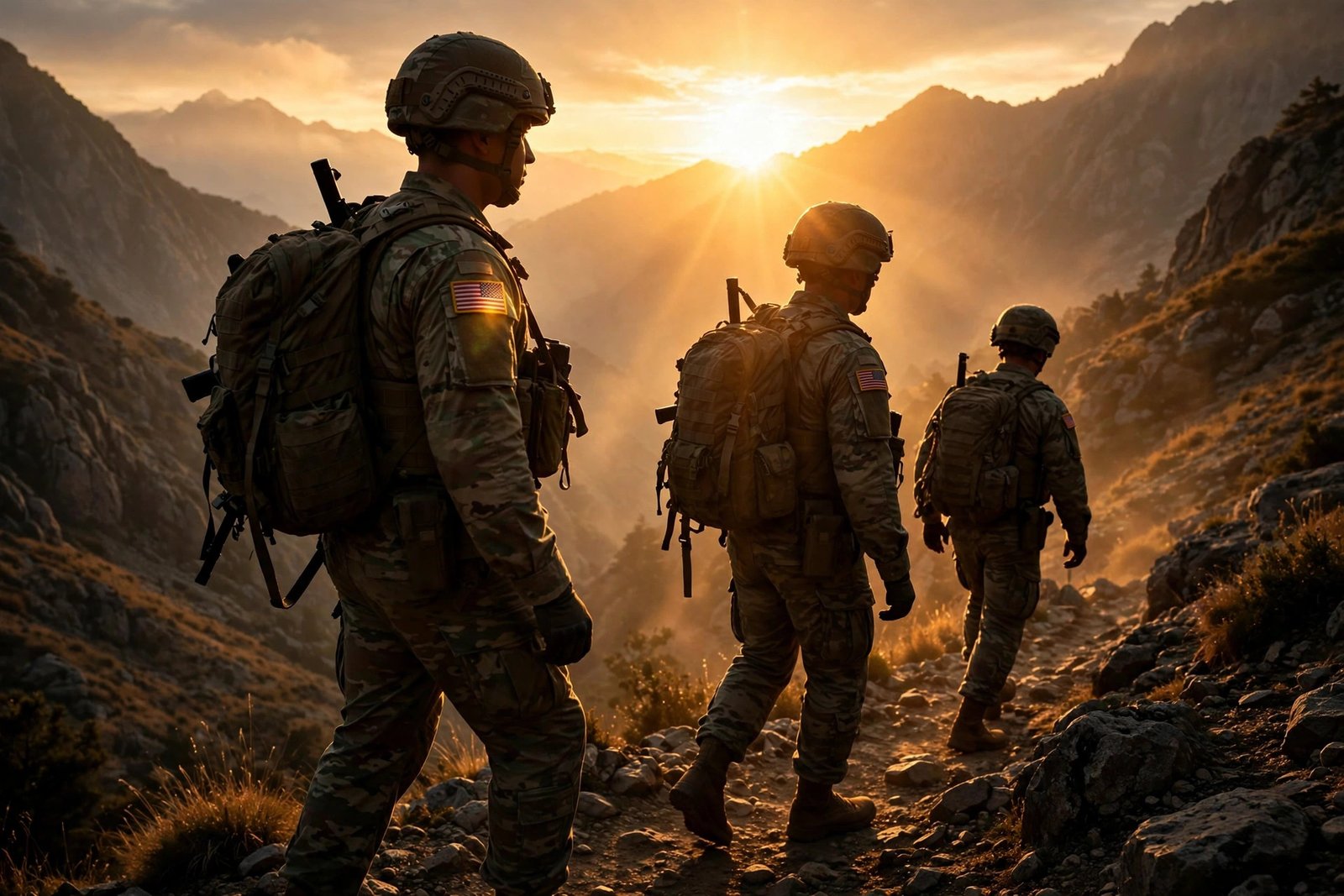
“Rangers lead the way.” The motto is famous, and it was earned on a beach in Normandy. On June 6, 1944, as American troops landed at Omaha Beach, the Rangers of the 2nd and 5th Battalions scaled cliffs, cleared enemy positions, and pushed inland under heavy fire. The phrase, shouted as a rallying cry that morning, became the motto of a force whose history stretches from colonial frontier fighters to today’s 75th Ranger Regiment, one of the most respected special operations units in the U.S. Army.
The U.S. Army’s own history traces Ranger lineage back before the Revolutionary War, to frontier fighters in the 1700s who knew the land, moved fast, and fought in small, skilled bands. That spirit, adapted to each new war, is the thread that runs through the Rangers’ story: elite volunteers, tough training, and missions that demand more than ordinary infantry work. From the cliffs of Pointe du Hoc to the mountains of Afghanistan, Rangers have been called when a mission is difficult, dangerous, and essential.
This article follows that history, from the colonial Rangers through World War II, Korea, Vietnam, and the modern regiment, drawing on the Army’s official history and the stories of the soldiers who lived it.
The First Rangers: Frontier Fighters
American Ranger history predates the nation itself. In the mid-1700s, Captain Benjamin Church and Major Robert Rogers both formed Ranger units to fight during King Philip’s War and the French and Indian War. Rogers, whose Rangers operated in the forests of the Northeast, wrote 19 standing orders that are still studied today, covering discipline, movement, and readiness in hostile territory. His orders, written for small units operating far from support, read like an early manual for special operations.
During the Revolutionary War, the Continental Congress formed eight companies of expert riflemen in 1775, and by 1777 a force of frontiersmen commanded by Daniel Morgan was known as the Corps of Rangers. Francis Marion, the “Swamp Fox” of South Carolina, waged a guerrilla campaign that harassed British forces and became part of American legend. During the War of 1812, companies of U.S. Rangers patrolled the frontier from Ohio to western Illinois, on horseback and by boat.
The 19th century added famous names to the Ranger story, including Daniel Boone and Abraham Lincoln, both of whom served in Ranger or militia units in their younger years, and Confederate Ranger John Singleton Mosby, whose cavalry raids during the Civil War became famous. After the Civil War, however, more than half a century passed without formal Ranger units in America. The Ranger idea survived in memory and in training, but it would take another world war to bring it back.
World War II: Darby’s Rangers and D-Day
When the United States entered World War II, the Army had no units capable of the kind of commando missions the British had pioneered. That changed in 1942, when Major William O. Darby organized and activated the 1st Ranger Battalion at Carrickfergus, Northern Ireland, on June 19, 1942, using British Commando standards. Darby’s volunteers trained hard, fought in North Africa, and earned a reputation for toughness that made the Ranger name famous again.
The 3rd and 4th Ranger Battalions were activated and trained by Darby in Africa near the end of the Tunisian Campaign, and together with the 1st they formed the Ranger Force, wearing the scroll shoulder sleeve insignia that today’s Ranger battalions still wear. The 2nd and 5th Ranger Battalions entered the war on June 6, 1944, at Normandy, where the 2nd Battalion scaled the cliffs at Pointe du Hoc to silence German guns, and both battalions fought through Omaha Beach. It was there, according to Army history, that the motto “Rangers lead the way” was born.
In the Pacific, the 6th Ranger Battalion played a prominent role in the recapture of the Philippines, including the famous raid at Cabanatuan in January 1945 that freed more than 500 prisoners of war. In the China-Burma-India Theater, the 5307th Composite Unit, known as Merrill’s Marauders, marched and fought through brutal jungle conditions. By the end of the war, the Army had fielded seven Ranger battalions, and their service earned multiple unit citations before they were disbanded in 1945.
Korea, Vietnam, and the Long Road Back
Korea again showed the need for Rangers. Fifteen Ranger companies were formed during the Korean War, and the 1st Ranger Company, numbering 112 men, entered combat in December 1950 attached to the 2nd Infantry Division, destroying a North Korean divisional headquarters behind enemy lines. Despite that service, the companies were inactivated in 1951, and the Ranger Training Command was disbanded. The Army kept Ranger training alive through Ranger School, but there was no permanent Ranger unit.
Vietnam again called for Ranger companies, organized as long-range reconnaissance patrol units that operated deep in enemy territory. The 75th Infantry was reorganized on January 1, 1969, as a parent regiment under the Combat Arms Regimental System, preserving the lineage that would become the modern regiment. It was not until January 1974, when Army Chief of Staff General Creighton Abrams directed the formation of a permanent Ranger battalion, that the modern era truly began. The 1st Battalion, 75th Infantry, was activated and parachuted into Fort Stewart, Georgia, on July 1, 1974, followed by the 2nd Battalion later that year.
The 3rd Battalion and the regimental headquarters received their colors at Fort Benning, Georgia, on October 3, 1984, and the 75th Ranger Regiment was formally designated in February 1986. The modern battalions were first called upon in 1980, when elements of the 1st Battalion took part in the Iranian hostage rescue attempt. Since then, Rangers have deployed in Grenada, Panama, Iraq, Afghanistan, and other operations around the world, often as the first force on the ground.
What Makes a Ranger?
Becoming a Ranger starts with volunteering and surviving one of the toughest selection processes in the military. The Ranger Assessment and Selection Program, an eight-week course, tests physical fitness, marksmanship, small-unit tactics, medical skills, and mobility, the Big Five philosophy that the regiment emphasizes. Those who pass earn a place in the regiment and the right to wear the tan beret and the Ranger scroll.
Ranger School is a separate achievement, and the distinction matters. Ranger School, a 61-day course divided into the Darby, Mountain, and Swamp phases, awards the Ranger tab to graduates, including soldiers from across the Army and other services. Serving in the 75th Ranger Regiment is different: it means assignment to the regiment itself, with its own selection, training, and operational tempo. Many Rangers hold both the tab and the scroll, but the two are not the same.
The Ranger Creed, written by Command Sergeant Major Neal R. Gentry in 1974, captures the ethos: never shall a Ranger fail a comrade, never embarrass the regiment, and readily display the intestinal fortitude required to fight on to the objective and complete the mission, though a Ranger be the lone survivor. It is recited at formations and remembered on deployments, and it explains why the regiment’s standards remain so high.
The Best Ranger Competition and the Ranger Legacy
Each year, the Lieutenant General David E. Grange Jr. Best Ranger Competition at Fort Benning tests two-person teams from across the armed forces in a grueling multi-day event covering physical challenges, marksmanship, land navigation, and more. It is a showcase for the skills Ranger training builds, and a reminder that the Ranger community extends beyond the regiment to every soldier who has earned the tab.
Rangers have earned numerous Medals of Honor across conflicts from World War II to Afghanistan, and their stories are taught to new soldiers as examples of courage under fire. The regiment’s history is preserved at Fort Benning and in Army museums, but its most important legacy is living: the standard it sets for the rest of the Army. When the Army says a unit is elite, the Rangers are often the measuring stick.
For Americans who want to learn more, the Army’s official Ranger history pages and the National Infantry Museum at Fort Benning offer accessible starting points. Veterans’ organizations and regimental associations also preserve personal stories that official histories can only summarize, and many of those stories are shared at reunions, memorials, and public events.
Why the Ranger Story Still Matters
The Ranger story matters because it is a story about standards. In every war, the Army has discovered that it needs soldiers who can operate in small teams, far from support, under conditions that would break ordinary units. The Rangers are the answer to that need, and their history shows how hard it is to build and keep such a force. Units are created in wartime, disbanded in peace, and rebuilt when the next crisis arrives, until the modern regiment finally made the capability permanent.
It is also a story about ordinary Americans doing extraordinary things. Darby’s volunteers, the cliff climbers at Pointe du Hoc, the raiders at Cabanatuan, and the soldiers of the modern regiment were not born heroes. They were volunteers who trained, prepared, and held the line when it mattered. That is why the motto endures: Rangers lead the way, not because they are ordered to, but because they have trained to.
Related Reading
- Navajo Code Talkers: The Unbreakable Code of World War II
- Tuskegee Airmen: The Red Tails of World War II
- The 442nd: America’s Most Decorated WWII Unit
Frequently Asked Questions
Q: What is the 75th Ranger Regiment?
It is the Army’s premier light infantry special operations force, designated in February 1986, with battalions that conduct complex operations on behalf of the nation.
Q: Where does “Rangers lead the way” come from?
The motto was earned on D-Day, June 6, 1944, when Rangers of the 2nd and 5th Battalions fought at Omaha Beach and Pointe du Hoc in Normandy.
Q: What is the difference between the Ranger tab and the Ranger scroll?
The tab is awarded for completing Ranger School, a 61-day course. The scroll is worn by soldiers assigned to the 75th Ranger Regiment itself, after completing its selection program.
Q: When was the first Ranger battalion of World War II activated?
The 1st Ranger Battalion was activated at Carrickfergus, Northern Ireland, on June 19, 1942, under Major William O. Darby.
Q: How long is Ranger School?
Ranger School is 61 days, divided into the Darby, Mountain, and Swamp phases.