
It started with a crunch. A woman in a car, a thick bar of milk chocolate, and a sound so crisp that millions of people stopped scrolling to listen. Within months, that crunch had crossed an ocean, emptied pistachio warehouses, and put a dessert from a small Dubai chocolatier on menus at IHOP, Starbucks, and Crumbl. Nobody planned it. Nobody bought an ad. One video did it all.
Dubai chocolate is the strangest food story of the last few years: a luxury bar that most Americans have never held in their hands, yet everyone seems to know. It is a case study in how TikTok turns a local treat into a global category, and a warning about what happens when the whole world wants the same ingredient at the same time. This is how a pistachio-and-kataifi bar took over America.
What Is Dubai Chocolate, Exactly?
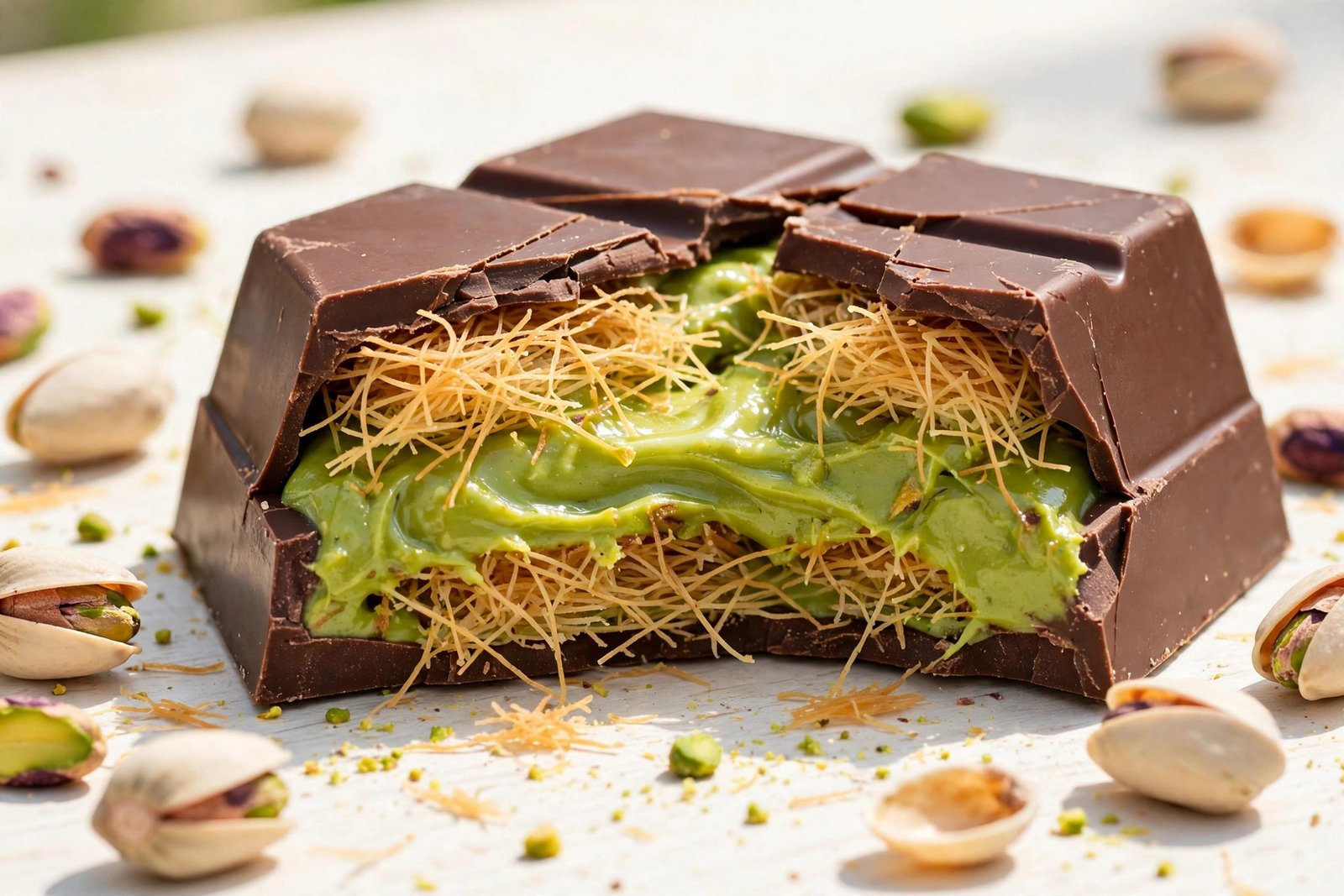
At its simplest, Dubai chocolate is a thick milk chocolate bar filled with pistachio cream and crisp, toasted kataifi — the fine shredded pastry used in knafeh, the traditional Levantine dessert of sweet cheese or cream wrapped in golden pastry threads and soaked in syrup. The original FIX bar also includes tahini, which adds a nutty depth to the filling. Break it open and you get two textures at once: the snap of the chocolate shell, then a creamy, crunchy green filling that looks as striking as it tastes.
The name is doing a lot of work. Today “Dubai chocolate” describes a style, not a single product. Dozens of companies now make their own versions, from Swiss giant Lindt to grocery-store brands, and the phrase has become shorthand for any chocolate built around pistachio cream and kataifi crunch. But the original is a specific bar with a specific name: “Can’t Get Knafeh of It,” made by FIX Dessert Chocolatier in Dubai. Everything else is a tribute, a copy, or a competitor — and the original is still only sold in Dubai and Abu Dhabi.
A Pregnancy Craving in a Dubai Kitchen
The story begins, as the best food stories often do, with a craving. Sarah Hamouda, a British-Egyptian entrepreneur living in Dubai, started FIX Dessert Chocolatier in 2021 with her husband Yezen Alani. She has said the idea began during a pregnancy, when she was craving the flavors of knafeh folded into chocolate. Working with Filipino chocolatier Nouel Catis Omamalin, she built the bar: milk chocolate outside, pistachio cream, tahini, and toasted kataifi inside.
For a long time, almost nothing happened. FIX was a small online business selling through the delivery app Deliveroo in Dubai only, in limited ordering windows at 2 p.m. and 5 p.m., with bars priced at 68.25 dirhams. Alani later told The New York Times that the company was selling about a bar a week. The bars were good, the idea was clever, and nobody outside a small circle in Dubai had ever heard of them. Then a stranger filmed herself eating one in her car, and the whole thing detonated.
The 30-Second Video That Changed Everything
In December 2023, UAE-based food creator Maria Vehera posted an ASMR video of herself tasting the “Can’t Get Knafeh of It” bar. There was no script, no sponsorship, and no production value — just the sound of the chocolate cracking and the filling spilling out, filmed in the front seat of her car. It was the kind of video the internet was built for: sensory, simple, and impossible to look away from.
The numbers climbed fast. By July 2024, the video had passed 65 million views, according to the Khaleej Times. By November 2024, it had topped 100 million views, according to Gulf News, and later counts pushed past 130 million. Alani told The New York Times the video brought at least 30,000 orders — so many that the delivery app FIX was using crashed. The bars sold out within minutes whenever a new batch went on sale, and the scarcity only made the frenzy worse. People began flying to Dubai just to buy the chocolate. An Expedia survey found that 17 percent of respondents would travel to Dubai for the chocolate alone.
That is the moment a local product became a global phenomenon. The bar was no longer just a dessert. It was a souvenir, a status symbol, and a piece of content — something to film yourself eating, the same way Vehera had.
From One Bar to a Global Category
Once the video went viral, the copycats arrived in waves. Lindt made a limited run of just 300 Dubai-style bars, then brought its Dubai Style bars to national retail in the United States in July 2025. Dubai Duty Free alone sold 719 tonnes of Dubai chocolate in 2025, across 13 brands, and now treats it as its own product category. The National reported that Dubai-style chocolate sales jumped 1,234 percent in a single year.
The gold rush also brought fakes and legal fights. FIX does not ship outside the region, so websites began selling counterfeit “FIX” bars that do not exist. In January 2025, a court in Cologne, Germany, ordered Aldi Süd to stop selling a “Dubai chocolate” bar that was actually made in Turkey, ruling that shoppers could be misled. The original FIX bars remain available only in Dubai and Abu Dhabi, while most of what is sold under the name elsewhere is made by someone else entirely.
That tension — between the one true original and a thousand imitations — is part of what keeps the story alive. The bar is both everywhere and nowhere. You can buy a Dubai-style bar in an American supermarket, but you cannot buy the real thing without a plane ticket.
America’s Dubai Chocolate Moment
The craze reached the United States in force in late 2024, and by early 2025 it was unavoidable. American Google searches for Dubai chocolate peaked in March 2025, at about 1.25 million searches in a single month, according to Ahrefs data. Then, like most viral moments, the search spike faded. But the product did not fade with it. According to food data firm Tastewise, online buzz around Dubai chocolate is down about 37 percent year on year — yet adoption keeps growing: 2.1 percent of American restaurants now list a Dubai chocolate item, more than four times the share a year ago.
That is the pattern of a trend becoming a menu staple. IHOP brought back its Dubai Chocolate Pancakes nationally and added a Dubai Chocolate Shake. Ruby Tuesday added a Dubai Chocolate Brownie Sundae. Starbucks lists a Dubai Chocolate Bite from 3.65 dollars alongside an Iced Dubai Chocolate Mocha. Trader Joe’s carries a Dubai chocolate bar made by Patislove, Costco and Walmart sell Dubai chocolate confections, Baskin-Robbins has Dubai-inspired ice cream, and Shake Shack and Ghirardelli have both offered Dubai-chocolate products. What started as a single bar in Dubai is now a flavor the whole American food industry speaks.
The appeal is easy to understand once you taste it. The combination of pistachio and kataifi hits three things Americans love at once: it is rich, it is crunchy, and it photographs beautifully. The green filling looks expensive. The snap sounds expensive. And for a restaurant, a Dubai chocolate dessert is a cheap way to borrow the glow of a viral moment without inventing anything new.
The Strawberry Cup and the Next Viral Wave
Just as the original bar was settling into menus, the trend mutated. The Dubai chocolate strawberry cup — fresh strawberries layered with pistachio cream, kataifi crunch, and melted chocolate — took off after creator @tinekeyounger posted her version, drawing more than 11 million views. The format exploded: more than 220,000 TikTok videos riffed on the strawberry cup, and Crumbl released its own version. Suddenly Dubai chocolate was not a bar at all. It was a building block.
That is how viral food trends survive their first wave. The bar becomes a flavor, the flavor becomes a topping, and the topping shows up on everything from milkshakes to cookies. In South Korea, a Dubai chewy cookie sold out in early 2026. Each new format pulls in a fresh audience that never cared about the original bar, and each one keeps pistachio and kataifi on the menu a little longer.
The Pistachio Problem
There was a cost to all of this, and it showed up in the nut aisle. The surge in demand for pistachios collided with a tight global supply, and prices jumped. Pistachio kernel prices rose from 7.65 dollars a pound to 10.30 dollars in the year to April 2025, a rise of about 35 percent. American pistachio supplies fell 20 percent between February 2024 and February 2025, and Iran exported 40 percent more pistachios to the UAE between September 2024 and March 2025 as buyers scrambled for stock.
The Iranian nut producer Keinia blamed the shortage squarely on the trend, saying the primary reason was the explosive surge in demand fueled by the viral Dubai chocolate TikTok trend, compounded by underlying supply constraints. Hamouda herself has pushed back on the idea that her company caused a global shortage, telling Tatler Asia that the claim is not entirely true — and she has a point. Drought in Iran and Turkey also squeezed the harvest, and the United States had a poor crop that produced fewer of the lower-grade kernels food manufacturers rely on. But there is no serious doubt that the chocolate craze was the spark. When the world suddenly wants pistachio cream in everything, the pistachio market feels it.
For consumers, the shortage showed up as higher prices and smaller bars. For the industry, it was a lesson in how fast a viral moment can move a commodity market. A chocolate bar invented in a home kitchen in Dubai had, within two years, changed what farmers planted, what traders charged, and what grocery stores stocked on the other side of the world.
Is Dubai Chocolate Here to Stay?
The honest answer is that the frenzy is over and the flavor is not. The search spike of March 2025 has faded, the resale markups on the original bar have cooled, and nobody is flying to Dubai for chocolate with quite the same urgency. But the product has done what few viral foods manage: it has become infrastructure. It is on national menus, in grocery aisles, and in the permanent vocabulary of American dessert. An Associated Press report in October 2025 described the trend as a lasting category rather than a fad, and the restaurant data backs that up — adoption is still climbing even as the buzz fades.
That is the real legacy of Dubai chocolate. It proved that a small business with a good idea and one lucky video can reshape a global market, and it proved that pistachio — long a supporting flavor — could carry a product on its own. The bar may stop trending. The flavor is not going anywhere.
How to Try It Without the Hype Price
If you want to taste what the fuss is about, you do not need a plane ticket or a resale markup. Start with the grocery store versions: Trader Joe’s Dubai chocolate bar, Lindt’s Dubai Style bars, and the Dubai chocolate items at Costco and Walmart all deliver the core experience — milk chocolate, pistachio cream, kataifi crunch — for a few dollars. They are not the FIX original, and nobody honest will tell you otherwise, but they are a fair way to find out whether you actually like the flavor.
If you want the real thing, be careful. FIX bars are sold only in Dubai and Abu Dhabi through Deliveroo, and websites offering to ship them to the United States are selling fakes. The safest way to try the original is still the old-fashioned one: go to Dubai, or ask a friend who is going. And if you are feeling ambitious, the homemade version is genuinely doable — toasted kataifi, pistachio cream, tahini, and melted milk chocolate, layered in a mold. It will not be identical to the original. But it will be yours, it will cost a fraction of the resale price, and it will crunch just as loudly on camera.
Frequently Asked Questions
What is Dubai chocolate made of?
The original is a milk chocolate bar filled with pistachio cream, tahini, and toasted kataifi — the fine shredded pastry used in knafeh, a traditional Levantine dessert. The combination gives it a creamy, crunchy green filling inside a snappy chocolate shell. Most American versions follow the same formula, though the exact recipe varies by brand.
Who invented Dubai chocolate?
The original bar, “Can’t Get Knafeh of It,” was created by FIX Dessert Chocolatier in Dubai, founded in 2021 by Sarah Hamouda and her husband Yezen Alani. Hamouda has said the idea began as a pregnancy craving for the flavors of knafeh in chocolate, and Filipino chocolatier Nouel Catis Omamalin helped develop the bar. The trend went viral after food creator Maria Vehera posted an ASMR taste-test video in December 2023.
Why is Dubai chocolate so expensive?
Several reasons. The original FIX bar is scarce — it is sold only in Dubai and Abu Dhabi, in limited daily windows, and it sells out in minutes — so resale prices soar. Pistachios are also expensive: prices rose about 35 percent in the year to April 2025, from 7.65 dollars to 10.30 dollars a pound, partly because of the surge in demand the craze created. Grocery-store versions in the United States are far cheaper.
Where can I buy Dubai chocolate in the US?
You cannot buy the original FIX bar in the United States — it is sold only in Dubai and Abu Dhabi. But American versions are widely available: Trader Joe’s carries a Dubai chocolate bar, Lindt sells Dubai Style bars nationally, Costco and Walmart stock Dubai chocolate confections, and chains including IHOP, Starbucks, and Crumbl offer Dubai chocolate menu items.
Is the Dubai chocolate trend over?
The viral peak has passed — American searches peaked in March 2025 and online buzz is down about 37 percent year on year, according to Tastewise. But adoption keeps growing: 2.1 percent of American restaurants now list a Dubai chocolate item, more than four times the share a year ago. The frenzy is over. The flavor has become a permanent part of American menus.
Related reading
For more of what’s buzzing in America right now, check out our guide to November’s viral fast-food drops, the Trader Joe’s mystery tote bag frenzy, and November 2026 TikTok trends, from Mariah Carey onward.