
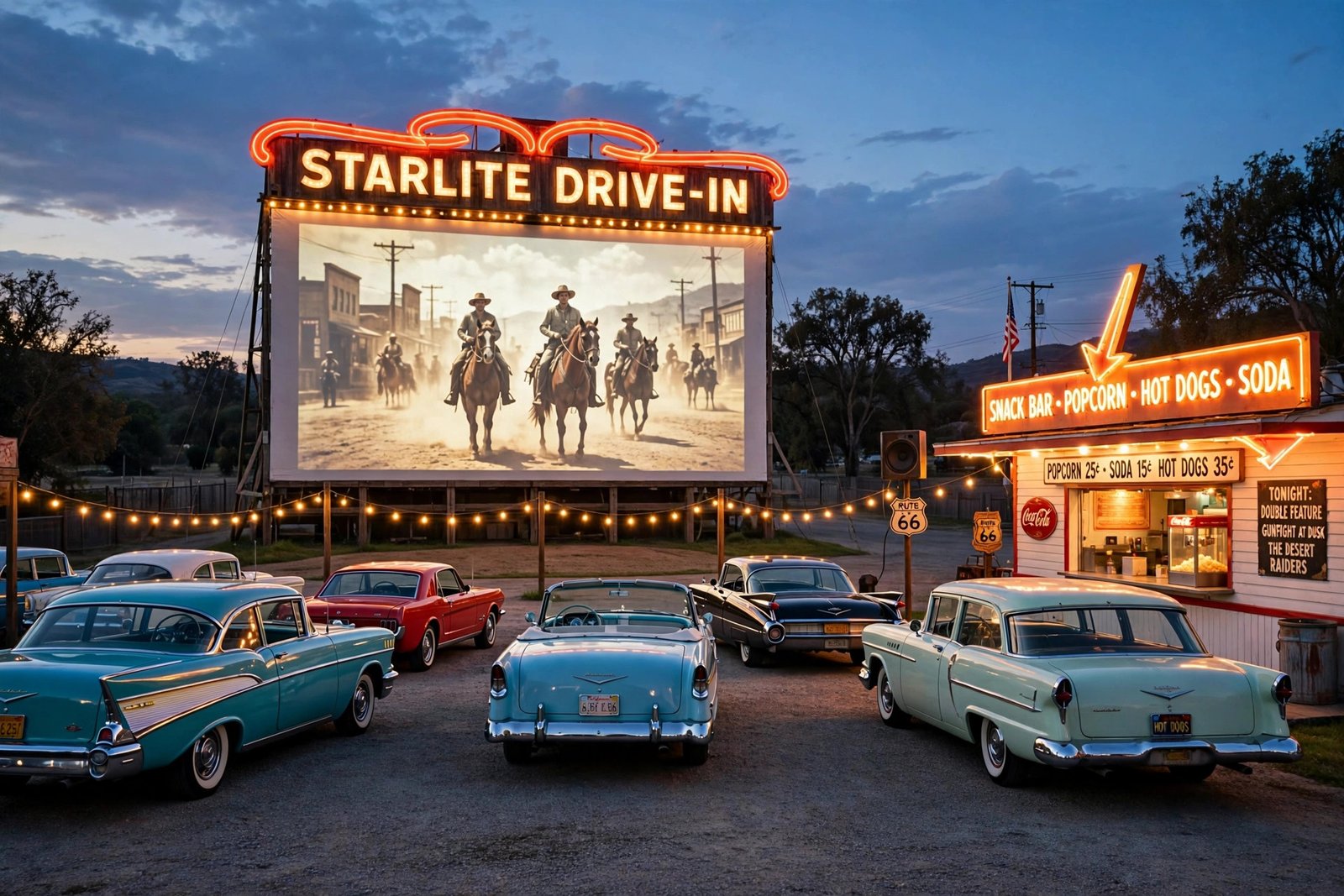
There is a particular kind of magic that only happens after dark in a gravel lot, when a giant screen flickers to life and a hundred cars settle in like an audience that brought its own armchairs. The drive-in movie theater is one of the most American inventions ever made: part cinema, part car culture, part summer night. It was born in the Depression, ruled the 1950s, nearly vanished altogether, and then — against all odds — came back. Today, roughly 300 drive-ins still operate across the United States, and the ones that survived have done it by leaning into exactly what makes them different. This is the story of how the drive-in rose, fell, and found its way back under the stars.
The Night It All Began: Camden, New Jersey, 1933
The drive-in was the idea of Richard Hollingshead Jr., a sales manager at his father’s auto-parts company in Camden, New Jersey. According to the Smithsonian, Hollingshead started experimenting in his own driveway, testing how to project a film outdoors so drivers could watch from their cars. Family lore says part of his motivation was his mother, who found traditional theater seats uncomfortable. Whatever the spark, he refined the idea, received a patent for the concept in May 1933, and opened his theater the following month.
On June 6, 1933, the first drive-in theater opened its gates in Camden. Admission was 25 cents per car plus 25 cents per person, and the opening feature was the British comedy Wives Beware. The screen was about 40 feet square, the lot held around 400 cars, and the sound came from speakers mounted near the screen — a setup that was crude by modern standards but thrilling at the time. Hollingshead’s own theater closed within a few years, but the idea was already loose in the world. The second drive-in in the country, Shankweiler’s in Orefield, Pennsylvania, opened in April 1934 — and it is still showing movies today.
Those early years were slow going. The Depression kept money tight, and outdoor sound was a real problem: a speaker loud enough to reach the back rows annoyed the neighbors, and a quiet one left the front rows straining to hear. The breakthrough came in the early 1940s, when in-car speakers — small units drivers could hang on a window — began to appear. Suddenly every car had its own private sound, and the drive-in was ready for its moment.
The Golden Age: More Than 4,000 Screens Under the Stars
After World War II, America fell in love with two things at once: the automobile and the suburbs. Families moved out of crowded cities into new neighborhoods, bought cars in record numbers, and looked for things to do together on warm evenings. The drive-in was built for exactly that moment. It was cheap, it was casual, and — as Hollingshead himself had pointed out — the whole family was welcome, no matter how noisy the children were. Parents could bring babies in pajamas. Teenagers could pile into the back seat. Nobody had to dress up or sit still.
The numbers tell the story. According to the Smithsonian, the number of drive-ins peaked in 1958 at 4,063, and at their height they accounted for roughly a quarter to a third of all movie screens in the country. The 1950s were the drive-in’s decade: double features, playgrounds under the screen, concession stands selling popcorn and hot dogs, and a screen big enough to see from the highway. For a generation of teenagers, the drive-in was also the classic date spot — a place that was public enough to be respectable and private enough to be romantic.
Drive-ins also became part of the landscape in a way indoor theaters never were. They sat on the edges of towns, along highways and country roads, their tall screens visible for miles. In many small towns, the drive-in was the only movie theater around, and Friday night at the drive-in was simply what you did. The experience was so tied to American life that it showed up everywhere in popular culture, from the drag-race scene in Grease to countless songs about summer nights and first dates.
The Long Decline: Why the Drive-Ins Faded
The decline started slowly and then gathered speed. Daylight saving time pushed summer sunsets later, which meant movies could not start until nine or later — tough for families with small children. Television arrived in living rooms, and then came color TV, cable, and the VCR. Why drive out to a field when a movie could come to your couch?
Economics did the rest. Drive-ins sit on large pieces of land, and as suburbs grew, that land became far more valuable as shopping centers, housing, and office parks than as a seasonal movie lot. At the same time, the indoor multiplex took over: a single building could run a dozen films at once, all year round, in any weather. The drive-in, which only worked after dark and mostly in warm months, could not compete on volume. By the early 2000s, fewer than 400 drive-ins remained, and the survivors were mostly in small towns and rural areas where land was cheaper and the tradition ran deep.
Then came a blow that nearly finished the job. In the early 2010s, Hollywood studios stopped distributing movies on 35mm film and switched to digital projection. A digital projector cost tens of thousands of dollars — a huge investment for a small seasonal business. Some drive-ins closed rather than pay. Others were saved by fundraisers, community campaigns, and loyal customers who refused to let their local screen go dark. The ones that made the switch, though, came out the other side with a sharper picture than film had ever given them.
The Pandemic Plot Twist
Just when the drive-in seemed destined to become a museum piece, the COVID-19 pandemic changed everything. In 2020, indoor theaters across the country closed their doors, and drive-ins suddenly had something no other venue could offer: a night out where every family sat in its own car, safely apart from strangers, under the open sky. It was social distancing with popcorn.
The result was a genuine renaissance. Long-closed drive-ins reopened. The Starlite Drive-In in Mitchell, South Dakota, came back to life after years of sitting dark. The Winchester Drive-In in Oklahoma City, which normally closed for the season in October, stayed open through the winter and took bookings for private events into January. Owners reported lines of cars stretching down the road, first-time visitors discovering a place they had driven past for years, and customers promising to come back even after the pandemic ended. Pop-up drive-ins appeared in parking lots and fairgrounds in cities that had not had a permanent one in decades. For a few strange months, the oldest movie format in America was also the newest idea in town.
It is worth being honest about what happened next: the pandemic boom did not restore the drive-in to its 1950s glory, and nobody serious claims it did. The total number of drive-ins has stayed roughly flat since then — still a few hundred, not a few thousand. What the pandemic did was different and arguably more important: it reminded a new generation that drive-ins exist, it proved the format still works, and it gave the surviving theaters a burst of attention and income at a moment when many of them needed it most.
Why the Survivors Are Thriving Now
Talk to the people running today’s drive-ins and you hear the same story: they survive by being an experience, not just a screen. A streaming service can show you the same movie, but it cannot give you the smell of popcorn drifting across a field, the kids in pajamas in the back seat, or the strange pleasure of watching a movie with a hundred strangers while sitting in your own car. The drive-in sells a night out, and that is something a living room cannot copy.
Technology helped, too. The old window speakers are gone; sound now comes through your car’s FM radio, crisp and clear, and many theaters have upgraded to modern digital projection with bright, sharp images. Some offer online ticketing, smartphone food ordering, and double features that make one ticket feel like a bargain. The best-run drive-ins have also diversified: car shows, flea markets, live music, and community events on nights when no movie is playing. Shankweiler’s in Pennsylvania, for example, expanded to year-round operation after new owners took over in 2022, and it has won national recognition in USA Today’s 10Best readers’ choice awards three years running.
There is also a generational shift at work. Younger moviegoers who grew up with streaming are discovering the drive-in as something retro and fun — a novelty to them, not a relic. Parents who went as kids are now bringing their own children, and the whole thing has the feel of a tradition being passed down rather than a business being kept alive on life support. Nostalgia is part of it, but so is the simple fact that watching a movie under the stars, with people you love, is a genuinely good time.
Famous Drive-Ins Still Showing Movies
If you want to see the comeback for yourself, a few legendary drive-ins are worth a trip. Shankweiler’s Drive-In Theatre in Orefield, Pennsylvania, opened on April 15, 1934, as the second drive-in in America, and it is widely recognized as the oldest continuously operating drive-in theater in the world. It celebrated its 90th anniversary in 2024 and now operates year-round under new ownership, showing first-run and second-run films with digital projection and FM sound.
Becky’s Drive-In, also in Pennsylvania’s Lehigh Valley, opened in 1946 and is still run by the same family that started it — a rare eighty-year run for any business, let alone a seasonal outdoor theater. The Mahoning Drive-In in Lehighton, Pennsylvania, is the last drive-in in the United States that shows movies exclusively on 35mm film, a throwback that draws film lovers from across the country. And in Maryland, the Bengies Drive-In Theatre pairs classic film screenings with car shows, leaning into the car culture that made the drive-in possible in the first place.
New York leads the country in drive-in theaters, with around 30 still operating, and Pennsylvania, Ohio, and Indiana are close behind. But drive-ins survive in most states, from the Starlite in South Dakota to the Winchester in Oklahoma City. The website DriveInMovie.com keeps an updated map and directory, which is the easiest way to find one near you.
What a Night at the Drive-In Looks Like Today
If you have never been, here is what to expect. Gates usually open an hour or two before showtime, and the best spots — the center rows, high enough to see over the cars in front — fill first. Many theaters still run double features, so one ticket buys two movies, with an intermission for a concession run. Bring a portable radio if your car’s battery worries you, and arrive with your headlights off or dimmed as a courtesy to everyone behind you.
A few practical tips make the night better. Check the theater’s website or social media before you go: showtimes change with the sunset, and rain can cancel a screening. Bring blankets and chairs if you want to sit outside your car, and bug spray in summer. Support the concession stand — for many drive-ins, food sales are what keep the lights on, and outside food policies vary by theater. And if you are bringing kids, the drive-in is one of the few movie venues where a restless toddler is not a problem. That was the whole point in 1933, and it still is.
Will the Drive-In Survive the Streaming Age?
Here is the honest answer: the drive-in will probably never be what it was in 1958, and it does not need to be. Four thousand screens were a product of a particular moment — cheap land, few entertainment choices, and a car-crazy postwar boom. That moment is gone. What remains is something smaller and, in its own way, tougher: a few hundred theaters that have survived television, the VCR, the multiplex, the digital switchover, and a pandemic, by offering an experience that no screen in a living room can match.
The comeback is real, but it is a quiet one. It looks like a family-owned theater in Pennsylvania winning a national award, a reopened screen in South Dakota, a sold-out double feature on a Friday night in a town you have never heard of. The drive-in did not die. It shrank, it adapted, and it waited for America to remember why it loved watching movies under the stars in the first place. On a warm night, with the screen glowing and the crickets going, that does not feel like nostalgia. It feels like a good idea that was never really a bad one.
Frequently Asked Questions
When did the first drive-in theater open?
The first drive-in theater opened on June 6, 1933, in Camden, New Jersey. It was created by Richard Hollingshead Jr., who patented the concept in May 1933. Admission was 25 cents per car plus 25 cents per person, and the first film shown was the comedy Wives Beware.
How many drive-in theaters were there at the peak?
Drive-ins peaked in 1958, when the Smithsonian reports there were 4,063 in the United States. At their height they made up roughly a quarter to a third of all movie screens in the country.
How many drive-in theaters are left in the United States?
Estimates vary depending on how you count seasonal and part-time screens, but most sources put the number at roughly 300. A 2026 survey by Ultimate Classic Rock counted 282 active drive-ins, while the United Drive-in Theatre Owners Association has cited figures around 300. Either way, it is less than a tenth of the 1950s peak.
What is the oldest drive-in theater still operating?
Shankweiler’s Drive-In Theatre in Orefield, Pennsylvania, opened on April 15, 1934, and is widely recognized as the oldest continuously operating drive-in theater in the world. It celebrated its 90th anniversary in 2024 and now operates year-round.
Why did drive-in theaters come back during the pandemic?
In 2020, indoor theaters closed and people needed entertainment that allowed social distancing. Drive-ins let each family watch from its own car, outdoors and apart from strangers. The format drew first-time visitors and long lines, and several closed drive-ins reopened. The boom did not restore the 1950s numbers, but it gave surviving theaters new audiences and new momentum.
Related reading
If you enjoyed this trip down America’s highways, you may also like our guide to Route 66, America’s most iconic drive, the story of America’s small-town diners, and the best New England fall foliage drives and towns.