
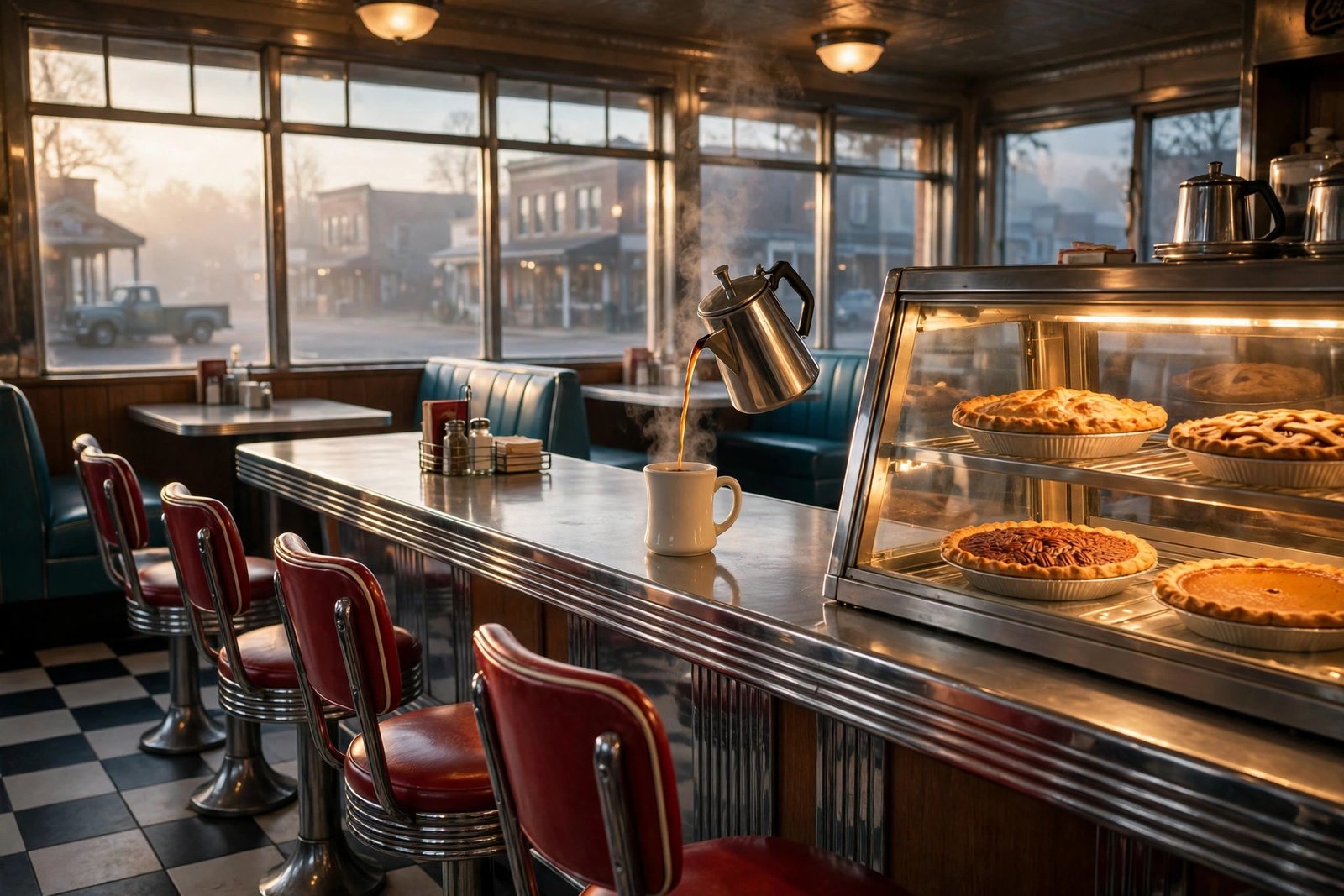
There is a seat in almost every small-town American diner that everyone in town understands is taken, even when it is empty. It belongs to a farmer who comes in before sunrise, or a retired teacher who does the crossword in ink, or a mechanic whose coffee appears the moment the bell over the door rings. Nobody assigned that seat. The diner simply kept it, the way the diner keeps everything: the same menu, the same pie case, the same waitress who has known your order and your family for thirty years.
In a country that rebuilds its main streets every generation and replaces its obsessions every season, the small-town diner endures. It has survived fast food, chain breakfast empires, espresso culture, food delivery apps, and the general national habit of eating in cars. It survives for reasons that have surprisingly little to do with food. To understand why the diner lasts, you have to understand what it actually sells — and it was never really the meatloaf.
From a Horse-Drawn Wagon to an American Institution
The diner began humbly, after dark. In 1872, in Providence, Rhode Island, a printer and part-time pressman named Walter Scott converted a horse-drawn wagon into a rolling kitchen and began selling sandwiches, coffee, and pie through a walk-up window to night-shift workers and newspaper men — people the city’s restaurants did not serve because they worked when restaurants were closed. Scott is credited with inventing the “night lunch wagon,” and in the process, ancestors of both the diner and the food truck.
The idea spread across industrial New England and beyond. Lunch wagons acquired a few stools, then became semi-permanent lunch cars parked on rented lots. By the early twentieth century, manufacturers were building them on purpose. Jerry O’Mahony of Bayonne, New Jersey, is credited with building the first stationary diner in 1912 and became a leading maker of the factory-built dining car; the Worcester Lunch Car Company in Massachusetts and the Kullman company in New Jersey built hundreds more. “Dining car” was shortened, naturally enough, to “diner.” The prefabricated diners were long and narrow because railroad cars were long and narrow, and they were shipped whole — by rail, later by truck — and set down on foundations from Maine to the Midwest. New Jersey, home to the manufacturers and dense with diners, eventually claimed the unofficial title of diner capital of the world. AAA’s history of the form, celebrating America’s diners, traces that wagon-to-landmark arc.
The early diners served working men quickly and cheaply, and respectability came later. In the 1920s and 1930s, owners added booths, indoor plumbing, and tiled interiors to welcome women and families, whom the early lunch-car culture had not courted. After World War II, diners bloomed along highways and in suburbs, their stainless steel and neon modernized into Formica, pastel porcelain, and eventually the faux-fifties styling we now think of as classic. Greek immigrant families became central to the diner’s golden age, especially in the Northeast and Midwest — arriving with restaurant experience and formidable work habits, buying diners, and running them as family enterprises open nearly around the clock. Many of the great diner menus — enormous, encyclopedic, something-for-everyone documents — carry that heritage to this day.
The Counter: America’s Most Democratic Piece of Furniture
Every element of the classic diner is a social technology, and the masterpiece is the counter. A table is private: your party, your conversation, your check. A counter is public. You sit shoulder to shoulder with strangers, on stools that swivel, in front of a person who is working — cooking, pouring, remembering. The counter collapses distance. The truck driver and the town judge eat the same eggs from the same grill, close enough to argue about the weather, the roads, and the high school team’s chances, and in small towns they do, daily.
This is why journalists on election years still drive to diners in Iowa, New Hampshire, and Pennsylvania to “take the temperature” of America. The practice is a cliché because it works after a fashion: the diner is one of the last places where a cross-section of a community sits in one room, unseparated by price, dress code, or reservation app. Sociologists have a term for such places — “third places,” neither home nor work, where community actually happens: barbershops, libraries, churches, and diners. Remove them, and a town does not just lose businesses. It loses the connective tissue between its households.
The Smithsonian explored this cultural role in its essay on the mystique of the American diner, tracing how writers and filmmakers from Jack Kerouac onward used the diner as America’s stage set for honesty — the place where travelers, drifters, sheriffs, and waitresses tell the truth at 2 a.m.
What the Diner Sells: Time, Recognition, and Pie
Look at the economics honestly and the diner’s survival is puzzling. The food is inexpensive, the coffee refills are famously bottomless, and the best customers — the regulars — are precisely the people most entitled to linger for hours over a two-dollar cup. A modern restaurant consultant would call this a catastrophe. The diner calls it the business model, because the product is not turnover. The product is belonging.
Recognition is the diner’s currency. The server who knows your order knows your name, your spouse’s name, and that you take the booth when your mother visits because she needs the high seat. In a small town, the diner is an information exchange faster than any group chat: who is hiring, who is ill, whose barn burned, whose daughter made the team. News arrives at the counter before it reaches print, and it arrives with commentary. Political scientists worry about the decline of local newspapers; everyone in a diner town knows the counter absorbed part of that function long ago.
And then there is the menu, which deserves respect as a cultural document. All-day breakfast — the diner’s refusal to tell you what time it is — is a small declaration of freedom. So are the blue plate special, the soup made that morning, the club sandwich, the milkshake, the rice pudding, and pie: always pie, in a rotating case, because a diner without pie in the case is making a promise it cannot keep. Portions are generous, substitutions are tolerated, and splitting a check six ways is met with a shrug. In an industry increasingly designed by optimization, the diner is designed by memory.
The Pressures Are Real
None of this is to pretend the small-town diner is safe. The pressures are severe and compounding. The classic diner model depended on cheap real estate at good corners, family labor across very long hours, and owners willing to work the grill themselves for decades. As founding families retire, their children — educated, reasonably unwilling to work 100-hour weeks — often do not take over, and a diner bought purely as an investment rarely survives, because its margins were its owners’ wages. Rising food and labor costs hit a business whose customers expect a five-dollar breakfast special. Chains colonized the highway exits. Fast-casual and delivery rewired younger eaters toward speed and novelty. And when a town’s anchor employers close, the diner’s sunrise crowd thins with them.
The coronavirus pandemic exposed the fragility further: a business built on packed counters and shared air, on elderly regulars and cash, was almost perfectly designed to suffer in 2020, and many beloved diners closed for good in those years. Each closure makes the local news like a death in the family, because that is the correct emotional category.
Yet new chapters keep being written. Across the country, young chefs have bought fading diners and restored them — keeping the counter, the hours, and the pie, while quietly improving the coffee and sourcing from local farms. Historic diners have been moved, restored, and listed on historic registers like the little railroad-car artifacts they are; Worcester Lunch Car diners in particular are treasured as industrial design. In some towns, community fundraising has saved the diner outright, residents treating it with the seriousness usually reserved for a library or a ballfield — which, functionally, is what it is.
Why It Endures
The deepest reason is the simplest. Most American institutions sort people: by income, by age, by politics, by taste. The diner, at its best, refuses to. The booths hold teenagers after the football game, linemen at dawn, widows who lunch together every Tuesday for twenty years, truckers passing through a town they will never see again, and families stretching a paycheck with dignity because nobody at a diner counter is ever made to feel that a small check is a small welcome. The food is honest, the prices are fair, the coffee keeps coming, and the door is open to whoever walks in — sometimes literally all night.
That is why the diner has outlived every prediction of its death since the age of the lunch wagon. America keeps building new ways to eat. It has not built many new ways to be a regular somewhere — to be known, expected, and missed when you don’t show up, by people whose only business is feeding you. As long as towns need a living room, and travelers need a light on the highway at midnight, there will be a counter, a bell over the door, and a seat that everyone understands is yours. Sit down. The coffee is already on its way.