
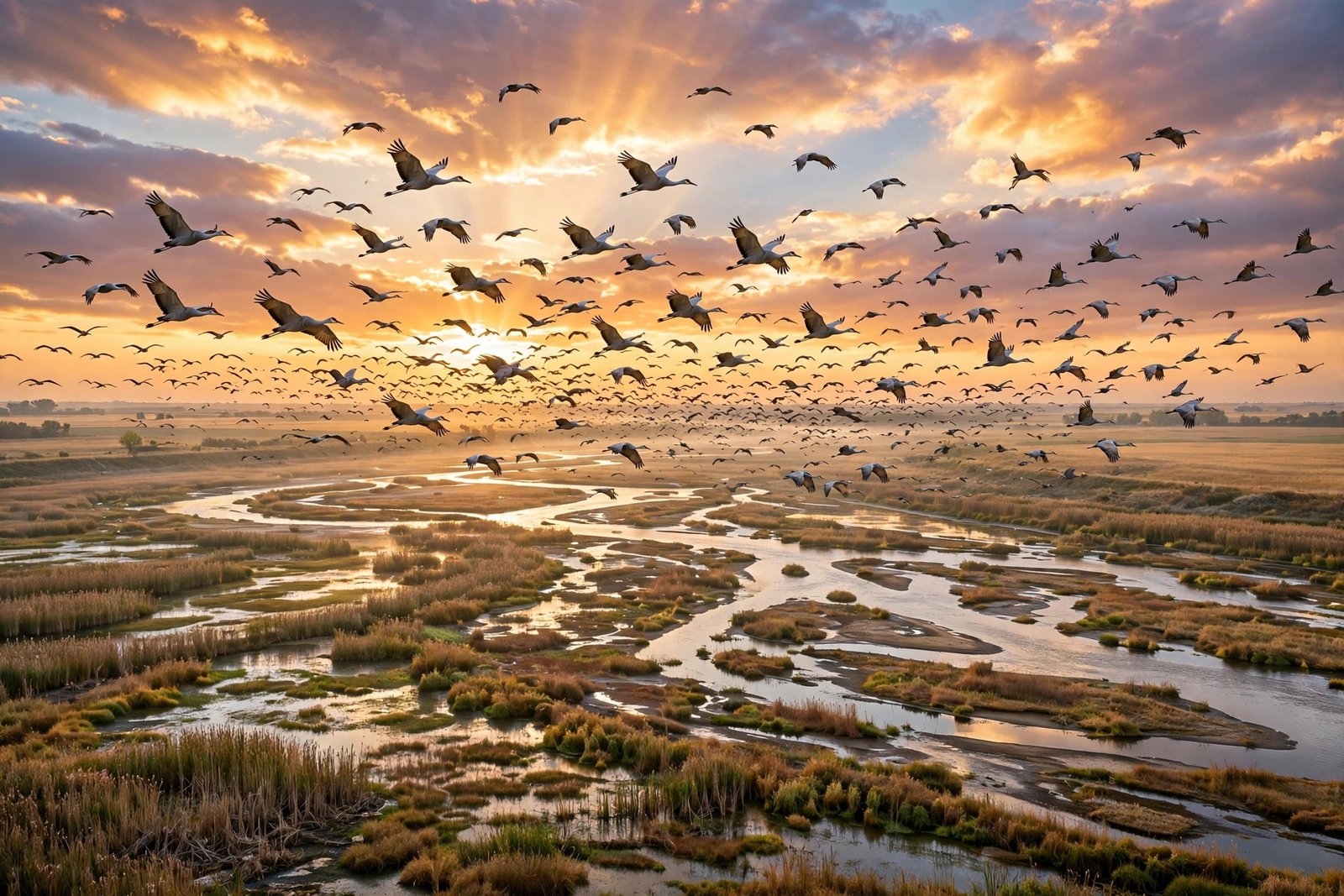
Every spring, something extraordinary happens along a quiet stretch of river in central Nebraska. As winter loosens its grip on the Great Plains, the sky fills with wings, and the air fills with sound — a rolling, trumpeting chorus that can be heard from miles away. Hundreds of thousands of sandhill cranes descend on the Platte River, turning an ordinary Midwestern waterway into the stage for one of the greatest wildlife spectacles in North America.
For a few short weeks each year, this is the place to be if you love wild America. Families, birdwatchers, photographers, and first-time visitors gather along the riverbanks at dawn, wrapped in warm coats, binoculars in hand, waiting for the moment the cranes lift off the water in great swirling clouds. It is a scene that has played out for thousands of years, long before there were roads or towns or cameras to record it. And it is still happening, right now, every single spring.
If you have never seen the sandhill crane migration, this guide will tell you what makes it so special, when to go, where to watch, and how to experience it without disturbing the birds that make it all possible.
An Ancient Traveler
Sandhill cranes are among the oldest living bird species on Earth. Their lineage stretches back millions of years, and fossil evidence shows that cranes very much like today’s birds were already walking the planet long before humans ever appeared. When you watch a sandhill crane step gracefully through a Nebraska cornfield, you are looking at a creature whose ancestors survived ice ages, shifting continents, and dramatic changes in climate.
That deep history is part of what makes the migration feel so powerful. These are not just birds passing through. They are survivors following a route their kind has used for ages, guided by instincts refined over countless generations. Standing on the banks of the Platte River in March, you are witnessing a ritual far older than any human tradition.
Sandhill cranes are tall, elegant birds with slate-grey plumage, long legs, and long necks. Adults carry a distinctive patch of red skin on their foreheads, which stands out vividly against their grey feathers. Their wingspan is impressive, and in flight they stretch their necks straight out in front of them, a posture that sets them apart from herons, which fly with their necks tucked back.
But it is their voice that most people remember first. The sandhill crane’s call is a loud, rolling trumpet, produced by a long windpipe that coils inside its chest like a French horn. The sound carries for miles across the flat Nebraska landscape, and when hundreds of thousands of cranes call at once, the result is a sound unlike anything else in nature — part music, part wild chorus, and completely unforgettable.
Why the Platte River?
Every spring, sandhill cranes migrate north from their wintering grounds in the southern United States and Mexico toward breeding grounds in Canada, Alaska, and Siberia. The journey is long, and the birds need a place to rest, refuel, and prepare for the next leg of the trip. The Platte River in central Nebraska is that place.
The river offers exactly what the cranes need. Its shallow, braided channels provide safe overnight roosting spots, where the birds can stand in the water, protected from predators by the river itself. During the day, the cranes fan out into the surrounding farmland, feeding in cornfields and wet meadows to build up the energy reserves they will need for the journey ahead.
This combination of safe water and rich farmland is rare, and it is why so many cranes concentrate here in such a short window of time. The Platte River valley acts like a funnel, drawing birds from across the southern wintering range into one central staging area before they scatter northward again. The result is one of the densest gatherings of large birds anywhere on the planet.
The peak of the gathering comes in March. By then, the river corridor can hold hundreds of thousands of cranes at once — a living river of grey wings stretching as far as the eye can see. For visitors, March is the month to plan around, with the middle of the month often offering the most spectacular numbers.
A Day in the Life of a Crane
A crane’s day on the Platte follows a reliable rhythm, and knowing it will help you plan your visit. Before dawn, the birds begin to stir on their river roosts. As the first light breaks over the prairie, they rise in waves, their calls filling the cold morning air. It is one of the great sounds of the natural world, and many visitors say the dawn lift-off alone is worth the trip.
Once airborne, the cranes head out to nearby fields to feed. They spend much of the day foraging in cornfields and meadows, picking up waste grain left over from the harvest and searching for insects, small animals, and plant matter. This feeding is serious business. The cranes need to gain weight and strength for the demanding flight north, and the rich Nebraska farmland gives them the fuel to do it.
As evening approaches, the cranes return to the river. They arrive in long, wavering lines, dropping down to the shallow water to roost for the night. The evening return is just as dramatic as the morning departure, with the sky filling with birds as the sun sets over the prairie. If you can only watch once a day, many experienced visitors recommend dawn, but sunset is a close second.
Between feeding and roosting, the cranes also socialize, preen, and — in spring — dance. The famous crane dance is one of the most delightful sights of the season, and it is worth watching for on its own.
The Famous Crane Dance
Sandhill cranes are famous for their dancing. During courtship, pairs leap into the air with their wings spread, bow to each other, toss sticks and grass into the air, and hop and flutter in elaborate displays. The dance strengthens the bond between mates, and sandhill cranes often pair for life.
But dancing is not only for courting pairs. Young cranes dance too, and even older birds will join in, especially in spring when energy is high and the flock is gathered in large numbers. Watching a group of cranes dance in a field — leaping, bowing, and calling — is joyful and strangely moving. It is a reminder that these birds have social lives, personalities, and traditions of their own.
Photographers love the dance because it produces dramatic, dynamic images: wings outstretched, legs kicking, bodies suspended mid-air. For the rest of us, it is simply fun to watch. If you visit the Platte in spring, keep your eyes on the fields during the middle of the day. You may well catch a performance.
Sharing the Sky: The Whooping Crane
The sandhill flocks along the Platte are not the only cranes on the move. Whooping cranes, an endangered species, sometimes migrate with the sandhill flocks along the same route. Taller and strikingly white with black wingtips, whooping cranes are among the rarest birds in North America, and spotting one among the grey masses of sandhills is a thrill for any birdwatcher.
The whooping crane’s story is one of conservation success against long odds. Once brought to the edge of extinction, the species has slowly recovered thanks to decades of protection, habitat conservation, and careful management. Its presence on the Platte is a reminder of what is at stake — and what is possible — when people commit to protecting wild places.
If you think you spot a whooping crane, observe quietly and from a distance, and consider reporting the sighting to local wildlife organizations. Your observation can help researchers track the migration and protect the birds along the way.
Where to Watch
Two of the best-known viewing sites along the Platte are the Audubon Rowe Sanctuary near Kearney, Nebraska, and the Crane Trust. Both organizations protect river habitat and offer guided viewing opportunities, including access to blinds — sheltered structures placed near the river where visitors can watch the cranes up close without disturbing them.
Viewing blinds are the gold standard for crane watching. From inside a blind, you can watch the birds roost, feed, and dance at close range while remaining hidden. The cranes behave naturally because they do not perceive you as a threat. Many blinds are available by reservation, and they tend to book up quickly for peak March dates, so plan ahead.
For more information about viewing opportunities, conservation work, and the cranes themselves, visit the National Audubon Society and Nebraska Game and Parks. Both are excellent starting points for planning a trip and learning more about the migration.
Beyond the sanctuaries, there are public viewing areas and bridges along the Platte where visitors can watch the cranes. Wherever you go, remember the golden rule of crane watching: keep your distance, stay quiet, and never approach a roost or a feeding flock. The birds are here to rest and refuel, and a disturbance that flushes them from the river costs them precious energy.
Tips for a Great Visit
- Go in March. The peak gathering happens in March, so aim for the middle of the month if you can, but any time in March can be rewarding.
- Arrive before dawn. The morning lift-off is the highlight. Get to your viewing spot early, dress warmly, and be ready for cold prairie mornings.
- Bring binoculars. Even from a good viewing spot, binoculars transform the experience, letting you pick out individual birds, watch the dancing, and scan for whooping cranes.
- Dress in layers. Nebraska mornings in March can be cold, even if the afternoon warms up. Warm coats, gloves, and hats make the wait comfortable.
- Book blinds early. Guided blind tours at Rowe Sanctuary and the Crane Trust are popular and fill up fast. Reserve as early as you can.
- Stay quiet and still. Cranes are sensitive to disturbance. Whisper, move slowly, and avoid sudden movements near roosts and feeding areas.
- Respect private land. Much of the land around the Platte is privately owned farmland. Stick to public areas and sanctuary property, and never trespass to get closer to the birds.
Protecting the Spectacle
The crane migration is a natural wonder, but it is not guaranteed. The Platte River faces pressures from water use, development, and habitat loss, and the cranes depend on the river remaining wide, shallow, and safe. Conservation groups work year-round to protect river habitat, secure water flows, and maintain viewing blinds so that visitors can enjoy the spectacle without harming the birds.
That work matters for more than cranes. The Platte River valley is a critical stopover for millions of migratory birds of many species, and the wetlands and meadows that cranes use also support a rich web of wildlife, from waterfowl to shorebirds to prairie plants. Protecting the Platte protects an entire ecosystem.
Visitors can help simply by following viewing guidelines, supporting the sanctuaries and conservation organizations that steward the river, and spreading the word about why this place matters. The more people who understand and value the migration, the stronger the case for keeping the Platte wild and flowing.
There is also a deeper reason to care. The sandhill crane migration connects us to a wilder, older America — a continent where great flocks still darken the sky and ancient journeys still unfold on schedule. In a world that often feels paved over and hurried, the cranes remind us that some things are still gloriously wild.
Why It Stays With You
Ask anyone who has watched the Platte River migration and they will tell you the same thing: it stays with you. The sound of the cranes, the sight of thousands of wings against a dawn sky, the feeling of standing quietly on a cold riverbank while an ancient migration unfolds around you — these are memories that do not fade.
Part of the magic is scale. It is one thing to read that hundreds of thousands of cranes gather on the Platte. It is another to stand there and hear them, to watch wave after wave lift off the water, to realize that you are a small witness to something vast and old. The migration puts our human lives in perspective in the best possible way.
So if you are looking for a spring trip that is different from the usual getaway — something wild, beautiful, and genuinely American — put the Platte River on your list. Go in March. Get up before dawn. Bring binoculars and a warm coat. And listen. The cranes have been making this journey for millions of years. For a few weeks each spring, they invite us to watch.
Related reading
- Monarch Butterfly Migration: Mexico’s Miracle
- Elk Rut in Rocky Mountain National Park
- The American Bison Comeback
FAQ
When is the best time to see sandhill cranes on the Platte River?
The peak gathering happens in March, when hundreds of thousands of cranes stop along the river during their spring migration. The middle of March is often the most spectacular time to visit, but any part of March can offer impressive numbers.
Where is the best place to watch the cranes?
The Audubon Rowe Sanctuary near Kearney, Nebraska, and the Crane Trust are two of the best-known viewing sites. Both offer guided viewing from blinds, which let you watch the cranes up close without disturbing them. Public viewing areas along the river are also available.
Why do so many cranes gather on the Platte River?
The Platte offers shallow river channels for safe overnight roosting and nearby cornfields and meadows for daytime feeding. The cranes stop here to rest and refuel on their long migration from wintering grounds in the southern United States and Mexico to breeding grounds in Canada, Alaska, and Siberia.
Can you see whooping cranes along the Platte?
Yes, sometimes. Whooping cranes, an endangered species, occasionally migrate with the sandhill flocks along the same route. They are white with black wingtips and are much rarer than sandhills, so spotting one is a special moment. Observe quietly and from a distance if you do.
How can visitors watch without disturbing the cranes?
Use viewing blinds where available, keep your distance, stay quiet, and never approach a roost or feeding flock. Stick to public areas and sanctuary property, respect private farmland, and follow the guidance of local conservation organizations.