
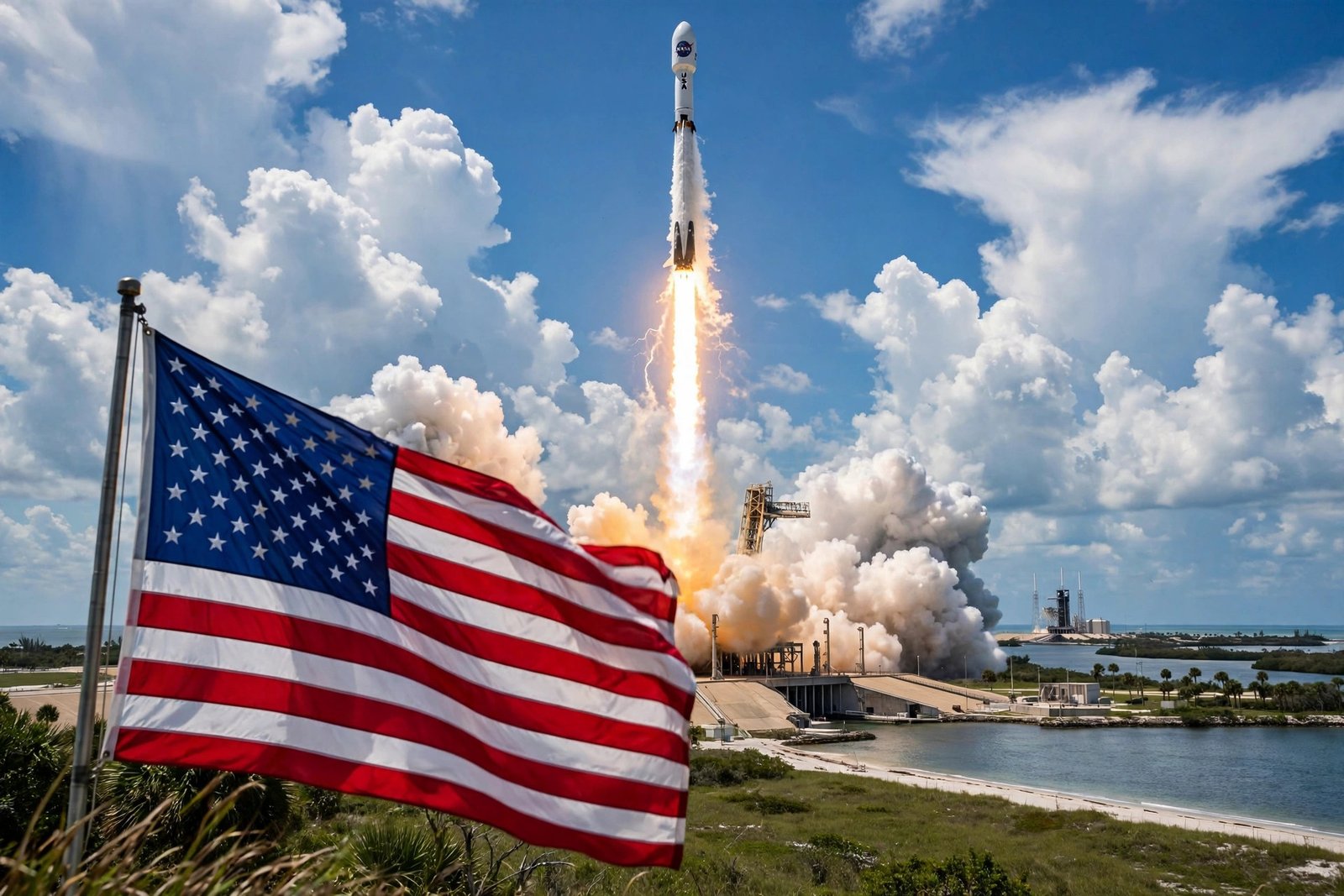
Look up at the night sky and you will not see them, but high above your head, American satellites are quietly doing work you depend on every single day. They guide your car to its destination, carry your phone calls, warn of incoming storms, and watch for missile launches around the world. Guarding those satellites is the job of the newest branch of the United States military: the US Space Force.
Created in 2019, the Space Force is the first new American military service in more than seventy years. Its members are called Guardians, its motto is “Semper Supra,” meaning “Always Above,” and its mission is as big as space itself. Yet for many Americans, the Space Force remains a mystery. Is it an army in orbit? Do Guardians fly spaceships? And why does America need a military branch just for space?
This guide explains the US Space Force in plain language: how it was created, what it actually does, who serves in it, and why space has become one of the most important frontiers in American national security.
A New Branch Is Born
The US Space Force was established on December 20, 2019, as the sixth branch of the US Armed Forces, joining the Army, Marine Corps, Navy, Air Force, and Coast Guard. It was the first new military service created since the Air Force itself became independent in 1947. The new branch was organized under the Department of the Air Force, in a similar way to how the Marine Corps sits within the Department of the Navy.
The creation of the Space Force did not come out of nowhere. For decades, the US military had operated satellites and space systems, mostly through the Air Force. Air Force Space Command had run military space operations since the early 1980s, and many of the people, satellites, and bases that became part of the Space Force already existed. What changed in 2019 was the structure: space operations were given their own service, with its own leadership and culture, rather than competing for attention inside the much larger Air Force.
The idea was straightforward. Space had grown from a support function into a domain of warfare in its own right, just like land, sea, and air. American leaders argued that a dedicated service was needed to develop space expertise, move faster on new technology, and treat space as a priority rather than an afterthought. The service’s first Chief of Space Operations was Gen. John W. “Jay” Raymond, who had previously led Air Force Space Command.
Why Space Needed Its Own Service
To understand the Space Force, it helps to understand how much modern life depends on space. Satellites are not just scientific curiosities. They are infrastructure, as essential in their own way as highways, power lines, and undersea internet cables.
Consider a normal day. You check the weather forecast, which relies on satellite data. You drive to work using GPS navigation. You make a phone call or stream a video, and some of that signal may travel through satellites. Farmers use GPS-guided equipment to plant and harvest. Airplanes navigate with satellite guidance. In short, space touches nearly every part of the American economy.
The military depends on space even more heavily. Satellites provide secure communications for troops in the field, intelligence imagery of distant regions, weather data for mission planning, and navigation for aircraft, ships, and ground forces. Without space systems, much of the modern US military would be flying blind, unable to communicate reliably or find its way. That dependence is also a vulnerability: other nations have developed the ability to interfere with satellites, through jamming signals, blinding sensors, or even destroying satellites outright. American military planners concluded that space could no longer be treated as a safe, peaceful backdrop. It had to be defended.
What the Space Force Actually Does
The mission of the US Space Force is to protect US and allied interests in space. In practice, that breaks down into several core jobs.
First, the Space Force operates military satellites, including communications satellites that carry secure military messages, reconnaissance satellites that gather intelligence, and weather satellites that support military operations. Guardians monitor these satellites around the clock, keep them in the right orbits, and make sure they keep working.
Second, the Space Force runs the Global Positioning System, the GPS constellation that civilians use every day. The GPS satellites are operated by the military, and their signals are provided free to the world. That means the same system that guides your road trip also guides military aircraft and helps synchronize everything from power grids to financial networks.
Third, the Space Force operates early-warning satellites that detect missile launches. These infrared sensors watch the globe for the bright heat signature of a rocket launch, giving American leaders precious minutes of warning if a missile is fired. It is one of the most consequential jobs in the entire military, and it happens silently, every minute of every day.
Fourth, the Space Force conducts space surveillance, tracking objects in orbit. There are thousands of active satellites, plus spent rocket stages and fragments of debris, all moving at enormous speeds. Guardians track these objects and warn satellite operators of potential collisions, helping keep orbit safe for everyone.
Finally, the Space Force is charged with defending American space assets against threats: protecting satellites from jamming and interference, developing ways to operate even when an adversary tries to disrupt space systems, and building resilience so that losing one satellite does not mean losing a capability entirely.
Meet the Guardians
Members of the Space Force are called Guardians, a name chosen to reflect the service’s mission of guarding American interests in space. The name was announced in late 2020 and quickly became part of the service’s identity.
Guardians work in a wide range of career fields. Space operations specialists operate satellites and monitor orbital activity. Intelligence professionals analyze data from space-based sensors. Cyber specialists defend the computer networks that control satellites and process space data. Engineers design and test new space systems. Acquisition professionals manage the contracts and programs that buy new satellites and ground equipment. In other words, the Space Force is not a force of astronauts in spaceships. It is a force of highly trained technical professionals, most of whom work at computer consoles in control centers on the ground.
Many of the first Guardians transferred from the Air Force when the service was created, bringing years of space experience with them. Over time, the Space Force has built its own recruiting, training, and career paths. The service is much smaller than the Army or the Air Force, with thousands of Guardians rather than hundreds of thousands of troops, which gives it a different feel: lean, technical, and focused.
How the Space Force Is Organized
The Space Force is headquartered at Peterson Space Force Base in Colorado Springs, Colorado, a city that has long been a hub of American military space activity. From there, the service is organized into major commands that handle different parts of the mission.
Space Operations Command is the field command responsible for operating satellites and conducting space operations day to day. If a satellite needs maneuvering, a signal needs monitoring, or a launch needs support, Space Operations Command is typically involved.
Space Systems Command handles the development and acquisition side: designing new satellites, buying new systems, and working with industry partners to build the next generation of space technology. This command is where the future of American military space capability takes shape, years before a new satellite ever reaches orbit.
Space Training and Readiness Command is responsible for training Guardians and preparing them for their missions, running the schools, exercises, and professional development that turn new recruits into qualified space professionals.
GPS and the Everyday Life of Space Power
Of all the Space Force’s jobs, none touches ordinary Americans more directly than GPS. The Global Positioning System began as a military project and grew into one of the most widely used technologies in human history. Today, GPS signals are free and available to anyone with a receiver, which includes nearly every smartphone on the planet.
The Space Force operates the GPS constellation, a fleet of satellites orbiting high above Earth, each broadcasting precise timing signals. Your phone or car navigation system listens to signals from several of these satellites at once and calculates your position by comparing the tiny differences in when each signal arrives. It only works because Guardians keep the satellites healthy, in position, and broadcasting accurate time.
Beyond navigation, GPS timing quietly underpins modern infrastructure. Cell phone networks, power grids, and financial systems all use GPS timing to stay synchronized. A disruption to GPS would ripple far beyond lost drivers, which is one reason the Space Force treats GPS as a critical national asset.
Threats in Orbit
Space is sometimes described as the final frontier, but it is also an increasingly contested one. Several nations have demonstrated anti-satellite capabilities, and many more are building space programs of their own. The risks to American satellites come in several forms.
Jamming is one of the most common threats. An adversary can broadcast interference on the same frequencies a satellite uses, degrading or blocking its signals. This is a particular concern for GPS, where even brief disruptions could confuse navigation systems.
Another threat is cyberattack. Satellites are controlled from ground stations through computer networks, and those networks, like any computer system, can be targeted. The Space Force invests heavily in cyber defense to protect the links between Earth and orbit.
Physical threats are also real. Anti-satellite weapons have been tested by multiple countries, and the debris from a destroyed satellite can itself become a hazard, threatening other satellites in nearby orbits. This is why space surveillance matters so much: knowing where everything is in orbit is the first step to avoiding collisions and understanding when something hostile has happened. The Space Force’s answer is resilience, spreading capability across many satellites so that no single loss is catastrophic, and developing faster ways to replace damaged ones.
Space Force vs. Air Force: What Is Different?
One of the most common questions about the Space Force is how it differs from the Air Force. After all, both services fly, both operate in the sky, and the Space Force was born from the Air Force. The distinction comes down to domain.
The Air Force operates in the atmosphere, flying aircraft that take off, fly missions, and land. The Space Force operates in orbit, where there is no air, no runways, and no landing. Its vehicles stay in space for years, circling the globe again and again, and its operators control them remotely from the ground. The skills are different too: an Air Force pilot trains to fly an aircraft, while a Guardian trains to operate a satellite, analyze orbital mechanics, or defend a space network. That said, the two services remain closely linked. The Space Force sits within the Department of the Air Force, and they work together constantly, since air and space operations are deeply intertwined in modern warfare.
Why Space Power Matters for America
Why should ordinary Americans care about a military branch that operates far above their heads? The answer comes down to three things: security, prosperity, and the future.
Security first. America’s ability to detect threats, communicate with forces around the world, and navigate precisely depends on space. If those capabilities were lost or degraded, American military power would be severely weakened, and the nation’s ability to respond to crises would suffer.
Prosperity second. The American economy runs on space-enabled services, from GPS navigation and weather forecasting to satellite communications and financial timing. Protecting the satellites behind those services is, in a real sense, protecting the economy.
The future third. Space is only going to become more important. Commercial space activity is booming, with private companies launching constellations of satellites and planning lunar missions. As more human activity moves into space, the need to keep it safe, orderly, and open will only grow. The creation of the Space Force signaled that the United States intends to remain a spacefaring nation, not just in civilian exploration through NASA, but in the security domain as well. Just as sea power defined great powers in past centuries and air power defined the last one, space power may define this one.
The Road Ahead
As a young service, the Space Force is still evolving. It continues to build its culture, refine its organization, and develop new capabilities. The challenges ahead are significant: keeping pace with rapidly advancing technology, recruiting and retaining technical talent in competition with the private sector, and navigating a space environment that grows more crowded and contested every year.
But the service starts from a strong foundation. It inherited decades of American space expertise, it operates some of the most capable satellite systems in the world, and it has a clear mission that grows more important with each passing year. The next time your phone guides you to a new restaurant, or a weather forecast helps you plan your weekend, remember that somewhere, a Guardian is on duty, watching over the satellites that make it possible. Always above, indeed.
Related reading
- US Aircraft Carriers: Sea Power Explained
- Artemis II: NASA’s Next Steps to the Moon
- Hoover Dam: Engineering Power
FAQ
When was the US Space Force created?
The US Space Force was established on December 20, 2019, as the sixth branch of the US Armed Forces. It was the first new military service since the Air Force became independent in 1947, and it is organized under the Department of the Air Force.
What are members of the Space Force called?
Members of the Space Force are called Guardians. The service’s motto is “Semper Supra,” Latin for “Always Above,” reflecting its mission of guarding American interests in space.
What does the Space Force actually do?
The Space Force operates military satellites, runs the GPS constellation, operates early-warning satellites that detect missile launches, tracks objects in orbit, and defends American space assets against threats such as jamming and cyberattacks. Most Guardians work from ground-based control centers, not in space itself.
Where is the Space Force headquartered?
The Space Force is headquartered at Peterson Space Force Base in Colorado Springs, Colorado. Its major commands include Space Operations Command, Space Systems Command, and Space Training and Readiness Command.
How is the Space Force different from NASA?
NASA is a civilian agency focused on space exploration and science, while the Space Force is a military service focused on national security in space. The two organizations cooperate but have different missions: NASA explores, and the Space Force protects American space capabilities.
For official information about the service, visit the US Space Force and the US Department of Defense.