
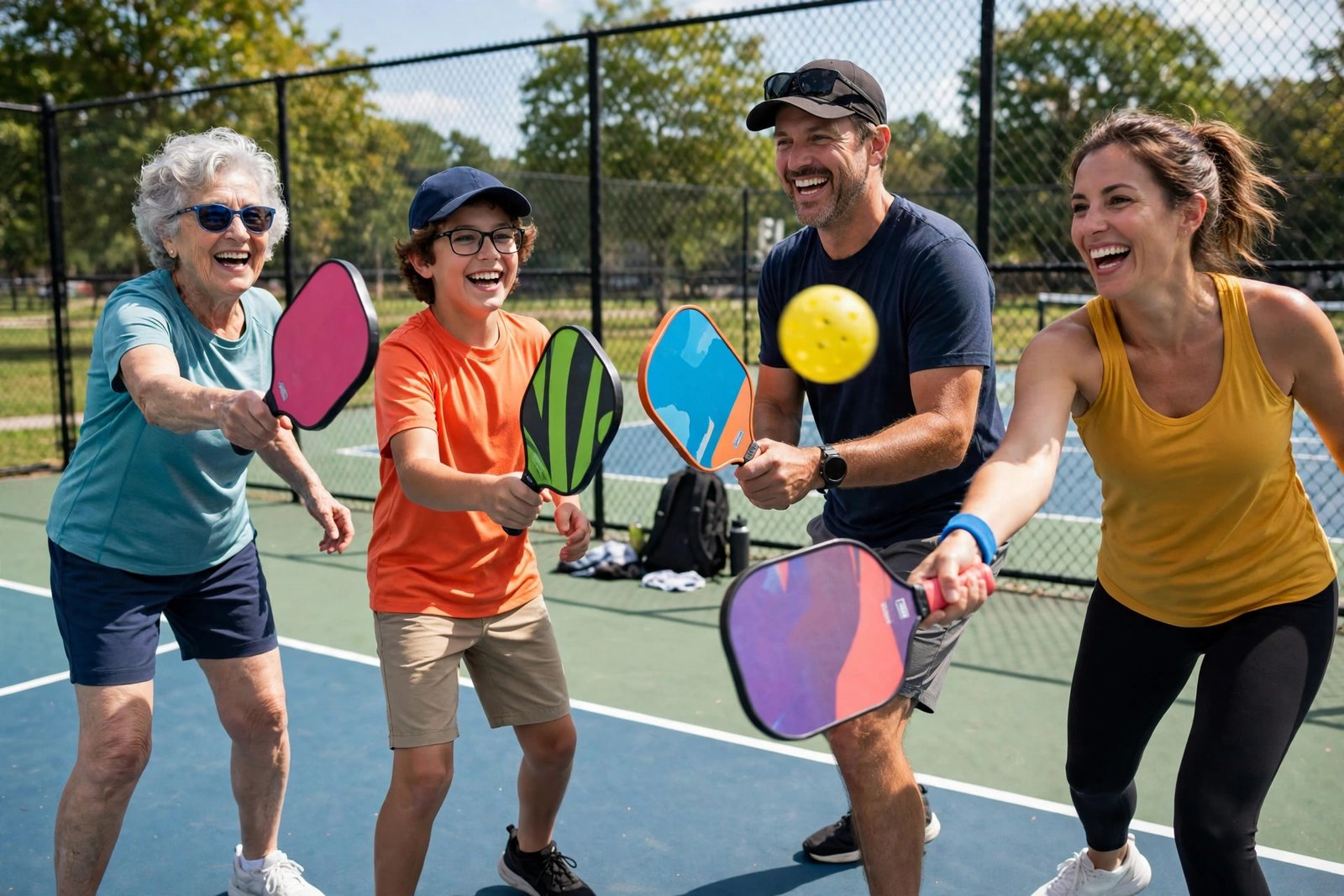
Drive past almost any park in America on a weekday morning and you will hear it before you see it: the sharp, hollow pop of a plastic ball meeting a paddle, followed by laughter, friendly trash talk, and the squeak of court shoes on painted asphalt. That sound is pickleball, and in a remarkably short time it has gone from a backyard curiosity to the most talked-about pastime in the country. Parks departments are painting new lines, gyms are converting basketball courts, and neighbors who had never held a racket are suddenly organizing weekly games and arguing, good-naturedly, about the rules of the kitchen.
What makes the rise so striking is how ordinary it all feels. Pickleball does not demand the fitness of a marathon runner or the power of a tennis pro. It asks for a paddle, a ball, a partner, and a willingness to look a little silly while you learn. That low barrier to entry is the heart of the story. This is a game invented by bored families on a summer afternoon, and it still carries that spirit: fun first, competition second, and everybody welcome.
A Bored Afternoon on Bainbridge Island
Pickleball was invented in the summer of 1965 on Bainbridge Island, Washington, at the summer home of Joel Pritchard, who later served in the United States Congress and as Washington lieutenant governor. Pritchard and his friend Bill Bell had returned from a round of golf one Saturday afternoon to find their families bored, with nothing to do. They set up a badminton net in the yard but could not find a shuttlecock, so they improvised. They lowered the net, picked up table tennis paddles, and started hitting a perforated plastic ball back and forth. The ball bounced well on the hard surface, the rallies lasted longer than anyone expected, and a new game was born out of sheer improvisation.
The following weekend, Pritchard and Bell invited their neighbor Barney McCallum to try the game, and the three men began shaping the improvisation into a real sport with real rules. McCallum, a practical tinkerer, went to work in his basement workshop and built the first purpose-built pickleball paddles from plywood, cutting them out with a band saw after the fragile table tennis paddles kept breaking. The early net height was adjusted as they played, settling at 36 inches at the sidelines and 34 inches at the center, which remains the regulation height today. The guiding idea behind the rules was simple and has never really changed: the game had to be challenging enough to be interesting, but easy enough for every member of the family to play together.
The game grew slowly at first, the way backyard games do, passed from neighbor to neighbor and friend to friend. In 1967, the first permanent pickleball court was built on Bainbridge Island, on the property of Pritchard’s neighbor Bob O’Brien. In 1972, Pritchard and David McCallum, Barney’s son, formed Pickle Ball, Inc. to promote the sport. The first known pickleball tournament followed in 1976 at the South Center Athletic Club in Tukwila, Washington. The national governing body, founded in 1984 as the United States of America Pickleball Association, is now known as USA Pickleball, and it publishes the official rulebook used across the country. In 2022, Washington named pickleball its official state sport, a fitting honor for a game born on a Bainbridge Island lawn.
What Is in a Name? Two Stories, One Game
Ask a group of pickleball players how the sport got its name and you will probably hear two different answers, and both are told with great confidence. The first story is the one most players know: the game was named after the Pritchard family dog, Pickles, who would chase the ball around the court during early games and run off with it whenever he got the chance. It is a charming story, easy to remember, and it has been repeated so often that many people take it as settled fact.
The second story comes from Joan Pritchard, Joel’s wife, who said she coined the name from the term pickle boat in crew racing. In rowing, a pickle boat is a boat crewed by the leftover oarsmen, the spare crew assembled from whoever was available. It was a perfect fit for a game assembled from the leftovers of three other sports: the court of badminton, the paddle of table tennis, and the net and spirit of tennis. Researchers who have dug into the timeline note that the dog Pickles was not born until 1968, three years after the game was invented and named, which makes the pickle boat explanation the more likely one. Still, the dog story refuses to die, and honestly, that is part of the fun. Pickleball has always been a sport that does not take itself too seriously, and a friendly argument about its name is very much in character.
The Court, the Kitchen, and the Rules That Make It Work
A pickleball court measures 20 feet wide by 44 feet long for both singles and doubles, the same size as a doubles badminton court and roughly a quarter of the size of a tennis court. That small court is one of the secrets of the game. Points stay close, rallies stay long, and nobody has to sprint from corner to corner the way tennis demands. The net stands 36 inches high at the sidelines and dips to 34 inches at the center. Each side of the court is divided into service boxes, and between the service boxes and the net sits the most famous patch of real estate in the sport: the kitchen.
The kitchen is the informal name for the non-volley zone, a seven-foot-deep area on each side of the net that spans the full width of the court. The rule is simple to state and tricky to master: you may stand in the kitchen whenever you like, but you may not hit the ball out of the air, volley it, while any part of your body is touching the kitchen or its lines. If your momentum carries you into the kitchen after a volley, that is a fault too. You may step into the kitchen only to play a ball that has already bounced inside it. The kitchen line itself counts as part of the kitchen, so a foot on the line during a volley is a fault. This one rule changes everything. It stops taller, stronger players from simply camping at the net and smashing every ball, and it turns the soft, patient shot known as the dink into the heart of the game.
Two other rules shape every rally. The serve is always underhand, delivered diagonally across the court, with the paddle contacting the ball below the waist, and it must clear the kitchen and land in the opposite service box. Then comes the two-bounce rule: the receiving team must let the serve bounce before returning it, and the serving team must let that return bounce before hitting it back. Only after those two bounces can players volley. Only the serving team can score points, and games are typically played to 11 points, win by two. The scoring can confuse newcomers for a game or two, and every regular player has a story about losing track of the score, but after a few sessions it becomes second nature, and the rhythm of serve, bounce, bounce, rally takes over.
Why It Appeals to Players of Every Age
Pickleball works for so many people because it meets players where they are. The court is small, so the running is modest. The paddle is light and short, so it is easier to control than a tennis racket. The ball is plastic and perforated, so it travels more slowly through the air than a tennis ball, giving players a fraction more time to react. A teenager can play a competitive game against a grandparent, and both can walk off the court feeling like they played well. That is rare in sport, and it is the reason so many families play together.
The social side matters just as much as the physical side. Most pickleball is played as doubles, which means you always have a partner beside you and two opponents across the net to chat with between points. Open play sessions at parks and recreation centers rotate players in and out, so a newcomer can show up alone and leave with new friends and a standing game for next week. For older players, that regular social contact is often as valuable as the exercise. For younger players, the game offers real competition, fast reflexes, and a surprisingly deep layer of strategy once you start learning placement, spin, and the art of the soft shot. The sport rewards patience and placement over raw power, which means a clever player can beat a stronger one, and that keeps people coming back.
Courts Are Popping Up Everywhere
One of the clearest signs of pickleball’s rise is written on the ground. Parks departments across the country have painted pickleball lines onto existing tennis and basketball courts, and many have built dedicated courts from scratch. Tennis courts are being converted, sometimes controversially, with one tennis court making room for several pickleball courts. Community centers, churches, schools, and homeowners associations have all joined in, and indoor facilities have opened in former warehouses and big-box stores, keeping the game going through winter in colder states.
The numbers behind the boom are striking. According to the Sports and Fitness Industry Association, known as SFIA, about 24.3 million Americans played pickleball in 2025, up 22.8 percent from the previous year, and the sport was the fastest-growing in the country for a fifth year in a row in the SFIA 2026 report. Participation had grown from about 4.2 million players in 2020, a remarkable climb in a short time. That growth has brought growing pains too. Courts fill up fast, regular players grumble about wait times, and neighborhoods near popular courts sometimes complain about the distinctive pop of the ball. But those are the complaints of a sport that has arrived, not one that is fading.
The professional side of the game has grown alongside the casual side. Leagues such as the Professional Pickleball Association and the Association of Pickleball Professionals now run tournaments with prize money, sponsors, and streaming broadcasts, and top players have become recognizable names within the sport. Television coverage and highlight clips have introduced the game to people who had never seen a court. Yet the heart of pickleball remains the local park, where the pros are just regular players with a favorite paddle and a standing Tuesday game.
How to Start Playing
Getting started is refreshingly simple. You need a paddle, a ball, and court shoes with good lateral support, and many parks and recreation centers lend equipment to beginners or run free introductory clinics. A basic paddle is fine for your first games; you do not need the most expensive model on the shelf. Wear comfortable athletic clothes, bring water, and show up a little early so you can watch a game before you join one. Most regular players are happy to explain the basics and fold a newcomer into the rotation.
Learn the three rules that trip up beginners: serve underhand and diagonally, let the ball bounce once on each side before anyone volleys, and stay out of the kitchen when you volley. Beyond that, the best advice is to aim for consistency over power. Keep the ball in play, aim for the middle of the court in doubles, and practice the soft dink shot that drops just over the net into the kitchen. You will miss plenty of shots at first, and so does everyone else. Take a beginner lesson if your local recreation department offers one, watch a few instructional videos from USA Pickleball, and give yourself a handful of sessions before you judge your game. Most players say the same thing about their first month: it took one game to get hooked and a few weeks to stop thinking about the score.
Related reading
- Tailgating in America: A Game Day Tradition
- Fall Farmers Markets Across America: A Harvest Guide
- Turkey Trot: The Thanksgiving Morning Tradition
Frequently Asked Questions
What is pickleball?
Pickleball is a paddle sport that combines elements of badminton, tennis, and table tennis. It is played on a 20 by 44 foot court with a perforated plastic ball and solid paddles, usually as doubles, and it is known for being easy to learn and fun for players of all ages.
Why is it called the kitchen?
The kitchen is the nickname for the non-volley zone, the seven-foot area on each side of the net. The origin of the nickname is not officially documented, but players have used it for decades, and it is now the standard term in the sport, used by USA Pickleball and coaches everywhere.
How was pickleball invented?
Pickleball was invented in the summer of 1965 on Bainbridge Island, Washington, by Joel Pritchard, Bill Bell, and Barney McCallum, who improvised a game for their bored families using a lowered badminton net, table tennis paddles, and a perforated plastic ball.
Is pickleball hard on your knees?
Pickleball involves less running than tennis because the court is much smaller, but it still involves quick lateral movement and stopping. Proper court shoes, warming up, and learning good footwork help reduce strain, and players with joint concerns should check with a doctor before starting any new sport.
What equipment do I need to start?
You need a pickleball paddle, a pickleball, and court shoes. Many parks and recreation centers provide paddles and balls for beginners, so you can try the game before buying your own equipment.
Learn more about the sport from USA Pickleball, the national governing body, read the concise history from Washington State University Magazine, and see the early history at Pickleball US. Participation figures in this article come from the Sports and Fitness Industry Association.