
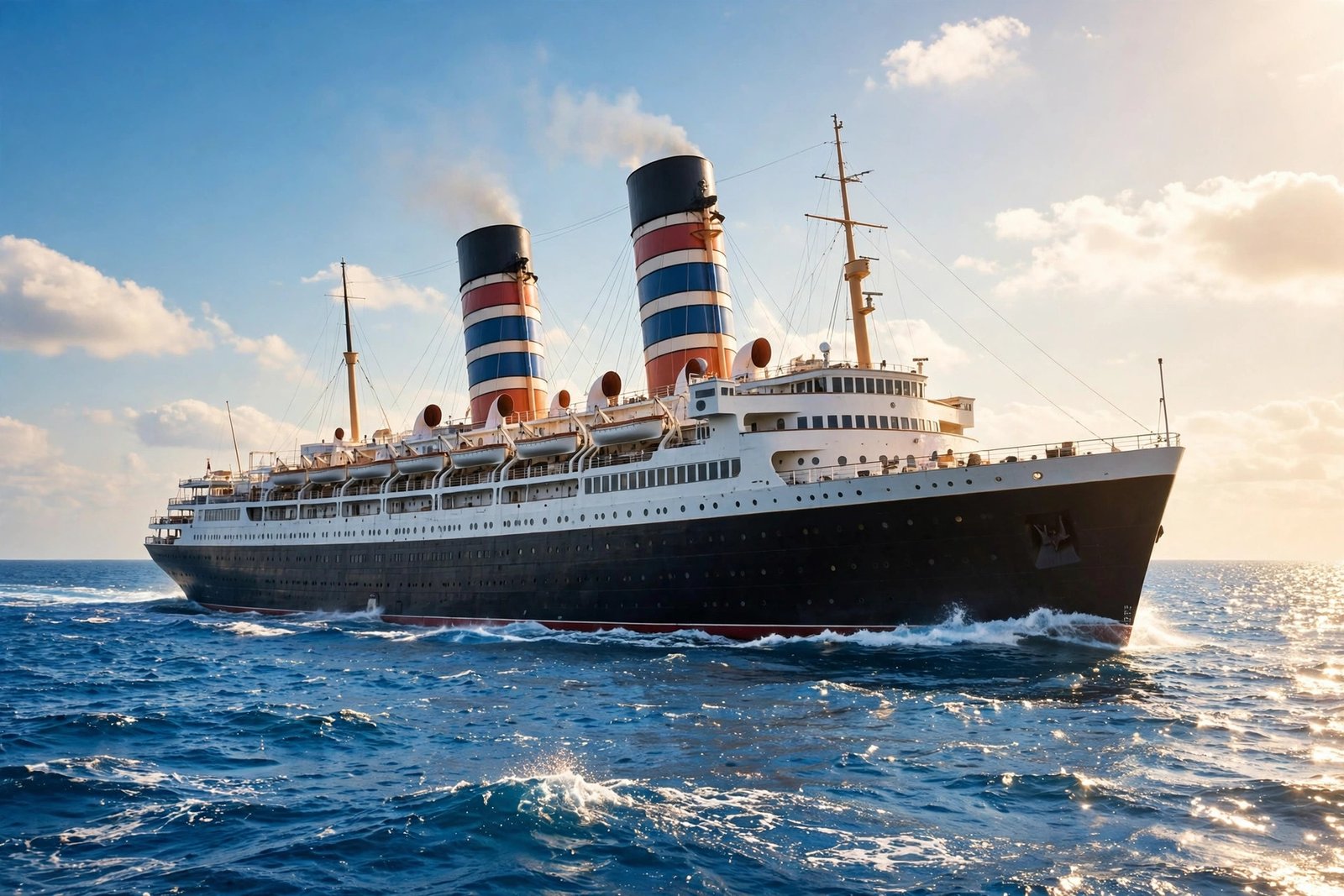
She was the fastest ocean liner ever built, a gleaming symbol of American power that carried presidents, movie stars, and thousands of ordinary travelers across the Atlantic in record time. Then she spent decades rusting at a Philadelphia pier, her future uncertain and her glory days seemingly behind her. Now the SS United States is about to begin her final voyage — not to a scrapyard, but to the bottom of the Gulf of Mexico, where she will become the world’s largest artificial reef.
In the second week of November 2026, the 990-foot liner is scheduled to be sunk about 22 nautical miles southwest of Destin-Fort Walton Beach, Florida. Deployment operations are expected to begin on Thursday, November 12, 2026 at 10 a.m., weather permitting. When she settles upright on the seafloor, she will surpass the USS Oriskany, sunk in 2006, as the largest artificial reef in the world — and the largest ship ever intentionally sunk as a reef. It is a remarkable second act for a ship that once represented the very best of American engineering.
A ship built for speed — and for war
The SS United States was launched in 1951 and made her maiden voyage in 1952. From the start, she was different from every other ocean liner. She was designed in secret with a dual purpose: in peacetime she would carry passengers in luxury across the Atlantic, but in wartime she could be converted quickly into a troop transport capable of carrying thousands of soldiers at high speed. That military purpose shaped almost everything about her design.
Her builders used aluminum wherever possible to keep her light, and she carried no wood on board except for the butcher’s block and the grand piano — a fire-safety measure that also saved weight. Her powerful engines gave her a top speed that no other ocean liner has ever matched. On her maiden voyage in 1952, she crossed the Atlantic in just over three days, capturing the Blue Riband for the fastest transatlantic crossing. That record still stands today: no ocean liner has ever gone faster.
For nearly two decades, the SS United States was the pride of the American merchant fleet. Presidents Harry Truman and John F. Kennedy sailed on her. So did the Duke and Duchess of Windsor, the actress Grace Kelly, and countless other dignitaries and celebrities. For ordinary passengers, she offered a level of comfort and style that made the crossing itself the destination — grand dining rooms, elegant lounges, and the thrill of traveling on the fastest ship afloat.
The long decline
By the late 1960s, the world had changed. Jet aircraft could cross the Atlantic in hours instead of days, and ocean liners could no longer compete for most travelers. The SS United States left service in 1969, after just 17 years carrying passengers. What followed was a long, sad chapter of uncertainty. She was sold, resold, stripped of her interiors, and moved from port to port as owners dreamed up plans — a casino, a hotel, a museum — that never came to pass.
Since 1996, she has been docked in Philadelphia, a familiar but fading sight on the Delaware River. Preservationists fought for years to save her, raising money and searching for a buyer who would restore her to glory. But the cost of restoration was enormous, and the ship’s interiors had long since been removed. As the years passed, rust spread across her hull, and the dream of a return to service faded. For many Philadelphians, she became a beloved landmark — and a painful reminder of what America used to build.
In March 2025, the ship finally left Philadelphia, towed to Mobile, Alabama, where workers began preparing her for her next chapter. The move itself was an event, drawing crowds of well-wishers who lined the riverbanks to say goodbye to a ship many had grown up watching from the shore.
How Florida bought a legend for $1 million
The rescue came from an unexpected place: Okaloosa County, Florida. In 2024, the county bought the SS United States for $1 million, with a bold plan to sink her as an artificial reef off the Destin-Fort Walton Beach coast. The $13 million project is funded by the county’s tourism bed tax — money collected from visitors staying in local hotels and rentals — on the argument that the reef will bring far more in tourism than it costs.
It is easy to see why local leaders were excited. The Destin-Fort Walton Beach area already draws divers, anglers, and beachgoers from across the country. A reef built around the world’s most famous ocean liner would be unlike anything else on Earth: a dive site where visitors could explore a ship longer than three football fields, rising from the seafloor like a sunken city. County officials expect the reef to attract divers from around the world, support local dive shops and charter boats, and create a thriving marine habitat that benefits fishing for decades.
Before she can be sunk, the ship must be carefully prepared. Workers in Mobile have been removing hazardous materials, cleaning fuel tanks, and cutting openings that will allow divers to explore safely and marine life to move through the structure. The goal is a clean, safe wreck that will last for generations on the seafloor.
The sinking: what will happen in November 2026
The sinking itself will be a carefully choreographed operation. The ship will be towed from Mobile to a site about 22 nautical miles southwest of Destin-Fort Walton Beach, where the water is about 180 feet deep. There, crews will open valves and flood compartments in a controlled sequence, allowing the massive liner to settle upright on the sandy bottom. The upper deck will rest about 55 to 60 feet below the surface — deep enough to be safe for shipping, shallow enough for experienced recreational divers to reach.
Deployment operations are expected to begin on Thursday, November 12, 2026 at 10 a.m., weather permitting. The exact timing depends on sea conditions, and the operation could shift if the weather turns. Before the sinking, the public will have a chance to say farewell: a send-off ceremony is planned for 1:30 p.m. on Wednesday, November 11 at the Destin-Fort Walton Beach Convention Center. It is a fitting date — Veterans Day — for a ship that was built with military service in mind.
Once she is down, the transformation will begin almost immediately. Within days, small fish will begin sheltering in her structure. Within months, corals, sponges, and other marine life will start to colonize her hull. Within a few years, scientists expect her to become a bustling underwater ecosystem, home to snapper, grouper, sea turtles, and sharks. Artificial reefs work because they give marine life something rare in the open Gulf: structure. On a flat sandy bottom, there is little shelter. A 990-foot ship provides shelter, shade, and surfaces for growth on an enormous scale.
Why sinking a ship helps the ocean
To some people, sinking a ship sounds like pollution. In practice, a properly prepared artificial reef is one of the most effective tools in marine conservation. Natural reefs in the Gulf of Mexico are limited, and the pressure on them from fishing and diving is intense. By creating a new reef, Okaloosa County hopes to take pressure off natural reefs while giving fish a place to live, feed, and reproduce.
The science will be watched closely. The project is being monitored by researchers from the Woods Hole Oceanographic Institution, the Dauphin Island Sea Lab, and Louisiana State University, who will track how marine life colonizes the wreck, how the structure changes over time, and how the reef affects the surrounding ecosystem. Their findings could shape future reef projects around the world, because no one has ever studied a reef this large from the moment of sinking.
The ship will also surpass a famous predecessor. The USS Oriskany, an aircraft carrier sunk off Pensacola in 2006, has been the world’s largest artificial reef for twenty years, and it has become one of the most popular dive sites in the Gulf. The SS United States is longer and will offer an even larger habitat. Divers who have explored the Oriskany describe the thrill of descending onto a vast gray shape emerging from the blue — and the SS United States promises that feeling on an even grander scale.
What divers and visitors can expect
For divers, the new reef will be a bucket-list destination, but it will not be a beginner’s dive. The upper deck at 55 to 60 feet below the surface is within the range of experienced recreational divers, but the seafloor at 180 feet is far beyond recreational limits. Divers will need proper training, good buoyancy control, and respect for the currents that can run strong in the open Gulf. Local dive operators are already preparing trips, and charter boats expect to run regular excursions once the site is declared safe and open.
For non-divers, the story will live on land as well. A shore-based museum is planned to tell the ship’s history, display artifacts saved from the vessel, and explain the reef project to visitors who may never put on a scuba tank. The museum will keep the human story alive — the presidents and movie stars, the engineers and crew, the immigrants and travelers who crossed the Atlantic on the fastest ship ever built — even as the ship herself rests underwater.
Anglers, too, are expected to benefit. Artificial reefs attract fish, and the waters around the wreck should become productive fishing grounds in the years ahead. That is part of the county’s calculation: the reef is not only a dive attraction, but an investment in the local fishing economy and in the health of Gulf waters.
A fitting final chapter
There is something poetic about the SS United States ending her life this way. She was built to serve America — to carry its people, to defend it in wartime, to show the world what American industry could do. She did all of that, and then she waited, rusting, for someone to remember her. The reef plan gives her a new purpose: to shelter marine life, to draw visitors to the Florida coast, and to keep her name alive for generations who will know her not as a rusting hulk in Philadelphia, but as a living reef in the Gulf.
Not everyone is happy with the plan. Some preservationists still wish she could have been saved as a museum ship or restored to service. Their grief is understandable — once she is sunk, there is no going back. But the practical reality is that decades of preservation efforts could not raise the money or find the plan to save her afloat. The reef gives her a future that the pier in Philadelphia could not: a place where she will be visited, studied, and loved, rather than slowly falling apart.
When the valves open on November 12 and the great liner slips beneath the waves for the last time, it will be the end of one story and the beginning of another. The fastest ocean liner ever built will become the largest artificial reef ever created. And somewhere below the surface of the Gulf of Mexico, in the quiet dark at 180 feet, the SS United States will begin her longest voyage yet — one measured not in days or miles, but in decades of new life.
FAQs
Q: When will the SS United States be sunk?
A: Deployment operations are expected to begin Thursday, November 12, 2026 at 10 a.m., weather permitting, about 22 nautical miles southwest of Destin-Fort Walton Beach, Florida.
Q: How big is the SS United States?
A: The liner is 990 feet long. She was launched in 1951, made her maiden voyage in 1952, and still holds the record as the fastest ocean liner ever built.
Q: How deep will the wreck sit?
A: She will rest upright in about 180 feet of water, with the upper deck about 55 to 60 feet below the surface, making the upper parts accessible to experienced recreational divers.
Q: Why is the ship being sunk instead of preserved as a museum?
A: Decades of preservation efforts could not raise the money or find a workable plan to restore her. Okaloosa County bought her for $1 million in 2024 and is funding the $13 million reef project with tourism bed tax revenue.
Q: Can the public attend a farewell event?
A: Yes. A public send-off ceremony is planned for 1:30 p.m. Wednesday, November 11, 2026 at the Destin-Fort Walton Beach Convention Center.
Related reading: White Sands National Park: New Mexico Gypsum Dunes | Cumberland Island, Georgia: Wild Horses Guide | Dry Tortugas National Park: Florida Hidden Gem
Sources: Cruise News: SS United States Set for Florida Reef Deployment | Wanderlust: Sinking of the SS United States | SlashGear: SS United States Final Mission